PUBLISHER: Mordor Intelligence | PRODUCT CODE: 2099276

PUBLISHER: Mordor Intelligence | PRODUCT CODE: 2099276
Corneal Cross-Linking Devices - Market Share Analysis, Industry Trends & Statistics, Growth Forecasts (2026 - 2031)
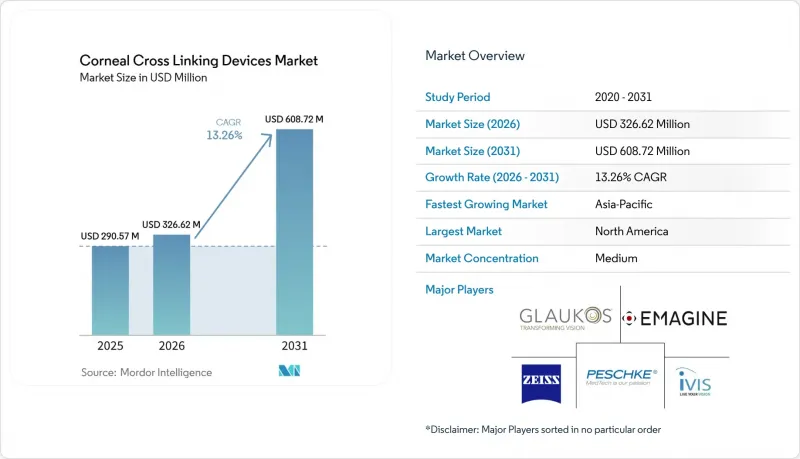
According to Mordor Intelligence, the corneal cross-linking devices market was valued at USD 290.57 million in 2025 and is projected to be valued at USD 326.62 million in 2026. This report is Segmented by Product Type (UV Devices, Riboflavin Solutions, and Others), Application (Keratoconus, Corneal Ectasia, and Others), Technology (Epithelium-Off Cross-Linking, and Others), End-User (Hospitals, Eye Clinics, and Others), and Geography (North America, Europe, Asia-Pacific, Middle East and Africa, South America). The Market Forecasts are Provided in Terms of Value (USD).
Global Corneal Cross-Linking Devices Market Trends and Insights
Rising Keratoconus Diagnosis Rates
The corneal cross-linking devices market is gaining from a broader diagnostic funnel as corneal topography is being used more often in routine ophthalmic workups and pre-refractive surgery screening. A 2025 multicenter review placed pooled global keratoconus prevalence at 289.1 per 100,000 persons and estimated more than 23.7 million affected people worldwide, which materially raises the addressable treatment pool for the corneal cross-linking devices market. A 2025 multicentric study from India also showed that the largest diagnosed group was 20 to 29 years old and that the mean delay from symptom onset to diagnosis was 2.7 years, which points to a large backlog of patients who can still be treated earlier than before. Earlier identification matters because cross-linking is most valuable before corneal thinning and visual loss become advanced. As that clinical pattern becomes more visible to physicians and families, the corneal cross-linking devices market is likely to see stronger procedural conversion in both specialty and referral settings. The same trend also improves the commercial value of diagnostic integration, because treatment volumes increasingly depend on who can identify progression first.
Shift Toward Faster, Customized Protocols
The corneal cross-linking devices market is moving away from long, operating-room-oriented workflows and toward shorter protocols that fit office-based care. A 2026 Journal of Refractive Surgery study found no statistically significant biomechanical difference between a new epi-on protocol and a widely used accelerated epi-off protocol, which supports the clinical case for less invasive and more convenient treatment pathways. EMAGine stated that its C-eye platform supports 11 preset protocols, including options intended to deliver Dresden-equivalent outcomes in less than 10 minutes, which shows how the corneal cross-linking devices market is competing on workflow efficiency as much as on treatment effect. Shorter sessions improve daily throughput, reduce patient burden, and make it easier for eye clinics to adopt treatment without dedicated operating room capacity. The commercial effect is important because faster protocols improve cost per visit and widen the range of sites that can offer care. The corneal cross-linking devices market is therefore shifting toward platforms that combine efficacy, portability, and lower procedural friction.
High Device Acquisition Costs
The corneal cross-linking devices market still faces a real adoption barrier because treatment requires both capital equipment and recurring single-use materials. That cost structure is easier to absorb in well-funded centers, but it is harder for smaller eye clinics and emerging-market providers with tighter cash flow. In 2026, physicians cited inadequate reimbursement for the Photrexa drug component from major payers such as UnitedHealthcare and Medicaid, which shows that even established parts of the corneal cross-linking devices market can face margin pressure at the provider level. In China, patient out-of-pocket treatment costs were listed at CNY 5,000 (USD 688) to CNY 10,000 (USD 1,376), and federal reimbursement was absent, which limits uptake outside higher-income urban settings. The present use of unclassified billing for Epioxa also adds claim uncertainty and administrative work for providers.
Other drivers and restraints analyzed in the detailed report include:
- Broader Adoption of Therapeutic Cross-Linking
- AI-Guided Treatment Planning Integration
- Limited Reimbursement Coverage
For complete list of drivers and restraints, kindly check the Table Of Contents.
Segment Analysis
UV light devices held 60.84% of corneal cross-linking devices market share in 2025, which reflects their role as the central hardware layer in every cross-linking procedure. The corneal cross-linking devices market still leans heavily on these systems because they carry the treatment protocol, the dosing logic, and, in many cases, the link to proprietary riboflavin products. That installed-base effect gives incumbent platforms a stable advantage because clinics do not switch hardware easily once training, service, and drug use are aligned. It also explains why the leading hardware platforms remain the commercial anchor of the corneal cross-linking devices market even as newer treatment protocols emerge.
Combination devices are projected to grow at 14.58% CAGR through 2031, which is the fastest rate within product type. The appeal comes from the ability to combine topography-guided PRK and cross-linking in one visit, which improves convenience for both physicians and patients. Riboflavin solutions remain strategically important because they create recurring revenue from each procedure and tie customers more closely to the platform family. Confocal microscopes and related imaging tools are still smaller in revenue, but they are gaining importance in tertiary settings where depth control and post-procedure assessment matter more.
Keratoconus accounted for 52.67% of revenue in 2025, which keeps it as the main application area in the corneal cross-linking devices market. This leading position reflects the fact that keratoconus is the core labeled indication for approved U.S. therapy and the condition with the strongest clinical evidence base. The corneal cross-linking devices industry also benefits from the age profile of the disease, because onset often occurs early and progression can be aggressive in teenagers and young adults. The Epioxa label for patients aged 13 years and older is therefore commercially important because it addresses an age group where preserving corneal stability can prevent lifelong visual decline.
Corneal ectasia is forecasted to grow at 14.82% CAGR through 2031, which makes it the fastest-rising application segment. The reason is straightforward because cumulative LASIK, PRK, and SMILE volumes continue to expand the pool of patients at risk of post-surgical ectasia. The corneal cross-linking devices market is responding as clinicians recognize this group as a separate treatment opportunity rather than a small extension of classic keratoconus care. Other applications such as pellucid marginal degeneration, infectious keratitis, and bullous keratopathy remain smaller and more specialized, but they keep the long-run indication base broader than a single-disease market.
Complete Report Scope:
- By Product Type
- UV Light Devices
- Riboflavin Solutions
- Combination Devices
- Confocal Microscopes
- Other Product Types
- By Application
- Keratoconus
- Corneal Ectasia
- Refractive Surgery Ectasia
- Pellucid Marginal Degeneration
- Other Applications
- By Technology
- Epithelium-Off Cross-Linking
- Epithelium-On Cross-Linking
- Accelerated Cross-Linking
- Customized and Topography-Guided Cross-Linking
- Other Technologies
- By End-User
- Hospitals
- Eye Clinics
- Ambulatory Surgical Centers
- Other End-Users
- By Geography
- North America
- United States
- Canada
- Mexico
- Europe
- Germany
- United Kingdom
- France
- Italy
- Spain
- Rest of Europe
- Asia-Pacific
- China
- Japan
- India
- Australia
- South Korea
- Rest of Asia-Pacific
- Middle East and Africa
- GCC
- South Africa
- Rest of Middle East and Africa
- South America
- Brazil
- Argentina
- Rest of South America
- North America
Geography Analysis
North America held 48.95% of corneal cross-linking devices market size in 2025, which made it the leading regional block in the corneal cross-linking devices market. The region benefited from a decade of U.S. epi-off platform familiarity and from reimbursement pathways that had already expanded across many commercial payers for documented progressive keratoconus. The United States moved into a new phase in March 2026 when Glaukos made Epioxa commercially available, giving physicians the first FDA-approved epi-on option and giving the corneal cross-linking devices market a new route to earlier and less invasive intervention. Early company commentary described physician interest as encouraging, but the next step for the region will depend on how quickly permanent reimbursement mechanisms develop for epi-on treatment.
Europe remained the second-largest regional market, supported by established ophthalmic infrastructure and a deep base of device manufacturers and corneal specialists. Germany, the United Kingdom, France, Italy, and Spain account for most regional revenue, with Germany and the United Kingdom especially important for evidence-led adoption patterns. Italy also matters because domestic companies such as iVis Technologies and IROMED have long contributed to the regional technology base.
Asia-Pacific is projected to grow at 16.28% CAGR through 2031, which makes it the fastest-growing region in the corneal cross-linking devices market. Disease burden is a major reason, with South Asian prevalence estimated at 1,374.5 per 100,000 persons in the 2025 review, far above the pooled global rate. India also showed a 2.7-year diagnostic delay in a 2025 study, which indicates a large untreated pool that could support strong future procedure growth as screening expands. In China, federal reimbursement is still absent, but regional pilots in Zhejiang and Jiangsu point to a possible pathway for broader inclusion over time. Japan, Australia, and South Korea contribute steady advanced-care volumes, while India and South Korea stand out as important installation opportunities. Middle East and Africa presents strong epidemiological need but weaker infrastructure, and South America remains led by private hospital adoption in Brazil and Argentina with growth still limited by affordability.
- AJL Ophthalmic S.A.
- Alcon
- BVI Medical
- Carl Zeiss
- EMAGine AG
- EssilorLuxottica
- Glaukos
- IROMED GROUP Srl
- iVis Technologies
- Lumenis
- Nidek
- Oculus Optikgerate
- OptoVue, Inc.
- Peschke GmbH
- Santen Pharmaceuticals
- SCHWIND eye-tech-solutions GmbH
- Topcon
- Ziemer Group
Additional Benefits:
- The market estimate (ME) sheet in Excel format
- 3 months of analyst support
TABLE OF CONTENTS
1 Introduction
- 1.1 Study Assumptions and Market Definition
- 1.2 Scope of the Study
2 Research Methodology
3 Executive Summary
4 Market Landscape
- 4.1 Market Overview
- 4.2 Market Drivers
- 4.2.1 Rising Keratoconus Diagnosis and Earlier Intervention
- 4.2.2 Shift Toward Faster, Office-Based Cross-Linking Workflows
- 4.2.3 Broader Adoption of Transepithelial and Accelerated Protocols
- 4.2.4 Expansion of Corneal Screening and Topography-Led Referral Pathways
- 4.2.5 Recurring Riboflavin and Consumables Demand from Installed Base Growth
- 4.2.6 AI-Guided Treatment Planning and Fluence Optimization Integration
- 4.3 Market Restraints
- 4.3.1 High Device Acquisition Cost and Procedure Affordability Pressure
- 4.3.2 Limited Reimbursement and Uneven Insurance Coverage
- 4.3.3 Protocol Variation and Clinical Standardization Gaps
- 4.3.4 Skilled Operator Dependence and Training Bottlenecks
- 4.4 Supply Chain Analysis
- 4.5 Regulatory Landscape
- 4.6 Technological Outlook
- 4.7 Porter's Five Forces Analysis
- 4.7.1 Threat of New Entrants
- 4.7.2 Bargaining Power of Suppliers
- 4.7.3 Bargaining Power of Buyers
- 4.7.4 Threat of Substitutes
- 4.7.5 Competitive Rivalry
5 Market Size & Growth Forecasts (Value, USD)
- 5.1 By Product Type
- 5.1.1 UV Light Devices
- 5.1.2 Riboflavin Solutions
- 5.1.3 Combination Devices
- 5.1.4 Confocal Microscopes
- 5.1.5 Other Product Types
- 5.2 By Application
- 5.2.1 Keratoconus
- 5.2.2 Corneal Ectasia
- 5.2.3 Refractive Surgery Ectasia
- 5.2.4 Pellucid Marginal Degeneration
- 5.2.5 Other Applications
- 5.3 By Technology
- 5.3.1 Epithelium-Off Cross-Linking
- 5.3.2 Epithelium-On Cross-Linking
- 5.3.3 Accelerated Cross-Linking
- 5.3.4 Customized and Topography-Guided Cross-Linking
- 5.3.5 Other Technologies
- 5.4 By End-User
- 5.4.1 Hospitals
- 5.4.2 Eye Clinics
- 5.4.3 Ambulatory Surgical Centers
- 5.4.4 Other End-Users
- 5.5 By Geography
- 5.5.1 North America
- 5.5.1.1 United States
- 5.5.1.2 Canada
- 5.5.1.3 Mexico
- 5.5.2 Europe
- 5.5.2.1 Germany
- 5.5.2.2 United Kingdom
- 5.5.2.3 France
- 5.5.2.4 Italy
- 5.5.2.5 Spain
- 5.5.2.6 Rest of Europe
- 5.5.3 Asia-Pacific
- 5.5.3.1 China
- 5.5.3.2 Japan
- 5.5.3.3 India
- 5.5.3.4 Australia
- 5.5.3.5 South Korea
- 5.5.3.6 Rest of Asia-Pacific
- 5.5.4 Middle East and Africa
- 5.5.4.1 GCC
- 5.5.4.2 South Africa
- 5.5.4.3 Rest of Middle East and Africa
- 5.5.5 South America
- 5.5.5.1 Brazil
- 5.5.5.2 Argentina
- 5.5.5.3 Rest of South America
- 5.5.1 North America
6 Competitive Landscape
- 6.1 Market Concentration
- 6.2 Market Share Analysis
- 6.3 Company Profiles (includes Global level Overview, Market level overview, Core Segments, Financials as available, Strategic Information, Market Rank/Share for key companies, Products & Services, Recent Developments)
- 6.3.1 AJL Ophthalmic S.A.
- 6.3.2 Alcon Inc.
- 6.3.3 BVI Medical
- 6.3.4 Carl Zeiss Meditec AG
- 6.3.5 EMAGine AG
- 6.3.6 EssilorLuxottica
- 6.3.7 Glaukos Corporation
- 6.3.8 IROMED GROUP Srl
- 6.3.9 iVis Technologies
- 6.3.10 Lumenis Be Ltd.
- 6.3.11 NIDEK CO., LTD.
- 6.3.12 Oculus Optikgerate GmbH
- 6.3.13 OptoVue, Inc.
- 6.3.14 Peschke GmbH
- 6.3.15 Santen Pharmaceutical Co., Ltd.
- 6.3.16 SCHWIND eye-tech-solutions GmbH
- 6.3.17 Topcon Corporation
- 6.3.18 Ziemer Ophthalmic Systems AG
7 Market Opportunities & Future Outlook
- 7.1 White-space & Unmet-need Assessment

