PUBLISHER: Mordor Intelligence | PRODUCT CODE: 2099283

PUBLISHER: Mordor Intelligence | PRODUCT CODE: 2099283
Europe Dipeptidyl Peptidase-4 (DPP-4) Inhibitors - Market Share Analysis, Industry Trends & Statistics, Growth Forecasts (2026 - 2031)
According to Mordor Intelligence, the Europe dipeptidyl peptidase-4 inhibitors market size is projected to expand from USD 2.89 billion in 2025 and USD 2.97 billion in 2026 to USD 3.44 billion by 2031, registering a CAGR of 3.03% between 2026 to 2031.
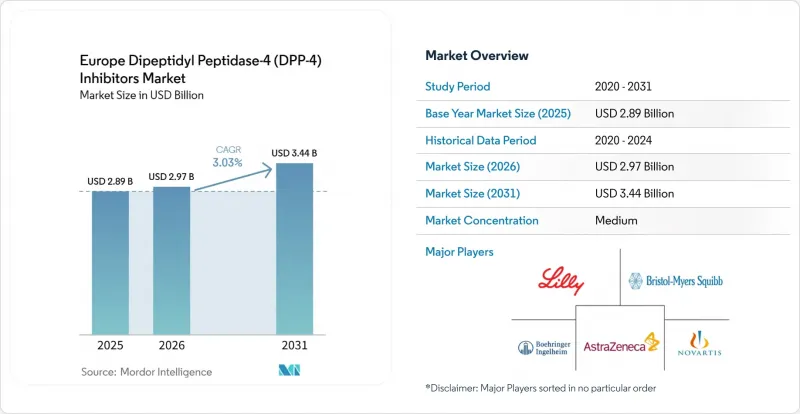
This report is Segmented by Drug Type (Sitagliptin, Saxagliptin, Linagliptin, Alogliptin, Vildagliptin, Other Drug Types), Medication Type (Branded, Generic), Distribution Channel (Hospital Pharmacies, Retail Pharmacies, Online Pharmacies), and Geography (Germany, United Kingdom, France, Italy, Spain, Rest of Europe). The Market Forecasts are Provided in Terms of Value (USD).
Europe Dipeptidyl Peptidase-4 (DPP-4) Inhibitors Market Trends and Insights
Rising Type 2 Diabetes Burden and Older Patient Pool
The European DPP-4 inhibitors market is supported by the steady rise in type 2 diabetes among older adults, especially in countries with aging populations and large primary care systems. Germany alone saw type 2 diabetes prevalence rise from 9.0% in 2011 to 9.6% in 2023, and the longer-term outlook still points to a much larger patient pool by 2040. Across older adults in the wider European survey base used in the IDF Diabetes Atlas, 21.2% had a total diabetes diagnosis, including undiagnosed cases, which shows that treatment demand in late-life care remains substantial. This matters because older patients are more likely to need oral therapies that fit routine use and create fewer dose-management issues across multiple medicines. The European DPP-4 inhibitors market, therefore keeps a durable role in the high-age patient pool even while newer therapies gain more attention in younger or more aggressive treatment pathways.
Preference for Oral, Low-Hypoglycemia Therapies in Europe
The European DPP-4 inhibitors market also benefits from a clear preference for oral therapies in older and clinically complex patients, where injection burden and hypoglycemia risk both affect treatment choice. A German claims study based on Barmer data found that DPP-4 inhibitors reduced severe hypoglycemia by 49% versus sulfonylureas among new users and by 69% in patients with severe renal insufficiency. That evidence aligns with geriatric prescribing practice, where safer oral agents are favored when patients already manage several conditions and medicines. A large comparative effectiveness study also showed that hospitalization-requiring hypoglycemia across all DPP-4 inhibitors stayed at 0.2%, which reinforces their safer profile for older adults. As a result, the European DPP-4 inhibitors market retains support from physicians who need stable glucose control without adding avoidable treatment risk in long-term care and primary care settings.
Substitution Pressure from SGLT-2 Inhibitors and GLP-1 Agents
The main restraint on the European DPP-4 inhibitors market is stronger substitution pressure from SGLT-2 inhibitors and GLP-1 receptor agonists. In the Netherlands, the National Health Care Institute advised in July 2025 that reimbursement conditions for four SGLT-2 inhibitors should be removed from the basic package for type 2 diabetes, which lowers access barriers for that competing class. European cardiology guidance also favors replacing DPP-4 inhibitors with SGLT-2 inhibitors or GLP-1 receptor agonists in patients with established cardiovascular disease, renal impairment, or heart failure. That change matters because it reduces the addressable pool for DPP-4 inhibitors at the more severe end of diabetes care, where outcome-driven treatment choices now carry more weight. The European DPP-4 inhibitors market still keeps a role in selected oral pathways, but competitive displacement from newer classes is now a persistent structural challenge.
Other drivers and restraints analyzed in the detailed report include:
- Role in Renal-Impaired and Polypharmacy Patients
- Wider Use in Cost-Sensitive Second-Line Treatment Pathways
- Generic Erosion and Tender-Driven Price Compression
For complete list of drivers and restraints, kindly check the Table Of Contents.
Segment Analysis
Sitagliptin held 36.83% of the European DPP-4 inhibitors market share in 2025, which kept it as the largest drug-type segment across the region. That lead reflects long-standing prescribing habits in Germany, France, and Italy, even though branded revenue has been pressured by generic entry since 2022. Generic manufacturers such as Accord Healthcare, Sandoz, and Dr. Reddy's Laboratories have expanded sitagliptin availability, which supports continued volume through both retail and institutional channels. In the Europe DPP-4 inhibitors market, sitagliptin has moved from being a clear branded growth story to being a high-volume backbone with strong familiarity in routine diabetes care.
Alogliptin is the fastest-growing drug type in the European DPP-4 inhibitors market, with a 4.62% CAGR projected through 2031. A 2025 comparative effectiveness study found that alogliptin had the lowest 1-year MACE rate at 1.7% and the lowest heart-failure hospitalization rate at 0.37% among DPP-4 inhibitors, which gives it a stronger profile in cardiometabolic prescribing discussions. Saxagliptin and linagliptin remain important mid-tier options, though they are used more selectively in settings where patient profile and treatment history shape choice. Vildagliptin still holds a stable role in parts of Europe, but price pressure and substitution keep that position narrower than before. The Europe DPP-4 inhibitors industry is therefore seeing a shift within the class, where sitagliptin sustains scale while alogliptin gains attention from outcome-sensitive specialists.
Complete Report Scope:
- By Drug Type
- Sitagliptin
- Saxagliptin
- Linagliptin
- Alogliptin
- Vildagliptin
- Other Drug Types
- By Medication Type
- Branded Medication
- Generic Medication
- By Distribution Channel
- Hospital Pharmacies
- Retail Pharmacies
- Online Pharmacies
- By Country
- Germany
- United Kingdom
- France
- Italy
- Spain
- Rest of Europe
List of Companies Covered in this Report:
- AstraZeneca
- Boehringer Ingelheim
- Bristol-Myers Squibb
- Dr. Reddy's Laboratories
- Eli Lilly and Company
- GlaxoSmithKline
- Merck
- Mitsubishi Tanabe Pharma
- Novartis
- Novo Nordisk
- Otsuka
- Pfizer
- Sandoz Group
- Sanofi
- STADA Arzneimittel
- Sun Pharmaceuticals Industries
- Takeda Pharmaceuticals
- Teva Pharmaceutical Industries
- Viatris
- Zentiva
Additional Benefits:
- The market estimate (ME) sheet in Excel format
- 3 months of analyst support
TABLE OF CONTENTS
1 Introduction
- 1.1 Study Assumptions & Market Definition
- 1.2 Scope of the Study
2 Research Methodology
3 Executive Summary
4 Market Landscape
- 4.1 Market Overview
- 4.2 Market Drivers
- 4.2.1 Rising Type 2 Diabetes Burden and Older Patient Pool
- 4.2.2 Preference for Oral, Low-Hypoglycemia Therapies in Europe
- 4.2.3 Role in Renal-Impaired and Polypharmacy Patients
- 4.2.4 Wider Use in Cost-Sensitive Second-Line Treatment Pathways
- 4.2.5 Local Guideline Stickiness in Primary Care and Elderly Care
- 4.2.6 Generic Availability Supporting Access Expansion
- 4.3 Market Restraints
- 4.3.1 Substitution Pressure from SGLT-2 Inhibitors and GLP-1 Agents
- 4.3.2 Mature Class Positioning Limits Premium Pricing Power
- 4.3.3 Generic Erosion and Tender-Driven Price Compression
- 4.3.4 Safety Perception and Modest Differentiation Versus Newer Classes
- 4.4 Value / Supply-Chain Analysis
- 4.5 Regulatory Landscape
- 4.6 Technological Outlook
- 4.7 Porter's Five Forces Analysis
- 4.7.1 Threat of New Entrants
- 4.7.2 Bargaining Power of Suppliers
- 4.7.3 Bargaining Power of Buyers
- 4.7.4 Threat of Substitutes
- 4.7.5 Industry Rivalry
5 Market Size & Growth Forecasts
- 5.1 By Drug Type
- 5.1.1 Sitagliptin
- 5.1.2 Saxagliptin
- 5.1.3 Linagliptin
- 5.1.4 Alogliptin
- 5.1.5 Vildagliptin
- 5.1.6 Other Drug Types
- 5.2 By Medication Type
- 5.2.1 Branded Medication
- 5.2.2 Generic Medication
- 5.3 By Distribution Channel
- 5.3.1 Hospital Pharmacies
- 5.3.2 Retail Pharmacies
- 5.3.3 Online Pharmacies
- 5.4 By Country
- 5.4.1 Germany
- 5.4.2 United Kingdom
- 5.4.3 France
- 5.4.4 Italy
- 5.4.5 Spain
- 5.4.6 Rest of Europe
6 Competitive Landscape
- 6.1 Market Concentration
- 6.2 Market Share Analysis
- 6.3 Company Profiles (includes Global Level Overview, Market-level Overview, Core Segments, Financials, Strategic Information, Market Rank/Share, Products & Services, Recent Developments)
- 6.3.1 AstraZeneca
- 6.3.2 Boehringer Ingelheim
- 6.3.3 Bristol Myers Squibb
- 6.3.4 Dr. Reddy's Laboratories
- 6.3.5 Eli Lilly and Company
- 6.3.6 GlaxoSmithKline
- 6.3.7 Merck and Co.
- 6.3.8 Mitsubishi Tanabe Pharma Corporation
- 6.3.9 Novartis
- 6.3.10 Novo Nordisk
- 6.3.11 Otsuka Holdings
- 6.3.12 Pfizer
- 6.3.13 Sandoz
- 6.3.14 Sanofi
- 6.3.15 STADA Arzneimittel
- 6.3.16 Sun Pharmaceutical Industries
- 6.3.17 Takeda Pharmaceutical
- 6.3.18 Teva Pharmaceutical Industries
- 6.3.19 Viatris
- 6.3.20 Zentiva
7 Market Opportunities & Future Outlook
- 7.1 White-space & Unmet-need Assessment

