PUBLISHER: Mordor Intelligence | PRODUCT CODE: 2099302

PUBLISHER: Mordor Intelligence | PRODUCT CODE: 2099302
Coronary Scoring Balloons - Market Share Analysis, Industry Trends & Statistics, Growth Forecasts (2026 - 2031)
According to Mordor Intelligence, the coronary scoring balloons market size is projected to be USD 157.5 million in 2025, USD 169.79 million in 2026, and reach USD 247.17 million by 2031, growing at a CAGR of 7.80% from 2026 to 2031.
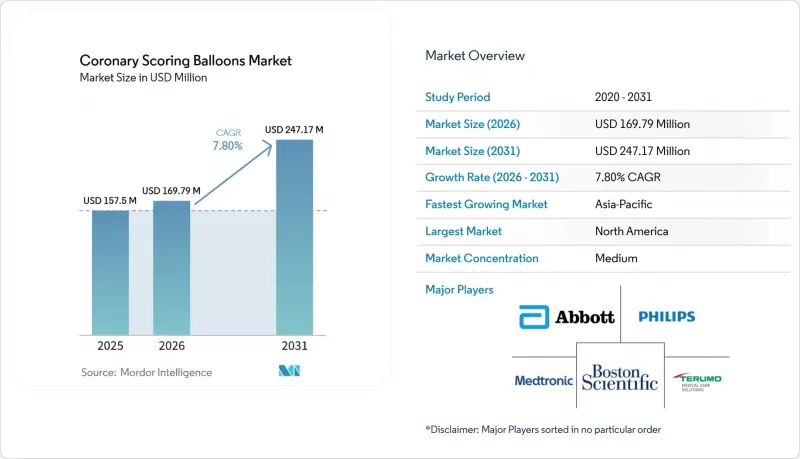
This report is Segmented by Balloon Type (Semi-Compliant, Non-Compliant, Other Types), Material (Nylon, Polyethylene Terephthalate, Polyurethane, Other), End Use (Hospitals, Cardiac Catheterization Laboratories, Ambulatory Surgical Centers, Other End Users), and Geography (North America, Europe, Asia-Pacific, Rest of the World). The Market Forecasts are Provided in Terms of Value (USD).
Global Coronary Scoring Balloons Market Trends and Insights
Rising Burden of Calcified Coronary Lesions
The coronary scoring balloons market is closely tied to the growing burden of calcified coronary disease, because lesion calcification is no longer treated as a minor procedural issue in PCI practice. Contemporary reviews showed moderate to severe calcification in 18% to 26% of PCI patients, which keeps demand centered on devices that can modify plaque in a controlled manner. Chronic kidney disease adds another layer of demand because it accelerates medial calcification through a pathway that differs from standard atherosclerosis, which broadens the target population beyond older age groups alone. A 2025 study in China found calcified plaque prevalence rose from 11.7% in patients younger than 45 to 36.0% in those older than 75, which suggests lesion complexity in Asia-Pacific will rise with volume growth. For the coronary scoring balloons market, this demand pattern is structural because it follows patient mix and lesion severity rather than a short-term purchasing cycle.
Shift Toward More Predictable Lesion Preparation Before Stenting
The coronary scoring balloons market is benefiting from a wider preference for predictable lesion preparation before stenting, especially in cases where uncontrolled balloon expansion can compromise final results. A 2024 systematic review and meta-analysis reported that cutting or scoring balloons used before stenting were linked to a 33% reduction in target lesion revascularization compared with conventional balloons, without increasing perforation, myocardial infarction, or all-cause mortality. This matters because operators are placing more value on lesion-level control than on simple predilation success. The same shift is creating added demand from drug-coated balloon workflows, since better lesion preparation is being tested as a way to improve outcomes in in-stent restenosis and related use cases. In the coronary scoring balloons market, this trend lifts unit demand by converting cases that once relied on plain non-compliant balloons into scoring balloon procedures.
Competition From Atherectomy and Intravascular Lithotripsy Caps Share Gains
The coronary scoring balloons market is facing tighter competition from atherectomy and intravascular lithotripsy in calcified lesion preparation, especially in cases at the severe end of the complexity spectrum. A 2026 observational study reported lower in-hospital mortality with IVL compared with cutting or scoring balloon angioplasty in patients with different risk profiles, while also noting that the finding was hypothesis generating and not based on randomized evidence. Reimbursement support is also strengthening IVL adoption because the 2026 CMS Final Rule confirmed separate payment for coronary IVL through HCPCS code C1761 and CPT add-on code +92972. This does not remove the role of scoring balloons, since cost, guidewire compatibility, and procedural simplicity still support their use in moderate calcification. For the coronary scoring balloons market, the practical effect is a narrower pool of borderline lesions that once defaulted to scoring balloons but may now move to IVL when payment and clinical confidence align.
Other drivers and restraints analyzed in the detailed report include:
- Expansion of PCI-Capable Cath Labs and Ambulatory Settings
- Underused Intravascular Imaging Creates Upside for Precision Scoring Use
- Higher Unit Cost Than Plain Balloons Limits Routine Substitution
For complete list of drivers and restraints, kindly check the Table Of Contents.
Segment Analysis
Non-compliant scoring balloons held 57.31% of the coronary scoring balloons market share in 2025, and they are also projected to post the fastest growth at 8.82% CAGR through 2031. This combination shows that the leading design is still gaining strength rather than entering a late maturity phase. In the coronary scoring balloons market, non-compliant devices are favored because they deliver focal scoring force at controlled inflation pressures without substantial vessel oversizing. Abbott's Scoreflex NC is positioned around that need, with a rated burst pressure of 20 atm and a 0.034-inch crossing profile that supports both deliverability and scoring reliability in calcified lesions.
Semi-compliant scoring balloons still hold a relevant role in the coronary scoring balloons market because they remain useful in moderate calcification and in vessels where trackability matters more than maximum focal force. Their lower crossing profile can make lesion access easier in tortuous anatomy, which keeps them in first-line use for selected procedures. Other balloon types, including hybrid scoring-cutting designs, serve a narrower part of the coronary scoring balloons market where severe calcification or difficult crossing reduces the effectiveness of standard designs. A 2025 first-in-man registry for iVascular's Naviscore reported 94% procedural success in 85 patients with moderate or severe de novo calcified lesions, which shows that innovation within balloon design is still expanding the usable range of the category.
Complete Report Scope:
- By Balloon Type
- Semi-Compliant Scoring Balloons
- Non-Compliant Scoring Balloons
- Other Baloon Types
- By Material
- Nylon
- Polyethylene Terephthalate
- Polyurethane
- Other Material
- By End Use
- Hospitals
- Cardiac Catheterization Laboratories
- Ambulatory Surgical Centers
- Other End Users
- By Geography
- North America
- United States
- Canada
- Mexico
- Europe
- Germany
- United Kingdom
- France
- Italy
- Spain
- Rest of Europe
- Asia-Pacific
- China
- Japan
- India
- Australia
- South Korea
- Rest of Asia-Pacific
- Rest of the World
- North America
Geography Analysis
North America held 38.10% of the coronary scoring balloons market share in 2025, which made it the largest regional contributor. The coronary scoring balloons market in North America is supported by deep PCI infrastructure, high clinical research activity, and established reimbursement pathways for complex coronary devices. The United States anchors most of the regional demand because imaging-guided PCI and specialized lesion preparation are more embedded in routine practice there than in many other markets. Structured quality initiatives have also helped drive imaging use higher, and that raises the probability that calcified lesions are treated with scoring balloons instead of plain non-compliant balloons. This regional base remains important because it supports premium device adoption and faster uptake of new workflow standards.
Europe remains the second-largest regional cluster in the coronary scoring balloons market, but adoption patterns vary widely across countries. Germany stands out as one of the strongest PCI markets in the region because of higher use of imaging guidance and plaque modification techniques. The 2024 Spanish cardiac catheterization registry also showed continuing use of plaque modification approaches and a 10.6% rate of intracoronary imaging guidance across PCI procedures. EU MDR compliance continues to shape launch timing in the coronary scoring balloons market because a CE MDR decision can open access to 27 EU countries at once, which is why certifications such as DK Medtech's 2025 approval matter strategically.
Asia-Pacific is the fastest-growing region in the coronary scoring balloons market, with a projected CAGR of 10.12% from 2026 to 2031. Japan remains a key reference market because imaging guides more than 75% of PCI procedures there, which strongly supports scoring balloon co-use. OrbusNeich's Scoreflex product family is approved and marketed in Japan, which shows how product depth and operator familiarity reinforce adoption in that country. China is also important because procedure volume is expanding and domestic manufacturers such as DK Medtech, Kossel Medtech, and MicroPort Scientific are pairing local regulatory progress with overseas expansion plans. India, South Korea, Australia, and the rest of Asia-Pacific add to the regional opportunity because interventional cardiology capacity is still broadening and unmet need in complex PCI remains meaningful.
- Abbott Laboratories
- B. Braun
- Beckton Dickinson
- BIOTRONIK SE and Co. KG
- Boston Scientific
- Cardinal Health
- Cardionovum
- Cook Group
- Cordis
- DK Medtech
- ENDOCOR
- Hexacath
- iVascular S.L.U.
- Medtronic
- Merit Medical Systems
- MicroPort
- OrbusNeich Medical Group Holdings Limited
- Koninklijke Philips
- Teleflex
- Terumo
- Tokai Medical Products Inc.
Additional Benefits:
- The market estimate (ME) sheet in Excel format
- 3 months of analyst support
TABLE OF CONTENTS
1 Introduction
- 1.1 Study Assumptions & Market Definition
- 1.2 Scope of the Study
2 Research Methodology
3 Executive Summary
4 Market Landscape
- 4.1 Market Overview
- 4.2 Market Drivers
- 4.2.1 Rising Burden of Calcified Coronary Lesions
- 4.2.2 Shift Toward More Predictable Lesion Preparation Before Stenting
- 4.2.3 Expansion of PCI-Capable Cath Labs and Ambulatory Settings
- 4.2.4 Clinical Preference for Lower Dissection and Better Stent Expansion Outcomes
- 4.2.5 Under-Used Intravascular Imaging Creates Upside for Precision Scoring Use
- 4.2.6 Reimbursement Favoring Device-Based Lesion Preparation Over Reintervention
- 4.3 Market Restraints
- 4.3.1 Higher Unit Cost Than Plain Balloons Limits Routine Substitution
- 4.3.2 Operator Learning Curve Slows Penetration in Smaller Centers
- 4.3.3 Competition From Atherectomy and Intravascular Lithotripsy Caps Share Gains
- 4.3.4 Regulatory Evidence Burden Delays New Product Introductions
- 4.4 Supply Chain Analysis
- 4.5 Regulatory Landscape
- 4.6 Technological Outlook
- 4.7 Porter's Five Forces Analysis
- 4.7.1 Threat of New Entrants
- 4.7.2 Bargaining Power of Suppliers
- 4.7.3 Bargaining Power of Buyers
- 4.7.4 Threat of Substitutes
- 4.7.5 Intensity of Competitive Rivalry
5 Market Size & Growth Forecasts (Value, USD)
- 5.1 By Balloon Type
- 5.1.1 Semi-Compliant Scoring Balloons
- 5.1.2 Non-Compliant Scoring Balloons
- 5.1.3 Other Baloon Types
- 5.2 By Material
- 5.2.1 Nylon
- 5.2.2 Polyethylene Terephthalate
- 5.2.3 Polyurethane
- 5.2.4 Other Material
- 5.3 By End Use
- 5.3.1 Hospitals
- 5.3.2 Cardiac Catheterization Laboratories
- 5.3.3 Ambulatory Surgical Centers
- 5.3.4 Other End Users
- 5.4 By Geography
- 5.4.1 North America
- 5.4.1.1 United States
- 5.4.1.2 Canada
- 5.4.1.3 Mexico
- 5.4.2 Europe
- 5.4.2.1 Germany
- 5.4.2.2 United Kingdom
- 5.4.2.3 France
- 5.4.2.4 Italy
- 5.4.2.5 Spain
- 5.4.2.6 Rest of Europe
- 5.4.3 Asia-Pacific
- 5.4.3.1 China
- 5.4.3.2 Japan
- 5.4.3.3 India
- 5.4.3.4 Australia
- 5.4.3.5 South Korea
- 5.4.3.6 Rest of Asia-Pacific
- 5.4.4 Rest of the World
- 5.4.1 North America
6 Competitive Landscape
- 6.1 Market Concentration
- 6.2 Market Share Analysis
- 6.3 Company Profiles (includes Global Level Overview, Market Level Overview, Core Segments, Financials as available, Strategic Information, Market Rank/Share, Products and Services, Recent Developments)
- 6.3.1 Abbott Laboratories
- 6.3.2 B. Braun Melsungen AG
- 6.3.3 Becton, Dickinson and Company
- 6.3.4 BIOTRONIK SE and Co. KG
- 6.3.5 Boston Scientific Corporation
- 6.3.6 Cardinal Health, Inc.
- 6.3.7 Cardionovum GmbH
- 6.3.8 Cook Medical Incorporated
- 6.3.9 Cordis
- 6.3.10 DK Medtech
- 6.3.11 Endocor GmbH
- 6.3.12 Hexacath
- 6.3.13 iVascular S.L.U.
- 6.3.14 Medtronic plc
- 6.3.15 Merit Medical Systems, Inc.
- 6.3.16 MicroPort Scientific Corporation
- 6.3.17 OrbusNeich Medical Group Holdings Limited
- 6.3.18 Philips
- 6.3.19 Teleflex Incorporated
- 6.3.20 Terumo Corporation
- 6.3.21 Tokai Medical Products Inc.
7 Market Opportunities & Future Outlook
- 7.1 White-Space and Unmet-Need Assessment

