PUBLISHER: Mordor Intelligence | PRODUCT CODE: 2099303

PUBLISHER: Mordor Intelligence | PRODUCT CODE: 2099303
Asia Pacific Dipeptidyl Peptidase-4 (DPP-4) Inhibitors - Market Share Analysis, Industry Trends & Statistics, Growth Forecasts (2026 - 2031)
According to Mordor Intelligence, the Asia Pacific dipeptidyl peptidase-4 inhibitors market size is projected to expand from USD 2.41 billion in 2025 and USD 2.49 billion in 2026 to USD 3.44 billion by 2031, registering a CAGR of 3.53% between 2026 to 2031.
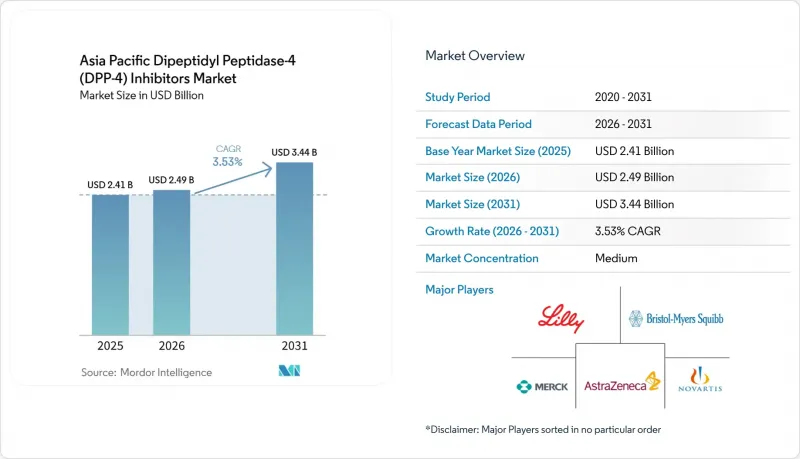
This report is Segmented by Drug Type (Sitagliptin, Saxagliptin, Linagliptin, Alogliptin, Vildagliptin, Other Drug Types), Medication Type (Branded, Generic), Distribution Channel (Hospital, Retail, Online Pharmacies), and Geography (China, Japan, India, Australia, South Korea, Rest of Asia-Pacific). The Market Forecasts are Provided in Terms of Value (USD).
Asia Pacific Dipeptidyl Peptidase-4 (DPP-4) Inhibitors Market Trends and Insights
Rising Type 2 Diabetes Burden In China And India
China and India remain the main volume engines for the Asia Pacific DPP-4 inhibitors market because both countries continue to add large numbers of adults who need long-term glucose control. India's diagnosed adult diabetic population reached 61.3 million in 2024, which keeps the treatment pool large even before accounting for undiagnosed patients. In China, the age-standardized prevalence rate is projected to rise by 37.19% between 2022 and 2050, so demand pressure is set to remain durable over time. The Asia Pacific DPP-4 inhibitors market is also helped by the clinical profile of Asian type 2 diabetes, where impaired insulin secretion keeps incretin-based oral therapy relevant. India still has room for broader treatment coverage, which means even modest gains in diagnosis-to-treatment conversion can lift prescription volumes for affordable generic products. This combination of scale, chronic therapy needs, and low treatment penetration gives the Asia Pacific DPP-4 inhibitors market a steady medium-term demand base.
Favorable Oral Safety Profile And Low Hypoglycemia Risk
The Asia Pacific DPP-4 inhibitors market benefits from an oral safety profile that remains highly relevant in older patient groups and in routine outpatient care. In Japan, more than 70% of patients with diabetes were aged 65 or older, which strengthens demand for agents with a low hypoglycemia risk. This matters because falls, arrhythmias, and hospital use become more serious concerns when treatment causes glucose to drop too aggressively. Japanese nationwide pharmacovigilance data did not establish causal links between DPP-4 inhibitors and acute pancreatitis or pancreatic cancer, which removed an older area of caution. A 2025 population-based study in advanced chronic kidney disease found no significant cardiovascular advantage for SGLT2 inhibitors over DPP-4 inhibitors, which preserves a meaningful prescribing niche. These factors help the Asia Pacific DPP-4 inhibitors market defend its place in elderly patients and in cases where simpler oral regimens remain preferred.
Competition From SGLT2 Inhibitors And GLP-1 Receptor Agonists
Competition from SGLT2 inhibitors and GLP-1 receptor agonists is the clearest ceiling on the Asia Pacific DPP-4 inhibitors market. The 2022-2024 ADA and EASD consensus pathway recommends a GLP-1 receptor agonist or SGLT2 inhibitor for patients with established cardiovascular disease, heart failure, or chronic kidney disease. That recommendation shifts prescribing away from DPP-4 inhibitors in the very patient groups where treatment intensity and clinical outcomes matter most. The effect is not a collapse in demand, because the overall diabetes pool is still expanding across the region. It does, however, narrow the first-line opportunity set as cardiometabolic risk stratification becomes more routine in specialist and payer-led pathways. As a result, the Asia Pacific DPP-4 inhibitors market remains relevant, but its growth ceiling stays lower than that of therapies with stronger cardiorenal positioning.
Other drivers and restraints analyzed in the detailed report include:
- Fixed-Dose Combination Uptake With Metformin
- Expansion Of Tier-2 And Tier-3 Pharmacy Access Across Southeast Asia
- Pricing Pressure After Patent Expirations
For complete list of drivers and restraints, kindly check the Table Of Contents.
Segment Analysis
Sitagliptin held 48.18% of the drug-type segment in 2025, which gave it the largest base within the Asia Pacific DPP-4 inhibitors market. That lead reflects its first-in-class position, deep prescriber familiarity, and the broadest clinical evidence base in this therapy group. The molecule also benefits from a large generic active ingredient pool, which lets manufacturers in India and China use it in multiple combination strategies. Saxagliptin and vildagliptin continue to hold meaningful positions where hospital formularies and established prescribing networks still support legacy use. Even with rising therapeutic competition, sitagliptin remains the reference point for pricing, access, and lifecycle decisions across the Asia Pacific DPP-4 inhibitors industry.
Alogliptin is projected to record the fastest CAGR at 3.98% through 2031, showing that growth is still possible in selective parts of the Asia Pacific DPP-4 inhibitors market. Its momentum is linked to ongoing commercial attention in Japan and nearby markets where formulation upgrades can extend brand life. Linagliptin keeps a defensible niche because its biliary excretion avoids renal dose adjustment, which matters in elderly patients with diabetic nephropathy. China is also showing room for differentiated dosing innovation, with kogerliptin entering the 2025 NRDL after a price reduction that supported reimbursement access. At the same time, Zydus Lifesciences secured first-cycle FDA approval for Zituvio, Zituvimet, and Zituvimet XR, which shows how post-patent sitagliptin platforms can still support multi-market growth.
Complete Report Scope:
- By Drug Type
- Sitagliptin
- Saxagliptin
- Linagliptin
- Alogliptin
- Vildagliptin
- Other Drug Types
- By Medication Type
- Branded Medication
- Generic Medication
- By Distribution Channel
- Hospital Pharmacies
- Retail Pharmacies
- Online Pharmacies
- By Country
- Germany
- United Kingdom
- France
- Italy
- Spain
- Rest of Europe
List of Companies Covered in this Report:
- AstraZeneca
- Boehringer Ingelheim
- Bristol-Myers Squibb
- Dr. Reddy's Laboratories
- Eli Lilly and Company
- GlaxoSmithKline
- Merck
- Mitsubishi Tanabe Pharma
- Novartis
- Novo Nordisk
- Otsuka
- Pfizer
- Sandoz Group
- Sanofi
- STADA Arzneimittel
- Sun Pharmaceuticals Industries
- Takeda Pharmaceuticals
- Teva Pharmaceutical Industries
- Viatris
- Zentiva
Additional Benefits:
- The market estimate (ME) sheet in Excel format
- 3 months of analyst support
TABLE OF CONTENTS
1 Introduction
- 1.1 Study Assumptions & Market Definition
- 1.2 Scope of the Study
2 Research Methodology
3 Executive Summary
4 Market Landscape
- 4.1 Market Overview
- 4.2 Market Drivers
- 4.2.1 Rising Type 2 Diabetes Burden and Older Patient Pool
- 4.2.2 Preference for Oral, Low-Hypoglycemia Therapies in Europe
- 4.2.3 Role in Renal-Impaired and Polypharmacy Patients
- 4.2.4 Wider Use in Cost-Sensitive Second-Line Treatment Pathways
- 4.2.5 Local Guideline Stickiness in Primary Care and Elderly Care
- 4.2.6 Generic Availability Supporting Access Expansion
- 4.3 Market Restraints
- 4.3.1 Substitution Pressure from SGLT-2 Inhibitors and GLP-1 Agents
- 4.3.2 Mature Class Positioning Limits Premium Pricing Power
- 4.3.3 Generic Erosion and Tender-Driven Price Compression
- 4.3.4 Safety Perception and Modest Differentiation Versus Newer Classes
- 4.4 Value / Supply-Chain Analysis
- 4.5 Regulatory Landscape
- 4.6 Technological Outlook
- 4.7 Porter's Five Forces Analysis
- 4.7.1 Threat of New Entrants
- 4.7.2 Bargaining Power of Suppliers
- 4.7.3 Bargaining Power of Buyers
- 4.7.4 Threat of Substitutes
- 4.7.5 Industry Rivalry
5 Market Size & Growth Forecasts
- 5.1 By Drug Type
- 5.1.1 Sitagliptin
- 5.1.2 Saxagliptin
- 5.1.3 Linagliptin
- 5.1.4 Alogliptin
- 5.1.5 Vildagliptin
- 5.1.6 Other Drug Types
- 5.2 By Medication Type
- 5.2.1 Branded Medication
- 5.2.2 Generic Medication
- 5.3 By Distribution Channel
- 5.3.1 Hospital Pharmacies
- 5.3.2 Retail Pharmacies
- 5.3.3 Online Pharmacies
- 5.4 By Country
- 5.4.1 Germany
- 5.4.2 United Kingdom
- 5.4.3 France
- 5.4.4 Italy
- 5.4.5 Spain
- 5.4.6 Rest of Europe
6 Competitive Landscape
- 6.1 Market Concentration
- 6.2 Market Share Analysis
- 6.3 Company Profiles (includes Global Level Overview, Market-level Overview, Core Segments, Financials, Strategic Information, Market Rank/Share, Products & Services, Recent Developments)
- 6.3.1 AstraZeneca
- 6.3.2 Boehringer Ingelheim
- 6.3.3 Bristol Myers Squibb
- 6.3.4 Dr. Reddy's Laboratories
- 6.3.5 Eli Lilly and Company
- 6.3.6 GlaxoSmithKline
- 6.3.7 Merck and Co.
- 6.3.8 Mitsubishi Tanabe Pharma Corporation
- 6.3.9 Novartis AG
- 6.3.10 Novo Nordisk
- 6.3.11 Otsuka Holdings
- 6.3.12 Pfizer
- 6.3.13 Sandoz
- 6.3.14 Sanofi
- 6.3.15 STADA Arzneimittel
- 6.3.16 Sun Pharmaceutical Industries
- 6.3.17 Takeda Pharmaceutical
- 6.3.18 Teva Pharmaceutical Industries
- 6.3.19 Viatris
- 6.3.20 Zentiva
7 Market Opportunities & Future Outlook
- 7.1 White-space & Unmet-need Assessment

