PUBLISHER: Mordor Intelligence | PRODUCT CODE: 2099308

PUBLISHER: Mordor Intelligence | PRODUCT CODE: 2099308
Sovereign Fiber Backbone Infrastructure - Market Share Analysis, Industry Trends & Statistics, Growth Forecasts (2026 - 2031)
According to Mordor Intelligence, the sovereign fiber backbone infrastructure market size was valued at USD 30.91 billion in 2025 and is expected to reach USD 34.20 billion by 2028, and USD 64.10 billion by 2031, registering a CAGR of 13.39% over 2026-2031.
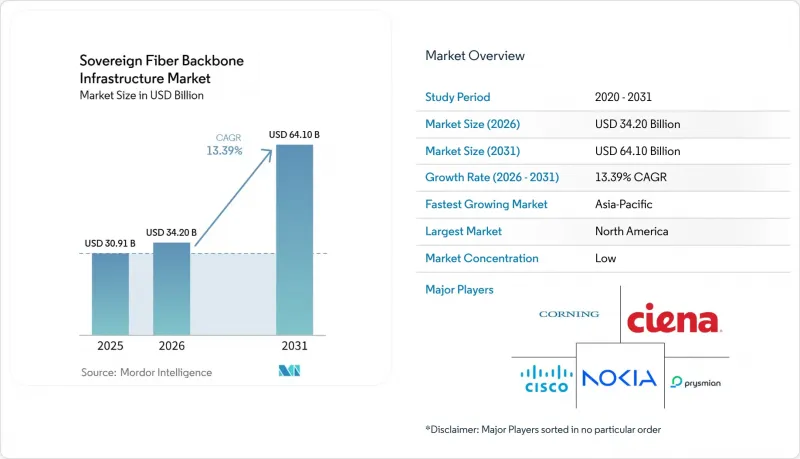
This report is Segmented by Infrastructure Type (Terrestrial, Intercity, Metro, Subsea and Cross-Border, and More), Deployment Architecture (Dark Fiber, Lit Fiber, and More), End User (Government, Telecom, Cloud and Hyperscale, and More), and Geography (North America, South America, Europe, Asia-Pacific, Middle East, and More). The Market Forecasts are Provided in Terms of Value (USD).
Global Sovereign Fiber Backbone Infrastructure Market Trends and Insights
National Data Sovereignty Laws Accelerate Domestic Backbone Buildouts
The sovereign fiber backbone infrastructure market is seeing a direct shift from broad localization rules to procurement-led network buildouts, especially where governments want more control over where sensitive traffic lands and how it is routed. This is increasing demand for nationally controlled backbone assets rather than reliance on transit arrangements that pass through third-party jurisdictions. In the sovereign fiber backbone infrastructure market, this changes route planning because public buyers increasingly favor domestically landed fiber and controlled backbone segments for sensitive workloads. It also creates scarcity in high-security dark fiber and exclusive route capacity, which supports stronger lease pricing and favors operators that already hold local permits, rights-of-way, and trust with state buyers. At the same time, international coordination on cable resilience and permit processing has risen on the policy agenda, which supports a more formal regulatory backdrop for sovereign network planning.
AI And Data Center Corridor Growth Raise Demand For Low-Latency Fiber Backbones
The sovereign fiber backbone infrastructure market is being reshaped by AI workload growth, as distributed compute clusters require lower-latency links across metro and intercity corridors than older enterprise traffic patterns demanded. Corning reported 36% year-over-year growth in the Optical Communications segment revenue in Q1 2026, underscoring how quickly fiber demand has risen with AI infrastructure deployment.Corning also signed a USD 6 billion supply agreement with Meta in January 2026 for AI-grade optical fiber, which reflects the scale of backbone and interconnect requirements now attached to large AI programs. In the sovereign fiber backbone infrastructure market, power constraints are also spreading AI capacity across more regional campuses, which increases the number of interconnect paths needed per deployment rather than reducing them. That pattern supports sustained demand for low-latency long-haul routes, metro rings, and optical upgrades across the routes that link high-density compute clusters.
High Upfront Civil Works and Permitting Complexity Slow Time To Revenue
The sovereign fiber backbone infrastructure market continues to face pressure from the intensity of civil works, as trenching, crossings, attachments, and route approvals still account for a large share of project costs and schedule risk. When multiple national and regional programs move simultaneously, contractor availability and agency review capacity become bottlenecks even before physical construction reaches peak activity. The FCC proposed a 120-day deadline for processing right-of-way authorization requests in June 2026, indicating that regulatory bodies are treating approval delays as a structural issue. In the sovereign fiber backbone infrastructure market, the effect of slow approvals is a longer wait between capital commitment and revenue generation, which raises financing pressure on multi-jurisdiction backbone builds. That challenge is strongest on long-haul routes, where a single unresolved permit can delay entire segments and force changes to network sequencing, contractor deployment, and customer activation.
Other drivers and restraints analyzed in the detailed report include:
- Hyperscaler And Cloud Interconnect Needs Push Long-Haul Capacity Expansion
- Defense, Critical Infrastructure, And Public Sector Segmentation Increase Demand For Controlled Fiber Routes
- Cross-Border Coordination and Landing Rights Delays Increase Project Risk
For complete list of drivers and restraints, kindly check the Table Of Contents.
Segment Analysis
Terrestrial national backbone accounted for 35.61% of revenue in 2025, making it the largest infrastructure type in the sovereign fiber backbone market. This leading position reflects state-funded broadband programs, national carrier upgrades, and the continued use of railway and public utility corridors as cost-efficient backbone deployment rights-of-way. The sovereign fiber backbone infrastructure market still depends heavily on terrestrial assets because they provide the domestic control that governments want for public services, defense communications, and high-priority digital traffic. NEC Corporation and Nokia were selected in February 2026 to expand Eletronet's optical backbone across Brazil by 8,000 kilometers, taking the system to 25,000 kilometers across 23 states with up to 1.2 Tb/s per optical channel.
The subsea and cross-border backbone segment is projected to grow at a 14.76% CAGR through 2031, making it the fastest-growing infrastructure type in the sovereign fiber backbone market. This growth reflects the need for route diversity as governments and operators try to reduce exposure to congested or geopolitically sensitive transit paths. In the sovereign fiber backbone infrastructure industry, this shift is important because route design is no longer only a resilience question and is increasingly treated as a matter of strategic control over traffic movement and landing jurisdiction. That is why sovereign buyers are accepting higher complexity and cost when new cable paths help them avoid specific bottlenecks or reliance on politically exposed corridors. The result is a more durable investment case for subsea and cross-border routes than traditional commercial return models alone would suggest.
Complete Report Scope:
- By Infrastructure Type
- Terrestrial National Backbone
- Intercity Long-Haul Backbone
- Metro Backbone Rings
- Subsea and Cross-Border Backbone
- Utility and Rail Corridor Fiber Backbone
- By Deployment Architecture
- Dark Fiber
- Lit Fiber Services
- Hybrid Fiber and Wave Services
- By End User
- Government and Defense
- Telecom Operators
- Cloud and Hyperscale Data Centers
- Enterprises and Financial Institutions
- Utilities and Critical Infrastructure Operators
- By Geography
- North America
- United States
- Canada
- Mexico
- South America
- Brazil
- Argentina
- Rest of South America
- Europe
- Germany
- United Kingdom
- France
- Italy
- Spain
- Russia
- Rest of Europe
- Asia-Pacific
- China
- India
- Japan
- South Korea
- Australia
- Rest of Asia-Pacific
- Middle East and Africa
- Middle East
- Turkey
- Saudi Arabia
- United Arab Emirates
- Qatar
- Rest of Middle East
- Africa
- South Africa
- Kenya
- Nigeria
- Rest of Africa
- Middle East
- North America
Geography Analysis
North America accounted for 22.31% of revenue in 2025, making it the largest regional segment in the sovereign fiber backbone infrastructure market. This position reflects the region's concentration of hyperscaler capital spending, AI corridor development, and a stronger policy focus on secure domestic routing for strategic digital infrastructure. Zayo completed 100% 400G enablement of its North American core network in July 2025 and also advanced new long-haul AI routes, including a 385-mile Chicago-to-Columbus build. The sovereign fiber backbone infrastructure market in North America also benefits from Canada's digital sovereignty efforts and Mexico's role as a transboundary corridor for nearshoring, data center growth, and cross-border traffic demand.
South America is entering a new investment phase in the sovereign fiber backbone infrastructure market, as the focus shifts from simple connectivity expansion toward AI, data center interconnect, and high-capacity optical upgrades. Brazil stands out in this transition as Eletronet's network expansion with NEC Corporation and Nokia adds scale, reach, and higher channel performance to a backbone platform aimed at hyperscaler and data center demand. Europe is also building momentum in the sovereign fiber backbone infrastructure market through coordinated backbone and submarine connectivity programs backed at the regional level. This matters because pan-European funding and policy coordination favor larger platforms over isolated national deployments. The result is a stronger foundation for sovereign connectivity, enabling regional interoperability and route resilience to be improved simultaneously.
Asia-Pacific is projected to expand at a 15.11% CAGR through 2031, which makes it the fastest-growing regional segment in the sovereign fiber backbone infrastructure market. Growth in this region reflects the overlap of India's digital infrastructure push, China's cable system scale, and rising hyperscale demand across Southeast Asia. Tata Communications announced a USD 152 million commitment in June 2026 to 2 India-Singapore subsea cable projects, including the MIST system and Project CS, adding major capacity between Mumbai, Chennai, and Singapore. The Asia Link Cable also landed in Hong Kong in May 2026 through a China Telecom-led consortium, strengthening the Hong Kong-to-Singapore international corridor. The Middle East and Africa are also becoming more important in the sovereign fiber backbone infrastructure market as Gulf states invest in overland alternatives to Red Sea exposure and African markets continue to scale national backbone systems and cross-border links.
- Nokia Corporation
- Huawei Technologies Co., Ltd.
- Ciena Corporation
- Cisco Systems, Inc.
- Corning Incorporated
- Prysmian S.p.A.
- Nexans S.A.
- Sterlite Technologies Limited
- Fujitsu Limited
- Infinera Corporation
- CommScope Holding Company, Inc.(Amphenol)
- ADVA Optical Networking SE
- Ribbon Communications Inc.
- ZTE Corporation
- Furukawa Electric Co., Ltd.
- SubCom, LLC
- NEC Corporation
- Alcatel Submarine Networks
- Telecom Egypt
- Telstra Group Limited
- Saudi Telecom Company
- Etisalat & (Emirates Telecommunications Company PJSC)
- Kenya Electricity Transmission Company Limited
- RailTel Corporation of India Limited
- Liquid Intelligent Technologies
Additional Benefits:
- The market estimate (ME) sheet in Excel format
- 3 months of analyst support
TABLE OF CONTENTS
1 INTRODUCTION
- 1.1 Study Assumptions and Market Definition
- 1.2 Scope of the Study
2 RESEARCH METHODOLOGY
3 EXECUTIVE SUMMARY
4 MARKET LANDSCAPE
- 4.1 Market Overview
- 4.2 Market Drivers
- 4.2.1 National Data Sovereignty Laws Accelerate Domestic Backbone Buildouts
- 4.2.2 Defense, Critical Infrastructure, and Public Sector Segmentation Increase Demand for Controlled Fiber Routes
- 4.2.3 Hyperscaler and Cloud Interconnect Needs Push Long-Haul Capacity Expansion
- 4.2.4 Geopolitical Route Diversification Away From Chokepoints Reduces Reliance on Foreign Transit
- 4.2.5 Open-Access Backbone Policies Improve Asset Utilization and Anchor Tenant Economics
- 4.2.6 AI and Data Center Corridor Growth Raises Demand for Low-Latency Fiber Backbones
- 4.3 Market Restraints
- 4.3.1 High Upfront Civil Works and Permitting Complexity Slow Time to Revenue
- 4.3.2 Cross-Border Coordination and Landing Rights Delays Increase Project Risk
- 4.3.3 Fiber Cut Exposure, Right-of-Way Theft, and Physical Security Risks Raise Operating Cost
- 4.3.4 Sovereign Procurement Rules Can Limit Vendor Flexibility and Raise Lifecycle Cost
- 4.4 Supply Chain Analysis
- 4.5 Regulatory Landscape
- 4.6 Technological Outlook
- 4.7 Porter's Five Forces Analysis
- 4.7.1 Bargaining Power of Suppliers
- 4.7.2 Bargaining Power of Buyers
- 4.7.3 Threat of New Entrants
- 4.7.4 Threat of Substitutes
- 4.7.5 Industry Rivalry
5 MARKET SIZE AND GROWTH FORECASTS (VALUE)
- 5.1 By Infrastructure Type
- 5.1.1 Terrestrial National Backbone
- 5.1.2 Intercity Long-Haul Backbone
- 5.1.3 Metro Backbone Rings
- 5.1.4 Subsea and Cross-Border Backbone
- 5.1.5 Utility and Rail Corridor Fiber Backbone
- 5.2 By Deployment Architecture
- 5.2.1 Dark Fiber
- 5.2.2 Lit Fiber Services
- 5.2.3 Hybrid Fiber and Wave Services
- 5.3 By End User
- 5.3.1 Government and Defense
- 5.3.2 Telecom Operators
- 5.3.3 Cloud and Hyperscale Data Centers
- 5.3.4 Enterprises and Financial Institutions
- 5.3.5 Utilities and Critical Infrastructure Operators
- 5.4 By Geography
- 5.4.1 North America
- 5.4.1.1 United States
- 5.4.1.2 Canada
- 5.4.1.3 Mexico
- 5.4.2 South America
- 5.4.2.1 Brazil
- 5.4.2.2 Argentina
- 5.4.2.3 Rest of South America
- 5.4.3 Europe
- 5.4.3.1 Germany
- 5.4.3.2 United Kingdom
- 5.4.3.3 France
- 5.4.3.4 Italy
- 5.4.3.5 Spain
- 5.4.3.6 Russia
- 5.4.3.7 Rest of Europe
- 5.4.4 Asia-Pacific
- 5.4.4.1 China
- 5.4.4.2 India
- 5.4.4.3 Japan
- 5.4.4.4 South Korea
- 5.4.4.5 Australia
- 5.4.4.6 Rest of Asia-Pacific
- 5.4.5 Middle East and Africa
- 5.4.5.1 Middle East
- 5.4.5.1.1 Turkey
- 5.4.5.1.2 Saudi Arabia
- 5.4.5.1.3 United Arab Emirates
- 5.4.5.1.4 Qatar
- 5.4.5.1.5 Rest of Middle East
- 5.4.5.2 Africa
- 5.4.5.2.1 South Africa
- 5.4.5.2.2 Kenya
- 5.4.5.2.3 Nigeria
- 5.4.5.2.4 Rest of Africa
- 5.4.5.1 Middle East
- 5.4.1 North America
6 COMPETITIVE LANDSCAPE
- 6.1 Market Concentration
- 6.2 Strategic Moves
- 6.3 Market Share Analysis
- 6.4 Company Profiles (includes Global Level Overview, Market Level Overview, Core Segments, Financials as available, Strategic Information, Market Rank/Share, Products and Services, Recent Developments)
- 6.4.1 Nokia Corporation
- 6.4.2 Huawei Technologies Co., Ltd.
- 6.4.3 Ciena Corporation
- 6.4.4 Cisco Systems, Inc.
- 6.4.5 Corning Incorporated
- 6.4.6 Prysmian S.p.A.
- 6.4.7 Nexans S.A.
- 6.4.8 Sterlite Technologies Limited
- 6.4.9 Fujitsu Limited
- 6.4.10 Infinera Corporation
- 6.4.11 CommScope Holding Company, Inc.(Amphenol)
- 6.4.12 ADVA Optical Networking SE
- 6.4.13 Ribbon Communications Inc.
- 6.4.14 ZTE Corporation
- 6.4.15 Furukawa Electric Co., Ltd.
- 6.4.16 SubCom, LLC
- 6.4.17 NEC Corporation
- 6.4.18 Alcatel Submarine Networks
- 6.4.19 Telecom Egypt
- 6.4.20 Telstra Group Limited
- 6.4.21 Saudi Telecom Company
- 6.4.22 Etisalat & (Emirates Telecommunications Company PJSC)
- 6.4.23 Kenya Electricity Transmission Company Limited
- 6.4.24 RailTel Corporation of India Limited
- 6.4.25 Liquid Intelligent Technologies
7 MARKET OPPORTUNITIES AND FUTURE OUTLOOK
- 7.1 White-Space and Unmet-Need Assessment

