PUBLISHER: Mordor Intelligence | PRODUCT CODE: 2099310

PUBLISHER: Mordor Intelligence | PRODUCT CODE: 2099310
Sports Sponsorship - Market Share Analysis, Industry Trends & Statistics, Growth Forecasts (2026 - 2031)
According to Mordor Intelligence, the sports sponsorship market size was valued at USD 92.18 billion in 2025 and estimated to grow from USD 99.52 billion in 2026 to reach USD 146.00 billion by 2031, at a CAGR of 7.97% during the forecast period 2026-2031.
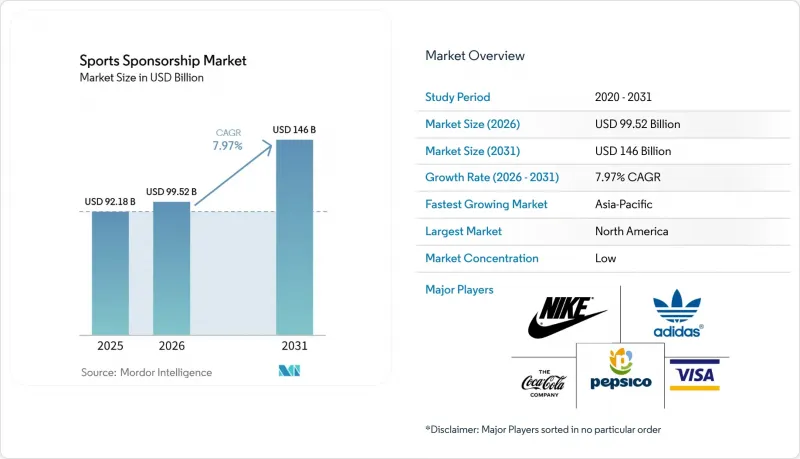
This report is Segmented by Sponsorship Type (Team Sponsorship, Athlete Sponsorship, Event Sponsorship, Venue Sponsorship, and More), Sport (Football, Cricket, Basketball, Motorsport, Tennis, and More), Event Type (International, Domestic), and Geography (North America, South America, Europe, Asia-Pacific, Middle East, and Africa). The Market Forecasts are Provided in Terms of Value (USD).
Global Sports Sponsorship Market Trends and Insights
Rising Number Of Global Sports Events and Properties
The 2026 event calendar places several major properties into one commercial period, and that is increasing the near-term demand pool for the sports sponsorship market. Sponsors are no longer planning only around one marquee event, because budgets now need to cover a wider spread of international tournaments, domestic leagues, and year-round athlete programs. JioStar secured 27 sponsors for the 2026 IPL broadcast season, which shows that domestic properties are also attracting deep commercial interest outside the biggest global events. Samsung also introduced a 68-athlete roster across 17 countries for Milano Cortina 2026, which reflects how global brands are using event platforms to build visibility across several markets at once. The wider effect is that the sports sponsorship market now offers more premium inventory across both global and domestic properties, although that also makes portfolio selection more demanding for buyers.
Rapid Shift Toward Data-Driven Sponsorship ROI Measurement
Brands in the sports sponsorship market are no longer willing to rely on media value equivalency as the main proof of return. They want a single view of exposure across broadcast, streaming, and social channels because audiences now move across all 3 in the same campaign cycle. Relo Metrics and VideoAmp introduced Total Sports Performance in June 2025 to connect sponsorship exposure with outcomes such as search intent, app installs, and in-store visits. SponsorUnited also launched SponsorUnited 4.0 in February 2026 with generative AI support and a dataset covering more than 403,000 brands and 2.2 million deals. As these tools become more common, rights holders need to offer better data access, and brands with stronger measurement systems are gaining an advantage in the sports sponsorship market.
Contract Inflation at Premium Sports Properties
Premium property pricing is rising faster than many sponsors can absorb, and that is narrowing the buyer pool at the top end of the sports sponsorship market. The result is a more selective bidding environment where only the largest global brands can sustain repeated renewals at marquee assets. McLaren Racing announced Mastercard as the official naming partner of its Formula 1 team from 2026, in a deal that the input described at approximately USD 100 million per year, which illustrates the scale of new top-tier commitments. Emirates also extended its partnership with Real Madrid through 2031 at EUR 100 million (USD 115 million) per year, which shows the level to which elite football pricing has moved. As these benchmarks rise, more advertisers are shifting toward athlete, domestic league, and esports partnerships where pricing remains more flexible across the sports sponsorship market.
Other drivers and restraints analyzed in the detailed report include:
- Expansion Of Women's Sports Commercial Inventory
- Growth Of Esports and Creator-Led Sports Sponsorships
- Sponsorship Fatigue and Audience Fragmentation
For complete list of drivers and restraints, kindly check the Table Of Contents.
Segment Analysis
Team sponsorship commanded 35.62% of the sports sponsorship market in 2025, which reflects the value of stable, season-long inventory for brands that want repeat exposure. Franchise structures in leagues such as the NBA, NHL, IPL, and the English Premier League continue to offer consistent visibility, deeper fan access, and broader activation options than one-off properties. SponsorUnited reported that NBA team sponsorship revenue reached a record USD 1.8 billion in the 2025-26 season, while NHL team sponsorship revenue reached USD 1.7 billion in the same period. The same report also showed that average NBA deal size rose 11.4% in 2025-26, which indicates that brands are choosing deeper and more integrated partnerships instead of simply adding more logos.
Event sponsorship is the fastest-growing type, with sports sponsorship market size for this segment projected to expand at a 9.44% CAGR from 2026 to 2031. This growth is being supported by the expanding creator role of athletes, because many of them now reach fans directly through social channels without relying only on league media. Prenetics announced a multi-year global partnership with Giannis Antetokounmpo in April 2026, and the arrangement included equity ownership instead of a standard cash-only endorsement structure . Event sponsorship and venue sponsorship remain important parts of the sports sponsorship market, especially as new stadium districts and year-round venue programs create non-game-day commercial opportunities. Other sponsorship formats, including broadcast integrations, digital placements, and data partnerships, are also gaining importance as rights holders look to monetize streaming and social inventory more directly.
Complete Report Scope:
- By Sponsorship
- Team Sponsorship
- Athlete Sponsorship
- Event Sponsorship
- Venue Sponsorship
- Other Sponsorships
- By Sport
- Football
- Cricket
- Basketball
- Motorsport
- Tennis
- Other Sports
- By Event Type
- International
- Domestic
- By Geography
- North America
- United States
- Canada
- Mexico
- South America
- Brazil
- Argentina
- Chile
- Rest of South America
- Europe
- Germany
- United Kingdom
- France
- Italy
- Spain
- Rest of Europe
- Asia-Pacific
- China
- Japan
- India
- South Korea
- Australia
- Rest of Asia-Pacific
- Middle East
- Saudi Arabia
- United Arab Emirates
- Qatar
- Rest of Middle East
- Africa
- South Africa
- Egypt
- Nigeria
- Rest of Africa
- North America
Geography Analysis
North America held 34.12% of the global sports sponsorship market in 2025, which made it the largest regional contributor. The region remains anchored by the NFL, NBA, MLB, NHL, and MLS, all of which offer large sponsor ecosystems and mature activation models. SponsorUnited reported nearly USD 4.5 billion in sponsorship spend across the 13 FIFA World Cup host cities in the United States, which highlights the commercial concentration already building around the 2026 cycle. Reuters also reported that Visa ended its league-wide NFL sponsorship in 2025 to redirect spending toward the FIFA World Cup 2026 and LA28, which illustrates how brands are reshaping North American budgets around global event windows. The United States leads on both value and volume, while Canada and Mexico still provide lower-cost entry points for brands that want broader regional exposure.
Asia-Pacific is the fastest-growing region in the sports sponsorship market, with a forecast CAGR of 9.82% from 2026 to 2031. India remains the main growth engine because cricket continues to dominate media rights, franchise development, and sponsor interest. JioStar secured 27 sponsors for the 2026 IPL broadcast season, which reflects both the commercial depth of the property and the widening category mix among advertisers. The deployment of stronger cross-platform measurement tools around IPL 2026 also supports a more auditable buying environment, which matters for multinational brands that want clearer accountability. Samsung's athlete program for Milano Cortina 2026 shows how Asia-Pacific companies use global sports properties to build regional and international brand presence at the same time.
Europe remains the highest-value region by average deal size, and the European Sponsorship Association reported EUR 34.45 billion (USD 39.6 billion) for the wider sponsorship market in 2025, with sport accounting for EUR 24.79 billion (USD 28.33 billion). Germany remained the largest national market at EUR 6.26 billion (USD 7.15 billion), while Spain grew the fastest among major markets at 14% to EUR 2.18 billion (USD 2.49 billion), and the UK followed at EUR 6.15 billion (USD 7.03 billion). South America continues to depend heavily on football-led sponsorship ecosystems, and the 2026 World Cup cycle is supporting commercial anticipation across nearby markets. Africa remains at an earlier stage in the sports sponsorship market, although youth demographics and mobile-first viewing habits are keeping the region on sponsor watchlists.
- Nike Inc.
- Adidas AG
- The Coca-Cola Company
- PepsiCo, Inc.
- Visa Inc.
- Mastercard Incorporated
- Red Bull GmbH
- Puma SE
- Anheuser-Busch InBev SA/NV
- Toyota Motor Corporation
- Ford Motor Company
- Samsung Electronics Co., Ltd.
- Qatar Airways Group Q.C.S.C.
- Tata Group
- Reliance Jio Infocomm Limited
- Heineken N.V.
- Emirates
- Etihad Airways PJSC
- Flydubai
- General Motors Company
Additional Benefits:
- The market estimate (ME) sheet in Excel format
- 3 months of analyst support
TABLE OF CONTENTS
1 INTRODUCTION
- 1.1 Study Assumptions and Market Definition
- 1.2 Scope of the Study
2 RESEARCH METHODOLOGY
3 EXECUTIVE SUMMARY
4 MARKET LANDSCAPE
- 4.1 Market Overview
- 4.2 Market Drivers
- 4.2.1 Rising Number of Global Sports Events and Properties
- 4.2.2 Rapid Shift Toward Data-Driven Sponsorship ROI Measurement
- 4.2.3 Expansion of Women's Sports Commercial Inventory
- 4.2.4 Growth of Esports and Creator-Led Sports Sponsorships
- 4.2.5 Rising Demand for Digital Activation and Social Engagement
- 4.2.6 Growing Brand Preference for Long-Term Partnership Models
- 4.3 Market Restraints
- 4.3.1 Contract Inflation at Premium Sports Properties
- 4.3.2 Sponsorship Fatigue and Audience Fragmentation
- 4.3.3 Stricter Ad Restrictions and Category Exclusions
- 4.3.4 Measurement Complexity Across Multi-Platform Activations
- 4.4 Industry Value Chain Analysis
- 4.5 Regulatory Landscape
- 4.6 Technological Outlook
- 4.7 Porter's Five Forces Analysis
- 4.7.1 Threat of New Entrants
- 4.7.2 Bargaining Power of Buyers
- 4.7.3 Bargaining Power of Suppliers
- 4.7.4 Threat of Substitutes
- 4.7.5 Industry Rivalry
5 MARKET SIZE AND GROWTH FORECASTS (VALUE)
- 5.1 By Sponsorship
- 5.1.1 Team Sponsorship
- 5.1.2 Athlete Sponsorship
- 5.1.3 Event Sponsorship
- 5.1.4 Venue Sponsorship
- 5.1.5 Other Sponsorships
- 5.2 By Sport
- 5.2.1 Football
- 5.2.2 Cricket
- 5.2.3 Basketball
- 5.2.4 Motorsport
- 5.2.5 Tennis
- 5.2.6 Other Sports
- 5.3 By Event Type
- 5.3.1 International
- 5.3.2 Domestic
- 5.4 By Geography
- 5.4.1 North America
- 5.4.1.1 United States
- 5.4.1.2 Canada
- 5.4.1.3 Mexico
- 5.4.2 South America
- 5.4.2.1 Brazil
- 5.4.2.2 Argentina
- 5.4.2.3 Chile
- 5.4.2.4 Rest of South America
- 5.4.3 Europe
- 5.4.3.1 Germany
- 5.4.3.2 United Kingdom
- 5.4.3.3 France
- 5.4.3.4 Italy
- 5.4.3.5 Spain
- 5.4.3.6 Rest of Europe
- 5.4.4 Asia-Pacific
- 5.4.4.1 China
- 5.4.4.2 Japan
- 5.4.4.3 India
- 5.4.4.4 South Korea
- 5.4.4.5 Australia
- 5.4.4.6 Rest of Asia-Pacific
- 5.4.5 Middle East
- 5.4.5.1 Saudi Arabia
- 5.4.5.2 United Arab Emirates
- 5.4.5.3 Qatar
- 5.4.5.4 Rest of Middle East
- 5.4.6 Africa
- 5.4.6.1 South Africa
- 5.4.6.2 Egypt
- 5.4.6.3 Nigeria
- 5.4.6.4 Rest of Africa
- 5.4.1 North America
6 COMPETITIVE LANDSCAPE
- 6.1 Market Concentration
- 6.2 Strategic Moves
- 6.3 Vendor Positioning Analysis
- 6.4 Company Profiles (includes Global Level Overview, Market Level Overview, Core Segments, Financials as available, Strategic Information, Market Rank/Share, Products and Services, Recent Developments)
- 6.4.1 Nike Inc.
- 6.4.2 Adidas AG
- 6.4.3 The Coca-Cola Company
- 6.4.4 PepsiCo, Inc.
- 6.4.5 Visa Inc.
- 6.4.6 Mastercard Incorporated
- 6.4.7 Red Bull GmbH
- 6.4.8 Puma SE
- 6.4.9 Anheuser-Busch InBev SA/NV
- 6.4.10 Toyota Motor Corporation
- 6.4.11 Ford Motor Company
- 6.4.12 Samsung Electronics Co., Ltd.
- 6.4.13 Qatar Airways Group Q.C.S.C.
- 6.4.14 Tata Group
- 6.4.15 Reliance Jio Infocomm Limited
- 6.4.16 Heineken N.V.
- 6.4.17 Emirates
- 6.4.18 Etihad Airways PJSC
- 6.4.19 Flydubai
- 6.4.20 General Motors Company
7 MARKET OPPORTUNITIES AND FUTURE OUTLOOK
- 7.1 White-Space and Unmet-Need Assessment

