PUBLISHER: Mordor Intelligence | PRODUCT CODE: 2099314

PUBLISHER: Mordor Intelligence | PRODUCT CODE: 2099314
North America Sodium Bicarbonate - Market Share Analysis, Industry Trends & Statistics, Growth Forecasts (2026 - 2031)
According to Mordor Intelligence, the North America sodium bicarbonate market size is projected to expand from USD 912.30 million in 2025 and USD 945.28 million in 2026 to USD 1.15 billion by 2031, registering a CAGR of 4.02% from 2026 to 2031.
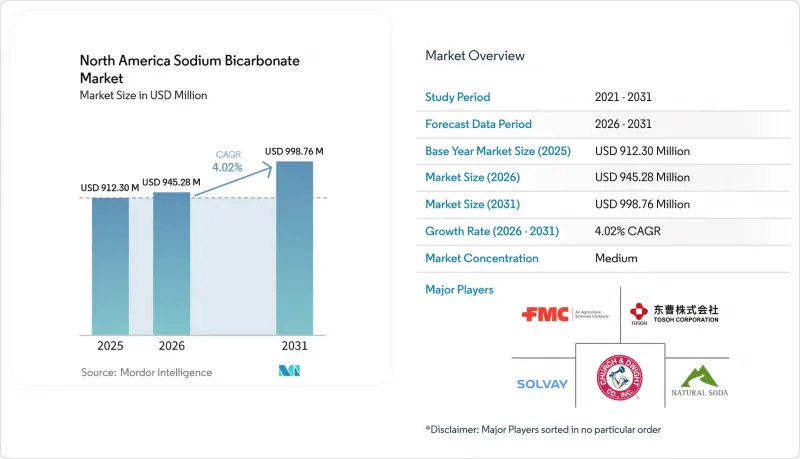
This report is Segmented by Grade (Pharma Grade, Food Grade, Industrial Grade, and Feed Grade), Form (Powder, Liquid, Crystal, and Pellets), Application (Food and Beverages, Pharmaceuticals, Animal Feed, Water Treatment, Industrial, and Others), and Geography (United States, Canada, Mexico, and Rest of North America). The Market Forecasts are Provided in Terms of Value (USD).
North America Sodium Bicarbonate Market Trends and Insights
Strong Demand From The Food And Beverage Industry
The food and beverage sector remains the largest base of demand for the North America sodium bicarbonate market, but the composition of that demand is shifting toward higher purity and more tightly specified supply. Food manufacturers continue to use sodium bicarbonate across bakery, dairy, and packaged food formulations, and the material keeps a strong position because formulators already know its functionality and handling profile. The North America sodium bicarbonate market is also benefiting from adjacent consumer product demand, as Church and Dwight announced the 2026 launch of ARM and HAMMER Fresh Laundry Detergent with 10x more baking soda, which shows how product development continues to widen commercial use around established baking soda familiarity. Church and Dwight also reported that sodium bicarbonate and animal nutrition businesses were key contributors to its 2025 performance, which supports the view that demand is not limited to one narrow food subsegment. FDA acceptance and established food use continue to support the North America sodium bicarbonate market, where manufacturers want familiar ingredients that fit clean label reformulation paths. That keeps value creation centered less on tonnage growth alone and more on reliable delivery of food compliant grades.
Expanding Flue Gas Treatment Adoption In Industrial Emissions Control
Industrial emissions control is adding a durable demand layer to the North America sodium bicarbonate market because many installations buy on compliance need rather than discretionary preference. The US Environmental Protection Agency continued to shape this application through combustion and incineration rules that govern acid gas and related emissions across multiple industrial sources. That regulatory framework supports dry sorbent injection demand, especially where operators need strong acid gas removal with manageable residue volumes and dependable material handling. The North America sodium bicarbonate market also gains from the fact that industrial-grade supply can be supported by the same regional production base that serves other end uses, which helps reduce procurement friction when compliance schedules tighten. This matters because emissions control buying patterns often move in waves as plants retrofit or upgrade, and the presence of nearby supply improves readiness. As a result, industrial applications give the North America sodium bicarbonate market a more balanced demand mix that does not depend only on food or healthcare volumes.
Soda Ash Price Volatility And Energy Intensive Conversion Economics
Even with strong trona access, the North America sodium bicarbonate market still faces exposure to feedstock and conversion economics because sodium bicarbonate production remains tied to soda ash availability and processing cost. Producers that are fully integrated have a clearer buffer, but participants that rely more on purchased input remain more exposed to shifts in procurement conditions. In the North America sodium bicarbonate market, this difference can widen the performance gap between large upstream linked suppliers and smaller conversion focused operators. Cost swings also complicate downstream pricing because food, pharma, and industrial buyers do not always absorb increases at the same pace. That pressure becomes more pronounced in applications where sodium bicarbonate competes with lower complexity alternatives. As a result, conversion economics remain a practical restraint on how quickly less integrated participants can scale.
Other drivers and restraints analyzed in the detailed report include:
- Higher Consumption In Hemodialysis And Antacid Formulations
- Abundant Natural Soda Ash Resources In The United States
- Increasing Energy, Water, And Utility Expenses In Sodium Bicarbonate Manufacturing
For complete list of drivers and restraints, kindly check the Table Of Contents.
Segment Analysis
Food grade held 42.56% of the North America sodium bicarbonate market share in 2025, which kept it as the largest grade in the region. That leadership reflects broad use across bakery, dairy, and packaged food manufacturing, where sodium bicarbonate remains a standard and familiar functional ingredient. The North America sodium bicarbonate market also continues to draw stable support from industrial and feed grades, with industrial grade tied to emissions control and water treatment and feed grade tied to dairy and beef nutrition. This mix reduces dependence on any one end market and helps the grade structure of the North America sodium bicarbonate market stay balanced. It also means that food grade leadership rests on both volume depth and wide customer reach.
Pharma grade is projected to grow at a 5.02% CAGR through 2031, which makes it the fastest expanding grade in the North America sodium bicarbonate market. Growth is tied to hemodialysis concentrate demand and antacid-related use, both of which benefit from the scale of the United States renal care base. The North America sodium bicarbonate industry therefore shows a clear split between its largest grade by volume and its fastest grade by value-linked growth. That distinction matters because pharma supply depends more on documentation, purity assurance, and validated systems than on bulk scale alone. In the North America sodium bicarbonate market, suppliers that already meet these standards hold an advantage that is difficult to narrow quickly.
Complete Report Scope:
- By Grade
- Pharma Grade
- Food Grade
- Industrial Grade
- Feed Grade
- By Form
- Powder
- Liquid
- Crystal
- Pallets
- By Applications
- Food and Beverages
- Pharmaceuticals
- Animal Feed
- Water Treatment
- Industrial
- Others
- By Geography
- United States
- Canada
- Mexico
- Rest of North America
List of Companies Covered in this Report:
- Solvay Inc.
- Church and Dwight Co., Inc.
- Natural Soda LLC
- Genesis Alkali
- Ciner Resources LP
- Natrium Products, Inc.
- Hawkins, Inc.
- Tosoh Corporation
- Novacap Group
- Tata Chemicals Limited
- CIECH S.A.
- AGC Inc.
- FMC Corporation
- Nirma Limited
- Sisecam
- Jost Chemical Co.
- CF Industries Holdings, Inc.
- GHCL Limited
- Bashkir Soda Company
- Inner Mongolia Yuanxing Energy Co., Ltd.
Additional Benefits:
- The market estimate (ME) sheet in Excel format
- 3 months of analyst support
TABLE OF CONTENTS
1 INTRODUCTION
- 1.1 Study Assumptions and Market Definition
- 1.2 Scope of the Study
2 RESEARCH METHODOLOGY
3 EXECUTIVE SUMMARY
4 MARKET LANDSCAPE
- 4.1 Market Overview
- 4.2 Market Drivers
- 4.2.1 Strong Demand from the Food & Beverage Industry
- 4.2.2 Expanding Flue Gas Treatment Adoption in Industrial Emissions Control
- 4.2.3 Higher Consumption in Hemodialysis and Antacid Formulations
- 4.2.4 Abundant Natural Soda Ash Resources in the United States
- 4.2.5 Growing Demand for Eco-Friendly Cleaning Products
- 4.2.6 Increasing Industrial Research and Development and Product Innovation
- 4.3 Market Restraints
- 4.3.1 Soda Ash Price Volatility and Energy-Intensive Conversion Economics
- 4.3.2 Increasing Energy, Water, and Utility Expenses in Sodium Bicarbonate Manufacturing
- 4.3.3 Competition From Alternative Neutralizing and Sorbent Ingredients
- 4.3.4 Stringent Quality and Traceability Requirements for High-Purity Grades
- 4.4 Supply Chain Outlook
- 4.5 Regulatory Landscape
- 4.6 Technological Outlook
- 4.7 Porter's Five Forces
- 4.7.1 Bargaining Power of Suppliers
- 4.7.2 Bargaining Power of Buyers
- 4.7.3 Threat of New Entrants
- 4.7.4 Threat of Substitutes
- 4.7.5 Competitive Rivalry
5 MARKET SIZE AND GROWTH FORECASTS (VALUE)
- 5.1 By Grade
- 5.1.1 Pharma Grade
- 5.1.2 Food Grade
- 5.1.3 Industrial Grade
- 5.1.4 Feed Grade
- 5.2 By Form
- 5.2.1 Powder
- 5.2.2 Liquid
- 5.2.3 Crystal
- 5.2.4 Pallets
- 5.3 By Applications
- 5.3.1 Food and Beverages
- 5.3.2 Pharmaceuticals
- 5.3.3 Animal Feed
- 5.3.4 Water Treatment
- 5.3.5 Industrial
- 5.3.6 Others
- 5.4 By Geography
- 5.4.1 United States
- 5.4.2 Canada
- 5.4.3 Mexico
- 5.4.4 Rest of North America
6 COMPETITIVE LANDSCAPE
- 6.1 Market Concentration
- 6.2 Strategic Moves
- 6.3 Market Ranking Analysis
- 6.4 Company Profiles (Includes Global-level Overview, Market-level Overview, Core Segments, Financials, Strategic Info, Market Rank/Share, Products & Services, Recent Developments)
- 6.4.1 Solvay Inc.
- 6.4.2 Church and Dwight Co., Inc.
- 6.4.3 Natural Soda LLC
- 6.4.4 Genesis Alkali
- 6.4.5 Ciner Resources LP
- 6.4.6 Natrium Products, Inc.
- 6.4.7 Hawkins, Inc.
- 6.4.8 Tosoh Corporation
- 6.4.9 Novacap Group
- 6.4.10 Tata Chemicals Limited
- 6.4.11 CIECH S.A.
- 6.4.12 AGC Inc.
- 6.4.13 FMC Corporation
- 6.4.14 Nirma Limited
- 6.4.15 Sisecam
- 6.4.16 Jost Chemical Co.
- 6.4.17 CF Industries Holdings, Inc.
- 6.4.18 GHCL Limited
- 6.4.19 Bashkir Soda Company
- 6.4.20 Inner Mongolia Yuanxing Energy Co., Ltd.
7 MARKET OPPORTUNITIES AND FUTURE OUTLOOK

