PUBLISHER: Mordor Intelligence | PRODUCT CODE: 2099412

PUBLISHER: Mordor Intelligence | PRODUCT CODE: 2099412
Airborne Electronic Warfare - Market Share Analysis, Industry Trends & Statistics, Growth Forecasts (2026 - 2031)
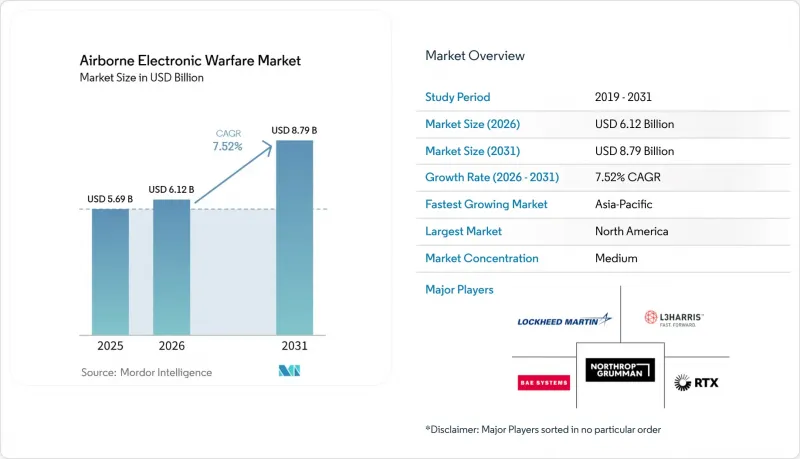
According to Mordor Intelligence, the airborne electronic warfare market size is expected to grow from USD 5.69 billion in 2025 to USD 6.12 billion in 2026, and is forecast to reach USD 8.79 billion by 2031, at a 7.52% CAGR over 2026-2031.
This report is Segmented by Capability (Electronic Attack, Electronic Protection, and More), Platform Type (Manned Aircraft and Unmanned Aircraft), Frequency Band (HF/ VHF, UHF/L/S, C/X, and Ku/Ka), Architecture (Pod-Mounted, Internally Integrated, and Payload/Pod for UAVs), Geography (North America, Europe, Asia-Pacific, and More). The Market Forecasts are Provided in Terms of Value (USD).
Global Airborne Electronic Warfare Market Trends and Insights
Rising Defense Budgets and Recapitalization Cycles
Accelerated defense spending boosted procurement of next-generation EW suites. The US Department of Defense (DoD) planned at least USD 21 billion for EW development over five years, a 40% uplift versus the previous cycle. European states formed a multinational coalition to pool EW resources to achieve lower unit costs and greater interoperability. Saudi Arabia and other Gulf nations have mirrored the trend, investing in fully integrated radar, missile, and EW solutions to counter Russian anti-access systems. Across regions, higher budgets shortened replacement cycles, pushing more orders for pod-mounted and embedded EW architectures that comply with open-system standards.
Growing Threat of Advanced Multi-Band SAM and Radar Systems
The spread of adaptable SAMs has forced air forces to adopt cognitive EW and reprogram within milliseconds. PLA prototypes demonstrated jammers capable of creating 3,600 false radar targets, accelerating US and NATO interest in wideband Active Electronically Scanned Array (AESA) countermeasures. Digital Radio Frequency Memory (DRFM) technology capable of simultaneous multi-band deception is now central to acquisition roadmaps, as evidenced by RTX's Next Generation Jammer Mid-Band contract, which covers requirements for the US Navy and the Royal Australian Air Force.
Acquisition and Life-Cycle Cost Overruns of Next-Gen EW Pods
Pod programs such as the NGJ-Mid Band experienced multiple contract modifications that expanded cost profiles and delayed milestones, placing pressure on already stretched defense budgets. Integrating AI/ML algorithms into legacy fighters raised unforeseen technical risks, pushing schedules to the right as developers worked through electromagnetic compatibility issues across avionics suites. Extended test campaigns are now mandatory to demonstrate reliability against adaptive threats, inflating support costs throughout product life cycles.
Other drivers and restraints analyzed in the detailed report include:
- Fighter Recapitalization Programmes Integrating Organic EW Suites
- UAV Fleet Expansion Requiring Ultra-Lightweight EW Payloads
- Electromagnetic-Spectrum Congestion and Deconfliction Hurdles
For complete list of drivers and restraints, kindly check the Table Of Contents.
Segment Analysis
Electronic attack accounted for 47.63% of the airborne electronic warfare market share in 2025, underscoring the premium placed on striking adversary radar and communications before kinetic weapons launch. Demand for wideband escort jamming and stand-off decoys kept the airborne electronic warfare market size for offensive payloads above USD 2.90 billion in 2026. Electronic support grew the fastest, at a 9.72% CAGR, as the armed services invested in real-time threat libraries and direction-finding sensors that feed into cognitive jammers. Electronic protection maintained steady budgets to harden satellite links and precision navigation signals, particularly in joint operations where the loss of GPS could cripple maneuver. Integrated suites that merge these three missions into a single processing stack became standard on new fighter and bomber programs, enhancing situational awareness while lowering sustainment costs.
Historical investments in electronic attack matured into exportable solutions, enabling NATO partners to field common waveforms and coordinate strike packages with minimal data latency. The airborne electronic warfare market now favors systems that deliver simultaneous detect-classify-jam capabilities within a single aperture. This trend reduces the need for multiple line-replaceable units and streamlines maintenance. Growth is also fueled by training ranges adopting high-fidelity threat emitters, enabling aircrews to rehearse against realistic multi-band radar clusters.
Manned aircraft continued to account for 73.92% of the airborne electronic warfare market in 2025 because recapitalization programs for the F-16, F-35, Typhoon, and EA-18G fleets maintained thousands of active airframes worldwide. The growth is driven by embedded architectures such as AN/ASQ-239 on the F-35. Unmanned systems, however, achieved an 11.08% CAGR through 2031 thanks to successful MQ-20 Avenger autonomous jamming trials by GA-ASI. Reduced risk to crews and lower operating costs supported the procurement of attritable air-launched effects that distribute EW nodes across the battlespace. Doctrinally, unmanned platforms increasingly act as decoys to draw out threat emitters, allowing crewed aircraft to preserve stealth while orchestrating coordinated attack sequences.
UAV producers focused on open-systems payload bays to enable end users to quickly swap EW cartridges. The market welcomed lightweight gallium nitride transmitters that reduced power draw by 20%, extending loiter to beyond 24 hours on MALE UAVs. In parallel, manned platforms integrated autonomous decision aids developed for unmanned craft, illustrating cross-pollination of hardware and software that elevates the entire fleet's resilience.
Complete Report Scope:
- By Capability
- Electronic Attack
- Electronic Protection
- Electronic Support
- By Platform Type
- Manned Aircraft
- Unmanned Aircraft
- By Frequency Band
- HF/ VHF
- UHF/L/S
- C/X
- Ku/Ka
- By Architecture
- Pod-mounted
- Internally Integrated
- Payload/Pod for UAVs
- By Geography
- North America
- United States
- Canada
- Mexico
- Europe
- United Kingdom
- Germany
- France
- Russia
- Rest of Europe
- Asia-Pacific
- China
- Japan
- India
- South Korea
- Rest of Asia-Pacific
- South America
- Brazil
- Rest of South America
- Middle East and Africa
- Middle East
- Saudi Arabia
- United Arab Emirates
- Israel
- Rest of Middle East
- Africa
- South Africa
- Rest of Africa
- Middle East
- North America
Geography Analysis
North America generated 44.78% of the airborne electronic warfare market revenue in 2025, anchored by multi-year US contracts, including Boeing's USD 615 million award for a next-generation Air Force EW system. The region's airborne electronic warfare market size is projected to grow at a 6.37% CAGR through 2031, supported by the modernization of the F-15, F-16, and EA-18G fleets and the ongoing development of the B-21 bomber's defensive suites. Canada's defense policy update earmarked funds for escort jammers on its future fighter, further strengthening regional demand.
Asia-Pacific is expected to post the fastest growth at 9.58% CAGR, reflecting China's 6G-enabled jamming trials and Japan's policy revisions that accelerated EW procurement for F-35 and next-generation fighter programs. Indigenous manufacturing centers in South Korea and India secured technology-transfer deals to assemble podded systems locally, reducing cost and building sovereign maintenance capacity. The airborne electronic warfare market thus benefited from both import acquisitions and emergent domestic production lines.
Europe remained resilient, buoyed by multinational initiatives to harmonize EW doctrines, including Germany's Eurofighter EK and the UK's Tempest future combat air system. Cooperative funding streams improved economies of scale and encouraged adoption of open-architecture standards, aligning with US SOSA profiles to guarantee coalition interoperability. Meanwhile, the Middle East and Africa saw spending concentrated among a smaller set of buyers. Yet, Saudi Arabia's integrated radar-EW roadmap and the UAE EDGE Group's export push highlighted a strategic intent to field credible spectrum-dominance capabilities.
- RTX Corporation
- Northrop Grumman Corporation
- BAE Systems plc
- L3Harris Technologies, Inc.
- Lockheed Martin Corporation
- Saab AB
- Thales Group
- Leonardo S.p.A.
- Elbit Systems Ltd.
- Israel Aerospace Industries Ltd.
- Mercury Systems, Inc.
- HENSOLDT AG
- Rohde & Schwarz GmbH & Co. KG
- Terma A/S
- QinetiQ Group
- Rafael Advanced Defense Systems Ltd.
- Honeywell Aerospace Inc.
Additional Benefits:
- The market estimate (ME) sheet in Excel format
- 3 months of analyst support
TABLE OF CONTENTS
1 INTRODUCTION
- 1.1 Study Assumptions and Market Definition
- 1.2 Scope of the Study
2 RESEARCH METHODOLOGY
3 EXECUTIVE SUMMARY
4 MARKET LANDSCAPE
- 4.1 Market Overview
- 4.2 Market Drivers
- 4.2.1 Rising defense budgets and recapitalization cycles
- 4.2.2 Growing threat of advanced multi-band SAM and radar systems
- 4.2.3 Fighter recapitalization programmes integrating organic EW suites
- 4.2.4 UAV fleet expansion requiring ultra-lightweight EW payloads
- 4.2.5 AI-enabled cognitive EW for adaptive jamming
- 4.2.6 Shift toward SOSA-aligned open EW architectures
- 4.3 Market Restraints
- 4.3.1 Acquisition and life-cycle cost overruns of next-gen EW pods
- 4.3.2 Electromagnetic-spectrum congestion and deconfliction hurdles
- 4.3.3 Export-control regimes (ITAR/ML5) throttling cross-border deals
- 4.3.4 SWaP limits when integrating EW on Group 1-3 drones
- 4.4 Value Chain Analysis
- 4.5 Regulatory Landscape
- 4.6 Technological Outlook
- 4.7 Porter's Five Forces Analysis
- 4.7.1 Threat of New Entrants
- 4.7.2 Bargaining Power of Suppliers
- 4.7.3 Bargaining Power of Buyers
- 4.7.4 Threat of Substitutes
- 4.7.5 Intensity of Competitive Rivalry
5 MARKET SIZE AND GROWTH FORECASTS (VALUE)
- 5.1 By Capability
- 5.1.1 Electronic Attack
- 5.1.2 Electronic Protection
- 5.1.3 Electronic Support
- 5.2 By Platform Type
- 5.2.1 Manned Aircraft
- 5.2.2 Unmanned Aircraft
- 5.3 By Frequency Band
- 5.3.1 HF/ VHF
- 5.3.2 UHF/L/S
- 5.3.3 C/X
- 5.3.4 Ku/Ka
- 5.4 By Architecture
- 5.4.1 Pod-mounted
- 5.4.2 Internally Integrated
- 5.4.3 Payload/Pod for UAVs
- 5.5 By Geography
- 5.5.1 North America
- 5.5.1.1 United States
- 5.5.1.2 Canada
- 5.5.1.3 Mexico
- 5.5.2 Europe
- 5.5.2.1 United Kingdom
- 5.5.2.2 Germany
- 5.5.2.3 France
- 5.5.2.4 Russia
- 5.5.2.5 Rest of Europe
- 5.5.3 Asia-Pacific
- 5.5.3.1 China
- 5.5.3.2 Japan
- 5.5.3.3 India
- 5.5.3.4 South Korea
- 5.5.3.5 Rest of Asia-Pacific
- 5.5.4 South America
- 5.5.4.1 Brazil
- 5.5.4.2 Rest of South America
- 5.5.5 Middle East and Africa
- 5.5.5.1 Middle East
- 5.5.5.1.1 Saudi Arabia
- 5.5.5.1.2 United Arab Emirates
- 5.5.5.1.3 Israel
- 5.5.5.1.4 Rest of Middle East
- 5.5.5.2 Africa
- 5.5.5.2.1 South Africa
- 5.5.5.2.2 Rest of Africa
- 5.5.5.1 Middle East
- 5.5.1 North America
6 COMPETITIVE LANDSCAPE
- 6.1 Market Concentration
- 6.2 Strategic Moves
- 6.3 Market Share Analysis
- 6.4 Company Profiles (includes Global level Overview, Market level overview, Core Segments, Financials as available, Strategic Information, Market Rank/Share for key companies, Products and Services, and Recent Developments)
- 6.4.1 RTX Corporation
- 6.4.2 Northrop Grumman Corporation
- 6.4.3 BAE Systems plc
- 6.4.4 L3Harris Technologies, Inc.
- 6.4.5 Lockheed Martin Corporation
- 6.4.6 Saab AB
- 6.4.7 Thales Group
- 6.4.8 Leonardo S.p.A.
- 6.4.9 Elbit Systems Ltd.
- 6.4.10 Israel Aerospace Industries Ltd.
- 6.4.11 Mercury Systems, Inc.
- 6.4.12 HENSOLDT AG
- 6.4.13 Rohde & Schwarz GmbH & Co. KG
- 6.4.14 Terma A/S
- 6.4.15 QinetiQ Group
- 6.4.16 Rafael Advanced Defense Systems Ltd.
- 6.4.17 Honeywell Aerospace Inc.
7 MARKET OPPORTUNITIES AND FUTURE OUTLOOK
- 7.1 White-space and Unmet-Need Assessment

