PUBLISHER: Mordor Intelligence | PRODUCT CODE: 2099430

PUBLISHER: Mordor Intelligence | PRODUCT CODE: 2099430
Vulvar Cancer Therapeutics - Market Share Analysis, Industry Trends & Statistics, Growth Forecasts (2026 - 2031)
According to Mordor Intelligence, the vulvar cancer therapeutics market size was valued at USD 0.67 billion in 2025 and is estimated to grow from USD 0.74 billion in 2026 to reach USD 1.21 billion by 2031, at a CAGR of 10.30% during the forecast period (2026-2031).
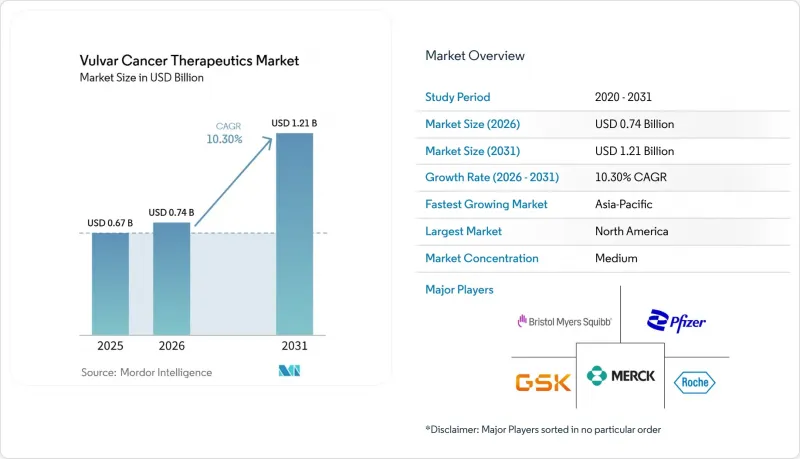
This report is Segmented by Treatment Type (Surgery, Chemotherapy, Radiation Therapy, Biologic Therapy, Targeted Therapy, and Immunotherapy), Cancer Type (Vulvar Squamous Cell Carcinoma, Melanoma, and More), End User (Hospitals, Clinics, and More), and Geography (North America, Europe, and More). The Market Forecasts are Provided in Terms of Value (USD).
Global Vulvar Cancer Therapeutics Market Trends and Insights
Rising HPV-Associated Incidence Expanding the Treatment Pool
HPV-positive vulvar cancer is expanding the addressable patient base for the vulvar cancer therapeutics market, particularly among older women entering higher treatment-use years. The 55-64 age group recorded a 53% increase in HPV-positive cases between 2000 and 2024, supporting a larger pool of patients likely to require systemic therapy over the forecast period. Countries such as Germany, the Netherlands, and Canada have high age-standardized incidence rates, indicating unmet demand in markets with established oncology spending capacity. Vaccination will reduce future disease burden over time, but it is not expected to materially reduce the treated population during this forecast window, as its benefits will emerge later than the current wave of diagnoses.
Expanding Immunotherapy and Biomarker-Driven Treatment Approaches
Immunotherapy remains a key growth driver in the vulvar cancer therapeutics market as it shifts from a limited salvage role to structured treatment pathways. Phase 2 findings expected to be presented at the 2025 ASCO Annual Meeting show that pembrolizumab with cisplatin-sensitized radiation, followed by pembrolizumab maintenance, delivers a 75% objective response rate, a 37.5% complete response rate, and a 70% 6-month recurrence-free survival rate in unresectable vulvar squamous cell carcinoma. Evidence from a 2025 systematic review and meta-analysis also supports immune checkpoint inhibitors in advanced vulvar cancer, with encouraging response patterns and manageable toxicity. Biomarker-linked selection is becoming more important, with treatment use increasingly tied to PD-L1, MSI-H, and TMB-H status rather than histology alone.
Small Patient Pool Limiting Commercial Scale
The small treated population remains a key constraint on the vulvar cancer therapeutics market, influencing trial design, pricing strategy, and dedicated commercial investment. GLOBOCAN estimates 47,336 new vulvar cancer cases globally, while the United States alone is projected to record 7,130 cases in 2026, keeping the patient pool small by oncology standards. This limits the feasibility of large Phase 3 trials and keeps many programs in single-arm or small randomized Phase 2 formats, which can slow reimbursement decisions when payers require mature survival data. Companies may also prioritize tumor-agnostic access routes over disease-specific commercial platforms, limiting the long-term depth of the vulvar cancer therapeutics market.
Other drivers and restraints analyzed in the detailed report include:
- Increasing Clinical Trial Activity in Rare Gynecologic Oncology
- Wider Adoption of Multimodal Treatment Pathways in Advanced Disease
- High Treatment Cost and Reimbursement Friction for Novel Therapies
For complete list of drivers and restraints, kindly check the Table Of Contents.
Segment Analysis
Biologic therapy is expected to hold 28.58% of the vulvar cancer therapeutics market share in 2025, while immunotherapy is projected to grow at a CAGR of 11.45% from 2026 to 2031. This indicates an established treatment base for biologics, while immune-based approaches gain faster adoption as clinical practice evolves. Immunotherapy growth is supported by biomarker-led patient selection, broader combination use, and rising relevance in advanced disease. Pembrolizumab remains a key example, supported by Phase 2 results presented in 2025 showing a 75% objective response rate, a 37.5% complete response rate, and a 70% six-month recurrence-free survival rate when combined with cisplatin-sensitized radiation and followed by maintenance treatment.
Complete Report Scope:
- By Treatment Type
- Surgery
- Chemotherapy
- Radiation Therapy
- Biologic Therapy
- Targeted Therapy
- Immunotherapy
- By Cancer Type
- Vulvar Squamous Cell Carcinoma
- Vulvar Melanoma
- Adenocarcinoma
- Basal Cell Carcinoma
- Other Vulvar Malignancies
- By End User
- Hospitals
- Specialty Clinics
- Cancer Research Institutes
- Others
- By Geography
- North America
- United States
- Canada
- Mexico
- Europe
- Germany
- United Kingdom
- France
- Italy
- Spain
- Rest of Europe
- Asia-Pacific
- China
- India
- Japan
- Australia
- South Korea
- Rest of Asia-Pacific
- Middle East and Africa
- GCC
- South Africa
- Rest of Middle East and Africa
- South America
- Brazil
- Argentina
- Rest of South America
- North America
Geography Analysis
North America is expected to remain the largest regional contributor to the vulvar cancer therapeutics market in 2025, supported by strong oncology infrastructure and wider adoption of biomarker-linked treatment pathways. The United States is the primary driver, with high patient volume and the FDA's tumor-agnostic framework supporting access to pembrolizumab in selected vulvar cancers. The National Cancer Institute projects 7,130 new cases in the United States in 2026, while age-adjusted incidence increased by 0.6% annually from 2014 to 2024 and mortality rose by 1.9% annually from 2015 to 2024. Canada strengthens the regional opportunity, as GLOBOCAN places it among countries with high age-standardized incidence, while Mexico remains an earlier-stage opportunity with expanding infrastructure in major cities but limited access to newer biologics and immunotherapies.
Europe is expected to be the second-largest regional contributor to the vulvar cancer therapeutics market, with Germany, France, and the United Kingdom serving as the main research and treatment centers. France also remains relevant, as the UNICANCER AcSe Immunotherapy program expanded study access for rare dMMR/MSI-H cancers, including vulvar cancer, across 24 French centers from July 2024. However, regional access remains slower than in the United States, as reimbursement bodies often require more mature survival evidence before supporting broad access, and EFPIA documented significant differences in time to availability across European countries.
Asia-Pacific is expected to be the fastest-growing region in the vulvar cancer therapeutics market, with a forecast CAGR of 11.56% from 2026 to 2031. Growth is driven by large patient populations, rising oncology capacity, and stronger regulatory focus on rare-cancer treatment pathways. Japan is gaining visibility through accelerated rare-cancer review mechanisms and deeper institutional research, while South Korea and Australia represent the higher-access tier due to advanced treatment systems and stronger participation in multinational trials. China and India remain the key volume opportunities, as tertiary oncology expansion and private hospital growth improve urban access; GCC countries and South Africa lead the Middle East and Africa, while Brazil and Argentina anchor South America, although reimbursement constraints continue to limit broader commercial penetration across both regions.
- Abbvie
- Amgen
- AstraZeneca
- Bayer
- Bristol-Myers Squibb
- Eli Lilly and Company
- Roche
- GlaxoSmithKline
- ISA Pharmaceuticals B.V.
- Johnson & Johnson
- Merck
- Novartis
- Ono Pharmaceutical
- PDS Biotechnology Corporation
- Pfizer
- Sanofi
- Takeda Pharmaceuticals
Additional Benefits:
- The market estimate (ME) sheet in Excel format
- 3 months of analyst support
TABLE OF CONTENTS
1 INTRODUCTION
- 1.1 Study Assumptions and Market Definition
- 1.2 Scope of the Study
2 RESEARCH METHODOLOGY
3 EXECUTIVE SUMMARY
4 MARKET LANDSCAPE
- 4.1 Market Overview
- 4.2 Market Drivers
- 4.2.1 Rising Incidence of HPV-Associated Vulvar Squamous Cell Carcinoma
- 4.2.2 Expanding Immunotherapy and Biomarker-Driven Treatment Use
- 4.2.3 Increasing Clinical Trial Activity in Rare Gynecologic Oncology
- 4.2.4 Wider Adoption of Multimodal Treatment Pathways in Advanced Disease
- 4.2.5 Improved Sentinel Node and Imaging-Guided Surgical Planning
- 4.2.6 Earlier Molecular Profiling for HPV-Independent Tumors
- 4.3 Market Restraints
- 4.3.1 Small Patient Pool Limiting Commercial Scale
- 4.3.2 High Treatment Cost and Reimbursement Friction for Novel Agents
- 4.3.3 Limited Labelled Indications and Sparse Pivotal Data
- 4.3.4 Post-Surgical Morbidity and Quality-of-Life Concerns Affecting Adoption
- 4.4 Supply/Value Chain Analysis
- 4.5 Regulatory Landscape
- 4.6 Technological Outlook
- 4.7 Porter's Five Forces Analysis
- 4.7.1 Bargaining Power of Suppliers
- 4.7.2 Bargaining Power of Buyers
- 4.7.3 Threat of New Entrants
- 4.7.4 Threat of Substitutes
- 4.7.5 Intensity of Competitive Rivalry
5 MARKET SIZE AND GROWTH FORECASTS (VALUE, USD)
- 5.1 By Treatment Type
- 5.1.1 Surgery
- 5.1.2 Chemotherapy
- 5.1.3 Radiation Therapy
- 5.1.4 Biologic Therapy
- 5.1.5 Targeted Therapy
- 5.1.6 Immunotherapy
- 5.2 By Cancer Type
- 5.2.1 Vulvar Squamous Cell Carcinoma
- 5.2.2 Vulvar Melanoma
- 5.2.3 Adenocarcinoma
- 5.2.4 Basal Cell Carcinoma
- 5.2.5 Other Vulvar Malignancies
- 5.3 By End User
- 5.3.1 Hospitals
- 5.3.2 Specialty Clinics
- 5.3.3 Cancer Research Institutes
- 5.3.4 Others
- 5.4 By Geography
- 5.4.1 North America
- 5.4.1.1 United States
- 5.4.1.2 Canada
- 5.4.1.3 Mexico
- 5.4.2 Europe
- 5.4.2.1 Germany
- 5.4.2.2 United Kingdom
- 5.4.2.3 France
- 5.4.2.4 Italy
- 5.4.2.5 Spain
- 5.4.2.6 Rest of Europe
- 5.4.3 Asia-Pacific
- 5.4.3.1 China
- 5.4.3.2 India
- 5.4.3.3 Japan
- 5.4.3.4 Australia
- 5.4.3.5 South Korea
- 5.4.3.6 Rest of Asia-Pacific
- 5.4.4 Middle East and Africa
- 5.4.4.1 GCC
- 5.4.4.2 South Africa
- 5.4.4.3 Rest of Middle East and Africa
- 5.4.5 South America
- 5.4.5.1 Brazil
- 5.4.5.2 Argentina
- 5.4.5.3 Rest of South America
- 5.4.1 North America
6 COMPETITIVE LANDSCAPE
- 6.1 Market Concentration
- 6.2 Market Share Analysis
- 6.3 Company Profiles (includes Global Level Overview, Market Level Overview, Core Segments, Financials as available, Strategic Information, Market Rank/Share, Products and Services, Recent Developments)
- 6.3.1 AbbVie Inc.
- 6.3.2 Amgen Inc.
- 6.3.3 AstraZeneca PLC
- 6.3.4 Bayer AG
- 6.3.5 Bristol-Myers Squibb Company
- 6.3.6 Eli Lilly and Company
- 6.3.7 F. Hoffmann-La Roche Ltd
- 6.3.8 GSK plc
- 6.3.9 ISA Pharmaceuticals B.V.
- 6.3.10 Johnson and Johnson
- 6.3.11 Merck & Co., Inc.
- 6.3.12 Novartis AG
- 6.3.13 Ono Pharmaceutical Co., Ltd.
- 6.3.14 PDS Biotechnology Corporation
- 6.3.15 Pfizer Inc.
- 6.3.16 Sanofi SA
- 6.3.17 Takeda Pharmaceutical Company Limited
7 MARKET OPPORTUNITIES AND FUTURE OUTLOOK
- 7.1 White Space and Unmet Need Assessment

