PUBLISHER: Mordor Intelligence | PRODUCT CODE: 2099472

PUBLISHER: Mordor Intelligence | PRODUCT CODE: 2099472
China Robotics CNC Turning Centers - Market Share Analysis, Industry Trends & Statistics, Growth Forecasts (2026 - 2031)
According to Mordor Intelligence, the China robotics CNC turning centers market size is expected to increase from USD 400.40 million in 2025 to USD 447.60 million in 2026 and reach USD 813.70 million by 2031, growing at a CAGR of 12.70% over 2026-2031.
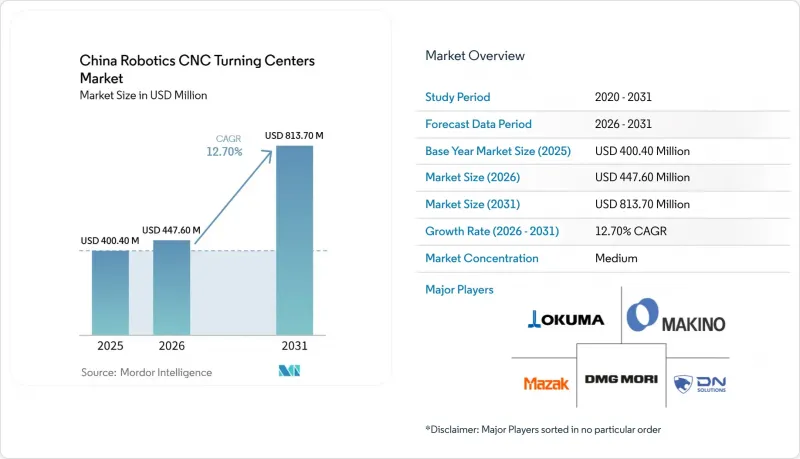
This report is Segmented by Machine Type (Horizontal Robotic Turning Centers, Vertical Robotic Turning Centers, and More), by Robot Type (Articulated Robots, and More), by Robot Integration Type (OEM, Retrofit/Aftermarket Robotic Automation), by End-User Industry (Oil, Gas, and Energy, Aerospace & Defense, and More), The Market Forecasts are Provided in Terms of Value (USD) and Volume (Units).
China Robotics CNC Turning Centers Market Trends and Insights
Made in China 2025 and Successive Industrial Policies Accelerating Robotic Manufacturing Automation
Industrial policy remains the clearest structural support for the China robotics CNC turning centers market. The Made in China 2025 program identified industrial robots as a priority technology area and set the tone for local component development, even though later policy frameworks largely absorbed its language and direction. The 15th Five-Year Plan for 2026 to 2030 now places robotics among eight strategic emerging industries and lists embodied intelligence among future industries, giving provincial and sector plans a clear signal to keep automation spending active. The 2025 AI plus manufacturing initiative also calls for AI agents in CNC machine tools and industrial robots, broadening the application range for robotic turning cells and supporting higher-value system configurations. This policy layering shortens adoption cycles, supports localization of key mechanical subsystems, and gives the China robotics CNC turning centers market a stronger demand floor than a purely cyclical capex market would normally have.
Rising Industrial Robot Density Accelerating Manufacturing Automation
Robot density is now a direct growth lever for the China robotics CNC turning centers market. China reached 567 robots per 10,000 manufacturing workers in 2024, ranked third globally, and built an operating stock of 2,027,000 units after installing 295,000 robots in that year alone. The metal and machinery sector, one of the closest end markets for robotic turning cells, recorded 54,600 installations in 2024, with Chinese suppliers accounting for 90% of those units and domestic installations rising 31% year over year. As robot adoption increases, customers increasingly judge systems by cell orchestration, predictive maintenance, and process software rather than arm hardware alone. That shift favors suppliers in the China robotics CNC turning centers market that can combine the robot, the CNC controller, and the software layer into a single integrated offering.
Dependence on Imported High-End Servo Systems, Controllers, and Precision Components
Imported high-end components remain a real constraint on the China robotics CNC turning centers market. The servo motors, gear reducers, and motion controllers account for close to 70% of an industrial robot's bill of materials, and the 15th Five-Year Plan directly identifies these areas as localization priorities. The same draft notes that localization improved in low to mid-range servo components by 2025, but high-end encoders, power semiconductors, and precision transmission parts still rely heavily on imports. That leaves turning-center builders exposed to exchange rate fluctuations, export controls, and component-level supply disruptions. It also creates technical lock-in because switching an installed design from one servo family to another often requires changes to the control architecture, revalidation, and customer requalification.
Other drivers and restraints analyzed in the detailed report include:
- Direct Government Subsidy Programs Lowering Automation Capex for Manufacturers
- New Energy Vehicle and EV Component Manufacturing Scaling Rapidly
- Intensifying Price Competition that Compresses Supplier Margins and Threatens Long-Term R&D Investment
For complete list of drivers and restraints, kindly check the Table Of Contents.
Segment Analysis
Horizontal robotic turning centers accounted for 49.21% of the China robotics CNC turning centers market in 2025. They remain the default choice for high-volume machining because gravity assists chip evacuation, workholding is straightforward for rotational parts, and gantry-style loading fits well with the layout. These strengths matter in automotive shafts, bearing rings, and EV motor housing programs where uptime and repeatability drive purchasing decisions. Vertical robotic turning centers still serve shorter, heavier disc or flange parts common in brake systems and in the production of heavy machinery.
The multi-tasking robotic turning centers segment is forecast to grow at a 13.52% CAGR from 2026 to 2031, which makes it the fastest-growing machine type in the China robotics CNC turning centers market. Its appeal lies in combining turning, milling, drilling, and grinding in a single setup, reducing transfers, cutting setup time, and lowering tolerance stacking in complex parts. That fits rising demand from NEV drivetrains and aerospace structural components, where part geometry and precision requirements are becoming harder to manage across separate machines. The China robotics CNC turning centers market is therefore moving toward systems that do more work within a single envelope, especially as AI-enabled CNC control becomes more relevant in multi-process sequences.
Articulated robots accounted for 57.61% of the China robotics CNC turning centers market share in 2025. They keep the largest position because they cover a broad payload range and because automotive and machinery integrators in China already have deep experience with their use in tending, loading, and transfer tasks. Gantry and Cartesian systems remain useful in dedicated transfer lines where linear motion, high payload handling, and repetitive travel paths matter more than arm flexibility. This keeps articulated robots in the leading role for scale, while other robot types grow around specific layout or cost needs.
Collaborative robots are projected to expand at a 14.78% CAGR from 2026 to 2031, making them the fastest-growing robot category in the China robotics CNC turning centers market. Cobot sales reached 49,500 units in China in 2025, and domestic manufacturers held close to 90% of the domestic cobot segment, indicating that local support and low system costs are widening adoption. Cobots matter in turning applications because they need less safety guarding and shorter programming cycles, which opens robotic tending to mid-tier job shops that could not justify full articulated automation before. The China robotics CNC turning centers market is seeing this shift most clearly, as smaller batch sizes, tighter labor availability, and lower capex budgets push customers toward simpler deployment economics.
Complete Report Scope:
- By Machine Type
- Horizontal Robotic Turning Centers
- Vertical Robotic Turning Centers
- Multi-Tasking Robotic Turning Centers
- Others
- By Robot Type
- Articulated Robots
- Collaborative Robots (Cobots)
- Gantry/Cartesian Robots
- By Robot Integration Type
- OEM-Integrated Robotic Turning Cells
- Retrofit/Aftermarket Robotic Automation
- By End-User Industry
- Automotive and Commercial Vehicles
- Aerospace & Defense
- Medical Devices and Surgical Instruments
- Oil, Gas, and Energy
- Electrical, Electronics and Semiconductor Equipment
- General Industrial Machinery
- Others
List of Companies Covered in this Report:
- DMG MORI Co., Ltd.
- Yamazaki Mazak Corporation
- Makino Milling Machine Co., Ltd.
- Okuma Corporation
- DN Solutions Co., Ltd.
- Hyundai WIA Corporation
- Tsugami Corporation
- Nakamura-Tome Precision Industry
- Shenyang Machine Tool Co., Ltd. (SMTCL)
- Dalian Machine Tool Group Co., Ltd. (DMTG)
- Qinchuan Machine Tool & Tool Group Co., Ltd.
- Haitian Precision Machinery Co., Ltd.
- FANUC Corporation
- ABB Ltd
- Yaskawa Electric Corporation
- KUKA AG
- Estun Automation Co., Ltd.
- Shenzhen Inovance Technology Co., Ltd.
- Siasun Robot & Automation Co., Ltd.
- Guangzhou CNC Equipment Co., Ltd. (GSK CNC)
Additional Benefits:
- The market estimate (ME) sheet in Excel format
- 3 months of analyst support
TABLE OF CONTENTS
1 Introduction
- 1.1 Study Assumptions & Market Definition
- 1.2 Scope of the Study
2 Research Methodology
3 Executive Summary
4 Market Landscape
- 4.1 Market Overview
- 4.2 Market Drivers
- 4.2.1 Made in China 2025 and Successive Industrial Policies Accelerating Robotic Manufacturing Automation
- 4.2.2 Rising Industrial Robot Density Accelerating Manufacturing Automation
- 4.2.3 Direct Government Subsidy Programs Lowering Automation Capex for Manufacturers
- 4.2.4 New Energy Vehicle and EV Component Manufacturing Scaling Rapidly
- 4.2.5 Aggressive Export Expansion by Chinese Robot Makers Building Global Credibility and Scale Economies
- 4.2.6 Ongoing Capacity Expansion by Domestic Robotics Manufacturers Supporting Long-Term Market Growth
- 4.3 Market Restraints
- 4.3.1 Dependence on Imported High-End Servo Systems, Controllers, and Precision Components
- 4.3.2 Intensifying Price Competition that Compresses Supplier Margins and Threatens Long-Term R&D Investment
- 4.3.3 Cyclical Sensitivity to Capital Expenditure in Manufacturing Sectors
- 4.3.4 Shortage of Skilled Robotics Integration and Maintenance Talent Despite High Adoption Rates
- 4.4 Value / Supply-Chain Analysis
- 4.4.1 Component & Raw Material Supply
- 4.4.2 Manufacturing & System Integration
- 4.4.3 Distribution & End-User Delivery
- 4.4.4 Aftermarket Services & Lifecycle Support
- 4.5 Regulatory Landscape
- 4.6 Technological Outlook
- 4.6.1 AI-Enabled Vision Guidance
- 4.6.2 Predictive Maintenance Integration
- 4.6.3 Digital Twin and Simulation Technologies
- 4.7 Automation Maturity Assessment by Industry
- 4.8 Digitalization Trends in CNC Machining
- 4.9 Investment and Procurement Models for Robotic CNC Turning Cells
- 4.10 Pricing Analysis
- 4.10.1 Average Selling Price (ASP) Benchmarking of Key Market Participants
- 4.10.2 Average Selling Price (ASP) Benchmarking by Automation Level
- 4.10.3 Average Selling Price (ASP) Benchmarking by Geography
- 4.11 Porter's Five Forces - Industry Attractiveness Scoring
- 4.11.1 Threat of New Entrants
- 4.11.2 Bargaining Power of Suppliers
- 4.11.3 Bargaining Power of Buyers
- 4.11.4 Threat of Substitutes
- 4.11.5 Industry Rivalry
- 4.12 Industry Case Studies
- 4.13 Impact of Geopolitical Events on the Market
5 Market Size & Growth Forecasts
- 5.1 By Machine Type
- 5.1.1 Horizontal Robotic Turning Centers
- 5.1.2 Vertical Robotic Turning Centers
- 5.1.3 Multi-Tasking Robotic Turning Centers
- 5.1.4 Others
- 5.2 By Robot Type
- 5.2.1 Articulated Robots
- 5.2.2 Collaborative Robots (Cobots)
- 5.2.3 Gantry/Cartesian Robots
- 5.3 By Robot Integration Type
- 5.3.1 OEM-Integrated Robotic Turning Cells
- 5.3.2 Retrofit/Aftermarket Robotic Automation
- 5.4 By End-User Industry
- 5.4.1 Automotive and Commercial Vehicles
- 5.4.2 Aerospace & Defense
- 5.4.3 Medical Devices and Surgical Instruments
- 5.4.4 Oil, Gas, and Energy
- 5.4.5 Electrical, Electronics and Semiconductor Equipment
- 5.4.6 General Industrial Machinery
- 5.4.7 Others
6 Competitive Landscape
- 6.1 Market Concentration
- 6.2 Strategic Moves
- 6.3 Market Share Analysis
- 6.4 Competitive Technology Benchmarking
- 6.5 Company Profiles (Includes Global Level Overview, Market Level Overview, Core Segments, Financials as Available, Strategic Information, Products & Services, and Recent Developments)
- 6.5.1 DMG MORI Co., Ltd.
- 6.5.2 Yamazaki Mazak Corporation
- 6.5.3 Makino Milling Machine Co., Ltd.
- 6.5.4 Okuma Corporation
- 6.5.5 DN Solutions Co., Ltd.
- 6.5.6 Hyundai WIA Corporation
- 6.5.7 Tsugami Corporation
- 6.5.8 Nakamura-Tome Precision Industry
- 6.5.9 Shenyang Machine Tool Co., Ltd. (SMTCL)
- 6.5.10 Dalian Machine Tool Group Co., Ltd. (DMTG)
- 6.5.11 Qinchuan Machine Tool & Tool Group Co., Ltd.
- 6.5.12 Haitian Precision Machinery Co., Ltd.
- 6.5.13 FANUC Corporation
- 6.5.14 ABB Ltd
- 6.5.15 Yaskawa Electric Corporation
- 6.5.16 KUKA AG
- 6.5.17 Estun Automation Co., Ltd.
- 6.5.18 Shenzhen Inovance Technology Co., Ltd.
- 6.5.19 Siasun Robot & Automation Co., Ltd.
- 6.5.20 Guangzhou CNC Equipment Co., Ltd. (GSK CNC)
7 Market Opportunities & Future Outlook
- 7.1 White-Space & Unmet-Need Assessment

