
PUBLISHER: Mordor Intelligence | PRODUCT CODE: 2099481

PUBLISHER: Mordor Intelligence | PRODUCT CODE: 2099481
Atipamezole - Market Share Analysis, Industry Trends & Statistics, Growth Forecasts (2026 - 2031)
According to Mordor Intelligence, the atipamezole market size is projected to be USD 126.98 million in 2025, USD 134.75 million in 2026, and reach USD 194.27 million by 2031, growing at a CAGR of 7.59% from 2026 to 2031.
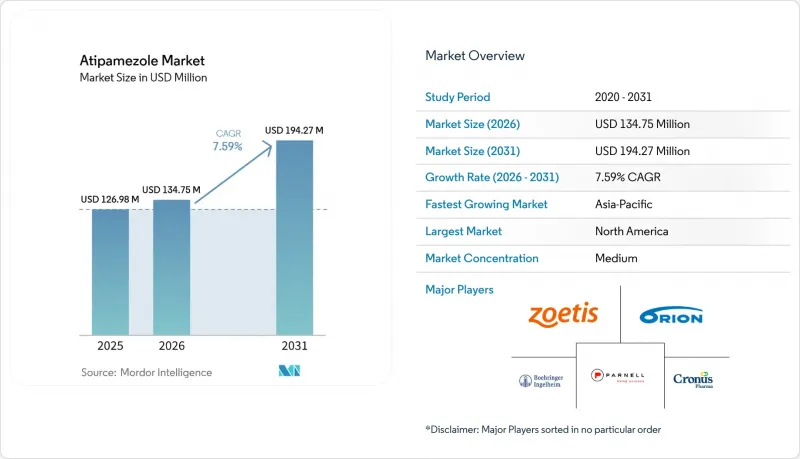
This report is Segmented by Product Form (Injectable Solution, Prefilled Syringe, and More), Route of Administration (Intramuscular, Intravenous, Subcutaneous), Animal Type (Dogs, Cats, Horses, and More), Application (Veterinary Sedation Reversal, and More), End User (Veterinary Clinics, and More), Distribution Channel (Direct Sales, and More), and Geography. Forecasts are Provided in Terms of Value (USD).
Global Atipamezole Market Trends and Insights
Rising Companion Animal Sedation Reversal Demand
Companion animal ownership kept rising in the United States in 2025, with 95 million households owning pets, dog ownership at 53% of households, and cat ownership reaching 39% after a 5% year-over-year increase. That larger pet base increases the number of animals moving through preventive care, diagnostics, and elective procedures where sedation is commonly used. The pattern is reinforced by access to care, because 83.4% of U.S. pet owners reported having a regular veterinarian in 2025, which supports recurring procedure volumes across routine practice. Spending patterns also matter, as dog owners spent an average of USD 598 on veterinary care in 2025, which signals continued willingness to pay for controlled and reversible anesthesia plans. The atipamezole market benefits directly because approved use is tied to medetomidine and exmedetomidine reversal, so higher use of those sedatives lifts follow-on demand for atipamezole.
Expansion of Veterinary Surgical Throughput
The atipamezole market is supported by the rising need to move sedated patients through surgery and recovery with less delay in busy clinics. Recovery speed matters because the product information shows that improvement begins quickly after dosing, with animals typically recovering in minutes and regaining mobility within a short period. That shorter recovery window frees cage space, staff time, and observation capacity, which makes reversible sedation more attractive in clinics handling several anesthetic cases each day. The benefit is not limited to efficiency, because a more predictable return from sedation also supports patient monitoring and helps clinics manage peri-anesthetic risk more consistently. As surgical throughput rises in urban veterinary networks, the atipamezole market should continue to gain from its role in closing the procedure cycle with a faster recovery path.
Narrow Species And Indication Dependence
The atipamezole market remains limited by the drug's narrow approved role, because commercial use is still tied mainly to reversal of medetomidine and dexmedetomidine in dogs and cats. U.S. and European product labels show that this is not a broad-spectrum anesthetic product, but a specific reversal agent with clear species and indication boundaries. Off-label use in other species exists, and recent research confirms continuing use in laboratory animals, but that volume remains much smaller than the core companion animal base. The atipamezole market is therefore highly dependent on the continued place of alpha-2 agonists in routine sedation protocols. If clinicians shift more procedures toward other anesthetic pathways that avoid medetomidine or dexmedetomidine, demand for atipamezole falls at the same time.
Other drivers and restraints analyzed in the detailed report include:
- Higher Protocol Standardization in Small Animal Clinics
- Growth in Pre-Measured Veterinary Drug Formats
- Stringent Veterinary Drug Approval And Labeling Requirements
For complete list of drivers and restraints, kindly check the Table Of Contents.
Segment Analysis
Injectable solutions held 62.43% of the atipamezole market share in 2025, reflecting their long-established role as the standard commercial format in veterinary use. This lead comes from regulatory familiarity, routine clinic stocking, and the fact that approved products are positioned around sterile injectable use rather than alternative oral or transdermal options.
The atipamezole market size for compounded injectable formulations is projected to expand at an 8.42% CAGR through 2031, making this the fastest-growing product form in the segment. That growth is tied to clearer U.S. compounding rules after the August 2024 FDA update to GFI #256, which gives veterinary compounders more defined operating conditions for office-stock and patient-specific use when medical need is met.
Intramuscular administration held 65.76% of 2025 revenue, which reflects the fact that approved product labeling consistently centers on intramuscular reversal after sedation. This route remains dominant because it is the labeled standard in major markets and is embedded in routine anesthesia guidance for dogs and cats.
The atipamezole market size for intravenous administration is projected to rise at 8.45% CAGR through 2031, making it the fastest-growing route segment. Growth here is linked to referral hospitals and critical care settings, where clinicians may need quicker or more controlled reversal during acute post-anesthetic management. Product information from Zoetis also shows that response can begin quickly after dosing, which supports the logic for closer route optimization in high-acuity settings.
Complete Report Scope:
- By Product Form
- Injectable Solution
- Prefilled Syringe
- Multi-Dose Vial
- Compounded Injectable Formulations
- By Route of Administration
- Intramuscular
- Intravenous
- Subcutaneous
- By Animal Type
- Dogs
- Cats
- Horses
- Exotic and Zoo Animals
- Others (Cattle, Sheep, Goats, etc.)
- By Application
- Veterinary Sedation Reversal
- Research and Experimental Use
- Diagnostic and Imaging Support
- Emergency and Post-Procedural Recovery
- By End User
- Veterinary Clinics
- Veterinary Hospitals
- Research Institutes
- Other End Users
- By Distribution Channel
- Direct Sales
- Veterinary Pharmacies
- Online Pharmacies
- Other Distribution Channels
- By Geography
- North America
- United States
- Canada
- Mexico
- Europe
- Germany
- United Kingdom
- France
- Italy
- Spain
- Rest of Europe
- Asia-Pacific
- China
- India
- Japan
- Australia
- South Korea
- Rest of Asia-Pacific
- Middle East and Africa
- GCC
- South Africa
- Rest of Middle East and Africa
- South America
- Brazil
- Argentina
- Rest of South America
- North America
Geography Analysis
North America held 37.45% of the Atipamezole market share in 2025, making it the largest regional contributor. The region leads because veterinary infrastructure is well developed, per-pet healthcare spending is high, and reversible sedation protocols are widely established in companion animal practice. In the United States, 83.4% of pet owners had a regular veterinarian in 2025, while dog owners spent an average of USD 598 on veterinary care, which supports steady procedural demand and repeat drug use. Europe remains a strong regional block for the Atipamezole market because multiple locally authorized products compete across national markets under a harmonized regulatory structure.
Asia-Pacific is projected to record the fastest 8.73% CAGR through 2031, making it the fastest-growing regional segment in the Atipamezole market. Growth there is tied to urbanization, higher disposable income, and expansion of private veterinary clinics, all of which raise the number of companion animals moving into formal sedation and recovery pathways. Japan offers a premium but tightly regulated market, while China, India, and South Korea provide stronger volume upside as clinic networks and pet care spending continue to deepen.
- Bimeda Holdings plc
- Bioveta, a.s.
- Boehringer Ingelheim
- Ceva
- Chanelle Pharma Group
- Cronus Pharma LLC
- Dechra Pharmaceuticals Limited
- HIPRA S.A.
- Huvepharma
- Laboratorios Calier, S.A.
- Merck
- Norbrook Laboratories Ltd.
- Orion
- Parnell Pharmaceuticals Holdings Ltd.
- ProDivet Pharmaceuticals SA/NV
- Vetoquinol
- Vetpharma Animal Health, S.L.
- Virbac
- Zoetis
Additional Benefits:
- The market estimate (ME) sheet in Excel format
- 3 months of analyst support
TABLE OF CONTENTS
1 Introduction
- 1.1 Study Assumptions & Market Definition
- 1.2 Scope of the Study
2 Research Methodology
3 Executive Summary
4 Market Landscape
- 4.1 Market Overview
- 4.2 Market Drivers
- 4.2.1 Rising Companion Animal Sedation Reversal Demand
- 4.2.2 Expansion of Veterinary Surgical Throughput
- 4.2.3 Higher Protocol Standardization in Small Animal Clinics
- 4.2.4 Growth in Pre-Measured Veterinary Drug Formats
- 4.2.5 Wider Use in Research and Laboratory Animal Protocols
- 4.2.6 Faster Clinic Turnaround From Rapid Recovery Agents
- 4.3 Market Restraints
- 4.3.1 Narrow Species and Indication Dependence
- 4.3.2 Stringent Veterinary Drug Approval and Labeling Requirements
- 4.3.3 Competitive Pressure From Alternative Sedation Regimens
- 4.3.4 Limited Awareness in Small and Mid-Tier Veterinary Practices
- 4.4 Supply-Chain Analysis
- 4.5 Regulatory Landscape
- 4.6 Porter's Five Forces
- 4.6.1 Threat of New Entrants
- 4.6.2 Bargaining Power of Suppliers
- 4.6.3 Bargaining Power of Buyers
- 4.6.4 Threat of Substitutes
- 4.6.5 Industry Rivalry
5 Market Size & Growth Forecasts (Value, USD)
- 5.1 By Product Form
- 5.1.1 Injectable Solution
- 5.1.2 Prefilled Syringe
- 5.1.3 Multi-Dose Vial
- 5.1.4 Compounded Injectable Formulations
- 5.2 By Route of Administration
- 5.2.1 Intramuscular
- 5.2.2 Intravenous
- 5.2.3 Subcutaneous
- 5.3 By Animal Type
- 5.3.1 Dogs
- 5.3.2 Cats
- 5.3.3 Horses
- 5.3.4 Exotic and Zoo Animals
- 5.3.5 Others (Cattle, Sheep, Goats, etc.)
- 5.4 By Application
- 5.4.1 Veterinary Sedation Reversal
- 5.4.2 Research and Experimental Use
- 5.4.3 Diagnostic and Imaging Support
- 5.4.4 Emergency and Post-Procedural Recovery
- 5.5 By End User
- 5.5.1 Veterinary Clinics
- 5.5.2 Veterinary Hospitals
- 5.5.3 Research Institutes
- 5.5.4 Other End Users
- 5.6 By Distribution Channel
- 5.6.1 Direct Sales
- 5.6.2 Veterinary Pharmacies
- 5.6.3 Online Pharmacies
- 5.6.4 Other Distribution Channels
- 5.7 By Geography
- 5.7.1 North America
- 5.7.1.1 United States
- 5.7.1.2 Canada
- 5.7.1.3 Mexico
- 5.7.2 Europe
- 5.7.2.1 Germany
- 5.7.2.2 United Kingdom
- 5.7.2.3 France
- 5.7.2.4 Italy
- 5.7.2.5 Spain
- 5.7.2.6 Rest of Europe
- 5.7.3 Asia-Pacific
- 5.7.3.1 China
- 5.7.3.2 India
- 5.7.3.3 Japan
- 5.7.3.4 Australia
- 5.7.3.5 South Korea
- 5.7.3.6 Rest of Asia-Pacific
- 5.7.4 Middle East and Africa
- 5.7.4.1 GCC
- 5.7.4.2 South Africa
- 5.7.4.3 Rest of Middle East and Africa
- 5.7.5 South America
- 5.7.5.1 Brazil
- 5.7.5.2 Argentina
- 5.7.5.3 Rest of South America
- 5.7.1 North America
6 Competitive Landscape
- 6.1 Market Concentration
- 6.2 Market Share Analysis
- 6.3 Company Profiles {(includes Global level Overview, Market level overview, Core Segments, Financials as available, Strategic Information, Market Rank/Share for key companies, Products & Services, and Recent Developments)}
- 6.3.1 Bimeda Holdings plc
- 6.3.2 Bioveta, a.s.
- 6.3.3 Boehringer Ingelheim International GmbH
- 6.3.4 Ceva
- 6.3.5 Chanelle Pharma Group
- 6.3.6 Cronus Pharma LLC
- 6.3.7 Dechra Pharmaceuticals Limited
- 6.3.8 HIPRA S.A.
- 6.3.9 Huvepharma
- 6.3.10 Laboratorios Calier, S.A.
- 6.3.11 Merck Animal Health
- 6.3.12 Norbrook Laboratories Ltd.
- 6.3.13 Orion Corporation
- 6.3.14 Parnell Pharmaceuticals Holdings Ltd.
- 6.3.15 ProDivet Pharmaceuticals SA/NV
- 6.3.16 Vetoquinol S.A.
- 6.3.17 Vetpharma Animal Health, S.L.
- 6.3.18 Virbac
- 6.3.19 Zoetis Inc.
7 Market Opportunities & Future Outlook
- 7.1 White-space & unmet-need assessment

