PUBLISHER: Mordor Intelligence | PRODUCT CODE: 2099484

PUBLISHER: Mordor Intelligence | PRODUCT CODE: 2099484
United States Air Freight Ancillary Services - Market Share Analysis, Industry Trends & Statistics, Growth Forecasts (2026 - 2031)
According to Mordor Intelligence, the United States air freight ancillary services market was valued at USD 29.28 billion in 2025 and is estimated to grow from USD 31.38 billion in 2026 to reach USD 43.69 billion by 2031, at a CAGR of 6.84% during the forecast period 2026-2031.
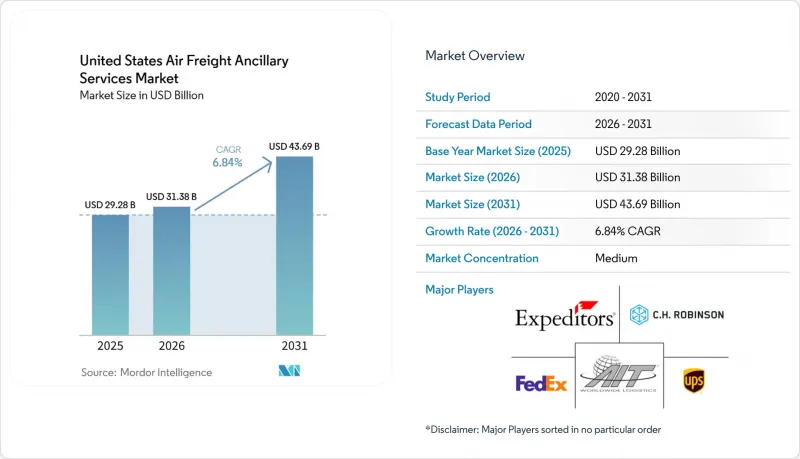
The United States air freight ancillary services market is being shaped by tighter pharmaceutical handling requirements, deeper shipper demand for integrated door-to-door execution, and a broader shift toward bundled logistics services rather than stand-alone freight moves. This report is Segmented by Service Type (Cargo Handling, Packaging and Labeling, and More), by Shipment Type (Domestic and International), by Industry Vertical (Fashion and Luxury Goods, E-Commerce and Retail, Consumer Electronics, Food and Beverages, and More), and by Region (Northeast, Southeast, Midwest, Southwest, and West). The Market Forecasts are Provided in Terms of Value (USD).
United States Air Freight Ancillary Services Market Trends and Insights
Pharmaceutical Cold Chain Compliance Reshapes Ancillary Revenue Structures
The United States air freight ancillary services market is seeing cold-chain compliance move from a specialist function to a core operating requirement for providers serving healthcare cargo. FDA good distribution requirements and IATA CEIV Pharma standards are pushing operators to maintain documented temperature integrity at each transfer point, turning handling, packaging, and monitoring into contract-critical service lines. This shift matters because the value of the shipment is now tied not only to speed, but also to proof that conditions remained within approved ranges throughout the warehouse, ramp, and handoff activities. GEODIS reinforced this direction in October 2025, when it opened a dedicated healthcare cold-chain cross-docking facility in Chicago with dual-zone, temperature-controlled storage near O'Hare International Airport. As a result, the United States air freight ancillary services market is directing a larger share of premium revenue toward operators with certified facilities, documented processes, and stronger temperature-control discipline.
E-Commerce Parcel Consolidation Demand Drives New Ancillary Bundling Models
The United States air freight ancillary services market is also supported by a shift away from simpler, low-value parcel structures toward more consolidated, document-heavy shipment flows. That shift is increasing the value of packaging, labeling, customs support, cargo handling, and consolidated forwarding because these steps now determine whether parcel-heavy cargo can move without delay. The operational result is that providers are trying to bundle more tasks into one managed transaction rather than leaving packaging, customs, and forwarding to separate specialists. This favors platforms and forwarders that can reduce handoffs, maintain invoice clarity, and support faster exception handling across international lanes. In the United States air freight ancillary services market, this trend is elevating the role of bundled parcel handling, even as freight growth is not evenly distributed across all shipment categories.
Fuel Surcharges and Rate Volatility Erode Ancillary Margin Predictability
The United States air freight ancillary services market remains exposed to fuel-linked pricing swings because ancillary contracts often sit atop transport costs that change faster than service fees can be reset. Time-critical shipments usually depend on packaging, handling, insurance, and documentation bundles sold under service commitments, but the transport leg can be subject to weekly surcharge changes. That mismatch makes forward pricing harder and weakens margin visibility for providers supporting healthcare, aerospace, and premium electronics cargo. C.H. Robinson noted in April 2026 that tankering remained a scenario risk on selected long-haul routes, which means aircraft may carry extra fuel to avoid costly stops and leave less room for paying cargo. In the United States air freight ancillary services market, that combination of unstable transport cost and reduced payload can disrupt both contracted volumes and labor planning on sensitive lanes.
Other drivers and restraints analyzed in the detailed report include:
- Nearshoring-Led United States-Mexico Corridor Reconfiguration Creates New Ancillary Demand Pools
- Real-Time Cargo Visibility and Chain-of-Custody Expectations Accelerate Technology Investment
- Capacity Constraints in Peak-Lane and Belly-Hold Networks Limit Ancillary Throughput
For complete list of drivers and restraints, kindly check the Table Of Contents.
Segment Analysis
Temperature-controlled services held 45.02% of the United States air freight ancillary services market share in 2025, and this segment is also projected to expand at 8.21% CAGR through 2031. That lead reflects the way healthcare cargo has shifted service value away from basic uplift and toward validated handling, monitored storage, and documented handoffs. In the United States air freight ancillary services market, cold-chain services now have greater pricing power because the operational risk of a temperature break is far higher than that associated with standard general cargo. This makes certified rooms, trained staff, packaging controls, and transfer discipline more important than simple warehouse space.
Cargo handling and cargo consolidation services remain the next-largest revenue streams because large parcel and retail flows still require sorting, build-up, unitization, and export preparation before uplift. Packaging and labeling also remain stable contributors, but the work is becoming more demanding in sensitive categories such as batteries and regulated electronics. IATA's 2026 lithium battery guidance increased the documentation and labeling burden for battery-powered goods, which supports the pricing of specialized packaging and acceptance support.
Complete Report Scope:
- By Service Type
- Cargo Handling Services
- Cargo Consolidation Services
- Packaging and Labeling Services
- Cargo Insurance Services
- Temperature-Controlled (Cold Chain) Services
- Other Services
- By Shipment Type
- Domestic Shipments
- International Shipments
- By Industry Vertical
- Aerospace and Defense
- Consumer Electronics
- Automotive and Industrial Manufacturing
- E-commerce and Retail
- Healthcare and Technology
- Food and Beverage (Perishables)
- Chemicals and Hazardous Materials
- Fashion and Luxury Goods
- Others
- By Region
- Northeast
- Southeast
- Midwest
- Southwest
- West
List of Companies Covered in this Report:
- Expeditors International of Washington, Inc.
- C.H. Robinson Worldwide, Inc.
- FedEx
- UPS
- AIT Worldwide Logistics, Inc.
- Radiant Logistics, Inc.
- Pilot Freight Services
- SEKO Logistics
- BDP International, Inc.
- Worldwide Express Operations, LLC
- GEODIS USA, Inc.
- Kuehne + Nagel
- DHL
- DSV (including DB Schenker)
- Nippon Express
- Flexport, Inc.
- Crane Worldwide Logistics
- CEVA Logistics
- Scan Global Logistics USA
- Airgroup Corporation
- OEC Group
- JAS Forwarding (USA), Inc.
Additional Benefits:
- The market estimate (ME) sheet in Excel format
- 3 months of analyst support
TABLE OF CONTENTS
1 Introduction
- 1.1 Study Assumptions and Market Definition
- 1.2 Scope of the Study
2 Research Methodology
3 Executive Summary
4 Market Landscape
- 4.1 Market Overview and Role of Ancillary Services in Air Freight Economics
- 4.2 Market Drivers
- 4.2.1 E-Commerce Parcel Consolidation Demand
- 4.2.2 Pharmaceutical Cold Chain Compliance Needs
- 4.2.3 Higher Demand for Single-Invoice Door-to-Door Solutions
- 4.2.4 Real-Time Cargo Visibility and Chain-of-Custody Expectations
- 4.2.5 Nearshoring-Led US-Mexico Air Cargo Reconfiguration
- 4.2.6 Specialized Handling Demand for High-Value Electronics and Batteries
- 4.3 Market Restraints
- 4.3.1 Fuel Surcharges and Rate Volatility in Time-Critical Shipments
- 4.3.2 Capacity Constraints in Peak-Lane and Belly-Hold Networks
- 4.3.3 High Compliance Burden for Temperature-Controlled and Dangerous Goods Flows
- 4.3.4 Labor Dependence and Facility Throughput Bottlenecks at Major Cargo Hubs
- 4.4 Regulatory Framework
- 4.5 Value Chain and Distribution Channel Architecture Analysis
- 4.6 Technology Innovations Outlook
- 4.7 Porter's Five Forces Analysis
- 4.7.1 Threat of New Entrants
- 4.7.2 Bargaining Power of Suppliers
- 4.7.3 Bargaining Power of Buyers
- 4.7.4 Threat of Substitutes
- 4.7.5 Rivalry Among Competitors
- 4.8 Evolution of the Air Freight Ancillary Services
- 4.9 Impact of Geo-Political Events on Supply Chain Shifts
5 Market Size and Growth Forecasts (Value, 2026-2031)
- 5.1 By Service Type
- 5.1.1 Cargo Handling Services
- 5.1.2 Cargo Consolidation Services
- 5.1.3 Packaging and Labeling Services
- 5.1.4 Cargo Insurance Services
- 5.1.5 Temperature-Controlled (Cold Chain) Services
- 5.1.6 Other Services
- 5.2 By Shipment Type
- 5.2.1 Domestic Shipments
- 5.2.2 International Shipments
- 5.3 By Industry Vertical
- 5.3.1 Aerospace and Defense
- 5.3.2 Consumer Electronics
- 5.3.3 Automotive and Industrial Manufacturing
- 5.3.4 E-commerce and Retail
- 5.3.5 Healthcare and Technology
- 5.3.6 Food and Beverage (Perishables)
- 5.3.7 Chemicals and Hazardous Materials
- 5.3.8 Fashion and Luxury Goods
- 5.3.9 Others
- 5.4 By Region
- 5.4.1 Northeast
- 5.4.2 Southeast
- 5.4.3 Midwest
- 5.4.4 Southwest
- 5.4.5 West
6 Competitive Landscape
- 6.1 Market Concentration
- 6.2 Key Strategic Moves
- 6.3 Market Share Analysis
- 6.4 Company Profiles (includes Global level Overview, Market level overview, Core Segments, Financials as available, Strategic Information, Market Rank/Share for key companies, Products & Services, and Recent Developments)
- 6.4.1 Expeditors International of Washington, Inc.
- 6.4.2 C.H. Robinson Worldwide, Inc.
- 6.4.3 FedEx
- 6.4.4 UPS
- 6.4.5 AIT Worldwide Logistics, Inc.
- 6.4.6 Radiant Logistics, Inc.
- 6.4.7 Pilot Freight Services
- 6.4.8 SEKO Logistics
- 6.4.9 BDP International, Inc.
- 6.4.10 Worldwide Express Operations, LLC
- 6.4.11 GEODIS USA, Inc.
- 6.4.12 Kuehne + Nagel
- 6.4.13 DHL
- 6.4.14 DSV (including DB Schenker)
- 6.4.15 Nippon Express
- 6.4.16 Flexport, Inc.
- 6.4.17 Crane Worldwide Logistics
- 6.4.18 CEVA Logistics
- 6.4.19 Scan Global Logistics USA
- 6.4.20 Airgroup Corporation
- 6.4.21 OEC Group
- 6.4.22 JAS Forwarding (USA), Inc.
7 Market Opportunities and Future Outlook
- 7.1 White-space and Unmet-Need Assessment

