PUBLISHER: Mordor Intelligence | PRODUCT CODE: 2099494

PUBLISHER: Mordor Intelligence | PRODUCT CODE: 2099494
EMEA Industrial Fats - Market Share Analysis, Industry Trends & Statistics, Growth Forecasts (2026 - 2031)
According to Mordor Intelligence, the EMEA industrial fats market size was valued at USD 58.81 billion in 2025 and is estimated to grow from USD 61.29 billion in 2026 to reach USD 79.08 billion by 2031, at a CAGR of 5.23% during the forecast period (2026-2031).
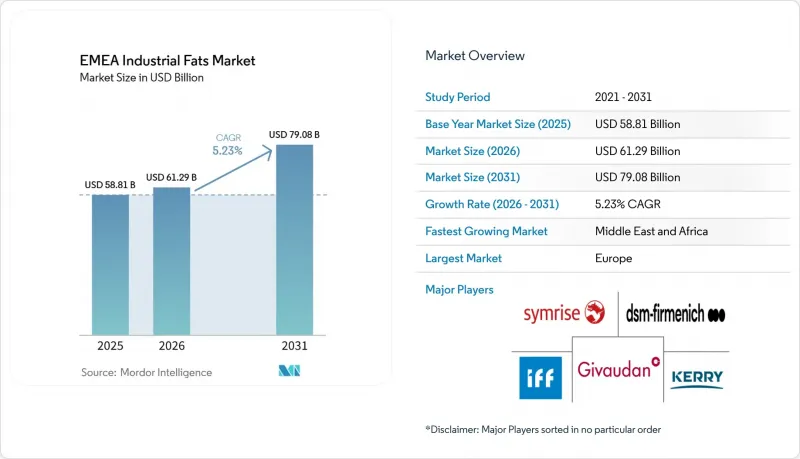
This report is Segmented by Product Type (Specialty Fats, Hydrogenated Fats, and More), Source (Plant-Based and Animal-Based), Form (Liquid, Semi-Solid, and Solid), Application (Food Processing, Biodiesel, and More), and Geography (Europe and Middle East and Africa). The Market Forecasts are Provided in Value (USD).
EMEA Industrial Fats Market Trends and Insights
Growth in biodiesel and renewable fuel production
The expanding production of biodiesel and other renewable fuels is a major driver of the EMEA industrial fats market, as industrial fats serve as key feedstocks for biofuel manufacturing. Growing investments in renewable fuel production facilities and the increasing adoption of bio-based feedstocks are driving demand for vegetable- and animal-derived industrial fats with suitable conversion characteristics. Advancements in feedstock processing and fuel production technologies are improving conversion efficiency and expanding the use of industrial fats in renewable energy applications. For instance, according to the European Biodiesel Board, total EU-27 biodiesel and bioSAF production increased to 14.7 million metric tonnes in 2025, reflecting the continued expansion of renewable fuel manufacturing capacity across the region . This growth in renewable fuel production is expected to strengthen long-term demand for industrial fats across the EMEA market.
Increasing demand for sustainable and certified vegetable oils
The growing preference for sustainably sourced and certified vegetable oils is driving the EMEA industrial fats market, as industrial manufacturers increasingly prioritize traceable raw materials that comply with environmental and sustainability requirements. Certified vegetable oils support responsible sourcing practices, enhance supply chain transparency, and help manufacturers meet evolving customer and regulatory expectations. This trend is encouraging producers to expand certified sourcing programs, strengthen traceability systems, and invest in sustainable refining and processing capabilities. For instance, FEDIOL, the EU vegetable oil and proteinmeal industry association, promotes responsible sourcing initiatives and supports the increased adoption of certified sustainable vegetable oils across the European vegetable oil value chain, reinforcing the transition toward sustainably produced industrial fats throughout the EMEA region.
Volatility in vegetable oil raw material supply
Fluctuations in the availability of vegetable oil feedstocks act as a significant restraint on the EMEA industrial fats market by creating uncertainty in raw material procurement and production planning. Industrial fats rely heavily on oils such as palm, sunflower, rapeseed, and soybean, making manufacturers vulnerable to supply disruptions caused by adverse weather conditions, crop diseases, geopolitical tensions, export restrictions, and logistics bottlenecks. Inconsistent raw material availability can affect production schedules, reduce operational efficiency, and increase the complexity of maintaining consistent product quality and long-term supply commitments. During periods of constrained supply, manufacturers may also face challenges in sourcing certified and traceable feedstocks, requiring alternative sourcing strategies or reformulation efforts that can further impact manufacturing efficiency and product consistency.
Other drivers and restraints analyzed in the detailed report include:
- Demand for processed and convenience foods
- Growth in plant-based and vegan food manufacturing
- Stringent regulations on fat composition and food safety
For complete list of drivers and restraints, kindly check the Table Of Contents.
Segment Analysis
Specialty industrial fats held a 38.41% share of the EMEA industrial fats market in 2025, driven by their ability to deliver precise functional performance that conventional fats cannot consistently achieve. Manufacturers increasingly require fats with controlled melting behavior, oxidative stability, crystallization characteristics, viscosity, and thermal resistance to support standardized production processes and stringent product quality requirements. Continuous advancements in fractionation, interesterification, and lipid modification technologies have enabled the development of tailor-made fat systems with enhanced consistency, purity, and processing efficiency, allowing manufacturers to optimize production while minimizing formulation variability.
Fractionated fats are projected to register the fastest growth at a CAGR of 6.56% through 2031, driven by increasing demand for highly functional fat ingredients with consistent physical and chemical properties. Advances in dry and solvent fractionation technologies have enabled manufacturers to produce fats with precise melting profiles, improved crystallization behavior, enhanced oxidative stability, and superior processing performance without extensive chemical modification. These characteristics make fractionated fats increasingly attractive for manufacturers seeking greater formulation accuracy, product consistency, and production efficiency. Rising emphasis on clean-label formulations and reduced reliance on hydrogenation has further accelerated the adoption of naturally fractionated fats, as they offer targeted functionality while preserving the intrinsic properties of the original oil.
Plant-based sources accounted for 83.23% of the EMEA industrial fats market in 2025, owing to their broad availability, versatile functionality, and compatibility with modern industrial processing requirements. These feedstocks offer consistent quality, predictable fatty acid composition, and strong adaptability to refining, fractionation, blending, and interesterification processes, enabling manufacturers to produce fats with specific physical and performance characteristics. Their scalability and ability to support standardized production have made them the preferred raw material for large-volume industrial operations that require uniformity across manufacturing batches. Ongoing innovation in oil modification technologies has further improved the thermal stability, oxidative resistance, crystallization behavior, and storage performance of plant-derived fats, expanding their suitability for demanding industrial applications.
Animal-based fats are projected to register the fastest growth at a CAGR of 6.91% through 2031, driven by increasing efforts to maximize the value of by-products generated from livestock processing and strengthen circular economy practices across industrial value chains. Advances in rendering technologies, purification methods, and quality control systems have improved the consistency, safety, and industrial performance of animal-derived fats, making them more suitable for high-value manufacturing applications. Their high energy density, favorable lubrication characteristics, and unique fatty acid composition offer functional advantages that are difficult to replicate with some alternative feedstocks. Rising emphasis on resource efficiency and waste reduction is also encouraging greater utilization of animal-derived materials as industrial inputs rather than disposal streams.
Complete Report Scope:
- By Product Type
- Specialty Fats
- Hydrogenated Fats
- Fractionated Fats
- Blended Fats
- Others
- By Source
- Plant-Based
- Animal-Based
- By Form
- Liquid
- Semi-Solid
- Solid
- By Application
- Food Processing
- Biodiesel
- Oleochemicals
- Surfactants and Detergents
- Lubricants and Greases
- Cosmetics and Personal Care
- Animal Feed
- Pharmaceuticals
- By Geography
- Europe
- United Kingdom
- Germany
- France
- Italy
- Spain
- Netherlands
- Poland
- Belgium
- Sweden
- Rest of Europe
- Middle East and Africa
- South Africa
- Saudi Arabia
- United Arab Emirates
- Nigeria
- Egypt
- Morocco
- Turkey
- Rest of Middle East and Africa
- Europe
List of Companies Covered in this Report:
- Cargill, Incorporated
- Archer Daniels Midland Company
- Bunge Limited
- Wilmar International Limited
- AAK AB
- Fuji Oil Holdings Inc.
- Olam Group Limited
- Louis Dreyfus Company B.V.
- IOI Corporation Berhad
- Sime Darby Plantation Berhad
- Kuala Lumpur Kepong Berhad
- Mewah International Inc.
- Associated British Foods plc
- J-Oil Mills, Inc.
- Kerry Group plc
- Viterra Limited
- COFCO International Limited
- Marico Limited
- Richardson International Limited
- Musim Mas Holdings Pte. Ltd.
Additional Benefits:
- The market estimate (ME) sheet in Excel format
- 3 months of analyst support
TABLE OF CONTENTS
1 INTRODUCTION
- 1.1 Study Assumptions and Market Definition
- 1.2 Scope of the Study
2 RESEARCH METHODOLOGY
3 EXECUTIVE SUMMARY
4 MARKET LANDSCAPE
- 4.1 Market Overview
- 4.2 Market Drivers
- 4.2.1 Growth in biodiesel and renewable fuel production
- 4.2.2 Increasing demand for sustainable and certified vegetable oils
- 4.2.3 Demand for processed and convenience foods
- 4.2.4 Growth in plant-based and vegan food manufacturing
- 4.2.5 Shift toward trans-fat-free and reformulated products
- 4.2.6 Advancements in food processing technologies
- 4.3 Market Restraints
- 4.3.1 Volatility in vegetable oil raw material supply
- 4.3.2 Stringent regulations on fat composition and food safety
- 4.3.3 Functional limitations of alternative fat ingredients
- 4.3.4 Supply chain disruptions affecting specialty fat ingredients
- 4.4 Supply Chain Analysis
- 4.5 Regulatory Landscape
- 4.6 Technological Outlook
- 4.7 Porter's Five Forces Analysis
- 4.7.1 Threat of New Entrants
- 4.7.2 Bargaining Power of Buyers
- 4.7.3 Bargaining Power of Suppliers
- 4.7.4 Threat of Substitutes
- 4.7.5 Intensity of Competitive Rivalry
5 MARKET SIZE AND GROWTH FORECASTS (VALUE)
- 5.1 By Product Type
- 5.1.1 Specialty Fats
- 5.1.2 Hydrogenated Fats
- 5.1.3 Fractionated Fats
- 5.1.4 Blended Fats
- 5.1.5 Others
- 5.2 By Source
- 5.2.1 Plant-Based
- 5.2.2 Animal-Based
- 5.3 By Form
- 5.3.1 Liquid
- 5.3.2 Semi-Solid
- 5.3.3 Solid
- 5.4 By Application
- 5.4.1 Food Processing
- 5.4.2 Biodiesel
- 5.4.3 Oleochemicals
- 5.4.4 Surfactants and Detergents
- 5.4.5 Lubricants and Greases
- 5.4.6 Cosmetics and Personal Care
- 5.4.7 Animal Feed
- 5.4.8 Pharmaceuticals
- 5.5 By Geography
- 5.5.1 Europe
- 5.5.1.1 United Kingdom
- 5.5.1.2 Germany
- 5.5.1.3 France
- 5.5.1.4 Italy
- 5.5.1.5 Spain
- 5.5.1.6 Netherlands
- 5.5.1.7 Poland
- 5.5.1.8 Belgium
- 5.5.1.9 Sweden
- 5.5.1.10 Rest of Europe
- 5.5.2 Middle East and Africa
- 5.5.2.1 South Africa
- 5.5.2.2 Saudi Arabia
- 5.5.2.3 United Arab Emirates
- 5.5.2.4 Nigeria
- 5.5.2.5 Egypt
- 5.5.2.6 Morocco
- 5.5.2.7 Turkey
- 5.5.2.8 Rest of Middle East and Africa
- 5.5.1 Europe
6 COMPETITIVE LANDSCAPE
- 6.1 Market Concentration
- 6.2 Strategic Moves
- 6.3 Market Positioning Analysis
- 6.4 Company Profiles (includes Global level Overview, Market level overview, Core Segments, Financials as available, Strategic Information, Market Rank/Share for key companies, Products and Services, and Recent Developments)
- 6.4.1 Cargill, Incorporated
- 6.4.2 Archer Daniels Midland Company
- 6.4.3 Bunge Limited
- 6.4.4 Wilmar International Limited
- 6.4.5 AAK AB
- 6.4.6 Fuji Oil Holdings Inc.
- 6.4.7 Olam Group Limited
- 6.4.8 Louis Dreyfus Company B.V.
- 6.4.9 IOI Corporation Berhad
- 6.4.10 Sime Darby Plantation Berhad
- 6.4.11 Kuala Lumpur Kepong Berhad
- 6.4.12 Mewah International Inc.
- 6.4.13 Associated British Foods plc
- 6.4.14 J-Oil Mills, Inc.
- 6.4.15 Kerry Group plc
- 6.4.16 Viterra Limited
- 6.4.17 COFCO International Limited
- 6.4.18 Marico Limited
- 6.4.19 Richardson International Limited
- 6.4.20 Musim Mas Holdings Pte. Ltd.
7 MARKET OPPORTUNITIES AND FUTURE OUTLOOK

