PUBLISHER: Mordor Intelligence | PRODUCT CODE: 2099524

PUBLISHER: Mordor Intelligence | PRODUCT CODE: 2099524
Erythropoietin Drugs - Market Share Analysis, Industry Trends & Statistics, Growth Forecasts (2026 - 2031)
According to Mordor Intelligence, the erythropoietin drugs market size was valued at USD 18.83 billion in 2025 and is estimated to grow from USD 21.02 billion in 2026 to reach USD 36.48 billion by 2031, at a CAGR of 11.65% during the forecast period (2026-2031).
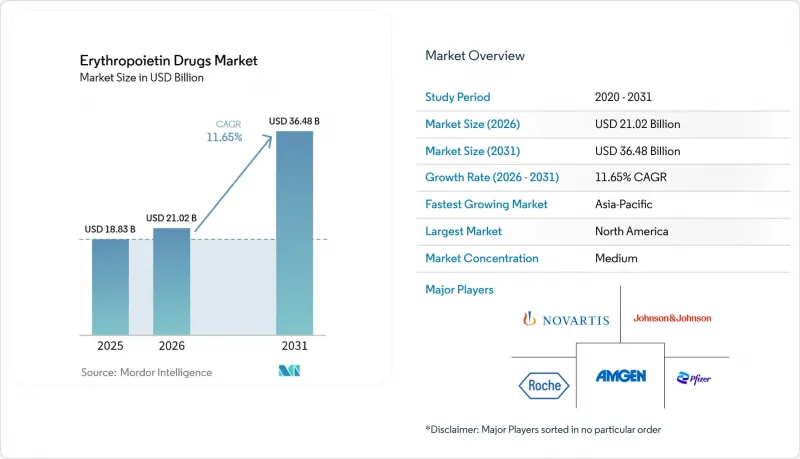
This report is Segmented by Type (Biologics, Biosimilars), Product (Epoetin Alfa, Epoetin Beta, Darbepoetin Alfa, MPG-Epoetin Beta, Others), Application (Kidney Diseases, Cancer, Neurology, Others), End User (Hospitals, Dialysis Centers, Specialty Clinics, Home Care, Others), and Geography (North America, Europe, Asia-Pacific, MEA, South America). The Market Forecasts are Provided in Terms of Value (USD).
Global Erythropoietin Drugs Market Trends and Insights
Rising Burden of Chronic Kidney Disease and Anemia
The erythropoietin drugs market is gaining from a growing chronic kidney disease (CKD) patient base rather than short-term pricing cycles. The Global Burden of Disease (GBD) Study 2025 reported 788 million adults living with CKD in 2025, compared with 378 million in 1990, expanding the long-term treatment pool for anemia management. KDIGO noted that anemia prevalence rises sharply with CKD progression and exceeds 90% in stage G5 across multiple cohorts, while the Indian Society of Nephrology's 2025 guidance supports erythropoiesis-stimulating agent (ESA) initiation when hemoglobin falls below 10.0 g/dL. Separate GBD 2021-based modeling showed 63.75 million CKD-related anemia cases globally and projected a further rise by 2035, with South and Southeast Asia, Central Europe, and Sub-Saharan Africa carrying a high age-standardized burden.
Expanding Chemotherapy-Induced Anemia Supportive Care Use
The erythropoietin drugs market also benefits from sustained use in chemotherapy-induced anemia, particularly in palliative care settings. The WHO noted that anemia affects 30% to 90% of patients receiving chemotherapy, depending on tumor type and treatment stage, supporting demand across oncology care pathways. Current ASCO and ASH guidance supports ESAs for patients receiving non-curative chemotherapy when the treatment goal is to reduce transfusion need. A 2025 real-world study of Cresp, Dr. Reddy's Laboratories' darbepoetin alfa, found positive hemoglobin dynamics in 78.2% of 523 Indian patients on palliative chemotherapy, while oncology guidance also links intravenous iron use with better hematopoietic response when ESAs are prescribed.
Safety Concerns and Conservative Hemoglobin Targeting
Safety guidance continues to limit dosing intensity in the erythropoietin drugs market. KDIGO 2026 is expected to recommend against targeting hemoglobin levels above 11.5 g/dL in erythropoiesis-stimulating agent (ESA)-maintained patients due to risks such as stroke, thromboembolism, and hypertension. This limits dose escalation and moderates volume upside from the rising chronic kidney disease population, while oncology use remains restricted to non-curative settings due to survival and tumor progression concerns. The UK Kidney Association also recommends clinical review for ESA hyporesponsiveness instead of repeated dose escalation, further limiting per-patient spending.
Other drivers and restraints analyzed in the detailed report include:
- Biosimilar Penetration in Price-Sensitive Hospital Procurement
- Long-Acting ESA Adoption in Dialysis and Renal Clinics
- Substitution Pressure From HIF-PHI and Other Non-ESA Alternatives
For complete list of drivers and restraints, kindly check the Table Of Contents.
Segment Analysis
Biologics are expected to hold 58.34% of the erythropoietin drugs market share in 2025, supported by strong formulary positions for originator brands such as Epogen, Aranesp, NeoRecormon, and Mircera across developed healthcare systems. Their position reflects physician familiarity, established hospital and dialysis procurement patterns, and demand for treatment continuity in chronic anemia care. Biosimilars are the fastest-growing type and are projected to expand at a CAGR of 14.53% through 2031, driven by lower costs and improved access to erythropoiesis-stimulating agents (ESAs). India, South Korea, and China are central to this shift as manufacturers scale complex biologics production and expand exports, gradually shifting share from originators to biosimilars without reducing the treatment base.
Epoetin alfa is expected to account for 35.45% of the erythropoietin drugs market in 2025, maintaining its position as the largest product category by revenue due to broad formulary access and sustained use across dialysis networks, hospitals, and oncology settings. Epoetin beta and methoxy polyethylene glycol-epoetin beta remain important adjacent categories across Europe, Japan, and chronic kidney disease (CKD) maintenance therapy, while Mircera continues to benefit from monthly maintenance dosing. The erythropoietin drugs market size for darbepoetin alfa is projected to grow at a CAGR of 13.67% through 2031, supported by weekly to biweekly dosing and use across multiple indications. Other products, including novel glycoengineered variants such as Loncipoetin Alfa from 3SBio, are expected to strengthen the premium long-acting tier, supported by adherence benefits and lower dosing frequency following its March 2026 approval in China.
Complete Report Scope:
- By Type
- Biologics
- Biosimilars
- By Product
- Epoetin Alfa
- Epoetin Beta
- Darbepoetin Alfa
- Methoxy Polyethylene Glycol-Epoetin Beta
- Other Erythropoietin Products
- By Application
- Kidney Diseses
- Cancer
- Neurology
- Other Applications
- By End User
- Hospitals
- Dialysis Centers
- Specialty Clinics
- Home Care Settings
- Other End Users
- By Geography
- North America
- United States
- Canada
- Mexico
- Europe
- Germany
- United Kingdom
- France
- Italy
- Spain
- Rest of Europe
- Asia-Pacific
- China
- India
- Japan
- Australia
- South Korea
- Rest of Asia-Pacific
- Middle East and Africa
- GCC
- South Africa
- Rest of Middle East and Africa
- South America
- Brazil
- Argentina
- Rest of South America
- North America
Geography Analysis
North America held 39.86% of the erythropoietin drugs market share in 2025, maintaining its position as the largest regional contributor. The region benefits from dense dialysis infrastructure, broad reimbursement coverage, and established use of erythropoiesis-stimulating agents (ESAs) across nephrology and oncology care. The United States remains the anchor market, where originator products and biosimilars compete within a mature treatment framework, while Canada and Mexico add incremental demand shaped by public procurement and reimbursement design.
Europe and Asia-Pacific define the next phase of competition in the erythropoietin drugs market. Europe remains supported by aging populations, structured disease management, and long-standing use of originator and biosimilar ESAs, with the United Kingdom, Germany, and France remaining key markets due to established renal care pathways and protocol-driven anemia management. The UK Kidney Association's 2025 update maintained ESAs as first-line therapy and positioned hypoxia-inducible factor prolyl hydroxylase inhibitors (HIF-PHIs) as an additional option rather than a full replacement, helping preserve ESA demand in the near term. Asia-Pacific is the fastest-growing region and is forecast to advance at a 14.56% CAGR through 2031, supported by China's dialysis expansion, India's biosimilar supply strength, and wider anemia management efforts across developing healthcare systems. In China, 3SBio reported a 39.6% share of the domestic recombinant human erythropoietin (rhEPO) market in 2025 through its Yibiao and Epiao brands, and its March 2026 long-acting approval adds a premium layer to that franchise.
The Middle East and Africa and South America offer uneven but meaningful expansion opportunities across the erythropoietin drugs market. Demand fundamentals remain strong in these regions because chronic kidney disease burden is high and anemia treatment access remains below clinical need in many countries. North Africa and the Middle East recorded the highest age-standardized chronic kidney disease prevalence globally at 18.0%, indicating long-term demand potential even where infrastructure gaps slow immediate uptake.
- 3SBio Inc.
- Amgen
- Biocon
- Celltrion
- Cipla
- Dr. Reddy's Laboratories
- Roche
- Hetero Labs Limited
- Intas Pharmaceutical
- Johnson & Johnson
- Kyowa Kirin
- LG Chem
- Novartis
- Pfizer
- Sandoz Group AG
- Sun Pharmaceuticals Industries
- Swedish Orphan Biovitrum AB
- Teva Pharmaceutical Industries
- Wockhardt Ltd.
- Zydus Lifesciences Limited
Additional Benefits:
- The market estimate (ME) sheet in Excel format
- 3 months of analyst support
TABLE OF CONTENTS
1 INTRODUCTION
- 1.1 Study Assumptions and Market Definition
- 1.2 Scope of the Study
2 RESEARCH METHODOLOGY
3 EXECUTIVE SUMMARY
4 MARKET LANDSCAPE
- 4.1 Market Overview
- 4.2 Market Drivers
- 4.2.1 Rising Burden of Chronic Kidney Disease and Anemia
- 4.2.2 Expanding Chemotherapy-Induced Anemia Supportive Care Use
- 4.2.3 Biosimilar Penetration in Price-Sensitive Hospital Procurement
- 4.2.4 Long-Acting ESA Adoption in Dialysis and Renal Clinics
- 4.2.5 Transfusion-Avoidance Protocols in Surgical and Oncology Care
- 4.2.6 Local Manufacturing and Public Tender Localization in Emerging Markets
- 4.3 Market Restraints
- 4.3.1 Safety Concerns and Conservative Hemoglobin Targeting
- 4.3.2 Pricing Erosion From Biosimilar Competition
- 4.3.3 Complex Cold-Chain and Biologics Manufacturing Requirements
- 4.3.4 Substitution Pressure From HIF-PHI and Other Non-ESA Alternatives
- 4.4 Supply/Value Chain Analysis
- 4.5 Regulatory Landscape
- 4.6 Technological Outlook
- 4.7 Porter's Five Forces Analysis
- 4.7.1 Bargaining Power of Suppliers
- 4.7.2 Bargaining Power of Buyers
- 4.7.3 Threat of New Entrants
- 4.7.4 Threat of Substitutes
- 4.7.5 Competitive Rivalry
5 MARKET SIZE AND GROWTH FORECASTS (VALUE, USD)
- 5.1 By Type
- 5.1.1 Biologics
- 5.1.2 Biosimilars
- 5.2 By Product
- 5.2.1 Epoetin Alfa
- 5.2.2 Epoetin Beta
- 5.2.3 Darbepoetin Alfa
- 5.2.4 Methoxy Polyethylene Glycol-Epoetin Beta
- 5.2.5 Other Erythropoietin Products
- 5.3 By Application
- 5.3.1 Kidney Diseses
- 5.3.2 Cancer
- 5.3.3 Neurology
- 5.3.4 Other Applications
- 5.4 By End User
- 5.4.1 Hospitals
- 5.4.2 Dialysis Centers
- 5.4.3 Specialty Clinics
- 5.4.4 Home Care Settings
- 5.4.5 Other End Users
- 5.5 By Geography
- 5.5.1 North America
- 5.5.1.1 United States
- 5.5.1.2 Canada
- 5.5.1.3 Mexico
- 5.5.2 Europe
- 5.5.2.1 Germany
- 5.5.2.2 United Kingdom
- 5.5.2.3 France
- 5.5.2.4 Italy
- 5.5.2.5 Spain
- 5.5.2.6 Rest of Europe
- 5.5.3 Asia-Pacific
- 5.5.3.1 China
- 5.5.3.2 India
- 5.5.3.3 Japan
- 5.5.3.4 Australia
- 5.5.3.5 South Korea
- 5.5.3.6 Rest of Asia-Pacific
- 5.5.4 Middle East and Africa
- 5.5.4.1 GCC
- 5.5.4.2 South Africa
- 5.5.4.3 Rest of Middle East and Africa
- 5.5.5 South America
- 5.5.5.1 Brazil
- 5.5.5.2 Argentina
- 5.5.5.3 Rest of South America
- 5.5.1 North America
6 COMPETITIVE LANDSCAPE
- 6.1 Market Concentration
- 6.2 Market Share Analysis
- 6.3 Company Profiles (includes Global Level Overview, Market Level Overview, Core Segments, Financials as available, Strategic Information, Market Rank/Share, Products and Services, Recent Developments)
- 6.3.1 3SBio Inc.
- 6.3.2 Amgen Inc.
- 6.3.3 Biocon Limited
- 6.3.4 Celltrion Inc.
- 6.3.5 Cipla Limited
- 6.3.6 Dr. Reddy's Laboratories Ltd.
- 6.3.7 F. Hoffmann-La Roche Ltd.
- 6.3.8 Hetero Labs Limited
- 6.3.9 Intas Pharmaceuticals Ltd.
- 6.3.10 Johnson & Johnson
- 6.3.11 Kyowa Kirin Co., Ltd.
- 6.3.12 LG Chem Ltd.
- 6.3.13 Novartis AG
- 6.3.14 Pfizer Inc.
- 6.3.15 Sandoz Group AG
- 6.3.16 Sun Pharmaceutical Industries Limited
- 6.3.17 Swedish Orphan Biovitrum AB
- 6.3.18 Teva Pharmaceutical Industries Ltd.
- 6.3.19 Wockhardt Ltd.
- 6.3.20 Zydus Lifesciences Limited
7 MARKET OPPORTUNITIES AND FUTURE OUTLOOK
- 7.1 White-Space and Unmet-Need Assessment

