PUBLISHER: Mordor Intelligence | PRODUCT CODE: 2099748

PUBLISHER: Mordor Intelligence | PRODUCT CODE: 2099748
India Inflight Catering - Market Share Analysis, Industry Trends & Statistics, Growth Forecasts (2026 - 2031)
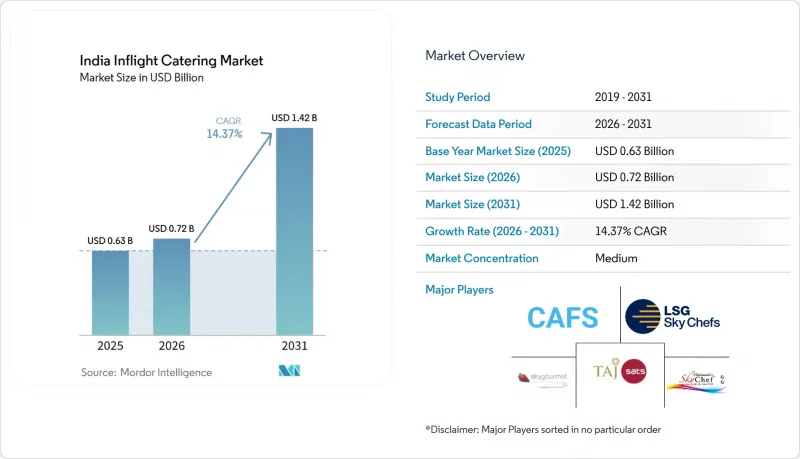
According to Mordor Intelligence, the India inflight catering market size is expected to grow from USD 631.30 million in 2025 to USD 723.69 million in 2026 and reach USD 1,416.31 million by 2031, growing at a CAGR of 14.37% over 2026-2031.
This report is Segmented by Food Type (Meals, Bakery and Confectionery, Beverages, and Other Food Types), Flight Type (Full-Service Carriers, Low-Cost Carriers, and Other Flight Types), Seating Class (Economy, Business, and First), Catering Type (Classic and Retail On Board), and Flight Duration (Short-Haul and Long-Haul). The Market Forecasts are Provided in Terms of Value (USD).
India Inflight Catering Market Trends and Insights
Rising Domestic And International Air Passenger Traffic
India's domestic carriers transported 166.90 million passengers in 2025, and scheduled domestic traffic reached 729.40 lakh passengers during January to May 2026, which kept the India inflight catering market closely tied to rising base travel volumes. May 2026 traffic also rose 9.49% month on month, showing that peak travel periods can sharply raise flight kitchen output needs in a short span. International traffic from Indian carriers also expanded by 7.70% during April to February of FY25, which extended demand toward longer and more complex meal cycles. As passenger volume rises across both domestic and international routes, kitchen operators need larger surge capacity, tighter dispatch planning, and stronger ingredient control across the India inflight catering market. This traffic mix matters because domestic routes offer frequency and scale, while international routes increase revenue per uplift due to more service-intensive catering requirements. The result is a broader and more stable demand base for the India inflight catering market than a single-network model would provide.
Fleet Growth And Route Expansion By LCCs and FSCs
Fleet additions remain one of the clearest demand supports for the India inflight catering market because each aircraft induction adds recurring catering volume to an airline's network. IndiGo stated in 2026 that it is inducting 52-56 aircraft this year and targets a fleet of 550 aircraft and 3,000 daily departures by FY30. Its 39 confirmed A321XLR orders also point to wider international reach, which will require longer-haul service formats and more demanding production planning. Air India is also expanding its widebody product base in 2026, including B787-9 and A350-1000 deliveries tied to the development of premium cabin service. Akasa Air reported 37% revenue growth in FY2025-26, which further supports the view that airline scale is broadening the buyer base for the India inflight catering market. This expansion pipeline gives caterers better forward visibility than many other food service categories because route and fleet growth translate into repeatable production demand.
Food Wastage From Forecast Error And Schedule Volatility
Food wastage remains a significant operational challenge in the India inflight catering market, as production must often be completed before final passenger demand is confirmed. Airbus cited industry work showing global airline cabin and catering waste at 3.6 million tons annually based on 2024 and 2025 data, with volumes projected to approach 4 million tons by the end of 2025. In India, aircraft swaps, cancellations, standby loads, and late schedule changes increase the risk of overproduction across both complimentary and retail meal formats. The issue becomes harder in the India inflight catering market as buy-on-board expands, because item-level retail demand is less predictable than with fixed-tray service. Airbus published an AI-based smart catering framework in April 2026 that projected double-digit reductions in preventable cabin food waste through machine learning-based load optimization. Adoption in India remains limited, so forecast error will remain a meaningful source of margin leakage until airlines and caterers tighten their system integration.
Other drivers and restraints analyzed in the detailed report include:
- Shift Toward Pre-Order, Buy-On-Board, And Ancillary Revenue Models
- Premiumization Of Onboard Meals And Personalized Passenger Experience
- High Food Safety, Security, And Multi-Airport Compliance Burden
For complete list of drivers and restraints, kindly check the Table Of Contents.
Segment Analysis
Meals accounted for 40.15% of the India inflight catering market share in 2025, keeping them the largest food type even as buying behavior shifted on domestic routes. That position reflects the continued importance of structured tray service on full-service, long-haul, and premium cabin operations across the India inflight catering market. Beverages also remained important in short domestic sectors, where coffee, tea, and snack combinations serve as frequent onboard purchases. Other food types, including dietary meals, regional dishes, and dessert-led options, also gained relevance as airlines widened their service mix. This means the food basket in the India inflight catering market is becoming more varied even before the largest category changes hands.
Bakery and confectionery is projected to grow at a 16.35% CAGR through 2031, making it the fastest-moving food sub-segment in the India inflight catering market. Its momentum is tied to lighter, snackable, and individually sold formats that suit short-haul and buy-on-board demand. As airlines reduce complimentary hot meals in some fare types, packaged pastries, cookies, and confectionery become easier to stock, sell, and forecast than bulk hot food. Air India's menu expansion to more than 18 special meal types also shows that caterers must manage a broader ingredient matrix, which supports niche food categories alongside core meals. The India inflight catering industry is therefore moving from a simpler meal-led structure toward a wider retail and dietary product mix without losing the central role of conventional meal service.
FSCs accounted for 45.95% of the India inflight catering market in 2025, supported by complimentary meal inclusion and higher average revenue per meal. Their position remained tied to longer-haul service, premium cabin complexity, and menu expectations that are harder to simplify. Airlines such as Air India are also investing in refreshed menus and upgraded long-haul experience, which supports stronger value capture per uplift. This keeps FSC demand important in the India inflight catering market, even as domestic LCC volume grows faster. It also preserves a clear quality-based segment where catering value is linked to service depth, not just throughput.
LCC inflight meals are forecast to grow at a 16.80% CAGR through 2031, which makes them the fastest-growing flight-type segment. That pace reflects the scale of IndiGo, Akasa Air, and other budget carriers in terms of domestic departures and route additions. The LCC model is changing the India inflight catering market because food is becoming a retail item rather than a standard ticket inclusion. That creates stronger dependence on packaging, SKU planning, and conversion rates during the flight. Charter and business aviation remain much smaller, but they add a specialized niche where customization and low-volume premium handling matter more than scale. The India inflight catering industry, therefore, faces a dual structure, with FSCs preserving value-rich service formats and LCCs expanding transaction-led demand more quickly.
Complete Report Scope:
- By Food Type
- Meals
- Bakery and Confectionery
- Beverages
- Other Food Types
- By Flight Type
- Full-Service Carriers (FSCs)
- Low-Cost Carriers (LCCs)
- Other Flight Types
- By Aircraft Seating Class
- Economy
- Business
- First
- By Catering Type
- Classic (Complimentary and Pre-ordered)
- Retail On Board (Buy-on-board)
- By Flight Duration
- Short-Haul
- Long-Haul
List of Companies Covered in this Report:
- Taj SATS Air Catering Limited
- Ambassadors Sky Chef
- Casino Air Caterers & Flight Services
- Skygourmet Catering Private Limited
- Oberoi Flight Services (Oberoi Group)
- Muthoot Pappachan Group
- LSG Sky Chefs India Pvt. Ltd.
- Uday Sky Kitchen (R.R.Holiday Homes Private Limited)
- LuLu Flight Kitchen Pvt. Ltd.
- Continuum Aviation Private Limited
- BizAv International Pvt Ltd.
Additional Benefits:
- The market estimate (ME) sheet in Excel format
- 3 months of analyst support
TABLE OF CONTENTS
1 INTRODUCTION
- 1.1 Study Assumptions and Market Definition
- 1.2 Scope of the Study
2 RESEARCH METHODOLOGY
3 EXECUTIVE SUMMARY
4 MARKET LANDSCAPE
- 4.1 Market Overview
- 4.2 Market Drivers
- 4.2.1 Rising domestic and international air passenger traffic
- 4.2.2 Fleet growth and route expansion by LCCs and FSCs
- 4.2.3 Shift toward pre-order, buy-on-board, and ancillary revenue models
- 4.2.4 Premiumization of onboard meals and personalized passenger experience
- 4.2.5 Airport-centric kitchen network expansion in emerging aviation hubs
- 4.2.6 Strengthening food safety, traceability, and compliance requirements
- 4.3 Market Restraints
- 4.3.1 Food wastage from forecast error and schedule volatility
- 4.3.2 High food safety, security, and multi-airport compliance burden
- 4.3.3 Airside logistics complexity and tight turnaround windows
- 4.3.4 Margin pressure from packaging, labor, and utility inflation
- 4.4 Value Chain Analysis
- 4.5 Regulatory Landscape
- 4.6 Technological Outlook
- 4.7 Porter's Five Forces Analysis
- 4.7.1 Bargaining Power of Buyers
- 4.7.2 Bargaining Power of Suppliers
- 4.7.3 Threat of New Entrants
- 4.7.4 Threat of Substitute Products
- 4.7.5 Intensity of Competitive Rivalry
5 MARKET SIZE AND GROWTH FORECASTS (VALUE)
- 5.1 By Food Type
- 5.1.1 Meals
- 5.1.2 Bakery and Confectionery
- 5.1.3 Beverages
- 5.1.4 Other Food Types
- 5.2 By Flight Type
- 5.2.1 Full-Service Carriers (FSCs)
- 5.2.2 Low-Cost Carriers (LCCs)
- 5.2.3 Other Flight Types
- 5.3 By Aircraft Seating Class
- 5.3.1 Economy
- 5.3.2 Business
- 5.3.3 First
- 5.4 By Catering Type
- 5.4.1 Classic (Complimentary and Pre-ordered)
- 5.4.2 Retail On Board (Buy-on-board)
- 5.5 By Flight Duration
- 5.5.1 Short-Haul
- 5.5.2 Long-Haul
6 COMPETITIVE LANDSCAPE
- 6.1 Market Concentration
- 6.2 Strategic Moves
- 6.3 Market Share Analysis
- 6.4 Company Profiles (includes Global Level Overview, Market Level Overview, Core Segments, Financials as available, Strategic Information, Market Rank/Share, Products and Services, and Recent Developments)
- 6.4.1 Taj SATS Air Catering Limited
- 6.4.2 Ambassadors Sky Chef
- 6.4.3 Casino Air Caterers & Flight Services
- 6.4.4 Skygourmet Catering Private Limited
- 6.4.5 Oberoi Flight Services (Oberoi Group)
- 6.4.6 Muthoot Pappachan Group
- 6.4.7 LSG Sky Chefs India Pvt. Ltd.
- 6.4.8 Uday Sky Kitchen (R.R.Holiday Homes Private Limited)
- 6.4.9 LuLu Flight Kitchen Pvt. Ltd.
- 6.4.10 Continuum Aviation Private Limited
- 6.4.11 BizAv International Pvt Ltd.
7 MARKET OPPORTUNITIES AND FUTURE OUTLOOK
- 7.1 White-Space And Unmet-Need Assessment

