PUBLISHER: Mordor Intelligence | PRODUCT CODE: 2099778

PUBLISHER: Mordor Intelligence | PRODUCT CODE: 2099778
GCC Gold Jewelry - Market Share Analysis, Industry Trends & Statistics, Growth Forecasts (2026 - 2031)
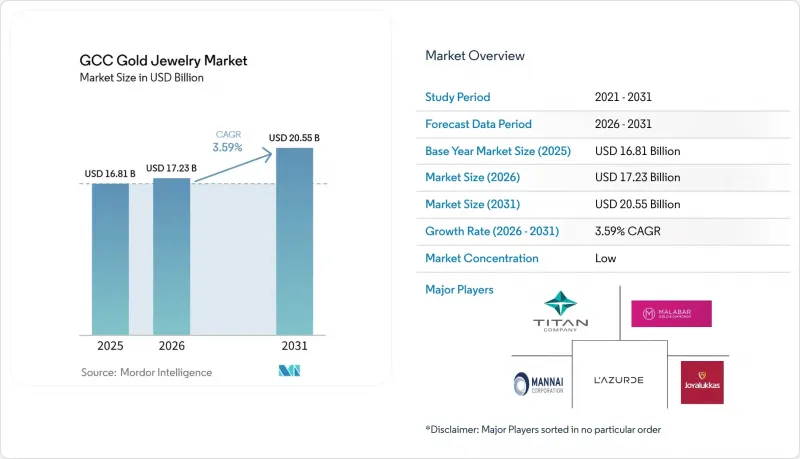
According to Mordor Intelligence, the GCC gold jewelry market was valued at USD 16.81 billion in 2025 and is estimated at USD 17.23 billion in 2026, reaching USD 20.55 billion by 2031, growing at a CAGR of 3.59% during 2026-2031.
This report is Segmented by Product Type (Rings, Necklaces, Earrings, Bracelets, and More, Karat/Purity (24 Karat, 22 Karat, 18 Karat, and Others)), End User (Men, Women, and Children), Distribution Channel (Offline Retail Stores and Online Retail Stores), and Geography (Saudi Arabia, United Arab Emirates, Kuwait, Qatar, Bahrain, and Oman). The Market Forecasts are Provided in Value (USD).
GCC Gold Jewelry Market Trends and Insights
Cultural significance of gold jewelry in weddings and traditional celebration
Gold jewelry remains deeply embedded in GCC wedding traditions and religious celebrations, creating a structural source of demand that is relatively resilient to gold price fluctuations. Unlike discretionary fashion purchases, bridal sets, engagement jewelry, and ceremonial gifts are considered essential components of weddings, Eid, Ramadan, and other family occasions, ensuring consistent purchasing activity throughout the year. Consumers often adjust jewelry weight or design preferences rather than postpone purchases, providing the market with a stable demand base. The significance of this cultural demand is reflected in the growing scale of industry events such as the Saudi Arabia Jewellery Exposition (SAJEX) 2025, held in September 2025, which brought together over 100 exhibitors across 200 booths and attracted more than 2,000 international trade buyers . This highlights the region's strong bridal and traditional jewelry ecosystem while creating new opportunities for manufacturers and retailers to showcase culturally relevant collections.
Increasing adoption of personalized and customized gold jewelry
The growing adoption of personalized and customized gold jewelry is transforming the GCC market from a traditional commodity-based purchase into a design-led, value-added retail experience. Rather than competing solely on gold purity or weight, jewelry brands are increasingly differentiating themselves through bespoke craftsmanship, allowing consumers to create unique pieces that reflect individual identities, family heritage, and special occasions. Demand is rising for custom name necklaces, engraved pendants, initials, signet rings, zodiac motifs, and made-to-order bridal jewelry, particularly among younger consumers seeking exclusive designs. At the same time, retailers are integrating AI-powered jewelry design tools, 3D visualization, CAD/CAM technology, and digital customization platforms, enabling customers to preview, modify, and personalize jewelry before production.
Counterfeit risk and hallmarking compliance costs
The growing prevalence of counterfeit gold jewelry and rising hallmarking compliance costs present significant challenges for the GCC gold jewelry market, particularly for small and mid-sized retailers. Meeting stricter requirements for purity testing, hallmarking, traceability, and product certification demands continuous investment in quality assurance systems, certified sourcing, documentation, and regulatory audits, increasing operational costs across the value chain. While these measures strengthen consumer confidence, they also raise barriers for retailers with limited financial and technical resources. The persistence of counterfeit products further underscores the need for regulatory enforcement. For example, in August 2025, Saudi Arabia's Ministry of Commerce shut down a foreign e-commerce platform selling copper-coated counterfeit gold bullion at nearly half the prevailing market value, citing violations of the Kingdom's E-Commerce Law and its executive regulations .
Other drivers and restraints analyzed in the detailed report include:
- Gold jewelry's role as a dual-purpose asset
- Tourism-led luxury retail spend in dubai and saudi arabia
- Dependence on imported finished jewelry and inputs
For complete list of drivers and restraints, kindly check the Table Of Contents.
Segment Analysis
Rings accounted for 33.46% of the GCC gold jewelry market in 2025. The segment dominates because rings are purchased across multiple occasions rather than for a single purpose, creating consistently high replacement and repeat purchase cycles. Unlike necklaces or bracelets, consumers often own multiple rings for daily wear, formal events, religious occasions, engagements, and weddings, resulting in higher unit sales. The category also benefits from broad design flexibility, allowing manufacturers to offer products across different gold purities, weights, price points, and fashion preferences without significantly altering production processes. In addition, rings require comparatively lower gold content than larger jewelry pieces, enabling jewelers to introduce a wider variety of collections and refresh inventories more frequently.
Chains and pendants are the fastest-growing product type, projected to expand at a CAGR of 4.81% during 2026-2031. Growth is driven by their versatility and styling flexibility, as consumers increasingly prefer jewelry that can be worn individually or layered with other pieces for different occasions. The segment also benefits from frequent product innovation through interchangeable pendants, symbolic motifs, initials, religious charms, and gemstone additions, allowing consumers to personalize jewelry without replacing the entire chain. Furthermore, lightweight chain designs and detachable pendant collections enable brands to introduce new designs quickly while encouraging repeat purchases of complementary pieces.
The 22 karat purity segment held 54.53% of the GCC gold jewelry market in 2025. Its dominance is supported by its balance between high gold purity and structural strength, allowing manufacturers to produce both traditional handcrafted jewelry and contemporary designs without compromising durability. The segment serves as the industry benchmark for bridal sets, bangles, necklaces, rings, and ceremonial collections, resulting in extensive product availability across virtually every organized jewelry retailer in the GCC. Its standardized use throughout the regional jewelry ecosystem enables efficient sourcing, manufacturing, hallmarking, inventory management, and resale, further strengthening consumer preference. In addition, 22K gold offers a distinctive rich yellow appearance widely associated with premium quality and authenticity, making it the preferred purity for heritage-inspired collections and heirloom jewelry.
The 18 karat segment is projected to grow at a CAGR of 3.78% during 2026-2031. The segment is expanding as jewelry manufacturers increasingly prioritize design innovation over traditional purity preferences. Its higher alloy content provides greater hardness, enabling intricate settings, slimmer profiles, articulated links, and complex geometric designs that are difficult to achieve with 22K or 24K gold. This makes 18K the preferred choice for diamond jewelry, gemstone-studded collections, contemporary luxury pieces, and precision-crafted designer products. The segment also supports a wider range of finishes, including white gold, rose gold, and mixed-metal combinations, allowing brands to diversify collections and respond to evolving fashion trends. Furthermore, its durability makes it well suited for everyday wear, encouraging brands to expand premium lifestyle collections and increasing its adoption across modern retail formats, supporting its position as the fastest-growing purity segment.
Complete Report Scope:
- By Product Type
- Rings
- Necklaces
- Earrings
- Bracelets
- Chains and Pendants
- Other Product Types
- By Karat/Purity
- 24 Karat
- 22 Karat
- 18 Karat
- Others
- By End User
- Men
- Women
- Children
- By Distribution Channel
- Offline Retail Stores
- Online Retail Stores
- By Geography
- Saudi Arabia
- United Arab Emirates
- Kuwait
- Qatar
- Bahrain
- Oman
- Saudi Arabia
List of Companies Covered in this Report:
- Malabar Gold and Diamonds
- Titan Company Limited
- Joyalukkas Jewellery LLC
- Mannai Corporation (Damas International)
- L'azurde Company for Jewelry
- Pure Gold Jewellers
- Kalyan Jewellers
- Ahmed Seddiqi and Sons
- Jawhara Jewellery
- Rivoli Group
- Swarovski AG
- Richemont
- LVMH Moet Hennessy Louis Vuitton
- Chanel
- Cartier
- Bulgari
- Graff
- Harry Winston
- Tanishq
- Senco Gold and Diamonds
Additional Benefits:
- The market estimate (ME) sheet in Excel format
- 3 months of analyst support
TABLE OF CONTENTS
1 INTRODUCTION
- 1.1 Study Assumptions and Market Definition
- 1.2 Scope of the Study
2 RESEARCH METHODOLOGY
3 EXECUTIVE SUMMARY
4 MARKET LANDSCAPE
- 4.1 Market Overview
- 4.2 Market Drivers
- 4.2.1 Cultural significance of gold jewelry in weddings and traditional celebration
- 4.2.2 Increasing adoption of personalized and customized gold jewelry
- 4.2.3 Gold jewelry's role as a dual-purpose asset
- 4.2.4 Tourism-led luxury retail spend in dubai and saudi arabia
- 4.2.5 Localized collections for arab and expatriate taste profiles
- 4.2.6 Popularity of ethically sourced and responsibly produced gold
- 4.3 Market Restraints
- 4.3.1 Counterfeit risk and hallmarking compliance costs
- 4.3.2 Dependence on imported finished jewelry and inputs
- 4.3.3 Gold price volatility and inventory margin compression
- 4.3.4 Intense Price Transparency and Low Switching Costs in Mass Gold
- 4.4 Consumer Behavior Analysis
- 4.5 Regulatory Landscape
- 4.6 Technological Outlook
- 4.7 Porter's Five Forces Analysis
- 4.7.1 Threat of New Entrants
- 4.7.2 Bargaining Power of Buyers
- 4.7.3 Bargaining Power of Suppliers
- 4.7.4 Threat of Substitutes
- 4.7.5 Intensity of Competitive Rivalry
5 MARKET SIZE AND GROWTH FORECASTS (VALUE)
- 5.1 By Product Type
- 5.1.1 Rings
- 5.1.2 Necklaces
- 5.1.3 Earrings
- 5.1.4 Bracelets
- 5.1.5 Chains and Pendants
- 5.1.6 Other Product Types
- 5.2 By Karat/Purity
- 5.2.1 24 Karat
- 5.2.2 22 Karat
- 5.2.3 18 Karat
- 5.2.4 Others
- 5.3 By End User
- 5.3.1 Men
- 5.3.2 Women
- 5.3.3 Children
- 5.4 By Distribution Channel
- 5.4.1 Offline Retail Stores
- 5.4.2 Online Retail Stores
- 5.5 By Geography
- 5.5.1 Saudi Arabia
- 5.5.1.1 United Arab Emirates
- 5.5.1.2 Kuwait
- 5.5.1.3 Qatar
- 5.5.1.4 Bahrain
- 5.5.1.5 Oman
- 5.5.1 Saudi Arabia
6 COMPETITIVE LANDSCAPE
- 6.1 Market Concentration
- 6.2 Strategic Moves
- 6.3 Market Share Analysis
- 6.4 Company Profiles (includes Global level Overview, Market level overview, Core Segments, Financials as available, Strategic Information, Market Rank/Share for key companies, Products and Services, and Recent Developments)
- 6.4.1 Malabar Gold and Diamonds
- 6.4.2 Titan Company Limited
- 6.4.3 Joyalukkas Jewellery LLC
- 6.4.4 Mannai Corporation (Damas International)
- 6.4.5 L'azurde Company for Jewelry
- 6.4.6 Pure Gold Jewellers
- 6.4.7 Kalyan Jewellers
- 6.4.8 Ahmed Seddiqi and Sons
- 6.4.9 Jawhara Jewellery
- 6.4.10 Rivoli Group
- 6.4.11 Swarovski AG
- 6.4.12 Richemont
- 6.4.13 LVMH Moet Hennessy Louis Vuitton
- 6.4.14 Chanel
- 6.4.15 Cartier
- 6.4.16 Bulgari
- 6.4.17 Graff
- 6.4.18 Harry Winston
- 6.4.19 Tanishq
- 6.4.20 Senco Gold and Diamonds
7 MARKET OPPORTUNITIES AND FUTURE OUTLOOK

