
PUBLISHER: Mordor Intelligence | PRODUCT CODE: 2099819

PUBLISHER: Mordor Intelligence | PRODUCT CODE: 2099819
Cationic Starches - Market Share Analysis, Industry Trends & Statistics, Growth Forecasts (2026 - 2031)
According to Mordor Intelligence, the cationic starches market size is expected to grow from USD 1.82 billion in 2025 to USD 1.89 billion in 2026 and is forecast to reach USD 2.33 billion by 2031 at 4.27% CAGR over 2026-2031.
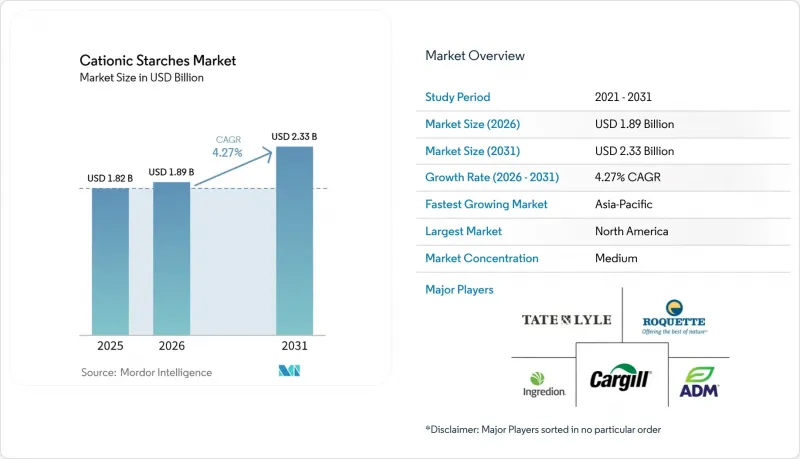
This report is Segmented by Source (Maize, Wheat, Potato, Tapioca, Others), Application (Food and Beverage, Pharmaceutical, Personal Care and Cosmetics, Textile, Animal Feed, Paper and Corrugating, Others), and Geography (North America, Europe, Asia-Pacific, South America, Middle East and Africa). The Market Forecasts are Provided in Terms of Value (USD).
Global Cationic Starches Market Trends and Insights
Rising demand from the paper and paperboard industry
The paper sector remains the largest demand center shaping the cationic starches market, but this relationship extends beyond paper volume growth. Paper mills that increase recycled fiber content often face higher anionic charge in the furnish, which raises the need for cationic starch to maintain retention and drainage performance within operating targets. According to the FAO, global paper and paperboard production reached 423 million tonnes in 2024, a 4% increase compared to 2023. This growth reflects rising demand for packaging, tissue, and specialty paper products, all of which use cationic starch to improve paper strength, retention, drainage, and printability. Ingredion's February 2025 investment announcement for Cedar Rapids highlighted continued demand from packaging and papermaking customers for specialty industrial starches that offer strength, biodegradability, and recyclability benefits. For the cationic starches market, this trend keeps paper and packaging demand important for both scale and value addition.
Increasing adoption in textile sizing and finishing applications
The increasing adoption of cationic starch in textile sizing and finishing applications is a significant driver of the cationic starches market. Cationic starch is widely used as a sizing agent to improve yarn strength, reduce breakage during weaving, and enhance production efficiency by minimizing friction between fibers. In textile finishing, it provides improved fabric stiffness, smoothness, dye affinity, and print quality while contributing to better dimensional stability. Growing demand for high-quality apparel, technical textiles, and home furnishings is encouraging manufacturers to adopt performance-enhancing and sustainable textile chemicals. In addition, cationic starch is biodegradable and derived from renewable resources, making it an attractive alternative to synthetic sizing agents amid tightening environmental regulations. As textile producers increasingly prioritize cost-effective, eco-friendly, and high-performance finishing solutions, the consumption of cationic starch in textile processing is expected to continue rising throughout the forecast period.
Volatility in corn, potato, and tapioca starch prices
Raw material cost volatility remains a direct restraint on the cationic starches market, as maize, potato, and tapioca starches depend on agricultural supply chains influenced by weather, energy prices, and currency movements. Maize presents the highest exposure, as the leading source segment depends on global corn balances and faces competing demand from food, feed, and fuel applications. When grain costs rise rapidly, participants in the cationic starches market cannot pass on these increases evenly, as paper and textile applications often remain highly price sensitive. Large integrated suppliers can reduce part of this pressure through broader sourcing networks and trading capabilities, while smaller specialty producers typically have fewer hedging options and limited flexibility to protect margins. This dynamic creates an uneven competitive effect in the cationic starches market, where scale helps companies absorb volatility, while regional players face sharper cost pressures. It also slows investment in differentiation, as producers facing raw material pressure tend to prioritize throughput and contract retention over new product development.
Other drivers and restraints analyzed in the detailed report include:
- Growing demand for clean-label texture-enhancing ingredients
- Expanding demand for functional food ingredients with improved stability
- Strict food safety regulations governing modified starch ingredients
For complete list of drivers and restraints, kindly check the Table Of Contents.
Segment Analysis
Maize dominated the cationic starches market by source, accounting for 70.26% of the total market share in 2025. Its leadership is primarily attributed to the abundant global availability of maize, well-established cultivation, and its cost-effective processing into starch. Maize-based cationic starch offers consistent quality, high purity, and excellent cationization efficiency, making it the preferred raw material for paper manufacturing, wastewater treatment, textiles, and adhesives. The extensive industrial infrastructure supporting corn wet milling further strengthens its commercial viability and ensures stable supply across major consuming regions. In addition, continuous improvements in starch modification technologies have enhanced the functional performance of maize-derived cationic starch, reinforcing its adoption in diverse industrial applications.
Potato is projected to be the fastest-growing source segment, expanding at a CAGR of 5.46% through 2031. The increasing demand for specialty starches with superior viscosity, binding, and film-forming properties is driving the adoption of potato-derived cationic starch across multiple industries. Potato starch possesses naturally large granules and a higher amylopectin content, enabling improved water retention and enhanced functionality in paper coating, textiles, and specialty industrial formulations. Growing interest in sustainable and renewable raw materials is also encouraging manufacturers to diversify beyond conventional maize-based starches, particularly in regions with strong potato production.
Complete Report Scope:
- By Source
- Maize
- Wheat
- Potato
- Tapioca
- Others
- By Application
- Food and Beverage
- Pharmaceutials
- Personal Care and Cosmetics
- Textile
- Animal Feed
- Paper and Corrugating
- Others
- By Geography
- North America
- United States
- Canada
- Mexico
- Rest of North America
- Europe
- United Kingdom
- Germany
- Spain
- France
- Italy
- Russia
- Rest of Europe
- Asia-Pacific
- China
- India
- Japan
- Australia
- Rest of Asia Pacific
- South America
- Brazil
- Argentina
- Rest of South America
- Middle East and Africa
- Saudi Arabia
- South Africa
- Rest of Middle East and Africa
- North America
Geography Analysis
North America held 34.11% of the cationic starches market share in 2025, making it the largest regional base in the current structure of demand. The region benefits from a strong paper and packaging network, broad corn availability, and integrated starch supply chains that support both standard and specialty grades. The United States remains central to the cationic starches market, as it combines large paper products consumption with a major domestic feedstock base and strong industrial processing capacity. Canada supports the market through pulp and tissue manufacturing, while Mexico offers incremental growth linked to industrial expansion and supply chain relocation. Traceability and sustainable sourcing expectations from large consumer goods companies also help North American suppliers defend higher-value positions in the cationic starches market.
Europe remains important to the cationic starches market due to its concentrated base of specialty suppliers with strong positions in potato-based starch and regulated end uses. Demand in the region depends less on volume expansion and more on compliance, sustainability expectations, and the ability to meet precise application requirements in food and pharmaceuticals. Current EU food additive rules maintain strict formulation discipline, giving established suppliers an advantage when customers need technical support and dependable documentation. Germany, France, and the United Kingdom remain key demand centers, while Eastern Europe offers a more active outlook for capacity additions and industrial growth than some mature Western European markets.
Asia-Pacific is the fastest-growing region in the cationic starches market, with a projected CAGR of 5.78% through 2031. China remains the largest demand anchor in the region, supported by its broad containerboard, tissue, and food processing base. India is emerging as the fastest-accelerating national opportunity, driven by paper capacity additions, a large textile export platform, and growing pharmaceutical manufacturing. Southeast Asia also remains important, as Vietnam, Bangladesh, and Thailand continue to add textile and industrial starch demand amid regional manufacturing shifts. South America and the Middle East and Africa still account for smaller shares of the cationic starches market, but both regions are building a stronger base through packaging growth, food diversification, and industrial development. As a result, the cationic starches market is steadily shifting eastward, although North America still holds the largest current share.
- Cargill, Incorporated
- Tate & Lyle PLC
- Ingredion Incorporated
- Roquette Freres S.A.
- Archer Daniels Midland Company
- AGRANA Beteiligungs-AG
- Avebe U.A.
- Tereos S.A.
- BENEO GmbH
- Grain Processing Corporation
- Global Bio-chem Technology Group Company Limited
- Visco Starch Manufacturers
- SPAC Starch Products (India) Limited
- Universal Starch-Chem Allied Ltd.
- Gujarat Ambuja Exports Limited
- Sudstarke GmbH
- Lyckeby Starch AB
- Novidon B.V.
- Gulshan Polyols Limited
- Sanstar Limited
Additional Benefits:
- The market estimate (ME) sheet in Excel format
- 3 months of analyst support
TABLE OF CONTENTS
1 INTRODUCTION
- 1.1 Study Assumptions & Market Definition
- 1.2 Scope of the Study
2 RESEARCH METHODOLOGY
3 EXECUTIVE SUMMARY
4 MARKET LANDSCAPE
- 4.1 Market Overview
- 4.2 Market Drivers
- 4.2.1 Rising demand from the paper and paperboard industry
- 4.2.2 Increasing adoption in textile sizing and finishing applications
- 4.2.3 Growing demand for clean-label texture-enhancing ingredients
- 4.2.4 Expanding demand for functional food ingredients with improved stability
- 4.2.5 Technological advancements in starch modification processes
- 4.2.6 Growth of pulp and paper manufacturing in emerging economies
- 4.3 Market Restraints
- 4.3.1 Strict food safety regulations governing modified starch ingredients
- 4.3.2 Volatility in corn, potato, and tapioca starch prices
- 4.3.3 Limited adoption in regions with low industrialization
- 4.3.4 High production and chemical modification costs
- 4.4 Supply Chain Analysis
- 4.5 Regulatory Outlook
- 4.6 Porter's Five Forces
- 4.6.1 Threat of New Entrants
- 4.6.2 Bargaining Power of Buyers/Consumers
- 4.6.3 Bargaining Power of Suppliers
- 4.6.4 Threat of Substitute Products
- 4.6.5 Intensity of Competitive Rivalry
5 MARKET SIZE AND GROWTH FORECASTS (VALUE)
- 5.1 By Source
- 5.1.1 Maize
- 5.1.2 Wheat
- 5.1.3 Potato
- 5.1.4 Tapioca
- 5.1.5 Others
- 5.2 By Application
- 5.2.1 Food and Beverage
- 5.2.2 Pharmaceutials
- 5.2.3 Personal Care and Cosmetics
- 5.2.4 Textile
- 5.2.5 Animal Feed
- 5.2.6 Paper and Corrugating
- 5.2.7 Others
- 5.3 By Geography
- 5.3.1 North America
- 5.3.1.1 United States
- 5.3.1.2 Canada
- 5.3.1.3 Mexico
- 5.3.1.4 Rest of North America
- 5.3.2 Europe
- 5.3.2.1 United Kingdom
- 5.3.2.2 Germany
- 5.3.2.3 Spain
- 5.3.2.4 France
- 5.3.2.5 Italy
- 5.3.2.6 Russia
- 5.3.2.7 Rest of Europe
- 5.3.3 Asia-Pacific
- 5.3.3.1 China
- 5.3.3.2 India
- 5.3.3.3 Japan
- 5.3.3.4 Australia
- 5.3.3.5 Rest of Asia Pacific
- 5.3.4 South America
- 5.3.4.1 Brazil
- 5.3.4.2 Argentina
- 5.3.4.3 Rest of South America
- 5.3.5 Middle East and Africa
- 5.3.5.1 Saudi Arabia
- 5.3.5.2 South Africa
- 5.3.5.3 Rest of Middle East and Africa
- 5.3.1 North America
6 COMPETITIVE LANDSCAPE
- 6.1 Market Concentration
- 6.2 Strategic Moves
- 6.3 Market Ranking Analysis
- 6.4 Company Profiles (includes Global-level Overview, Market-level Overview, Core Segments, Financials (if available), Strategic Information, Market Rank/Share, Products & Services, Recent Developments)
- 6.4.1 Cargill, Incorporated
- 6.4.2 Tate & Lyle PLC
- 6.4.3 Ingredion Incorporated
- 6.4.4 Roquette Freres S.A.
- 6.4.5 Archer Daniels Midland Company
- 6.4.6 AGRANA Beteiligungs-AG
- 6.4.7 Avebe U.A.
- 6.4.8 Tereos S.A.
- 6.4.9 BENEO GmbH
- 6.4.10 Grain Processing Corporation
- 6.4.11 Global Bio-chem Technology Group Company Limited
- 6.4.12 Visco Starch Manufacturers
- 6.4.13 SPAC Starch Products (India) Limited
- 6.4.14 Universal Starch-Chem Allied Ltd.
- 6.4.15 Gujarat Ambuja Exports Limited
- 6.4.16 Sudstarke GmbH
- 6.4.17 Lyckeby Starch AB
- 6.4.18 Novidon B.V.
- 6.4.19 Gulshan Polyols Limited
- 6.4.20 Sanstar Limited
7 MARKET OPPORTUNITIES AND FUTURE OUTLOOK

