PUBLISHER: Mordor Intelligence | PRODUCT CODE: 2099821

PUBLISHER: Mordor Intelligence | PRODUCT CODE: 2099821
India Sweets - Market Share Analysis, Industry Trends & Statistics, Growth Forecasts (2026 - 2031)
According to Mordor Intelligence, the India sweets market was valued at USD 1.11 billion in 2025 and is estimated to reach USD 1.19 billion in 2026, anticipated to grow to USD 1.76 billion by 2031, registering a CAGR of 8.12% during 2026-2031.
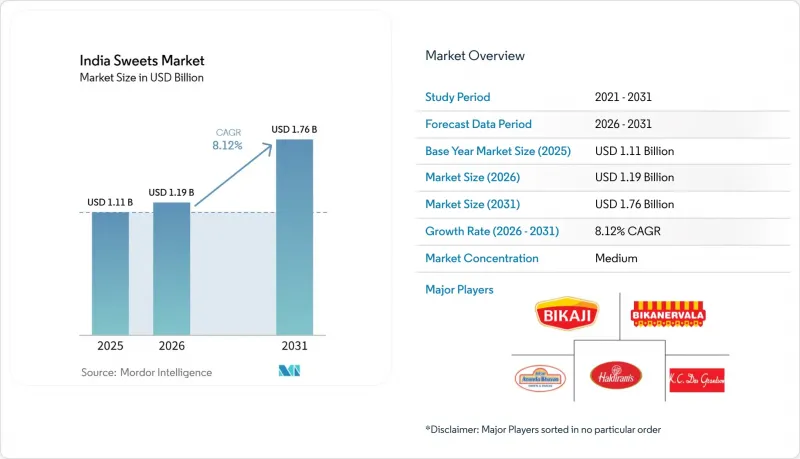
This report is Segmented by Product Type (Rasgulla and Gulab Jamun, Barfi, and More), Ingredient Type (Milk and Milk Derivatives, Cereal and Pulses, Dry Fruits, and Others), Packaging Type (Boxes, Tins and Jars, and More), Distribution Channel (Supermarkets/Hypermarkets, Convenience and Grocery Stores, and More). The Market Forecasts are Provided in Both Value (USD) and Volume (Tons).
India Sweets Market Trends and Insights
Growing demand for premium and artisanal Indian sweets
Consumers are increasingly seeking premium-quality Indian sweets made using authentic recipes, high-grade ingredients, and artisanal production methods, prompting manufacturers to expand their premium product portfolios. Demand is growing for sweets made with pure desi ghee, premium dry fruits, saffron, natural flavors, and preservative-free formulations, particularly for festive gifting and special occasions. Premium packaging, handcrafted presentation, and regional specialty offerings are further adding product value and supporting brand differentiation. For instance, in September 2024, Priniti Foods entered the premium Indian sweets category by launching five traditional sweets such as Rasgulla, Gulab Jamun, Dry Fruit Panjeeri Ladoo, Dry Fruit Besan Ladoo, and Soan Papdi, strengthening its presence in the premium packaged sweets segment. This trend continues to drive innovation and premiumization across the India sweets market.
Rising popularity of festive and gifting culture
India's festive and gifting culture remains a key driver of the sweets market, as traditional sweets are an integral part of festivals, weddings, religious ceremonies, family celebrations, and corporate gifting. Growing consumer preference for premium packaged sweets, curated gift hampers, and customized assortments is encouraging manufacturers to introduce festive collections, premium packaging, and value-added offerings. This seasonal demand supports both higher sales volumes and product premiumization. For instance, according to the Agricultural and Processed Food Products Export Development Authority (APEDA), Diwali spending in 2025 reached approximately USD 69 billion, with food and grocery purchases accounting for a significant share, highlighting the role of festive consumption in driving demand for sweets across India .
Short shelf life of traditional sweets
The short shelf life of traditional Indian sweets is a significant restraint on market growth, particularly for fresh and dairy-based products that are vulnerable to microbial contamination, moisture migration, texture degradation, and flavor deterioration. Many popular sweets require immediate consumption or refrigerated storage to maintain freshness, taste, and quality, limiting their commercial viability over extended periods. This creates challenges in inventory planning, stock rotation, and demand forecasting, often resulting in higher product wastage and increased returns for manufacturers and retailers. Limited shelf life also restricts interstate distribution, export potential, and expansion into distant markets where longer transportation times are involved. To address these challenges, manufacturers must invest in advanced preservation technologies, improved packaging solutions, cold-chain infrastructure, and quality assurance systems, all of which increase production complexity and operational costs.
Other drivers and restraints analyzed in the detailed report include:
- Innovation in healthier sweet formulations
- Growth of online food delivery and quick commerce platforms
- Stringent food safety and quality compliance requirements
For complete list of drivers and restraints, kindly check the Table Of Contents.
Segment Analysis
Rasgulla and Gulab Jamun together accounted for the largest product-type share at 29.43% in 2025, driven by their enduring cultural relevance, widespread consumer acceptance, and year-round demand across multiple consumption occasions. Their strong association with celebrations, festivals, family gatherings, and religious traditions ensures consistent purchase frequency throughout the year. Improvements in hygienic production, packaging, and shelf-life extension have enabled manufacturers to expand availability while maintaining product freshness and quality. Premiumization through the use of high-quality dairy ingredients, authentic recipes, and attractive gifting formats has further strengthened their market position. Their ability to retain traditional appeal while adapting to evolving retail and packaging standards continues to reinforce their dominance within the India sweets market.
Barfi is the fastest-growing product type at a CAGR of 9.09% during 2026-2031, driven by increasing innovation in premium formulations, ingredient diversification, and value-added product offerings. Manufacturers are introducing variants enriched with dry fruits, saffron, chocolate, millet, and reduced-sugar ingredients to meet changing consumer preferences for differentiated sweets. Improved packaging, premium gifting appeal, and better preservation technologies have expanded the product's accessibility across organized retail and online channels while maintaining quality. Growing consumer interest in artisanal products, regional specialties, and contemporary flavor combinations is further accelerating demand, positioning Barfi as one of the most rapidly expanding categories in the India sweets market.
Milk and milk derivatives held a 57.89% ingredient share in 2025, reflecting their fundamental role in defining the taste, texture, aroma, and richness of traditional Indian sweets. Their functional properties enable the preparation of a wide variety of products while delivering the creaminess and mouthfeel that consumers associate with premium-quality mithai. Improvements in dairy processing, quality assurance, and cold-chain infrastructure have enhanced ingredient consistency and product quality, allowing manufacturers to maintain traditional characteristics at larger production scales. The growing emphasis on purity, authentic recipes, and high-quality dairy ingredients has further reinforced the preference for milk-based formulations, ensuring that dairy remains the cornerstone of India's sweets industry.
Dry fruits are projected to be the fastest-growing ingredient segment at a CAGR of 9.33% during 2026-2031, driven by increasing demand for premium, nutrient-rich, and value-added sweet offerings. Manufacturers are incorporating ingredients such as almonds, pistachios, cashews, walnuts, and dates to enhance taste, texture, visual appeal, and perceived product quality. The rising popularity of premium gifting, festive assortments, and artisanal sweets has further accelerated the use of dry fruits as a key differentiating ingredient. Additionally, product innovation featuring dry fruit-rich formulations, clean-label positioning, and healthier indulgence options is expanding consumer appeal, supporting sustained growth of this ingredient segment across the forecast period.
Complete Report Scope:
- By Product Type
- Rasgulla and Gulab Jamun
- Barfi
- Soan Papdi
- Peda
- Laddoo
- Others
- By Ingredient Type
- Milk and Milk Derivatives
- Cereal and Pulses
- Dry Fruits
- Others
- By Packaging Type
- Boxes
- Tins And Jars
- Plastic Containers
- Flexible Packs
- By Distribution Channel
- Supermarkets/Hypermarkets
- Convenience and Grocery Stores
- Specialty Stores
- Online Retail Stores
- Other Distribution Channels
List of Companies Covered in this Report:
- Haldirams Snacks Pvt. Ltd
- Bikaji Foods International Limited
- Bikanervala Foods Private Limited
- Adyar Ananda Bhavan Sweets Pvt Ltd
- K. C. Das Grandson Pvt. Ltd.
- N K Food Products
- Lal Sweets Private Limited
- Karnataka Milk Federation
- Gujarat Co-operative Milk Marketing Federation Limited
- Tamil Nadu Co-operative Milk Producers Federation Limited
- Odisha State Co-operative Milk Producers Federation Limited
- Bihar State Co-operative Milk Producers Federation Limited
- Parag Milk Foods Limited
- Mother Dairy Fruit and Vegetable Private Limited
- ITC Limited
- Nestle India Limited
- Perfetti Van Melle India Private Limited
- DS Group
- Lotte India Corporation Limited
- Parle Products Private Limited
Additional Benefits:
- The market estimate (ME) sheet in Excel format
- 3 months of analyst support
TABLE OF CONTENTS
1 INTRODUCTION
- 1.1 Study Assumptions and Market Definition
- 1.2 Scope of the Study
2 RESEARCH METHODOLOGY
3 EXECUTIVE SUMMARY
4 MARKET LANDSCAPE
- 4.1 Market Overview
- 4.2 Market Drivers
- 4.2.1 Growing demand for premium and artisanal Indian sweets
- 4.2.2 Rising popularity of festive and gifting culture
- 4.2.3 Innovation in healthier sweet formulations
- 4.2.4 Growth of online food delivery and quick commerce platforms
- 4.2.5 Increasing demand for regional and traditional specialty sweets
- 4.2.6 Product innovation through fusion and contemporary flavors
- 4.3 Market Restraints
- 4.3.1 Short shelf life of traditional sweets
- 4.3.2 Stringent food safety and quality compliance requirements
- 4.3.3 Adulteration and counterfeit products affecting consumer trust
- 4.3.4 Dependence on perishable dairy ingredients
- 4.4 Technological Outlook
- 4.5 Regulatory Landscape
- 4.6 Supply-Chain Analysis
- 4.7 Porter's Five Forces Analysis
- 4.7.1 Threat of New Entrants
- 4.7.2 Bargaining Power of Buyers
- 4.7.3 Bargaining Power of Suppliers
- 4.7.4 Threat of Substitutes
- 4.7.5 Intensity of Competitive Rivalry
5 MARKET SIZE AND GROWTH FORECASTS (VALUE AND VOLUME)
- 5.1 By Product Type
- 5.1.1 Rasgulla and Gulab Jamun
- 5.1.2 Barfi
- 5.1.3 Soan Papdi
- 5.1.4 Peda
- 5.1.5 Laddoo
- 5.1.6 Others
- 5.2 By Ingredient Type
- 5.2.1 Milk and Milk Derivatives
- 5.2.2 Cereal and Pulses
- 5.2.3 Dry Fruits
- 5.2.4 Others
- 5.3 By Packaging Type
- 5.3.1 Boxes
- 5.3.2 Tins And Jars
- 5.3.3 Plastic Containers
- 5.3.4 Flexible Packs
- 5.4 By Distribution Channel
- 5.4.1 Supermarkets/Hypermarkets
- 5.4.2 Convenience and Grocery Stores
- 5.4.3 Specialty Stores
- 5.4.4 Online Retail Stores
- 5.4.5 Other Distribution Channels
6 COMPETITIVE LANDSCAPE
- 6.1 Market Concentration
- 6.2 Strategic Moves
- 6.3 Market Positioning Analysis
- 6.4 Company Profiles (includes Global level Overview, Market level overview, Core Segments, Financials as available, Strategic Information, Market Rank/Share for key companies, Products and Services, and Recent Developments)
- 6.4.1 Haldirams Snacks Pvt. Ltd
- 6.4.2 Bikaji Foods International Limited
- 6.4.3 Bikanervala Foods Private Limited
- 6.4.4 Adyar Ananda Bhavan Sweets Pvt Ltd
- 6.4.5 K. C. Das Grandson Pvt. Ltd.
- 6.4.6 N K Food Products
- 6.4.7 Lal Sweets Private Limited
- 6.4.8 Karnataka Milk Federation
- 6.4.9 Gujarat Co-operative Milk Marketing Federation Limited
- 6.4.10 Tamil Nadu Co-operative Milk Producers Federation Limited
- 6.4.11 Odisha State Co-operative Milk Producers Federation Limited
- 6.4.12 Bihar State Co-operative Milk Producers Federation Limited
- 6.4.13 Parag Milk Foods Limited
- 6.4.14 Mother Dairy Fruit and Vegetable Private Limited
- 6.4.15 ITC Limited
- 6.4.16 Nestle India Limited
- 6.4.17 Perfetti Van Melle India Private Limited
- 6.4.18 DS Group
- 6.4.19 Lotte India Corporation Limited
- 6.4.20 Parle Products Private Limited
7 MARKET OPPORTUNITIES AND FUTURE OUTLOOK

