PUBLISHER: Mordor Intelligence | PRODUCT CODE: 2099824

PUBLISHER: Mordor Intelligence | PRODUCT CODE: 2099824
Breast Tissue Markers - Market Share Analysis, Industry Trends & Statistics, Growth Forecasts (2026 - 2031)
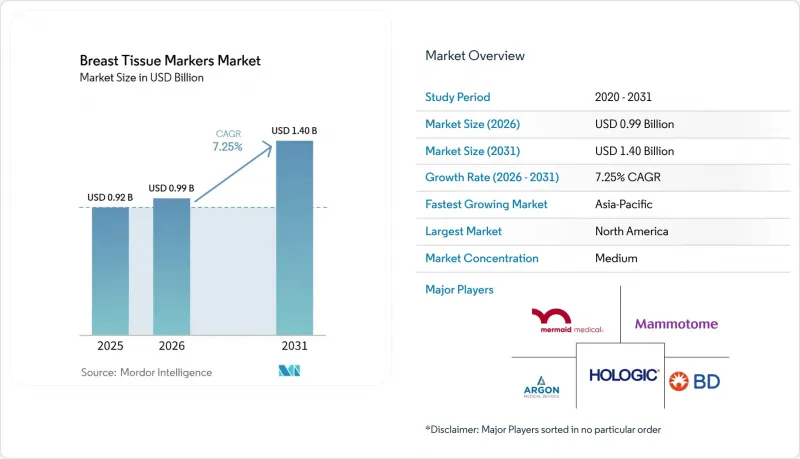
According to Mordor Intelligence, the breast tissue markers market size is expected to grow from USD 0.92 billion in 2025 to USD 0.99 billion in 2026 and is forecast to reach USD 1.40 billion by 2031 at 7.25% CAGR over 2026-2031.
This report is Segmented by Product (Coil, Ribbon, Wing, U Shaped, Conic, Ring, Heart, Venus, Others), Material (Bio-Absorbable, Non-Absorbable), Usage Type (Biopsy, Image-Guided Biopsy, Surgical Planning, Others), End User (Hospitals, Ambulatory Surgical Centers, Diagnostic Centers, Specialty Clinics), and Geography (North America, Europe, Asia-Pacific, MEA, South America). Market Forecasts in Value (USD).
Global Breast Tissue Markers Market Trends and Insights
Rising Breast Cancer Screening and Biopsy Volumes Drive Structural Demand
The breast tissue markers market remains closely linked to the screening pathway, as abnormal findings that proceed to biopsy often require markers for future localization and imaging follow-up. Each additional screening mammogram creates a measurable probability of abnormal findings moving to biopsy, and many benign biopsies still require accurate site marking for downstream care. A nationwide AI-assisted screening study published in Nature Medicine in 2025 reported a breast cancer detection rate of 6.7 per 1,000 women in the AI-supported cohort and a biopsy positive predictive value of 64.5%, indicating that improved screening tools strengthened case quality rather than reduced marker placement needs. With the WHO reporting 2.4 million new breast cancer diagnoses globally in 2024, the breast tissue markers market continues to benefit from a broad clinical pipeline that is unlikely to weaken in the near term.
Shift toward Non-Wire, Image-Guided Localization Opens Adjacent Procedure Volume
The breast tissue markers market is expanding beyond basic clip placement, as wire-free and image-guided localization systems support both biopsy follow-up and surgical navigation. Clinicians have long used wire-guided localization for non-palpable breast lesions, but wireless systems eliminate same-day wire placement constraints and reduce dependence on operating room scheduling. In a French cancer center study covering the first 200 procedures, the Sirius Pintuition system achieved successful primary lesion excision and marker retrieval in all cases, while the re-excision rate required to achieve margin clearance was 9%. In February 2025, Mammotome and Sirius Medical entered an exclusive distribution agreement covering the United States and Germany, giving the system broader commercial access through an established breast care sales network.
Marker Migration and Localization Accuracy Concerns Persist Despite Advances
The breast tissue markers market continues to face a key clinical challenge, as marker displacement can affect localization accuracy between biopsy and surgery. This risk is more pronounced when the biopsy cavity changes shape, fills with fluid, or shrinks after systemic therapy, as these conditions can shift the marker position. A 2026 PubMed Central study found that the Scout radar reflector produced off-target temperature measurement artifacts ranging from -30°C to +100°C in nearby MRI voxels, while the French Sirius Pintuition study reported marker dislodgement during surgery in 17 of 200 cases, although surgeons successfully excised the primary lesion in all cases. As a result, the market continues to favor designs that improve tissue grip and reduce displacement during excision.
Other drivers and restraints analyzed in the detailed report include:
- Demand for MRI-Visible and Multi-Modality Compatibility Reshapes Product Design
- Expansion of Ambulatory and Same-Day Breast Procedures Reconfigures End-User Economics
- Reimbursement and Coverage Gaps Slow Adoption of Advanced Marker Formats
For complete list of drivers and restraints, kindly check the Table Of Contents.
Segment Analysis
Coil markers accounted for 35.65% of product revenue in 2025, making them the largest product format in the breast tissue markers market. Their leadership reflected established use with vacuum-assisted biopsy systems and strong clinical familiarity among radiologists interpreting mammography and MRI after placement. Coil formats also supported routine workflows because many breast imaging centers already used common delivery devices for deployment.
Heart-shaped markers are forecast to grow at a CAGR of 8.93% through 2031, making them the fastest-growing product category in the breast tissue markers market. Their adoption is supported by stronger tissue adherence in cases where cavity shape changes may increase displacement risk. Mammotome expanded access to HydroMARK Plus shapes in 2026, including Dragonfly and Hummingbird options with exposed wing structures that engage tissue after hydrogel hydration. Ribbon, wing, U-shaped, ring, conic, and Venus designs remain relevant in specific use cases, while product selection increasingly depends on imaging performance and surgical handling.
Bio-absorbable markers held 65.23% of the breast tissue markers market size within the material segment in 2025, making them the clear revenue leader. Their strong position reflected rising preference for products that reduce retained foreign-body load during long follow-up periods after treatment. This factor became more important as surveillance imaging increased and treatment pathways increasingly included systemic therapy before surgery.
The same segment is projected to expand at a CAGR of 9.67% through 2031, placing bio-absorbable products at the forefront of material growth in the breast tissue markers market. Carbon Medical Technologies received EU MDR certification for its BiomarC Tissue Marker System in April 2025, supporting European access for a non-metallic marker line designed for visibility under ultrasound, mammography, CT, and MRI. A 2025 US patent application describing a drug-refillable biodegradable tissue marker architecture indicated that the material category was moving toward broader functionality beyond site marking.
Complete Report Scope:
- By Product
- Coil
- Ribbon
- Wing
- U Shaped
- Conic
- Ring
- Heart
- Venus
- Other Product Types
- By Material
- Bio-absorbable
- Non-Absorbable
- By Usage Type
- Biopsy
- Stereotactic-Guided Biopsy
- Ultrasound-Guided Biopsy
- MRI-Guided Biopsy
- Surgical Planning
- Other Usage Types
- By End User
- Hospitals
- Ambulatory Surgical Centers
- Diagnostic Centers
- Specialty Clinics
- By Geography
- North America
- United States
- Canada
- Mexico
- Europe
- Germany
- United Kingdom
- France
- Italy
- Spain
- Rest of Europe
- Asia-Pacific
- China
- India
- Japan
- Australia
- South Korea
- Rest of Asia-Pacific
- Middle East and Africa
- GCC
- South Africa
- Rest of Middle East and Africa
- South America
- Brazil
- Argentina
- Rest of South America
- North America
Geography Analysis
North America accounted for 38.56% of global revenue in 2025, making it the largest regional bloc in the breast tissue markers market. High screening penetration, extensive breast imaging infrastructure, and reimbursement systems that support marker placement within routine biopsy workflows strengthen regional demand. The United States remains the core revenue base, supported by large case volumes, with 321,910 invasive breast cancer diagnoses and 60,730 ductal carcinoma in situ diagnoses expected in 2026. Mammotome also continues to expand HydroMARK Plus access across North American pathways following its 2026 regulatory clearances.
Europe remains a key contributor to the breast tissue markers market, supported by organized screening programs in Germany, France, the United Kingdom, and Italy that sustain biopsy referral volumes. Reimbursement and regulatory frameworks play a strong role in product adoption across the region. In France, the inclusion of Magseed in the SE08 reimbursement package at EUR 390.16 per placement in January 2026 reduced the cost barrier for wireless localization in hospital practice. EU MDR compliance standards also favor companies with stronger clinical evidence and established post-market systems, increasing entry barriers for smaller suppliers.
Asia-Pacific is the fastest-growing region, with the breast tissue markers market size projected to expand at a CAGR of 8.56% through 2031. China represents the largest regional opportunity, as breast cancer incidence has surpassed 300,000 new cases annually, and national screening expansion continues to widen the downstream pool for biopsy and marker placement. Large urban centers are advancing image-guided localization, while underserved cities provide room for broader adoption as infrastructure improves. Japan and South Korea are well-positioned for multi-modality marker uptake, Australia benefits from established reimbursement pathways, and growth across Asia-Pacific, the Middle East, and Africa, and South America is supported by screening expansion, private hospital investment, and the shift toward image-guided breast care.
- Argon Medical Devices
- Beckton Dickinson
- Biopsy Sciences LLC
- Carbon Medical Technologies, Inc.
- Cianna Medical, Inc.
- Cook Group
- Elucent Medical, LLC
- Endomag Ltd
- Hologic
- INRAD
- Mammotome (Devicor Medical Products, LLC)
- Medax Medical Devices
- Medtronic
- Merit Medical Systems
- Mermaid Medical
- Scion Medical Technologies, LLC
- SOMATEX Medical Technologies GmbH
- Sterylab S.r.l.
- Tsunami S.r.l.
- Vigeo S.r.l.
Additional Benefits:
- The market estimate (ME) sheet in Excel format
- 3 months of analyst support
TABLE OF CONTENTS
1 INTRODUCTION
- 1.1 Study Assumptions and Market Definition
- 1.2 Scope of the Study
2 RESEARCH METHODOLOGY
3 EXECUTIVE SUMMARY
4 MARKET LANDSCAPE
- 4.1 Market Overview
- 4.2 Market Drivers
- 4.2.1 Rising Breast Cancer Screening and Biopsy Volumes
- 4.2.2 Shift Toward Non-Wire, Image-Guided Localization
- 4.2.3 Demand for MRI-Visible and Multi-Modality Compatible Markers
- 4.2.4 Expansion of Ambulatory and Same-Day Breast Procedures
- 4.2.5 Advancement in Biodegradable and Bioabsorbable Marker Materials
- 4.2.6 Improved Clinical Workflow and Surgical Planning Efficiency
- 4.3 Market Restraints
- 4.3.1 Marker Migration and Localization Accuracy Concerns
- 4.3.2 Reimbursement and Coverage Gaps for Advanced Marker Systems
- 4.3.3 Material Compliance and Sterilization Complexity
- 4.3.4 Limited Training and Clinical Familiarity in Emerging Markets
- 4.4 Supply/Value Chain Analysis
- 4.5 Regulatory Landscape
- 4.6 Technological Outlook
- 4.7 Porter's Five Forces Analysis
- 4.7.1 Threat of New Entrants
- 4.7.2 Bargaining Power of Suppliers
- 4.7.3 Bargaining Power of Buyers
- 4.7.4 Threat of Substitutes
- 4.7.5 Competitive Rivalry
5 MARKET SIZE AND GROWTH FORECASTS (VALUE, USD)
- 5.1 By Product
- 5.1.1 Coil
- 5.1.2 Ribbon
- 5.1.3 Wing
- 5.1.4 U Shaped
- 5.1.5 Conic
- 5.1.6 Ring
- 5.1.7 Heart
- 5.1.8 Venus
- 5.1.9 Other Product Types
- 5.2 By Material
- 5.2.1 Bio-absorbable
- 5.2.2 Non-Absorbable
- 5.3 By Usage Type
- 5.3.1 Biopsy
- 5.3.2 Stereotactic-Guided Biopsy
- 5.3.3 Ultrasound-Guided Biopsy
- 5.3.4 MRI-Guided Biopsy
- 5.3.5 Surgical Planning
- 5.3.6 Other Usage Types
- 5.4 By End User
- 5.4.1 Hospitals
- 5.4.2 Ambulatory Surgical Centers
- 5.4.3 Diagnostic Centers
- 5.4.4 Specialty Clinics
- 5.5 By Geography
- 5.5.1 North America
- 5.5.1.1 United States
- 5.5.1.2 Canada
- 5.5.1.3 Mexico
- 5.5.2 Europe
- 5.5.2.1 Germany
- 5.5.2.2 United Kingdom
- 5.5.2.3 France
- 5.5.2.4 Italy
- 5.5.2.5 Spain
- 5.5.2.6 Rest of Europe
- 5.5.3 Asia-Pacific
- 5.5.3.1 China
- 5.5.3.2 India
- 5.5.3.3 Japan
- 5.5.3.4 Australia
- 5.5.3.5 South Korea
- 5.5.3.6 Rest of Asia-Pacific
- 5.5.4 Middle East and Africa
- 5.5.4.1 GCC
- 5.5.4.2 South Africa
- 5.5.4.3 Rest of Middle East and Africa
- 5.5.5 South America
- 5.5.5.1 Brazil
- 5.5.5.2 Argentina
- 5.5.5.3 Rest of South America
- 5.5.1 North America
6 COMPETITIVE LANDSCAPE
- 6.1 Market Concentration
- 6.2 Market Share Analysis
- 6.3 Company Profiles (includes Global Level Overview, Market Level Overview, Core Segments, Financials as available, Strategic Information, Market Rank/Share, Products and Services, Recent Developments)
- 6.3.1 Argon Medical Devices, Inc.
- 6.3.2 Becton, Dickinson and Company
- 6.3.3 Biopsy Sciences LLC
- 6.3.4 Carbon Medical Technologies, Inc.
- 6.3.5 Cianna Medical, Inc.
- 6.3.6 Cook Medical LLC
- 6.3.7 Elucent Medical, LLC
- 6.3.8 Endomag Ltd
- 6.3.9 Hologic, Inc.
- 6.3.10 INRAD, Inc.
- 6.3.11 Mammotome (Devicor Medical Products, LLC)
- 6.3.12 Medax Medical Devices
- 6.3.13 Medtronic plc
- 6.3.14 Merit Medical Systems, Inc.
- 6.3.15 Mermaid Medical A/S
- 6.3.16 Scion Medical Technologies, LLC
- 6.3.17 SOMATEX Medical Technologies GmbH
- 6.3.18 Sterylab S.r.l.
- 6.3.19 Tsunami S.r.l.
- 6.3.20 Vigeo S.r.l.
7 MARKET OPPORTUNITIES AND FUTURE OUTLOOK
- 7.1 White-Space and Unmet-Need Assessment

