PUBLISHER: Mordor Intelligence | PRODUCT CODE: 2099832

PUBLISHER: Mordor Intelligence | PRODUCT CODE: 2099832
India Bulk Transport - Market Share Analysis, Industry Trends & Statistics, Growth Forecasts (2026 - 2031)
According to Mordor Intelligence, the India bulk transport market size is expected to increase from USD 120.18 billion in 2025 to USD 130.57 billion in 2026 and reach USD 190.86 billion by 2031, growing at a CAGR of 7.89% over 2026-2031.
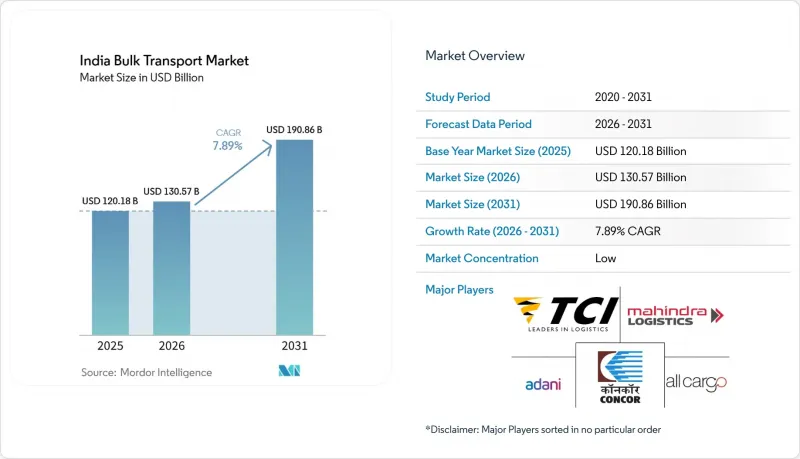
Public investment remains the backbone of this expansion, with FY27 capital expenditure raised to INR 12.2 lakh crore (USD 145.70 billion), keeping road, rail, port, and industrial projects active across the country. This report is Segmented by Mode of Transport (Road, Rail, Waterways, Other Modes of Transport), by Shipment Form (Dry Bulk, Liquid and Gaseous Bulk, Breakbulk), and by End User Industry (Agricultural Bulk, Mineral and Metal Ores, Energy Commodities, Construction Aggregates and Cement, Industrial Chemicals and Fertilizers, Others). The Market Forecasts are Provided in Terms of Value (USD) and Volume.
India Bulk Transport Market Trends and Insights
Industrial Capex and Infrastructure-Material Flows
India's public and private investment cycle remains the deepest structural support for bulk freight demand in the India bulk transport market. The Union Budget 2026-27 raised public capital expenditure to INR 12.2 lakh crore (USD 145.70 billion), which preserved multi-year momentum in highways, railways, ports, and allied industrial infrastructure. Steel and cement production, which are the 2 largest construction-linked commodity generators in this space, grew by 9.10% and 8.60% through FY26, keeping demand for iron ore, coking coal, aggregates, and clinker high. Private sector capital expenditure also rose 67% to INR 7.7 lakh crore (USD 91.96 billion) in the first half of FY26, led by metals, automobiles, and chemicals, which broadened the freight base beyond public works alone. As new facilities begin production, the weak point quickly shifts from demand creation to plant-gate connectivity, especially where rail sidings and high-quality feeder roads are missing. That shift gives third-party logistics operators and corridor specialists a larger role because many shippers now need integrated port, rail, and road execution rather than a single transport leg.
Dedicated Freight Corridors and Multimodal Park Rollout
The completed DFC network changes the economics of long-haul bulk movement in the India bulk transport market. The Eastern DFC was already operational, and the final Western DFC section completed its successful trial run on March 31, 2026, which closes a major infrastructure gap on one of India's most important freight systems. On commissioned sections, freight trains averaged 2.44 hours per 100 km against 5.25 hours on conventional mixed-use routes, which materially improves rail's value proposition for dense bulk flows on longer corridors. Planned Gati Shakti Multi-Modal Cargo Terminals along these corridors should make the benefits more durable, as faster trunk movement becomes more useful when aggregation and interchange points are available near production and consumption centers. The new Dankuni-Surat DFC also extends this logic into mineral-rich territory, which matters because the east-to-west industrial arc accounts for a large share of ore, coal, steel inputs, and heavy industrial loads. As more cargo is drawn into corridor-linked networks, the market should see a gradual shift from standalone road hauling toward planned multimodal chains.
Fragmented Truck Fleet and Driver Shortage
Road freight still carries the largest volume base, but its structure also creates one of the clearest limits on the India bulk transport market. Around 75-77% of truck operators own fewer than 5 vehicles, which keeps the sector price-led, weakly capitalized, and uneven in technology adoption. India had nearly 6 million trucks on the road but only around 3.6 million active drivers, meaning 25-30% of fleet capacity sat idle on a typical day and directly constrained throughput at. This shortage matters most for construction materials, agricultural cargo, and industrial chemicals, because these lanes often depend on spot market trucking across semi-urban and regional routes. When demand rises suddenly, small operators usually respond through price increases rather than through disciplined redeployment of spare assets. The result is higher rate volatility, weaker service quality, and a hard ceiling on how much incremental industrial output road freight can absorb without rising cost pressure.
Other drivers and restraints analyzed in the detailed report include:
- National Logistics Policy, PM Gati Shakti, and ULIP Integration
- Inland Waterways and Coastal-Shipping Promotion
- Rail Siding and Plant-Gate First/Last-Mile Gaps
For complete list of drivers and restraints, kindly check the Table Of Contents.
Segment Analysis
Road freight held 65.88% of the India bulk transport market share in 2025, reflecting its unmatched end-point reach and ability to serve sites without rail or water access. That lead remains important because bulk cargo still depends heavily on flexible pickup and delivery across mines, plants, storage yards, and construction sites. The logistics cost assessment cited in the source draft found that heavy-duty trailers weighing more than 55 tonnes operated at INR 1.51 (USD 0.016) per tonne-km for bulk movement, thereby keeping the road attractive where transfer points were limited. Indian Railways loaded a record 1,670.00 MT in FY26, with fertilizer up 13.49% and pig iron and finished steel up 13.11%, which showed that rail demand was strengthening in core industrial categories. These numbers show that the road remains essential, but they also indicate that the balance is beginning to shift, with freight density and corridor quality supporting rail substitution.
Waterways is projected to expand at a 9.57% CAGR, making it the fastest-growing slice of the India bulk transport market through 2031. National waterways cargo reached 198.00 MMT through February 2026, which confirms that the traffic base is becoming meaningful rather than experimental. The government also wants inland water transport and coastal freight to take a larger share of heavy cargo, which supports longer-term rebalancing across modes. Other modes, including multimodal service bundles, matter beyond their current volume because organized operators are now packaging road, rail, and coastal shipping into unified contracts. That trend should steadily narrow road's structural lead and deepen the role of planned network design in the India bulk transport industry.
Complete Report Scope:
- By Mode of Transport
- Road
- Rail
- Waterways
- Other Modes of Transport, including Multimodal
- By Shipment Form
- Dry Bulk
- Liquid and Gaseous Bulk
- Breakbulk
- By End User Industry
- Agricultural Bulk
- Mineral and Metal Ores
- Energy Commodities (Crude/LNG/Refined)
- Construction Aggregates and Cement
- Industrial Chemicals and Fertilizers
- Others
List of Companies Covered in this Report:
- Transport Corporation of India Ltd.
- Container Corporation of India Ltd.
- Adani Logistics Ltd.
- Allcargo Logistics Ltd.
- Mahindra Logistics Ltd.
- CJ Darcl Logistics Ltd.
- Safexpress Pvt. Ltd.
- VRL Logistics Ltd.
- V-Trans (India) Ltd.
- OM Logistics Ltd.
- Nippon Express Holdings
- DHL Group
- DSV A/S
- Kuehne+Nagel
- A.P. Moller - Maersk
- Gateway Rail Freight Ltd.
- DP World
- Aegis Logistics Ltd.
- Sical Logistics Ltd.
- Express Roadways Pvt Ltd.
Additional Benefits:
- The market estimate (ME) sheet in Excel format
- 3 months of analyst support
TABLE OF CONTENTS
1 Introduction
- 1.1 Study Assumptions and Market Definition
- 1.2 Scope of the Study
2 Research Methodology
3 Executive Summary
4 Market Landscape
- 4.1 Market Overview
- 4.2 Market Drivers
- 4.2.1 Industrial Capex and Infrastructure-Material Flows
- 4.2.2 Dedicated Freight Corridors and Multimodal Park Rollout
- 4.2.3 National Logistics Policy, PM Gati Shakti, and ULIP Integration
- 4.2.4 Inland Waterways and Coastal-Shipping Promotion
- 4.2.5 Sectoral Logistics Blueprints for Coal, Cement, Steel, and Fertilizers
- 4.2.6 Digital Freight Matching and Organized Freight Procurement
- 4.3 Market Restraints
- 4.3.1 Fragmented Truck Fleet and Driver Shortage
- 4.3.2 Rail Siding and Plant-Gate First/Last-Mile Gaps
- 4.3.3 Hazardous-Cargo and Axle-Load Compliance Pressure
- 4.3.4 Fuel Price Volatility and Cost Pass-Through Constraints
- 4.4 Value Chain and Supply Chain Analysis
- 4.5 Regulatory Landscape
- 4.6 Technological Outlook
- 4.7 Infrastructure and Corridor Analysis
- 4.8 Porter's Five Forces Analysis
- 4.8.1 Threat of New Entrants
- 4.8.2 Bargaining Power of Suppliers
- 4.8.3 Bargaining Power of Buyers
- 4.8.4 Threat of Substitutes
- 4.8.5 Competitive Rivalry
- 4.9 Impact of Geopolitical Events on the Market
5 Market Size and Growth Forecasts (Value and Volume)
- 5.1 By Mode of Transport
- 5.1.1 Road
- 5.1.2 Rail
- 5.1.3 Waterways
- 5.1.4 Other Modes of Transport, including Multimodal
- 5.2 By Shipment Form
- 5.2.1 Dry Bulk
- 5.2.2 Liquid and Gaseous Bulk
- 5.2.3 Breakbulk
- 5.3 By End User Industry
- 5.3.1 Agricultural Bulk
- 5.3.2 Mineral and Metal Ores
- 5.3.3 Energy Commodities (Crude/LNG/Refined)
- 5.3.4 Construction Aggregates and Cement
- 5.3.5 Industrial Chemicals and Fertilizers
- 5.3.6 Others
6 Competitive Landscape
- 6.1 Market Concentration
- 6.2 Strategic Moves
- 6.3 Market Share Analysis
- 6.4 Company Profiles (Includes Global Level Overview, Market Level Overview, Core Segments, Financials as Available, Strategic Information, Market Rank/Share for Key Companies, Products and Services, and Recent Developments)
- 6.4.1 Transport Corporation of India Ltd.
- 6.4.2 Container Corporation of India Ltd.
- 6.4.3 Adani Logistics Ltd.
- 6.4.4 Allcargo Logistics Ltd.
- 6.4.5 Mahindra Logistics Ltd.
- 6.4.6 CJ Darcl Logistics Ltd.
- 6.4.7 Safexpress Pvt. Ltd.
- 6.4.8 VRL Logistics Ltd.
- 6.4.9 V-Trans (India) Ltd.
- 6.4.10 OM Logistics Ltd.
- 6.4.11 Nippon Express Holdings
- 6.4.12 DHL Group
- 6.4.13 DSV A/S
- 6.4.14 Kuehne+Nagel
- 6.4.15 A.P. Moller - Maersk
- 6.4.16 Gateway Rail Freight Ltd.
- 6.4.17 DP World
- 6.4.18 Aegis Logistics Ltd.
- 6.4.19 Sical Logistics Ltd.
- 6.4.20 Express Roadways Pvt Ltd.
7 Market Opportunities and Future Outlook
- 7.1 White-space and unmet-need assessment

