PUBLISHER: Mordor Intelligence | PRODUCT CODE: 2099862

PUBLISHER: Mordor Intelligence | PRODUCT CODE: 2099862
Germany Indoor Farming - Market Share Analysis, Industry Trends & Statistics, Growth Forecasts (2026 - 2031)
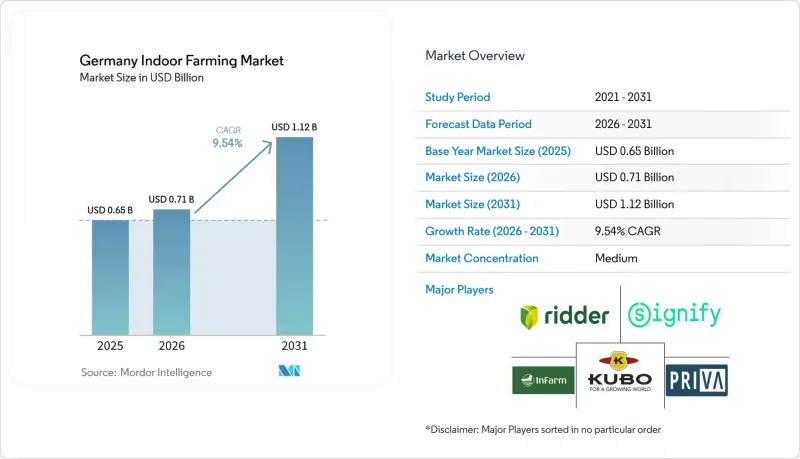
According to Mordor Intelligence, the Germany indoor farming market is forecasted to grow from USD 650 million in 2025 to USD 711.8 million in 2026, reaching USD 1,117.7 million by 2031, at a CAGR of 9.54% over 2026-2031.
This report is Segmented by Growing System (Aeroponics, Hydroponics, Aquaponics, and More), by Facility Type (Glass or Poly Greenhouses, Indoor Vertical Farms, and More), and by Crop Type (Fruits and Vegetables, Herbs and Microgreens, and More). The Market Forecasts are Provided in Terms of Value (USD).
Germany Indoor Farming Market Trends and Insights
Urban Demand for Fresh, Pesticide-Free Produce
Germany's organic food market is growing, indicating that demand for traceable and clean-label food extends beyond a small premium niche. Discount retailers now account for a substantial share of organic purchases, reflecting broad everyday adoption rather than occasional premium buying. This shift is relevant to indoor farming because leafy greens, herbs, and strawberries grown indoors can be sold through large supermarket channels where freshness, shelf life, and pesticide-free positioning carry commercial weight. Private-label contracts through discounters also give growers access to stable volume that was previously difficult to secure when indoor produce was sold primarily through specialty retail. As a result, the Germany indoor farming market is supported by recurring food demand tied to mainstream retail rather than a narrow high-end consumer segment.
LED Efficiency and Climate Control Cost Declines
Commercial horticultural LED fixtures sold in 2025 and 2026 routinely exceeded 3.5 µmol/J efficacy, which was linked to a 30%-40% reduction in electricity use for the same light intensity. Signify reinforced this trend in June 2025 with the launch of the Philips GrowWise smart spectrum algorithm, which the company stated can reduce energy use or increase crop growth by up to 6% through real-time light adjustment. In 2026, Ridder and Signify formalized integration under the Horti Lighting Protocol, giving growers a more direct route to connected control without extensive custom integration work. Additionally, NLight's centralized DC architecture claims a 10%-20% capital expenditure reduction for greenhouse lighting projects, which is significant in a market where power costs can determine project viability. While these developments do not eliminate energy risk, they narrow one of the largest cost gaps that has constrained smaller facilities. As a result, the Germany indoor farming market is seeing a clearer path toward commercially viable projects at more modest scales and in more urban settings.
High Capital Expenditure and Energy Intensity
Capital expenditure for a medium-scale vertical farm is regularly increasing and energy costs account for 40%-70% of operating expenditure in fully enclosed systems, which explains why energy price volatility has had a strong effect on investor confidence. This burden is especially difficult for new operators that need to scale output before they can negotiate better procurement terms or spread overhead across larger volumes. Partial solutions are emerging, including Schneebergerhof's March 2026 greenhouse opening with direct wind and solar power supply. Durr AG's EcoY system, launched in June 2025, uses grow-tube technology that can reduce water use by up to 95% and applies supplemental LED lighting only where natural daylight is insufficient. Even so, high upfront capital requirements and power intensity will continue to slow the Germany indoor farming market until lower-cost engineering and stronger energy integration become more widespread across commercial projects.
Other drivers and restraints analyzed in the detailed report include:
- Shrinking Arable Land and Weather Volatility
- Year-Round Production Strengthens Grocery Supply Reliability
- Shortage of Skilled Horticulture and Automation Talent
For complete list of drivers and restraints, kindly check the Table Of Contents.
Segment Analysis
Hydroponics held 47.8% of the Germany indoor farming market in 2025, making it the clear operating base for commercial production. Its lead reflects a favorable cost-to-yield profile, a broader equipment supply base, and production methods that operators understand well enough to scale with lower execution risk. Aquaponics and soil-based systems remain present but are more limited in scope, as biological complexity is higher in aquaponics and yield intensity is lower in soil-based formats. Hybrid systems are drawing interest where crop flexibility matters, yet their market position remains modest as most operators prefer proven system designs during the current financing cycle.
Aeroponics is forecast to be the fastest-growing system between 2026 and 2031, at a CAGR of 15.8%, reflecting a shift in performance expectations. This outlook is linked to maturing precision misting technology and growing interest in water efficiency, particularly for high-value herbs, microgreens, and specialty strawberries. In June 2025, Korber Technologies and Veganz Group AG introduced the OrbiFarm platform, reporting trial yields up to 36 times higher than conventional cultivation in Fraunhofer testing, which has drawn strategic attention to the system even before broad commercial rollout. Closed-loop hydroponic systems use only 5% of the water required by conventional field cultivation, and aeroponics reduces water input further. In the Germany indoor farming market, this efficiency gap is increasingly relevant as buyers pay closer attention to resource use and supply stability. Hydroponics is anticipated to remain the dominant system in the near term, while aeroponics is likely to capture a larger share of new high-efficiency projects as commercial validation improves.
Complete Report Scope:
- By Growing System
- Aeroponics
- Hydroponics
- Aquaponics
- Soil-Based
- Hybrid
- By Facility Type
- Glass or Poly Greenhouses
- Indoor Vertical Farms
- Container Farms
- Indoor Deep-Water Culture Systems
- Other Facility Types
- By Crop Type
- Fruits and Vegetables
- Leafy Vegetables
- Tomato
- Strawberry
- Eggplant
- Other Fruits and Vegetables
- Herbs and Microgreens
- Basil
- Tarragon
- Wheatgrass
- Other Herbs and Microgreens
- Flowers and Ornamentals
- Perennials
- Annuals
- Ornamentals
- Other Flowers and Ornamentals
- Other Crop Types
- Fruits and Vegetables
List of Companies Covered in this Report:
- Infarm Group GmbH
- Vertical Farm Systems GmbH
- Siemens AG
- Signify N.V. (Philips Horticulture LED Solutions)
- Priva Holding B.V.
- Ridder Holding B.V.
- KUBO Group B.V.
- Netafim Ltd.
- Grodan B.V.
- Valoya Oy
- Stulz GmbH
- Bosch Rexroth AG
- Yaskawa Electric Corporation
- Urban Crop Solutions
- Agrotonomy
Additional Benefits:
- The market estimate (ME) sheet in Excel format
- 3 months of analyst support
TABLE OF CONTENTS
1 INTRODUCTION
- 1.1 Study Assumptions and Market Definition
- 1.2 Scope of the Study
2 RESEARCH METHODOLOGY
3 EXECUTIVE SUMMARY
4 MARKET LANDSCAPE
- 4.1 Market Overview
- 4.2 Market Drivers
- 4.2.1 Urban demand for fresh, pesticide-free produce
- 4.2.2 LED efficiency and climate control cost declines
- 4.2.3 Shrinking arable land and weather volatility
- 4.2.4 Year-round production strengthens grocery supply reliability
- 4.2.5 Repurposing vacant industrial real estate
- 4.2.6 Carbon and energy efficiency monetization
- 4.3 Market Restraints
- 4.3.1 High capital expenditure and energy intensity
- 4.3.2 Shortage of skilled horticulture and automation talent
- 4.3.3 Investment pullback after operator failures
- 4.3.4 Urban grid capacity constraints
- 4.4 Regulatory Landscape
- 4.5 Technological Outlook
- 4.6 Porter's Five Forces Analysis
- 4.6.1 Threat of New Entrants
- 4.6.2 Bargaining Power of Buyers
- 4.6.3 Bargaining Power of Suppliers
- 4.6.4 Threat of Substitutes
- 4.6.5 Intensity of Competitive Rivalry
5 MARKET SIZE AND GROWTH FORECASTS (VALUE)
- 5.1 By Growing System
- 5.1.1 Aeroponics
- 5.1.2 Hydroponics
- 5.1.3 Aquaponics
- 5.1.4 Soil-Based
- 5.1.5 Hybrid
- 5.2 By Facility Type
- 5.2.1 Glass or Poly Greenhouses
- 5.2.2 Indoor Vertical Farms
- 5.2.3 Container Farms
- 5.2.4 Indoor Deep-Water Culture Systems
- 5.2.5 Other Facility Types
- 5.3 By Crop Type
- 5.3.1 Fruits and Vegetables
- 5.3.1.1 Leafy Vegetables
- 5.3.1.2 Tomato
- 5.3.1.3 Strawberry
- 5.3.1.4 Eggplant
- 5.3.1.5 Other Fruits and Vegetables
- 5.3.2 Herbs and Microgreens
- 5.3.2.1 Basil
- 5.3.2.2 Tarragon
- 5.3.2.3 Wheatgrass
- 5.3.2.4 Other Herbs and Microgreens
- 5.3.3 Flowers and Ornamentals
- 5.3.3.1 Perennials
- 5.3.3.2 Annuals
- 5.3.3.3 Ornamentals
- 5.3.3.4 Other Flowers and Ornamentals
- 5.3.4 Other Crop Types
- 5.3.1 Fruits and Vegetables
6 COMPETITIVE LANDSCAPE
- 6.1 Market Concentration
- 6.2 Strategic Moves
- 6.3 Market Share Analysis
- 6.4 Company Profiles (includes Global Level Overview, Market Level Overview, Core Segments, Financials as available, Strategic Information, Market Rank/Share, Products and Services, Recent Developments)
- 6.4.1 Infarm Group GmbH
- 6.4.2 Vertical Farm Systems GmbH
- 6.4.3 Siemens AG
- 6.4.4 Signify N.V. (Philips Horticulture LED Solutions)
- 6.4.5 Priva Holding B.V.
- 6.4.6 Ridder Holding B.V.
- 6.4.7 KUBO Group B.V.
- 6.4.8 Netafim Ltd.
- 6.4.9 Grodan B.V.
- 6.4.10 Valoya Oy
- 6.4.11 Stulz GmbH
- 6.4.12 Bosch Rexroth AG
- 6.4.13 Yaskawa Electric Corporation
- 6.4.14 Urban Crop Solutions
- 6.4.15 Agrotonomy
7 MARKET OPPORTUNITIES AND FUTURE OUTLOOK

