PUBLISHER: Mordor Intelligence | PRODUCT CODE: 2099879

PUBLISHER: Mordor Intelligence | PRODUCT CODE: 2099879
Turmeric Supplements - Market Share Analysis, Industry Trends & Statistics, Growth Forecasts (2026 - 2031)
According to Mordor Intelligence, the turmeric supplements market size is projected to rise from USD 347.62 million in 2025 to USD 368.08 million in 2026 and reach USD 506.09 million by 2031, registering a CAGR of 6.58% during 2026-2031.
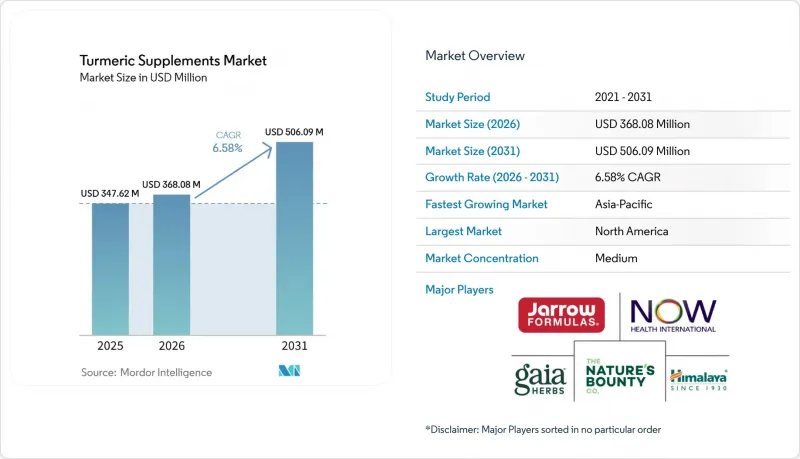
This report is Segmented by Product Type (Softgels, Gummies, and More), Formulation (Standard and Enhanced/Bioavailability-Enhanced), Distribution Channel (Supermarkets/Hypermarkets, Online Retail Stores, and More), and Geography (North America, Europe, Asia-Pacific, South America, and the Middle East and Africa). The Market Forecasts are Provided in Terms of Value (USD).
Global Turmeric Supplements Market Trends and Insights
Increasing prevalence of joint health concerns and age-related disorders
The rising prevalence of arthritis and age-related joint problems is driving growth in the global turmeric supplement market, as more consumers seek natural ingredients that may help reduce inflammation. According to the National Association of Chronic Disease Directors, as of May 2025, the number of people living with arthritis in the United States is expected to exceed 78 million by 2040. About 60% of arthritis patients are under the age of 65, and nearly 220,000 children are also affected, showing that many different age groups need long-term joint health support. To meet this demand, manufacturers continue to launch advanced turmeric supplements, including Greenspace Herbs' Curcumin QA (2026), Cosmos Health's Curcumin18(TM) (2026), and Blackmores' TurmXTRA(TM)-based supplement range, increasing the availability of high-bioavailability products for joint mobility and healthy aging.
Growing popularity of Ayurvedic and traditional herbal medicine
More people are using Ayurvedic and traditional herbal medicine, which is helping drive the global turmeric supplements market. Consumers are looking for plant-based products to support preventive healthcare and overall wellness. According to the Ministry of AYUSH in 2025, about 46% of the rural and 53% of the urban populations in India use AYUSH (Ayurveda, Yoga, Unani, Siddha, and Homeopathy) to prevent or treat health problems. This shows that traditional healthcare systems are widely accepted. Due to this growing demand, supplement manufacturers are adding more turmeric-based products. Recent launches include Greenspace Herbs' Curcumin QA, Blackmores' TurmXTRA(TM)-based supplement range, and Dabur's SIENS nutraceutical portfolio, showing rising investment in science-backed herbal and Ayurvedic formulations.
Intense competition from alternative dietary supplements
The turmeric supplements market faces strong competition from other dietary supplements offering similar health benefits. These include omega-3 fatty acids, glucosamine, collagen, boswellia, ginger, cannabidiol (CBD), probiotics, and multivitamins. Consumers looking for joint health, inflammation support, immunity, or general wellness can choose from many well-known alternatives. This increases product substitution and strengthens competition. Manufacturers of competing supplements are also launching new formulations, combination products, and personalized nutrition solutions. This makes it harder for turmeric supplements to stand out. As a result, turmeric supplement brands need to invest in clinical validation, better bioavailability technologies, and product innovation to maintain consumer preference and market share.
Other drivers and restraints analyzed in the detailed report include:
- Increasing demand for vegan and allergen-free formulations
- Advancements in bioavailability-enhanced curcumin formulations
- Stringent regulations governing health claims
For complete list of drivers and restraints, kindly check the Table Of Contents.
Segment Analysis
Capsules and tablets dominated the turmeric supplements market, accounting for 63.76% of the product type segment in 2025. Consumers continue to prefer these formats for their strong trustworthiness, precise dosage delivery, ease of use, and longer shelf life compared to other supplement formats. Healthcare professionals widely recommend capsules and tablets, particularly for consumers using turmeric supplements for long-term wellness, inflammation management, and joint health support. Their extensive availability across pharmacies, supermarkets, health stores, and online platforms further strengthens their position as the leading product type in the market.
Gummies are projected to be the fastest-growing product type, registering a CAGR of 8.82% during 2026-2031. Rising demand for convenient, palatable, and easy-to-consume supplements is encouraging manufacturers to expand their gummy-based turmeric supplement offerings. The segment is gaining traction among younger consumers, older adults, and first-time supplement users who prefer alternatives to traditional capsules and tablets. Product innovations, including vegan, sugar-free, and enhanced-bioavailability gummies, are broadening consumer appeal and driving faster market growth.
Complete Report Scope:
- By Product Type
- Capsules/Tablets
- Softgels
- Gummies
- Powders
- Others
- By Formulation
- Standard
- Enhanced/Bioavailability-Enhanced
- By Distribution Channel
- Supermarkets/Hypermarkets
- Drugstores and Pharmacies
- Online Retail Stores
- Other Channels
- By Geography
- North America
- United States
- Canada
- Mexico
- Rest of North America
- Europe
- Germany
- United Kingdom
- Italy
- France
- Spain
- Rest of Europe
- Asia-Pacific
- China
- Japan
- India
- South Korea
- Rest of Asia-Pacific
- South America
- Brazil
- Argentina
- Colombia
- Rest of South America
- Middle East and Africa
- South Africa
- Saudi Arabia
- United Arab Emirates
- Rest of Middle East and Africa
- North America
Geography Analysis
North America accounted for 22.28% of the turmeric supplements market in 2025, making it the largest regional market. The region benefits from strong consumer awareness of preventive healthcare and high spending on dietary supplements. Its well-developed retail, pharmacy, and online distribution networks support broad product availability. The United States remains the key growth driver, supported by demand for clinically validated, high-bioavailability turmeric formulations. Ongoing product innovation and the presence of established brands continue to strengthen North America's market position.
Asia-Pacific is projected to be the fastest-growing region, registering a CAGR of 8.38% during 2026-2031. The region's growth is driven by the long-standing cultural use of turmeric, rising health consciousness, and increasing disposable incomes. India plays a dual role as a major turmeric producer and a fast-expanding consumer market for turmeric supplements. China, Japan, and South Korea are also contributing to demand, particularly for premium, functional, and wellness-focused supplement products. Expanding e-commerce platforms and modern retail formats are further improving product access across the region.
Europe remains an important market for turmeric supplements, supported by consumer preference for natural health products and preventive wellness solutions. Germany, the United Kingdom, France, Italy, and Spain continue to generate steady demand through pharmacies, health stores, and online channels. The region's established regulatory environment and strong interest in plant-based supplements support continued product adoption. South America and the Middle East and Africa also present emerging opportunities as retail infrastructure improves and consumer awareness increases. Expanding supplement penetration in these regions is expected to support future market development.
- NOW Health Group, Inc.
- Nature's Bounty Co.
- Gaia Herbs, Inc.
- Himalaya Wellness Company
- Jarrow Formulas, Inc.
- Pharmavite LLC
- Doctor's Best, Inc.
- Swanson Health Products, Inc.
- Thorne HealthTech, Inc.
- Natural Factors
- Integrative Therapeutics, LLC
- Life Extension Foundation Buyers Club, Inc.
- Enzymedica, Inc.
- EuroPharma, Inc.
- Source Naturals, Inc.
- Solaray, LLC
- Banyan Botanicals, LLC
- NutriGold Inc.
- Bluebonnet Nutrition Corporation
- Vital Nutrients, LLC
Additional Benefits:
- The market estimate (ME) sheet in Excel format
- 3 months of analyst support
TABLE OF CONTENTS
1 INTRODUCTION
- 1.1 Study Assumptions and Market Definition
- 1.2 Scope of the Study
2 RESEARCH METHODOLOGY
3 EXECUTIVE SUMMARY
4 MARKET LANDSCAPE
- 4.1 Market Overview
- 4.2 Market Drivers
- 4.2.1 Consumer preference for preventive healthcare and natural wellness products
- 4.2.2 Increasing prevalence of joint health concerns and age-related disorders
- 4.2.3 Advancements in bioavailability-enhanced curcumin formulations
- 4.2.4 Growing popularity of Ayurvedic and traditional herbal medicine
- 4.2.5 Availability of organic and clean-label turmeric supplements
- 4.2.6 Increasing demand for vegan and allergen-free formulations
- 4.3 Market Restraints
- 4.3.1 Intense competition from alternative dietary supplements
- 4.3.2 Low bioavailability of curcumin
- 4.3.3 Stringent regulations governing health claims
- 4.3.4 Quality inconsistencies and product adulteration
- 4.4 Consumer Behavior Analysis
- 4.5 Regulatory Outlook
- 4.6 Porter's Five Forces
- 4.6.1 Threat of New Entrants
- 4.6.2 Bargaining Power of Buyers
- 4.6.3 Bargaining Power of Suppliers
- 4.6.4 Threat of Substitute Products
- 4.6.5 Intensity of Competitive Rivalry
5 MARKET SIZE AND GROWTH FORECASTS (VALUE)
- 5.1 By Product Type
- 5.1.1 Capsules/Tablets
- 5.1.2 Softgels
- 5.1.3 Gummies
- 5.1.4 Powders
- 5.1.5 Others
- 5.2 By Formulation
- 5.2.1 Standard
- 5.2.2 Enhanced/Bioavailability-Enhanced
- 5.3 By Distribution Channel
- 5.3.1 Supermarkets/Hypermarkets
- 5.3.2 Drugstores and Pharmacies
- 5.3.3 Online Retail Stores
- 5.3.4 Other Channels
- 5.4 By Geography
- 5.4.1 North America
- 5.4.1.1 United States
- 5.4.1.2 Canada
- 5.4.1.3 Mexico
- 5.4.1.4 Rest of North America
- 5.4.2 Europe
- 5.4.2.1 Germany
- 5.4.2.2 United Kingdom
- 5.4.2.3 Italy
- 5.4.2.4 France
- 5.4.2.5 Spain
- 5.4.2.6 Rest of Europe
- 5.4.3 Asia-Pacific
- 5.4.3.1 China
- 5.4.3.2 Japan
- 5.4.3.3 India
- 5.4.3.4 South Korea
- 5.4.3.5 Rest of Asia-Pacific
- 5.4.4 South America
- 5.4.4.1 Brazil
- 5.4.4.2 Argentina
- 5.4.4.3 Colombia
- 5.4.4.4 Rest of South America
- 5.4.5 Middle East and Africa
- 5.4.5.1 South Africa
- 5.4.5.2 Saudi Arabia
- 5.4.5.3 United Arab Emirates
- 5.4.5.4 Rest of Middle East and Africa
- 5.4.1 North America
6 COMPETITIVE LANDSCAPE
- 6.1 Market Concentration
- 6.2 Strategic Moves
- 6.3 Market Ranking Analysis
- 6.4 Company Profiles (includes Global-level Overview, Market-level Overview, Core Segments, Financials (if available), Strategic Information, Market Rank/Share, Products and Services, Recent Developments)
- 6.4.1 NOW Health Group, Inc.
- 6.4.2 Nature's Bounty Co.
- 6.4.3 Gaia Herbs, Inc.
- 6.4.4 Himalaya Wellness Company
- 6.4.5 Jarrow Formulas, Inc.
- 6.4.6 Pharmavite LLC
- 6.4.7 Doctor's Best, Inc.
- 6.4.8 Swanson Health Products, Inc.
- 6.4.9 Thorne HealthTech, Inc.
- 6.4.10 Natural Factors
- 6.4.11 Integrative Therapeutics, LLC
- 6.4.12 Life Extension Foundation Buyers Club, Inc.
- 6.4.13 Enzymedica, Inc.
- 6.4.14 EuroPharma, Inc.
- 6.4.15 Source Naturals, Inc.
- 6.4.16 Solaray, LLC
- 6.4.17 Banyan Botanicals, LLC
- 6.4.18 NutriGold Inc.
- 6.4.19 Bluebonnet Nutrition Corporation
- 6.4.20 Vital Nutrients, LLC
7 MARKET OPPORTUNITIES AND FUTURE OUTLOOK

