PUBLISHER: Mordor Intelligence | PRODUCT CODE: 2099904

PUBLISHER: Mordor Intelligence | PRODUCT CODE: 2099904
Human Platelet Lysate - Market Share Analysis, Industry Trends & Statistics, Growth Forecasts (2026 - 2031)
According to Mordor Intelligence, the human platelet lysate market size was valued at USD 60.92 million in 2025 and is estimated to grow from USD 74.73 million in 2026 to reach USD 87.65 million by 2031, at a CAGR of 6.25% during the forecast period (2026-2031).
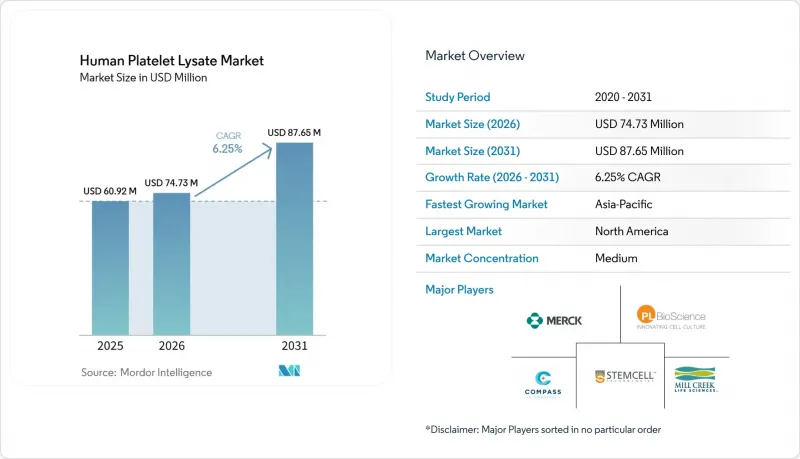
This report is Segmented by Product Type (Heparin-Free, Heparin-Containing, Pathogen-Reduced), Source (Apheresis, Whole Blood, Platelet-Rich Plasma), Form (Liquid, Lyophilized), Application (CGT, Regen Medicine, R&D, Tissue Engineering, Vaccines), End User (Pharma & Biotech, Academic, CROs/CDMOs, Hospitals), and Geography (North America, Europe, Asia-Pacific, MEA, South America). Forecasts in Value (USD).
Global Human Platelet Lysate Market Trends and Insights
Rising Shift From Fetal Bovine Serum to Xeno-Free Human Platelet Lysate
The human platelet lysate market gained support from the steady shift away from fetal bovine serum in clinical and regulated cell culture applications. Manufacturers faced increasing pressure to use human-derived supplements, as these materials aligned more closely with safety and traceability expectations for advanced therapy production. A 2026 review in Frontiers in Toxicology reported that more than 1,180 distinct cell lines had already been cultured under serum-free conditions by late 2025, showing that this transition was no longer limited to a narrow group of mesenchymal stem cell programs. This trend expanded demand beyond early HPL use cases. Manufacturers seeking approvals across multiple regions also benefited when starting materials aligned with xeno-free expectations, as this reduced documentation friction during regulatory review.
Growing Cell and Gene Therapy Manufacturing Pipeline
The scale of the gene, cell, and RNA therapy development pipeline also supported growth in the human platelet lysate market. The ASGCT and Citeline landscape report showed 4,164 gene, cell, and RNA therapies in development as of Q4 2025, keeping upstream media and supplement demand tied to a large active project base. As more programs advanced into Phase II and Phase III, manufacturers found it harder to change raw materials because later-stage manufacturing required tighter process control and more complete documentation. This trend supported suppliers that maintained Drug Master Files or similar regulatory packages, as customers could reference existing data instead of rebuilding support files.
Batch-to-Batch Variability and Donor Heterogeneity
The human platelet lysate market continues to face quality consistency challenges because donor platelet profiles vary across collections. Variations in growth factors, such as PDGF-AB, PDGF-BB, FGF, and VEGF, can create measurable lot-to-lot differences, complicating process development for customers that require stable media performance across clinical batches. A 2025 study reported that donor pools of 16 still showed meaningful growth factor variation and recommended larger pools of 20 to 24 donors to improve batch stability. This issue affects the human platelet lysate market because smaller manufacturers and academic groups may lack regular access to enough donations to achieve these pool sizes. It also increases the workload for product characterization, release testing, and customer qualification, especially for processed formats such as lyophilized HPL, where manufacturers must prove that reconstitution preserves expected biological performance with consistent results for regulated use.
Other drivers and restraints analyzed in the detailed report include:
- Expansion of GMP-Grade, Donor-Traceable Platelet Lysate Products
- Recycling of Expired Platelet Units and Leukoreduction Filters
- Limited Supply of Platelet Starting Material and Compliance Constraints
For complete list of drivers and restraints, kindly check the Table Of Contents.
Segment Analysis
Heparin-free formulations held 58.65% of the human platelet lysate market share in 2025, showing strong buyer preference for products that support fully anticoagulant-free workflows in clinical settings. This leadership reflected rising demand for materials that aligned more clearly with xeno-free declarations and avoided complications associated with the downstream use of animal-derived heparin.
Heparin-containing HPL remained important in the human platelet lysate industry because many research groups and some manufacturing programs continued to use established protocols built around this format. This installed base explained why the segment remained commercially meaningful, even though heparin-free products led current revenue. At the same time, heparin-containing HPL is projected to expand at a CAGR of 8.93% during 2026-2031, showing that growth is not limited to the clinically preferred format. Some CDMOs and development programs continued to favor validated workflows over immediate reformulation, especially when heparin suppliers and media systems had already been qualified.
Platelet-rich plasma was the leading source in 2025 with 55.23% of segment revenue, supported by its ability to deliver high platelet concentration per collection unit. In the human platelet lysate market, this made PRP attractive because stronger platelet density could improve growth factor yield per liter and support efficient production economics at scale. PRP also fit well in regions with advanced automated apheresis systems and mature blood establishment controls, strengthening its position in advanced manufacturing networks. Single-donor traceability provided another practical advantage when buyers required clear documentation and easier linkage between the collected unit and the finished supplement batch.
Whole blood-derived platelets were the fastest-growing source category and are projected to expand at a CAGR of 9.67% through 2031, indicating a broader sourcing shift within the human platelet lysate market. Their momentum came from blood banking networks that improved buffy coat processing and used standard whole blood donations more effectively for downstream platelet recovery. This source route could lower per-unit collection costs because it used platelet fractions recovered from standard donation flows instead of relying only on dedicated apheresis sessions. The cross-border standardization study published in Stem Cell Research and Therapy in 2025 also supported the viability of pooled donor material across multiple institutions, strengthening the case for broader procurement models.
Complete Report Scope:
- By Product Type
- Heparin-Free Human Platelet Lysate
- Heparin-Containing Human Platelet Lysate
- Pathogen-Reduced Human Platelet Lysate
- By Source
- Apheresis Platelets
- Whole Blood-Derived Platelets
- Platelet-Rich Plasma
- By Form
- Liquid
- Lyophilized
- By Application
- Cell and Gene Therapy Manufacturing
- Regenerative Medicine
- Research and Drug Discovery
- Tissue Engineering
- Vaccine Development
- By End User
- Pharmaceutical and Biotechnology Companies
- Academic and Research Institutes
- Contract Research Organizations and CDMOs
- Hospitals and Cell Therapy Centers
- By Geography
- North America
- United States
- Canada
- Mexico
- Europe
- Germany
- United Kingdom
- France
- Italy
- Spain
- Rest of Europe
- Asia-Pacific
- China
- India
- Japan
- Australia
- South Korea
- Rest of Asia-Pacific
- Middle East and Africa
- GCC
- South Africa
- Rest of Middle East and Africa
- South America
- Brazil
- Argentina
- Rest of South America
- North America
Geography Analysis
North America accounted for 40.56% of the human platelet lysate market size in 2025, making it the largest regional contributor. The region led due to the United States' strong base of commercially approved CGT products, specialized CDMOs, and GMP-oriented research institutions. Suppliers benefited from established ancillary material qualification and documentation practices within customer procurement systems. BioLife Solutions stated in Q1 2026 that it held more than a 70% share in U.S. commercially sponsored clinical trials and nearly 80% of more than 30 active Phase III programs, while Canada supported the region through academic medical center networks and Mexico remained at an earlier adoption stage.
Europe remained a key center for production innovation and supply standardization in the human platelet lysate market. In July 2025, PL BioScience opened its new GMP headquarters in Aachen, Germany, spanning more than 1,200 m2 and capable of producing up to 20,000 liters of GMP-grade HPL annually. The United Kingdom, France, Belgium, and the Netherlands supported regional standardization through blood establishment networks. A 2025 multicenter study across Belgium, the Netherlands, and France showed that cross-border HPL standardization was practical when institutions aligned around shared methods.
Asia-Pacific is projected to grow at a CAGR of 8.56% through 2031, making it the fastest-growing regional segment of the human platelet lysate market. China's biopharmaceutical expansion, South Korea's organized CGT distribution structure, and India's broader import diversification are supporting growth. In April 2026, ExcellaTherapeutics signed a distribution agreement with PL BioScience to supply ELAREM Ultimate-FD PLUS in South Korea, strengthening high-specification HPL distribution in North Asia. Japan adds a compliance-driven market layer, while South America and the Middle East and Africa remain at earlier adoption stages, with Brazil and GCC countries standing out as promising demand centers.
- Anova IRM GmbH
- AventaCell BioMedical Corp.
- BBI Solutions
- BioLife Solutions
- Charles River
- Compass Biomedical, Inc.
- Cook Group
- Corning
- Lonza Group Ltd.
- MacoPharma
- Merck
- Mill Creek Life Sciences LLC
- PL BioScience GmbH
- Sartorius
- Stem Cell Technologies
- Terumo
- Thermo Fisher Scientific
Additional Benefits:
- The market estimate (ME) sheet in Excel format
- 3 months of analyst support
TABLE OF CONTENTS
1 INTRODUCTION
- 1.1 Study Assumptions and Market Definition
- 1.2 Scope of the Study
2 RESEARCH METHODOLOGY
3 EXECUTIVE SUMMARY
4 MARKET LANDSCAPE
- 4.1 Market Overview
- 4.2 Market Drivers
- 4.2.1 Rising Shift From Fetal Bovine Serum to Xeno-Free Human Platelet Lysate in MSC Expansion
- 4.2.2 Growing Cell and Gene Therapy Manufacturing Pipelines Needing Human-Derived Supplements
- 4.2.3 Expansion of GMP-Grade, Donor-Traceable Platelet Lysate for Clinical-Grade Cell Processing
- 4.2.4 Recycling of Expired Platelet Units and Leukoreduction Filter Contents Lowers Raw-Material Cost
- 4.2.5 Decentralized Cell Therapy Manufacturing Increases Demand for Closed, Standardized Supplement Supply
- 4.3 Market Restraints
- 4.3.1 Batch-to-Batch Variability and Donor Heterogeneity
- 4.3.2 Limited Supply of Platelet Starting Material and Competition With Transfusion Demand
- 4.3.3 Complex GMP Release, Documentation, and Quality-Control Burden for Blood-Bank Derived Inputs
- 4.4 Value/Supply-Chain Analysis
- 4.5 Regulatory Landscape
- 4.6 Technological Outlook
- 4.7 Porter's Five Forces Analysis
- 4.7.1 Bargaining Power of Suppliers
- 4.7.2 Bargaining Power of Buyers
- 4.7.3 Threat of New Entrants
- 4.7.4 Threat of Substitutes
- 4.7.5 Competitive Rivalry
5 MARKET SIZE AND GROWTH FORECASTS (VALUE, USD)
- 5.1 By Product Type
- 5.1.1 Heparin-Free Human Platelet Lysate
- 5.1.2 Heparin-Containing Human Platelet Lysate
- 5.1.3 Pathogen-Reduced Human Platelet Lysate
- 5.2 By Source
- 5.2.1 Apheresis Platelets
- 5.2.2 Whole Blood-Derived Platelets
- 5.2.3 Platelet-Rich Plasma
- 5.3 By Form
- 5.3.1 Liquid
- 5.3.2 Lyophilized
- 5.4 By Application
- 5.4.1 Cell and Gene Therapy Manufacturing
- 5.4.2 Regenerative Medicine
- 5.4.3 Research and Drug Discovery
- 5.4.4 Tissue Engineering
- 5.4.5 Vaccine Development
- 5.5 By End User
- 5.5.1 Pharmaceutical and Biotechnology Companies
- 5.5.2 Academic and Research Institutes
- 5.5.3 Contract Research Organizations and CDMOs
- 5.5.4 Hospitals and Cell Therapy Centers
- 5.6 By Geography
- 5.6.1 North America
- 5.6.1.1 United States
- 5.6.1.2 Canada
- 5.6.1.3 Mexico
- 5.6.2 Europe
- 5.6.2.1 Germany
- 5.6.2.2 United Kingdom
- 5.6.2.3 France
- 5.6.2.4 Italy
- 5.6.2.5 Spain
- 5.6.2.6 Rest of Europe
- 5.6.3 Asia-Pacific
- 5.6.3.1 China
- 5.6.3.2 India
- 5.6.3.3 Japan
- 5.6.3.4 Australia
- 5.6.3.5 South Korea
- 5.6.3.6 Rest of Asia-Pacific
- 5.6.4 Middle East and Africa
- 5.6.4.1 GCC
- 5.6.4.2 South Africa
- 5.6.4.3 Rest of Middle East and Africa
- 5.6.5 South America
- 5.6.5.1 Brazil
- 5.6.5.2 Argentina
- 5.6.5.3 Rest of South America
- 5.6.1 North America
6 COMPETITIVE LANDSCAPE
- 6.1 Market Concentration
- 6.2 Market Share Analysis
- 6.3 Company Profiles (includes Global Level Overview, Market Level Overview, Core Segments, Financials as available, Strategic Information, Market Rank/Share, Products and Services, Recent Developments)
- 6.3.1 Anova IRM GmbH
- 6.3.2 AventaCell BioMedical Corp.
- 6.3.3 BBI Solutions
- 6.3.4 BioLife Solutions, Inc.
- 6.3.5 Charles River Laboratories International, Inc.
- 6.3.6 Compass Biomedical, Inc.
- 6.3.7 Cook Medical LLC
- 6.3.8 Corning Incorporated
- 6.3.9 Lonza Group Ltd.
- 6.3.10 Macopharma SA
- 6.3.11 Merck KGaA
- 6.3.12 Mill Creek Life Sciences LLC
- 6.3.13 PL BioScience GmbH
- 6.3.14 Sartorius AG
- 6.3.15 STEMCELL Technologies Inc.
- 6.3.16 Terumo BCT, Inc.
- 6.3.17 Thermo Fisher Scientific Inc.
7 MARKET OPPORTUNITIES AND FUTURE OUTLOOK
- 7.1 White-Space and Unmet-Need Assessment

