PUBLISHER: Mordor Intelligence | PRODUCT CODE: 2099932

PUBLISHER: Mordor Intelligence | PRODUCT CODE: 2099932
Middle East Feed Phytogenics - Market Share Analysis, Industry Trends & Statistics, Growth Forecasts (2026 - 2031)
According to Mordor Intelligence, the Middle East phytogenics market for feed is projected to expand from USD 44.1 million in 2025 and USD 47.8 million in 2026 to USD 71.6 million by 2031, registering a CAGR of 8.42% between 2026 and 2031.
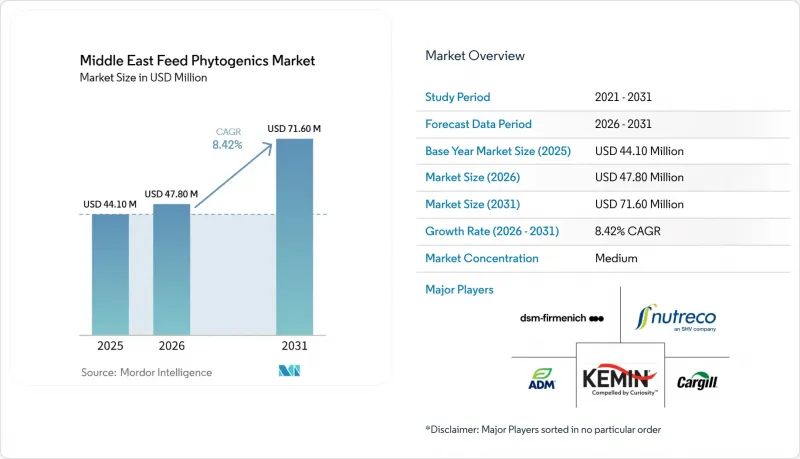
This report is Segmented by Sub Additive (Essential Oils, Oleoresins, and More), by Animal (Poultry, Ruminants, and More), and by Geography (Saudi Arabia, Turkey, and More). The Market Forecasts are Provided in Terms of Value (USD) and Volume (Metric Tons).
Middle East Feed Phytogenics Market Trends and Insights
Shift from Antibiotic Growth Promoters to Natural Performance Additives
Saudi Arabia and the United Arab Emirates tightened restrictions on antibiotic growth promoters in 2024 and 2025, which accelerated the shift toward phytogenics and other natural feed additives in intensive poultry and ruminant systems. Saudi Arabia's National Action Plan on Antimicrobial Resistance 2022-2025 set a clear direction toward reducing antimicrobial use in food animals, and that policy direction created a compliance-led demand base for alternatives in the Middle East feed phytogenics market. This shift matters commercially because smaller integrators that once relied on lower-cost antibiotic programs now face a narrower economic gap between conventional programs and phytogenic solutions. The Middle East feed phytogenics market also benefits, as buyers increasingly evaluate these products as a practical response to regulatory pressure rather than as a discretionary performance input. A 2025 systematic review in Frontiers in Animal Science reported that phytogenic feed additives improved broiler body weight gain by 5% to 13%, while one essential oil blend at 125 parts per million lifted total weight gain by 12.9% and improved feed conversion ratio from 1.71 to 1.60 over 42 days.
Expansion of Industrial Poultry Production Under Food-Security Programs
Food security policy is driving large poultry investments across the Gulf, creating a stable volume base for additive suppliers serving the Middle East feed phytogenics market. Saudi Arabia's Vision 2030 framework includes strong support for agricultural self-sufficiency, and the poultry segment remains central to that effort. As new feed mills and integrated farms come online, purchasing shifts toward standardized additive programs that can be validated across larger flocks and multiple feed cycles. This pattern supports established suppliers because large integrators tend to favor consistent technical service, clear documentation, and products that fit into long-term procurement contracts. The result is that poultry expansion not only adds volume to the Middle East feed phytogenics market but also raises the value of supplier relationships and performance evidence in the region.
Higher Cost versus Conventional Additive Programs
Higher pricing remains the clearest barrier to the Middle East feed phytogenics market, especially in cost-sensitive farming systems where producers primarily compare additives based on near-term feed costs. This issue is most visible in Iraq and Iran, where tighter farm economics reduce the willingness to pay a premium for performance or compliance-led solutions. The Gulf Cooperation Council Standardization Organization standard GSO 2141:2023 added quality and safety compliance requirements for feed additives, which can increase documentation and import costs for smaller product lots. Regional suppliers with local blending capacity are in a stronger position because they can spread those costs over broader product portfolios. That leaves standalone phytogenic suppliers under greater pressure unless they can clearly demonstrate performance gains that offset the initial price premium.
Other drivers and restraints analyzed in the detailed report include:
- Rising Feed-Efficiency Focus Amid High Feed Input Costs
- Red Sea and Gulf Aquaculture Build-Out
- Inconsistent Efficacy and Dosage Standardization Across Botanical Actives
For complete list of drivers and restraints, kindly check the Table Of Contents.
Segment Analysis
Essential oils accounted for 38.0% of revenue in 2025, which made them the largest product type in the Middle East feed phytogenics market, and they are also projected to be the fastest-growing product category at an 8.9% CAGR during 2026-2031. Their position reflects the strong commercial acceptance of compounds such as carvacrol, thymol, and cinnamaldehyde in broiler and layer programs across the region. These compounds provide nutritionists with a clear inclusion case because they are linked to antimicrobial activity, antioxidant support, and improved feed efficiency. Oleoresins accounted for the second-largest product block because they align well with water-based delivery strategies and practical farm programs for heat-stressed birds. Other phytogenics remained smaller parts of the portfolio mix, but they continued to gain attention in ruminant and niche health applications.
A 2025 paper in Scientific Reports showed that nanoencapsulated essential oil formulations outperformed free-form formulations in terms of body weight gain and feed conversion ratio in broilers, strengthening the technical case for premium products in this segment. That finding matters because the Middle East feed phytogenics market is increasingly rewarding products that hold activity through feed processing and deliver a predictable release in the animal. Suppliers with established essential oil programs are in a stronger position because the largest part of the Middle East feed phytogenics industry is already aligned with the fastest-expanding product class. The Middle East feed phytogenics market share held by essential oils in 2025 also shows that buyers are no longer treating the category as a trial segment. Instead, essential oils now form the core product platform for many poultry-focused phytogenic programs.
Complete Report Scope:
- By Sub Additive
- Essential Oil
- Herbs and Spices
- Other Phytogenics
- By Animal
- Aquaculture
- Fish
- Shrimp
- Other Aquaculture Species
- Poultry
- Broiler
- Layer
- Other Poultry Birds
- Ruminants
- Beef Cattle
- Dairy Cattle
- Other Ruminants
- Swine
- Other Animals
- Aquaculture
- By Geography
- Saudi Arabia
- Turkey
- Iran
- United Arab Emirates
- Iraq
- Rest of Middle East
List of Companies Covered in this Report:
- Cargill, Incorporated
- DSM-Firmenich AG
- Kemin Industries, Inc.
- Nutreco N.V. (SHV Holdings N.V.)
- Archer Daniels Midland Company
- Adisseo
- Alltech, Inc.
- Phytobiotics Futterzusatzstoffe GmbH
- DOSTOFARM GmbH
- Orffa Additives B.V.
- MIAVIT GmbH
- Anpario plc
- Nutrex
- Natural Remedies
- Himalaya Wellness Company
Additional Benefits:
- The market estimate (ME) sheet in Excel format
- 3 months of analyst support
TABLE OF CONTENTS
1 INTRODUCTION
- 1.1 Study Assumptions and Market Definition
- 1.2 Scope of the Study
2 RESEARCH METHODOLOGY
3 EXECUTIVE SUMMARY
4 MARKET LANDSCAPE
- 4.1 Market Overview
- 4.2 Market Drivers
- 4.2.1 Shift from Antibiotic Growth Promoters to Natural Performance Additives
- 4.2.2 Expansion of Industrial Poultry Production Under Food-Security Programs
- 4.2.3 Rising Feed-Efficiency Focus Amid High Feed Input Costs
- 4.2.4 Red Sea and Gulf Aquaculture Build-Out
- 4.2.5 Halal-Certified Phytogenics for Export-Oriented Poultry Value Chains
- 4.2.6 Heat-Stress Mitigation Demand in Arid Production Systems
- 4.3 Market Restraints
- 4.3.1 Higher Cost Versus Conventional Additive Programs
- 4.3.2 Inconsistent Efficacy and Dosage Standardization Across Botanical Actives
- 4.3.3 Red Sea and Strait of Hormuz Logistics Disruptions
- 4.3.4 Fragmented Approvals and Limited in-Market Testing Infrastructure
- 4.4 Regulatory Landscape
- 4.5 Technological Outlook
- 4.6 Porter's Five Forces Analysis
- 4.6.1 Threat of New Entrants
- 4.6.2 Bargaining Power of Suppliers
- 4.6.3 Bargaining Power of Buyers
- 4.6.4 Threat of Substitutes
- 4.6.5 Intensity of Competitive Rivalry
5 MARKET SIZE AND GROWTH FORECASTS (VALUE AND VOLUME)
- 5.1 By Sub Additive
- 5.1.1 Essential Oil
- 5.1.2 Herbs and Spices
- 5.1.3 Other Phytogenics
- 5.2 By Animal
- 5.2.1 Aquaculture
- 5.2.1.1 Fish
- 5.2.1.2 Shrimp
- 5.2.1.3 Other Aquaculture Species
- 5.2.2 Poultry
- 5.2.2.1 Broiler
- 5.2.2.2 Layer
- 5.2.2.3 Other Poultry Birds
- 5.2.3 Ruminants
- 5.2.3.1 Beef Cattle
- 5.2.3.2 Dairy Cattle
- 5.2.3.3 Other Ruminants
- 5.2.4 Swine
- 5.2.5 Other Animals
- 5.2.1 Aquaculture
- 5.3 By Geography
- 5.3.1 Saudi Arabia
- 5.3.2 Turkey
- 5.3.3 Iran
- 5.3.4 United Arab Emirates
- 5.3.5 Iraq
- 5.3.6 Rest of Middle East
6 COMPETITIVE LANDSCAPE
- 6.1 Market Concentration
- 6.2 Strategic Moves
- 6.3 Market Share Analysis
- 6.4 Company Profiles (Includes Global Level Overview, Market Level Overview, Core Segments, Financials as Available, Strategic Information, Market Rank/Share for Key Companies, Products and Services, and Recent Developments)
- 6.4.1 Cargill, Incorporated
- 6.4.2 DSM-Firmenich AG
- 6.4.3 Kemin Industries, Inc.
- 6.4.4 Nutreco N.V. (SHV Holdings N.V.)
- 6.4.5 Archer Daniels Midland Company
- 6.4.6 Adisseo
- 6.4.7 Alltech, Inc.
- 6.4.8 Phytobiotics Futterzusatzstoffe GmbH
- 6.4.9 DOSTOFARM GmbH
- 6.4.10 Orffa Additives B.V.
- 6.4.11 MIAVIT GmbH
- 6.4.12 Anpario plc
- 6.4.13 Nutrex
- 6.4.14 Natural Remedies
- 6.4.15 Himalaya Wellness Company
7 MARKET OPPORTUNITIES AND FUTURE OUTLOOK

