PUBLISHER: Mordor Intelligence | PRODUCT CODE: 2099954

PUBLISHER: Mordor Intelligence | PRODUCT CODE: 2099954
Clinical Software As A Medical Device (SaMD) - Market Share Analysis, Industry Trends & Statistics, Growth Forecasts (2026 - 2031)
According to Mordor Intelligence, the clinical software as a medical device market size is projected to be USD 16.09 billion in 2025, USD 18.93 billion in 2026, and reach USD 42.67 billion by 2031, growing at a CAGR of 17.65% from 2026 to 2031.
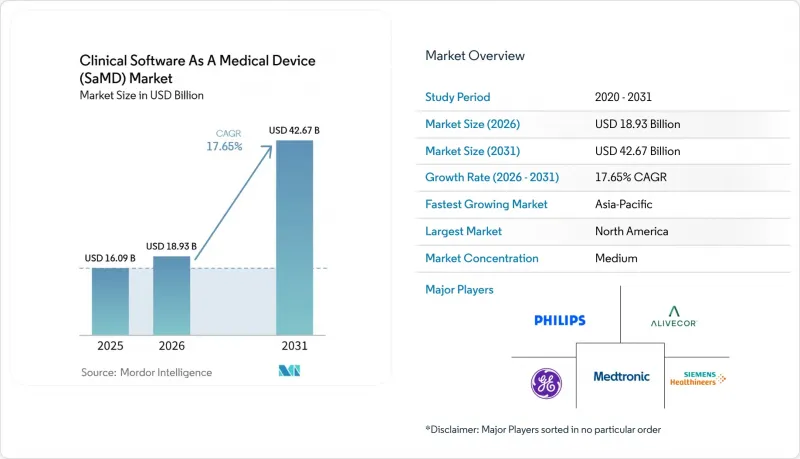
This report is Segmented by Clinical Application (Diagnostic, Monitoring, Therapeutic, Disease Management, CDS Software), Deployment Mode (Cloud-Based, On-Premise, Hybrid), End User (Hospitals, Ascs, Specialty Clinics, Home Healthcare Providers, Diagnostic Centers), and Geography (North America, Europe, Asia-Pacific, MEA, South America). The Market Forecasts are in Value (USD).
Global Clinical Software As A Medical Device (SaMD) Market Trends and Insights
AI-Enabled Clinical Workflow Automation Accelerates Diagnostic Throughput
AI-enabled workflow automation remained the leading growth driver in the clinical software as a medical device market, as it helped providers manage rising case volumes and persistent specialist shortages. Radiology continued to show the strongest adoption, with AI-focused authorizations concentrated in image-based use cases and supporting software deployment at scale. Hospitals also moved from isolated point tools to platform purchases to manage multiple algorithms across shared imaging environments. Aidoc reflected this shift, with its aiOS platform deployed across nearly 2,000 hospitals and analyzing more than 60 million patient cases annually as of April 2026. This scale strengthened its commercial position in the clinical software as a medical device market. Reimbursement also supported adoption, as coverage for HeartFlow FFRCT Analysis and Plaque Analysis by major national insurers showed that AI-driven diagnostic workflows could move beyond pilots when economic support was clear.
Expanding FDA and International SaMD Clearances Widen the Deployable Market
A broader pool of regulatory clearances supported the clinical software as a medical device market, as new approvals increased the number of tools that health systems could deploy with lower adoption risk. In the United States, the authorization base for AI-enabled medical devices expanded sharply through 2025, and the monthly pace of approvals showed that clinical software was no longer a niche regulatory category. This trend encouraged procurement teams to evaluate more cleared products across diagnostic, monitoring, and decision support functions. Outside the United States, China continued to build a large approval base for AI medical devices, mainly in imaging, while European regulators moved closer to a structured compliance regime under MDR and the EU AI Act. This development changed competition in the clinical software as a medical device market. Larger companies with established regulatory teams were better positioned than smaller single-product firms to manage lifecycle updates, documentation, and cross-market compliance.
Clinical Liability and Black-Box Trust Constraints Slow AI Decision Embedding
Clinical liability remains a practical barrier in the clinical software as a medical device market, as physicians continue to hold primary responsibility even when software outputs influence final clinical actions. This accountability creates hesitation in high-acuity settings, where clinicians may use the software for support but remain reluctant to treat it as a primary decision signal. Trust also depends on consistent model performance across patient groups and practice settings after deployment. Peer-reviewed work cited in the user draft highlighted limited access to representative training data and uneven post-market performance across diverse populations, reinforcing concerns that real-world behavior can differ from validation outcomes.
Other drivers and restraints analyzed in the detailed report include:
- Reimbursement Momentum for Remote Monitoring Unlocks a New Revenue Channel
- Growing Demand for Software-Only Diagnostics Displaces Specialist-Dependent Workflows
- Cybersecurity Exposure and Model Drift Create a Compounding Post-Market Burden
For complete list of drivers and restraints, kindly check the Table Of Contents.
Segment Analysis
Diagnostic software accounted for 38.55% of revenue in 2025, giving it the largest position in the clinical software as a medical device market. Imaging-based workflows supported this lead because they had the deepest regulatory history and the clearest fit for machine-led analysis. Diagnostic software also benefited from easier-to-standardize data structures, making performance validation more practical than in many other clinical settings.
Monitoring software is forecast to grow at an 18.93% CAGR through 2031, making it the fastest-expanding clinical application in the clinical software as a medical device market size profile. Improving reimbursement conditions for remote oversight programs largely drive this growth. CMS support for shorter monitoring windows made this category more commercially viable for patients who could not sustain long data collection cycles and supported recurring software use outside hospital settings.
Complete Report Scope:
- By Clinical Application
- Diagnostic Software
- Monitoring Software
- Therapeutic Software
- Disease Management Software
- Clinical Decision Support Software
- By Deployment Mode
- Cloud-Based
- On-Premise
- Hybrid
- By End User
- Hospitals and Health Systems
- Ambulatory Surgical Centers
- Specialty Clinics
- Home Healthcare Providers
- Diagnostic and Imaging Centers
- By Geography
- North America
- United States
- Canada
- Mexico
- Europe
- Germany
- United Kingdom
- France
- Italy
- Spain
- Rest of Europe
- Asia-Pacific
- China
- India
- Japan
- Australia
- South Korea
- Rest of Asia-Pacific
- Middle East and Africa
- GCC
- South Africa
- Rest of Middle East and Africa
- South America
- Brazil
- Argentina
- Rest of South America
- North America
Geography Analysis
North America held 38.86% of revenue in 2025, giving the region the leading position in the clinical software as a medical device market. This reflected strong U.S. regulatory activity, payer support, and hospital technology adoption. The United States remained the main driver, supported by the most active authorization pipeline for AI-enabled clinical software and a mature path from clearance to procurement. GE HealthCare reached 100 cumulative U.S. authorizations by July 2025, highlighting how major imaging companies used software portfolios as long-term competitive assets, while Canada and Mexico supported regional growth through provincial screening activity and private hospital AI adoption.
Europe progressed through a more compliance-intensive path in the clinical software as a medical device market, as MDR requirements and the future application of the EU AI Act increasingly shaped adoption. Germany, the UK, and France remained the strongest regional centers, supported by advanced hospital infrastructure, strong clinical validation networks, and readiness for regulated digital health deployment. The region's regulatory structure favored larger suppliers with established quality, documentation, and post-market support teams. Lunit's selection in September 2025 as the exclusive AI partner for breast cancer screening in Spain's Valencian Community showed how public screening initiatives could support large-scale implementation of evidence-based software.
Asia-Pacific is forecast to grow at a 19.56% CAGR through 2031, making it the fastest-expanding region in the clinical software as a medical device market size outlook. Unmet specialist needs, large screening populations, and growing private care capacity are driving demand. China remained a central growth engine, supported by a large approval base for AI medical devices and policy support for higher-end medical technologies. Qure.ai's January 2026 USD 8 million Gates Foundation grant for AI ultrasound focused on tuberculosis and pneumonia reflected the relevance of software-led diagnostic access in public-health-linked care delivery, while the Middle East and Africa and South America remained smaller but meaningful medium-term volume opportunities.
- Aidoc Ltd.
- AliveCor
- Arterys, Inc.
- Butterfly Network, Inc.
- CureMetrix, Inc.
- DeepHealth, Inc.
- Digital Diagnostics
- GE HealthCare Technologies Inc.
- HeartFlow, Inc.
- iCAD, Inc.
- Imbio, Inc.
- Koninklijke Philips
- Lunit
- Medtronic
- Nanox AI Ltd.
- Oxipit UAB
- Qure.ai Technologies Private Limited
- Siemens Healthineers
- Viz.ai, Inc.
Additional Benefits:
- The market estimate (ME) sheet in Excel format
- 3 months of analyst support
TABLE OF CONTENTS
1 INTRODUCTION
- 1.1 Study Assumptions and Market Definition
- 1.2 Scope of the Study
2 RESEARCH METHODOLOGY
3 EXECUTIVE SUMMARY
4 MARKET LANDSCAPE
- 4.1 Market Overview
- 4.2 Market Drivers
- 4.2.1 AI-Enabled Clinical Workflow Automation Reduces Time-to-Decision
- 4.2.2 Expanding FDA and International SaMD Clearances for Narrow Clinical Claims
- 4.2.3 Reimbursement Momentum for Remote Monitoring and Digital Diagnostics
- 4.2.4 Installed Base Integration Into Imaging, EHR, and Device Ecosystems
- 4.2.5 Growing Demand for Software-Only Diagnostic and Triage Tools
- 4.2.6 Rising Adoption of Cloud-Native Clinical Software for Faster Updates and Scalability
- 4.3 Market Restraints
- 4.3.1 Clinical Liability and Black-Box Trust Constraints
- 4.3.2 Cybersecurity, Model Drift, and Post-Market Surveillance Burden
- 4.3.3 Lengthy Validation and Regulatory Evidence Requirements
- 4.3.4 Interoperability Friction Across PACS, EHR, and Legacy IT Stacks
- 4.4 Value Chain Analysis
- 4.5 Regulatory Landscape
- 4.6 Technological Outlook
- 4.7 Porter's Five Forces Analysis
- 4.7.1 Threat of New Entrants
- 4.7.2 Bargaining Power of Suppliers
- 4.7.3 Bargaining Power of Buyers
- 4.7.4 Threat of Substitutes
- 4.7.5 Intensity of Competitive Rivalry
5 MARKET SIZE AND GROWTH FORECASTS (VALUE, USD)
- 5.1 By Clinical Application
- 5.1.1 Diagnostic Software
- 5.1.2 Monitoring Software
- 5.1.3 Therapeutic Software
- 5.1.4 Disease Management Software
- 5.1.5 Clinical Decision Support Software
- 5.2 By Deployment Mode
- 5.2.1 Cloud-Based
- 5.2.2 On-Premise
- 5.2.3 Hybrid
- 5.3 By End User
- 5.3.1 Hospitals and Health Systems
- 5.3.2 Ambulatory Surgical Centers
- 5.3.3 Specialty Clinics
- 5.3.4 Home Healthcare Providers
- 5.3.5 Diagnostic and Imaging Centers
- 5.4 By Geography
- 5.4.1 North America
- 5.4.1.1 United States
- 5.4.1.2 Canada
- 5.4.1.3 Mexico
- 5.4.2 Europe
- 5.4.2.1 Germany
- 5.4.2.2 United Kingdom
- 5.4.2.3 France
- 5.4.2.4 Italy
- 5.4.2.5 Spain
- 5.4.2.6 Rest of Europe
- 5.4.3 Asia-Pacific
- 5.4.3.1 China
- 5.4.3.2 India
- 5.4.3.3 Japan
- 5.4.3.4 Australia
- 5.4.3.5 South Korea
- 5.4.3.6 Rest of Asia-Pacific
- 5.4.4 Middle East and Africa
- 5.4.4.1 GCC
- 5.4.4.2 South Africa
- 5.4.4.3 Rest of Middle East and Africa
- 5.4.5 South America
- 5.4.5.1 Brazil
- 5.4.5.2 Argentina
- 5.4.5.3 Rest of South America
- 5.4.1 North America
6 COMPETITIVE LANDSCAPE
- 6.1 Market Concentration
- 6.2 Market Share Analysis
- 6.3 Company Profiles (includes Global Level Overview, Market Level Overview, Core Segments, Financials as available, Strategic Information, Market Rank/Share, Products and Services, Recent Developments)
- 6.3.1 Aidoc Ltd.
- 6.3.2 AliveCor, Inc.
- 6.3.3 Arterys, Inc.
- 6.3.4 Butterfly Network, Inc.
- 6.3.5 CureMetrix, Inc.
- 6.3.6 DeepHealth, Inc.
- 6.3.7 Digital Diagnostics, Inc.
- 6.3.8 GE HealthCare Technologies Inc.
- 6.3.9 HeartFlow, Inc.
- 6.3.10 iCAD, Inc.
- 6.3.11 Imbio, Inc.
- 6.3.12 Koninklijke Philips N.V.
- 6.3.13 Lunit Inc.
- 6.3.14 Medtronic plc
- 6.3.15 Nanox AI Ltd.
- 6.3.16 Oxipit UAB
- 6.3.17 Qure.ai Technologies Private Limited
- 6.3.18 Siemens Healthineers AG
- 6.3.19 Viz.ai, Inc.
7 MARKET OPPORTUNITIES AND FUTURE OUTLOOK
- 7.1 White-Space and Unmet-Need Assessment

