PUBLISHER: Mordor Intelligence | PRODUCT CODE: 2099973

PUBLISHER: Mordor Intelligence | PRODUCT CODE: 2099973
China GPU Cooling Solutions - Market Share Analysis, Industry Trends & Statistics, Growth Forecasts (2026 - 2031)
According to Mordor Intelligence, the China GPU cooling solutions market size is expected to be USD 3.23 billion in 2025, USD 4.11 billion in 2026, and reach USD 15.60 billion by 2031, growing at a CAGR of 30.59% from 2026 to 2031.
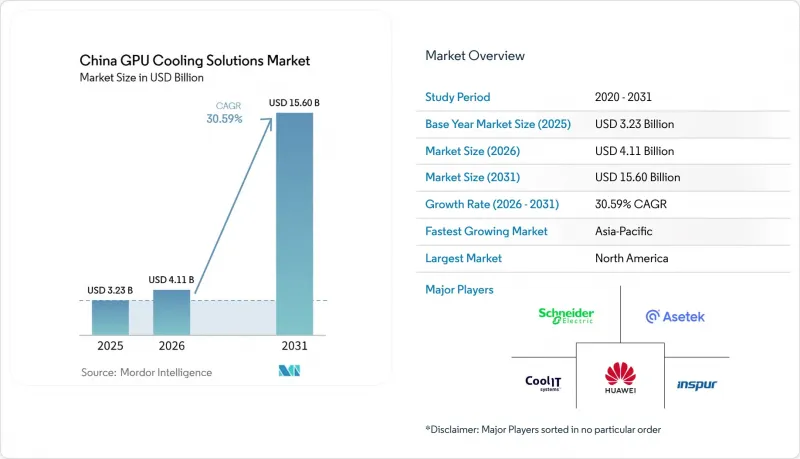
This report is Segmented by Cooling Technology (Air Cooling, Liquid Cooling, Direct-To-Chip, Immersion Cooling, and More), Cooling Level (Component-Level Cooling, and Server and Rack-Level Cooling), Deployment (Hyperscale and Cloud, Enterprise, Government and Research HPC, and Edge), and GPU Power Density (Below 300W, 300W-700W, and Above 700W). The Market Forecasts are Provided in Terms of Value (USD).
China GPU Cooling Solutions Market Trends and Insights
Rapid Expansion of AI Clusters in Chinese Hyperscale Data Centers
ByteDance's 500 megawatt colocation deal with VNET and DeepSeek's Inner Mongolia build highlight how racks now exceed 50 kilowatts, a level that renders air paths thermodynamically untenable. Alibaba Cloud's Zhangbei campus combined immersion tanks and wind power to cut PUE to 1.09, proving liquid systems can meet both energy and ESG targets. The Fifteenth Five-Year Plan instructs operators to colocate compute with renewables, collapsing build cycles to under a year. Vendors with prefabricated manifolds, sealed coolant loops, and remote-commissioning services now close orders in weeks, giving them a strategic edge in the China GPU cooling solutions market.
Government Incentives for Domestic GPU Manufacturing and Ecosystem Localization
The Ministry of Industry and Information Technology offers tax rebates to server makers that certify local content across cold plates, pumps, and heat exchangers. Huawei's March 2026 Xinghe AI Fabric 2.0 switch features integrated liquid channels, cutting the rack footprint 30% while anchoring procurement inside China. Shanghai and Shenzhen have opened liquid-cooling test labs that pool research bodies with component suppliers, shrinking prototype loops from six months to eight weeks. These measures secure supply resilience and accelerate time-to-compliance with the 2027 China RoHS fluorocarbon cap.
High Upfront Capital Expenditure for Liquid and Immersion Cooling Infrastructure
Turner and Townsend's Data Center Cost Index shows a 15-25% capex premium for direct-to-chip loops and 40-60% for immersion tanks, adding USD 3-6 million to a 10 MW build. Hyperscalers amortize this over long contracts, but smaller firms in Xi'an or Chengdu often defer upgrades. Where industrial power falls below USD 0.06 /kWh, payback on immersion stretches past four years, locking many operators into air cooling and slowing part of the China GPU cooling solutions market.
Other drivers and restraints analyzed in the detailed report include:
- Rising GPU Thermal Design Power Exceeding 700 W in Next-Generation Accelerators
- Growing Adoption of Immersion Cooling in Cryptocurrency Mining Farms
- Limited Availability of Fluorocarbon-Free Dielectric Fluids Meeting China RoHS
For complete list of drivers and restraints, kindly check the Table Of Contents.
Segment Analysis
Immersion cooling is expected to record the fastest growth among cooling technologies, with a CAGR of 25.50%, supported by rising demand from hyperscale data center operators seeking to reduce power usage effectiveness (PUE) to below 1.10. Air cooling accounted for a substantial 47.04% share in 2025, reflecting its established deployment in racks with power densities below 500 watts. However, as AI workloads increase, rack-level heat loads are rising, prompting operators to adopt liquid-based alternatives to improve thermal efficiency and support higher computing density. Direct-to-chip cooling loops are increasingly being retrofitted in brownfield facilities where floor-loading limitations and ceiling-height constraints make full immersion tank deployment impractical. In Beijing pilot deployments, Inspur's cold-plate cabinets achieved a PUE of 1.15, demonstrating the operational viability of liquid cooling in existing data center environments. Hybrid cooling systems, which combine fan walls with rear-door heat exchangers, are also gaining traction as enterprises seek to operate AI servers alongside legacy IT infrastructure without fully redesigning their facilities.
Alibaba Cloud's Zhangbei facility combines immersion cooling with surplus wind power, strengthening the competitiveness of renewable energy-rich regions in the Chinese GPU cooling solutions market. Sugon's C8000 megawatt-scale immersion tank further demonstrates the capability of domestic players to advance directly toward ultra-dense cooling architectures designed for high-performance computing and AI workloads. Air cooling is expected to remain relevant for edge inference deployments in factory halls and similar distributed environments, particularly where GPU power consumption remains below 300 watts. As a result, the market is likely to remain segmented by deployment type. Liquid cooling technologies are expected to dominate new AI cluster installations that require high-density computing and advanced thermal management, while a large base of legacy data centers will continue to rely on optimized air cooling systems supported by incremental efficiency upgrades.
In 2025, server and rack-level loops commanded a 59.02% market share and are projected to grow at a robust 26.10% CAGR, thanks to their simplified deployment and alignment with OEM warranties. These solutions are gaining traction due to their ability to streamline operations and reduce complexities in data center cooling systems. Schneider Electric's EcoStruxure skid introduces an innovative design by positioning manifolds at the rear of the rack, allowing operators to phase in liquid cooling row by row. This phased approach not only enhances operational flexibility but also minimizes downtime during implementation. On the other hand, Huawei's liquid-cooled 51.2 Tbps switch excels in delivering peak density performance, making it a preferred choice for high-performance environments. However, its reliance on a single hardware roadmap limits flexibility for operators seeking diverse hardware options.
Operators are increasingly favoring rack loops as a strategic measure to mitigate risks associated with future silicon transitions, a critical factor in the Chinese GPU cooling solutions market. This preference is particularly evident in a 2025 survey conducted by CDCC, where 68% of managers indicated their choice of rack loops for new data halls. Rack loops offer scalability and adaptability, making them a reliable option for evolving technological demands. However, the impending release of AMD's 1,400-watt MI355X is expected to drive a shift towards component-level cold plates, especially for top-tier AI training facilities. These cold plates are likely to become essential for managing the high thermal output of advanced GPUs, gradually altering the market dynamics after 2028. This anticipated shift underscores the need for operators to balance their cooling strategies to accommodate future advancements.
Complete Report Scope:
- By Cooling Technology
- Air Cooling
- Liquid Cooling (Direct-to-Chip)
- Immersion Cooling
- Hybrid Cooling
- By Cooling Level
- Component-Level Cooling
- Server and Rack-Level Cooling
- By Deployment
- Hyperscale and Cloud
- Enterprise
- Government and Research (HPC)
- Edge
- By GPU Power Density
- Below 300W
- 300W - 700W
- Above 700W
List of Companies Covered in this Report:
- Asetek A/S
- CoolIT Systems Inc.
- Schneider Electric SE
- Inspur Electronic Information Industry Co., Ltd.
- Lenovo Group Limited
- Huawei Technologies Co., Ltd.
- Alibaba Cloud (Alibaba Group Holding Limited)
- Tencent Cloud Computing (Beijing) Co., Ltd.
- Sugon Information Industry Co., Ltd.
- GRC (Green Revolution Cooling, Inc.)
- Submer Technologies SL
- Nautilus Data Technologies, Inc.
- Iceotope Technologies Ltd.
- Haier Smart Home Co., Ltd.
- Chilldyne Inc.
- Asperitas BV
- Midea Group Co., Ltd.
- Vertiv Holdings Co.
- Delta Electronics, Inc.
- Fujitsu Limited
Additional Benefits:
- The market estimate (ME) sheet in Excel format
- 3 months of analyst support
TABLE OF CONTENTS
1 INTRODUCTION
- 1.1 Study Assumptions and Market Definition
- 1.2 Scope of the Study
2 RESEARCH METHODOLOGY
3 EXECUTIVE SUMMARY
4 MARKET LANDSCAPE
- 4.1 Market Overview
- 4.2 Market Drivers
- 4.2.1 Rapid Expansion of AI Clusters in Chinese Hyperscale Data Centers
- 4.2.2 Government Incentives for Domestic GPU Manufacturing and Ecosystem Localization
- 4.2.3 Rising GPU Thermal Design Power Exceeding 700W in Next-Gen Accelerators
- 4.2.4 Growing Adoption of Immersion Cooling in Cryptocurrency Mining Farms
- 4.2.5 Deployment of Edge Inference Nodes in Smart Manufacturing Zones
- 4.2.6 Integration of Waste-Heat Recovery for District Heating in Northern China
- 4.3 Market Restraints
- 4.3.1 High Upfront Capital Expenditure for Liquid and Immersion Cooling Infrastructure
- 4.3.2 Limited Availability of Fluorocarbon-Free Dielectric Fluids Meeting China RoHS
- 4.3.3 Talent Shortage in Liquid Cooling System Design and Maintenance
- 4.3.4 Grid Water Usage Regulations in Water-Stressed Northern Provinces
- 4.4 Industry Value Chain Analysis
- 4.5 Regulatory Landscape
- 4.6 Technological Outlook
- 4.7 Impact of Macroeconomic Factors on the Market
- 4.8 Porter's Five Forces Analysis
- 4.8.1 Threat of New Entrants
- 4.8.2 Bargaining Power of Suppliers
- 4.8.3 Bargaining Power of Buyers
- 4.8.4 Threat of Substitutes
- 4.8.5 Competitive Rivalry
5 MARKET SIZE AND GROWTH FORECASTS (VALUE)
- 5.1 By Cooling Technology
- 5.1.1 Air Cooling
- 5.1.2 Liquid Cooling (Direct-to-Chip)
- 5.1.3 Immersion Cooling
- 5.1.4 Hybrid Cooling
- 5.2 By Cooling Level
- 5.2.1 Component-Level Cooling
- 5.2.2 Server and Rack-Level Cooling
- 5.3 By Deployment
- 5.3.1 Hyperscale and Cloud
- 5.3.2 Enterprise
- 5.3.3 Government and Research (HPC)
- 5.3.4 Edge
- 5.4 By GPU Power Density
- 5.4.1 Below 300W
- 5.4.2 300W - 700W
- 5.4.3 Above 700W
6 COMPETITIVE LANDSCAPE
- 6.1 Market Concentration
- 6.2 Strategic Moves
- 6.3 Market Share Analysis
- 6.4 Company Profiles (includes Global Level Overview, Market Level Overview, Core Segments, Financials as available, Strategic Information, Market Rank/Share, Products and Services, Recent Developments)
- 6.4.1 Asetek A/S
- 6.4.2 CoolIT Systems Inc.
- 6.4.3 Schneider Electric SE
- 6.4.4 Inspur Electronic Information Industry Co., Ltd.
- 6.4.5 Lenovo Group Limited
- 6.4.6 Huawei Technologies Co., Ltd.
- 6.4.7 Alibaba Cloud (Alibaba Group Holding Limited)
- 6.4.8 Tencent Cloud Computing (Beijing) Co., Ltd.
- 6.4.9 Sugon Information Industry Co., Ltd.
- 6.4.10 GRC (Green Revolution Cooling, Inc.)
- 6.4.11 Submer Technologies SL
- 6.4.12 Nautilus Data Technologies, Inc.
- 6.4.13 Iceotope Technologies Ltd.
- 6.4.14 Haier Smart Home Co., Ltd.
- 6.4.15 Chilldyne Inc.
- 6.4.16 Asperitas BV
- 6.4.17 Midea Group Co., Ltd.
- 6.4.18 Vertiv Holdings Co.
- 6.4.19 Delta Electronics, Inc.
- 6.4.20 Fujitsu Limited
7 MARKET OPPORTUNITIES AND FUTURE OUTLOOK
- 7.1 White-Space and Unmet-Need Assessment

