PUBLISHER: Mordor Intelligence | PRODUCT CODE: 2099979

PUBLISHER: Mordor Intelligence | PRODUCT CODE: 2099979
Europe, Middle East, and Africa (EMEA) Biostimulants Seed Treatment - Market Share Analysis, Industry Trends & Statistics, Growth Forecasts (2026 - 2031)
According to Mordor Intelligence, the Europe, Middle East, and Africa (EMEA) biostimulants seed treatment market was valued at USD 390.00 million in 2025 and is projected to grow from USD 432.10 million in 2026 to USD 721.40 million by 2031, registering a CAGR of 10.79% during the forecast period from 2026 to 2031.
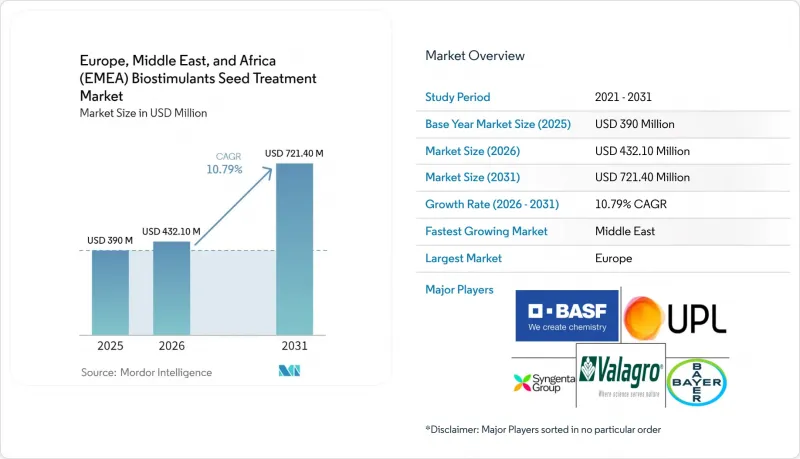
This report is Segmented by Product Type (Humic Substances, Amino Acids, and More), by Form (Liquid and Dry), by Application Method (Foliar Spray, Seed Treatment, and More), by Crop Type (Cereals and Grains, Oilseeds and Pulses, and More), and by Geography (Europe, The Middle East, and Africa). The Market Forecasts are Provided in Terms of Value (USD).
Europe, Middle East, and Africa (EMEA) Biostimulants Seed Treatment Market Trends and Insights
Increasing Demand for Early-Stage Crop Establishment Protection
Early-season crop establishment has become a primary focus for growers across Europe, the Middle East, and Africa, driving demand in the EMEA biostimulants seed treatment market. Seed-applied biostimulants are increasingly utilized to improve germination, root development, nutrient uptake, and seedling vigor during critical early growth stages. A 2025 study published in BioMed Central (BMC) Plant Biology demonstrated that seed biopriming with plant growth-promoting bacteria significantly enhanced wheat germination and seedling vigor under suboptimal temperature conditions, emphasizing the importance of biological seed treatments in stress-prone environments. As growers aim to mitigate establishment risks and enhance crop uniformity, the demand for biostimulant seed treatments continues to grow across major arable cropping systems.
Rising Regulatory Preference for Low-Residue Seed Inputs
The Europe, Middle East, and Africa (EMEA) biostimulants seed treatment market is experiencing growth due to regulatory frameworks promoting sustainable and low-residue agricultural inputs. A significant factor is the European Union Fertilising Products Regulation, which provides harmonized rules for biostimulants, simplifying market access across member states. Regulation (European Union) 2024/2516, adopted in 2024, introduced digital labeling requirements for European Union (EU) fertilising products, including biostimulants, enhancing product transparency and regulatory efficiency within the single market. This regulatory framework fosters investment in compliant biological seed treatment solutions and expands commercialization opportunities for established manufacturers.
Higher Upfront Cost versus Conventional Seed Treatments
Higher upfront costs compared to conventional seed treatments continue to hinder the adoption of biostimulant-based seed treatments in parts of the Europe, Middle East, and Africa (EMEA) region. This issue is particularly pronounced in Africa and several Middle Eastern agricultural markets, where access to affordable farm financing remains limited. According to the 2025 State of the Sector Report by the Smallholder and Agri-SME Finance and Investment Network (SAFIN), the annual financing demand of smallholder farmers and agricultural SMEs exceeds USD 323 billion, while available financing amounts to only USD 95 billion, resulting in a significant funding gap in Africa. Limited access to capital discourages growers from investing in higher-cost biological seed treatment solutions, despite their agronomic advantages.
Other drivers and restraints analyzed in the detailed report include:
- Climate Stress Intensifies Seed Treatment Adoption
- Expansion of Precision Planting and Seed Coating Technologies
- Low Technical Awareness Among Smallholder Farmers in Parts of Africa and the Middle East
For complete list of drivers and restraints, kindly check the Table Of Contents.
Segment Analysis
Europe, Middle East, and Africa (EMEA) biostimulants seed treatment market, seaweed extract seed treatment accounted for the largest share at 31.2% in 2025. Seaweed extracts maintain a strong position due to their broad compatibility across crop types and their ability to support nutrient uptake, root development, and tolerance to environmental stress. Their established use across commercial agriculture and specialty crops has supported widespread adoption. Humic substances and amino acids also remain important product categories, providing complementary benefits that enhance plant vigor and early-stage crop performance under diverse growing conditions.
Microbial stimulants are forecast to grow at the fastest CAGR of 12.5% from 2026 to 2031. Growth is supported by increasing interest in biological solutions that improve root colonization, nutrient efficiency, and plant resilience during crop establishment. Advances in formulation technologies are improving product stability, shelf life, and compatibility with modern seed treatment processes. Manufacturers are also investing in research and development to strengthen product performance and consistency. As growers seek sustainable alternatives that align with environmental objectives and regulatory requirements, microbial stimulants are gaining greater acceptance across a broad range of agricultural production systems.
The liquid segment accounted for the largest market share of 68.7% in 2025. These formulations are preferred due to their ability to provide uniform seed coverage and their seamless integration into commercial seed treatment operations. Their compatibility with automated application systems enables large-scale processing while ensuring consistent treatment quality. These operational benefits have solidified their position in industrial seed treatment facilities and established agricultural supply chains across the region.
The dry segment is projected to grow at the fastest CAGR of 11.2% from 2026 to 2031. This growth is driven by their storage stability, ease of transportation, and suitability for regions with limited cold-chain infrastructure. Dry formulations offer logistical advantages in areas with high temperatures and inconsistent distribution conditions. Manufacturers are continuously improving formulation technologies to enhance biological viability and product performance. As distribution networks expand into emerging agricultural markets, dry formulations are projected to gain wider acceptance while continuing to complement the dominance of liquid products.
Complete Report Scope:
- By Product Type
- Humic Substances
- Amino Acids
- Microbial Stimulants
- Seaweed Extracts
- Other Product Types
- By Form
- Liquid
- Dry
- By Application Method
- Foliar Spray
- Seed Treatment
- Soil Application
- By Crop Type
- Cereals and Grains
- Oilseeds and Pulses
- Fruits and Vegetables
- Turf and Landscapes
- Other Crop Types
- By Geography
- Europe
- Germany
- France
- Italy
- United Kingdom
- Russia
- Rest of Europe
- Middle East
- Saudi Arabia
- United Arab Emirates
- Israel
- Turkey
- Rest of Middle East
- Africa
- South Africa
- Egypt
- Morocco
- Rest of Africa
- Europe
List of Companies Covered in this Report:
- BASF SE
- Bayer AG
- Syngenta Crop Protection AG (Syngenta Group)
- UPL Limited
- Koppert B.V.
- Novonesis A/S
- Biolchim S.p.A. (J.M. Huber Corporation)
- Valagro S.p.A.
- FMC Corporation
- Acadian Seaplants Limited
- Seipasa, S.A.
- Bioiberica, S.A.U.
- Atlantica Agricola, S.A.
- Sumitomo Chemical Company Limited
- Trade Corporation International, S.A.
Additional Benefits:
- The market estimate (ME) sheet in Excel format
- 3 months of analyst support
TABLE OF CONTENTS
1 Introduction
- 1.1 Study Assumptions and Market Definition
- 1.2 Scope of the Study
2 Research Methodology
3 Executive Summary
4 Market Landscape
- 4.1 Market Overview
- 4.2 Market Drivers
- 4.2.1 Increasing demand for early-stage crop establishment protection
- 4.2.2 Rising regulatory preference for low-residue seed inputs
- 4.2.3 Climate stress intensifies seed treatment adoption
- 4.2.4 Expansion of precision planting and seed coating technologies
- 4.2.5 Growth of organic and regenerative farming programs
- 4.2.6 Local trial data and distributor education improve conversion rates
- 4.3 Market Restraints
- 4.3.1 Inconsistent field performance across soil and weather conditions
- 4.3.2 Higher upfront cost versus conventional seed treatments
- 4.3.3 Limited standardization of efficacy testing and claims
- 4.3.4 Low technical awareness among smallholder farmers in parts of Africa and the Middle East
- 4.4 Regulatory Landscape
- 4.5 Technological Outlook
- 4.6 Porter's Five Forces Analysis
- 4.6.1 Bargaining Power of Suppliers
- 4.6.2 Bargaining Power of Buyers
- 4.6.3 Threat of New Entrants
- 4.6.4 Threat of Substitutes
- 4.6.5 Intensity of Competitive Rivalry
5 Market Size and Growth Forecasts (Value)
- 5.1 By Product Type
- 5.1.1 Humic Substances
- 5.1.2 Amino Acids
- 5.1.3 Microbial Stimulants
- 5.1.4 Seaweed Extracts
- 5.1.5 Other Product Types
- 5.2 By Form
- 5.2.1 Liquid
- 5.2.2 Dry
- 5.3 By Application Method
- 5.3.1 Foliar Spray
- 5.3.2 Seed Treatment
- 5.3.3 Soil Application
- 5.4 By Crop Type
- 5.4.1 Cereals and Grains
- 5.4.2 Oilseeds and Pulses
- 5.4.3 Fruits and Vegetables
- 5.4.4 Turf and Landscapes
- 5.4.5 Other Crop Types
- 5.5 By Geography
- 5.5.1 Europe
- 5.5.1.1 Germany
- 5.5.1.2 France
- 5.5.1.3 Italy
- 5.5.1.4 United Kingdom
- 5.5.1.5 Russia
- 5.5.1.6 Rest of Europe
- 5.5.2 Middle East
- 5.5.2.1 Saudi Arabia
- 5.5.2.2 United Arab Emirates
- 5.5.2.3 Israel
- 5.5.2.4 Turkey
- 5.5.2.5 Rest of Middle East
- 5.5.3 Africa
- 5.5.3.1 South Africa
- 5.5.3.2 Egypt
- 5.5.3.3 Morocco
- 5.5.3.4 Rest of Africa
- 5.5.1 Europe
6 Competitive Landscape
- 6.1 Market Concentration
- 6.2 Strategic Moves
- 6.3 Market Share Analysis
- 6.4 Company Profiles (Includes Global Level Overview, Market Level Overview, Core Segments, Financials as Available, Strategic Information, Market Rank/Share for Key Companies, Products and Services, and Recent Developments)
- 6.4.1 BASF SE
- 6.4.2 Bayer AG
- 6.4.3 Syngenta Crop Protection AG (Syngenta Group)
- 6.4.4 UPL Limited
- 6.4.5 Koppert B.V.
- 6.4.6 Novonesis A/S
- 6.4.7 Biolchim S.p.A. (J.M. Huber Corporation)
- 6.4.8 Valagro S.p.A.
- 6.4.9 FMC Corporation
- 6.4.10 Acadian Seaplants Limited
- 6.4.11 Seipasa, S.A.
- 6.4.12 Bioiberica, S.A.U.
- 6.4.13 Atlantica Agricola, S.A.
- 6.4.14 Sumitomo Chemical Company Limited
- 6.4.15 Trade Corporation International, S.A.
7 Market Opportunities and Future Outlook

