PUBLISHER: Mordor Intelligence | PRODUCT CODE: 2099986

PUBLISHER: Mordor Intelligence | PRODUCT CODE: 2099986
South America Plastic Pouch Packaging - Market Share Analysis, Industry Trends & Statistics, Growth Forecasts (2026 - 2031)
According to Mordor Intelligence, the South America plastic pouch packaging market size was valued at USD 1.98 billion in 2025 and estimated to grow from USD 2.08 billion in 2026 to reach USD 2.57 billion by 2031, at a CAGR of 4.32% during the forecast period (2026-2031).
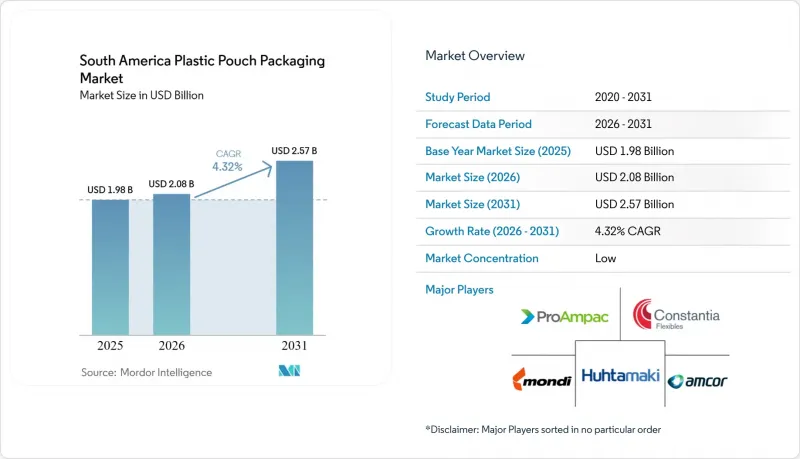
This report is Segmented by Material (Polyethylene (PE), Polypropylene (PP), Polyethylene Terephthalate (PET), Ethylene Vinyl Alcohol (EVOH), Polyvinyl Chloride (PVC), and More), Product Type (Flat Pouch and Stand Up Pouch), End User Industry (Food Products, Beverage, Personal Care and Household Care, and More), and Geography. The Market Forecasts are Provided in Terms of Value (USD).
South America Plastic Pouch Packaging Market Trends and Insights
Transition from Rigid Packaging to Flexible Plastic Pouch Solutions
The South America plastic pouch packaging market continues to benefit from a broad shift away from glass jars, tin cans, and HDPE containers toward lighter pouch formats across dry snacks, sauces, dairy, and frozen proteins. Brazil's flexible plastic packaging industry processed 2.321 million tons in 2025, which shows how deeply flexible formats are embedded in mainstream packaging demand. LDPE and LLDPE grades accounted for 73% of that Brazilian volume in 2025, reinforcing the strong operating base for PE-led pouch conversion across food, agro-industrial, and consumer goods uses. Agro-sector demand for flexible packaging rose 9.7% in 2025 to 316,000 tons, which shows that export-linked food chains are using multilayer pouch formats for freshness protection and lower logistics costs. This demand pattern remains important because smaller and mid-sized food manufacturers can adopt pouch filling and conversion with lower capital requirements than rigid packaging systems, keeping converter order books active even when regional economic conditions weaken.
Expansion of Organized Retail and Modern Trade Channels
The South America plastic pouch packaging market is also being supported by the spread of supermarket, cash-and-carry, and modern trade formats across large urban centers and secondary cities. Organized retail expansion increases the share of packaged products on shelves, which directly raises demand for lightweight, resealable, and display-ready pouch formats. Cencosud allocated USD 600 million in capital expenditure for 2026, with 70% directed to store growth and greenfield development across South American markets. That investment pace matters because a broader retail footprint strengthens procurement volumes for packaged foods, household products, and refill formats that rely heavily on flexible pouch packaging. It also favors converters that can respond to shorter product runs and more frequent packaging refresh cycles, especially as modern trade chains continue to expand product assortments.
Strengthening Plastic Packaging Regulations and Extended Producer Responsibility Policies
Regulatory tightening is one of the clearest near-term constraints on converter economics in the South America plastic pouch packaging market. Brazil's Decree No. 12,688 created immediate obligations on recovery and recycled content, and those rules raise qualification, sourcing, and reporting costs for converters that depend on multilayer structures. The pressure is strongest for laminates that combine PET, PA, and EVOH because these structures do not fit easily into current mechanical recycling systems used across much of the region. Compliance, therefore, favors larger suppliers that already have technical, certification, and customer support capabilities in place. The restraint is not simply about lower demand for plastic, but about a faster shift in orders toward converters that can meet regulatory requirements without disrupting food safety and performance standards.
Other drivers and restraints analyzed in the detailed report include:
- Rising Adoption of Sustainable and Recyclable Pouch Packaging
- Advancements In High-Barrier Films and Pouch Manufacturing Technologies
- Underdeveloped Collection and Recycling Infrastructure for Flexible Plastics
For complete list of drivers and restraints, kindly check the Table Of Contents.
Segment Analysis
Polyethylene held 46.01% of the South America plastic pouch packaging market share in 2025 because it combines low processing costs with wide compatibility across blown-film and cast-extrusion lines used by regional converters. Its leadership is reinforced by domestic resin availability in Brazil and by its broad fit across food, agro-industrial, and consumer goods pouch formats. In Brazil, LDPE and LLDPE alone accounted for 73% of the flexible packaging volume produced in 2025, underscoring the PE family's centrality to everyday pouch conversion activity. Polypropylene holds an important secondary position because it is better suited to hot-fill and retort applications, while PET and PVC continue to serve selected transparent and thermoformed pouch uses.
EVOH is projected to expand at a 7.59% CAGR through 2031, and this segment of the South America plastic pouch packaging market is being driven by higher demand for barrier performance in food safety and pharmaceutical packaging. Food processors and pharmaceutical manufacturers are increasingly specifying co-extruded structures with EVOH layers because they extend shelf life and support stricter packaging requirements. Kuraray's EVAL EVOH, presented at Interpack 2026, was positioned for recyclable mono-material packaging designs that align with emerging compliance needs in high-performance pouch applications. Nine-layer PE/EVOH/PE structures can reduce OTR to below 0.05 cm3/(m2*day), helping meat processors extend shelf life from 7 to 21 days and reduce waste across the supply chain.
Complete Report Scope:
- By Material
- Polyethylene (PE)
- Polypropylene (PP)
- Polyethylene Terephthalate (PET)
- Ethylene Vinyl Alcohol (EVOH)
- Polyvinyl Chloride (PVC)
- Other Materials
- By Product Type
- Flat Pouch
- Stand Up Pouch
- By End User Industry
- Food Products
- Candy and Confectionery
- Frozen Foods
- Fresh Produce
- Dairy Products
- Dry Foods
- Meat, Poultry, and Seafood
- Pet Food
- Other Food Products
- Beverage
- Medical and Pharmaceutical
- Personal Care and Household Care
- Other End User Industries
- Food Products
- By Geography
- Brazil
- Argentina
- Colombia
- Rest of South America
List of Companies Covered in this Report:
- Amcor plc
- ZARAPLAST S.A.
- ProAmpac Holdings, Inc.
- Finpak Flexibles, S.A. de C.V.
- SIG Group AG
- Mondi plc
- Constantia Flexibles Group GmbH
- Guala Pack S.p.a.
- Huhtamaki Oyj
- Bolsafilm SA
- BOLSAS DELTA S.A. DE C.V
Additional Benefits:
- The market estimate (ME) sheet in Excel format
- 3 months of analyst support
TABLE OF CONTENTS
1 INTRODUCTION
- 1.1 Study Assumptions and Market Definition
- 1.2 Scope of The Study
2 RESEARCH METHODOLOGY
3 EXECUTIVE SUMMARY
4 MARKET LANDSCAPE
- 4.1 Market Overview
- 4.2 Market Drivers
- 4.2.1 Transition from Rigid Packaging to Flexible Plastic Pouch Solutions
- 4.2.2 Expansion of Organized Retail and Modern Trade Channels
- 4.2.3 Rising Adoption of Sustainable and Recyclable Pouch Packaging
- 4.2.4 Advancements in High-Barrier Films and Pouch Manufacturing Technologies
- 4.2.5 Cost Optimization Through Lightweight and Material-Efficient Packaging
- 4.2.6 Expansion of Regional Manufacturing and Export-Oriented Industries
- 4.3 Market Restraints
- 4.3.1 Strengthening Plastic Packaging Regulations and Extended Producer Responsibility (EPR) Policies
- 4.3.2 Underdeveloped Collection and Recycling Infrastructure for Flexible Plastics
- 4.3.3 Volatility in Petrochemical Resin Prices and Raw Material Costs
- 4.3.4 Rising Competition from Paper-Based and Alternative Sustainable Packaging Materials
- 4.4 Industry Supply Chain Analysis
- 4.5 Sustainability and Regulatory Outlook
- 4.6 Technological Outlook
- 4.7 Porter's Five Forces Analysis
- 4.7.1 Bargaining Power of Buyers
- 4.7.2 Bargaining Power of Suppliers
- 4.7.3 Threat of New Entrants
- 4.7.4 Threat of Substitutes
- 4.7.5 Intensity of Competitive Rivalry
- 4.8 Impact of Macroeconomic Factors on the Market
5 MARKET SIZE AND GROWTH FORECASTS (VALUE)
- 5.1 By Material
- 5.1.1 Polyethylene (PE)
- 5.1.2 Polypropylene (PP)
- 5.1.3 Polyethylene Terephthalate (PET)
- 5.1.4 Ethylene Vinyl Alcohol (EVOH)
- 5.1.5 Polyvinyl Chloride (PVC)
- 5.1.6 Other Materials
- 5.2 By Product Type
- 5.2.1 Flat Pouch
- 5.2.2 Stand Up Pouch
- 5.3 By End User Industry
- 5.3.1 Food Products
- 5.3.1.1 Candy and Confectionery
- 5.3.1.2 Frozen Foods
- 5.3.1.3 Fresh Produce
- 5.3.1.4 Dairy Products
- 5.3.1.5 Dry Foods
- 5.3.1.6 Meat, Poultry, and Seafood
- 5.3.1.7 Pet Food
- 5.3.1.8 Other Food Products
- 5.3.2 Beverage
- 5.3.3 Medical and Pharmaceutical
- 5.3.4 Personal Care and Household Care
- 5.3.5 Other End User Industries
- 5.3.1 Food Products
- 5.4 By Geography
- 5.4.1 Brazil
- 5.4.2 Argentina
- 5.4.3 Colombia
- 5.4.4 Rest of South America
6 COMPETITIVE LANDSCAPE
- 6.1 Market Concentration
- 6.2 Strategic Moves and Development
- 6.3 Market Ranking Analysis
- 6.4 Company Profiles (includes Global Level Overview, Market Level Overview, Core Segments, Financials as available, Strategic Information, Market Rank/Share, Products and Services, Recent Developments)
- 6.4.1 Amcor plc
- 6.4.2 ZARAPLAST S.A.
- 6.4.3 ProAmpac Holdings, Inc.
- 6.4.4 Finpak Flexibles, S.A. de C.V.
- 6.4.5 SIG Group AG
- 6.4.6 Mondi plc
- 6.4.7 Constantia Flexibles Group GmbH
- 6.4.8 Guala Pack S.p.a.
- 6.4.9 Huhtamaki Oyj
- 6.4.10 Bolsafilm SA
- 6.4.11 BOLSAS DELTA S.A. DE C.V
7 MARKET OPPORTUNITIES AND FUTURE OUTLOOK
- 7.1 White-Space and Unmet-Need Assessment

