PUBLISHER: Mordor Intelligence | PRODUCT CODE: 2099987

PUBLISHER: Mordor Intelligence | PRODUCT CODE: 2099987
United States Sporting Goods - Market Share Analysis, Industry Trends & Statistics, Growth Forecasts (2026 - 2031)
According to Mordor Intelligence, the United States sporting goods market size was valued at USD 32.1 billion in 2025 and is estimated to grow from USD 33.9 billion in 2026 to reach USD 45.4 billion by 2031, at a 6% CAGR during the forecast period from 2026 to 2031.
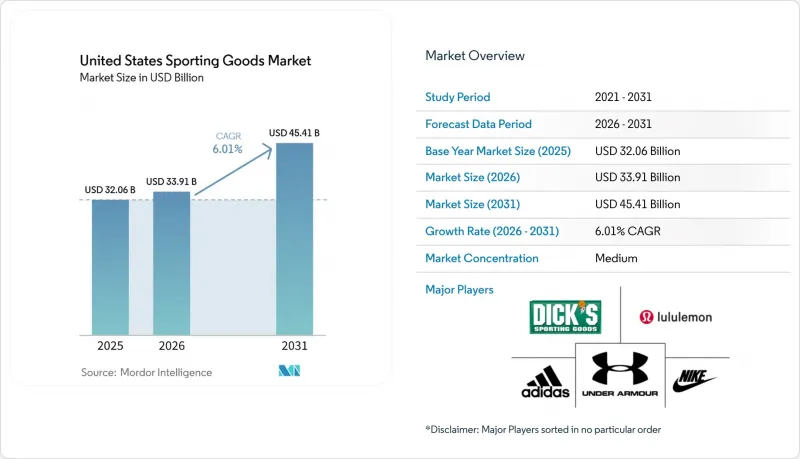
This report is Segmented by Product Type (Equipment, Protective Gear, Sports Bags, Accessories), Sports Type (Outdoor Sports, Indoor Sports, Adventure Sports, Other Sports), End User (Women, Men, Kids), Distribution Channel (Offline Retail Stores, Online Retail Stores), and Geography (United States). The Market Forecasts are Provided in Terms of Value (USD).
United States Sporting Goods Market Trends and Insights
Sustained Participation in Fitness and Recreation
The United States sporting goods market is benefiting from a larger active consumer base. SFIA projects that 250 million Americans will participate in at least one sport, fitness, or leisure activity in 2025. Team sports alone are expected to surpass 90 million participants, increasing demand for equipment, footwear, and related accessories across age groups. SFIA also expects the inactive share to fall below 20% for the first time, expanding the long-term addressable customer base for the United States sporting goods market. The Bureau of Economic Analysis indicates that personal consumption expenditures on membership clubs and participant sports centers may reach USD 85 billion in 2025, up from USD 81.5 billion in 2024, showing that spending continues to shift toward active recreation channels. This demand base remains important because recurring activity typically drives recurring replacement cycles rather than one-time purchases in the United States sporting goods market.
Expansion of Pickleball and Emerging Sports Participation
Pickleball has emerged as one of the clearest growth drivers in the United States sporting goods market. SFIA also projects that 24.3 million Americans will play pickleball in 2025, up 22.8% from the previous year and up 479% from 2020. Growth is not limited to casual trial, as both occasional and core participation are increasing simultaneously, supporting repeat spending on paddles, footwear, balls, and protective products. SFIA is also expected to add padel and disc golf to its participation tracking in 2026, signaling that the United States sporting goods market continues to create new equipment demand pockets beyond current mainstream categories.
Tariff and Trade Policy Volatility
Trade costs remain the clearest near-term drag on the United States sporting goods market. The Federal Reserve reported that Chinese-origin goods are expected to register an 8.5% year-on-year price increase by December 2025. The same Federal Reserve note stated that tariff pass-through to consumers would reach at least 30% from April to December 2025, indicating that higher landed costs are moving to retail shelves. Nike also noted an expected USD 986 million recovery tied to prior tariff impacts, highlighting that the issue is material at the company level and not limited to policy discussions. The United States sporting goods market remains exposed, as many product lines still depend on Asian sourcing for footwear, equipment, and accessories.
Other drivers and restraints analyzed in the detailed report include:
- Growth in Athletic Footwear Replacement Cycles
- Institutional Spending on School and Commercial Fitness Equipment
- Price Sensitivity and Private Label Substitution
For complete list of drivers and restraints, kindly check the Table Of Contents.
Segment Analysis
Equipment is expected to account for 42.5% of the United States sporting goods market by value in 2025, making it the largest product type in the category mix. The segment benefits from its position as the primary purchase category across team sports, racquet sports, golf, fitness, and several outdoor activities. SFIA expects baseball and softball equipment wholesale sales to grow by 7.9% in 2025, indicating that demand for hard goods remains active in organized sports. Institutional fitness equipment is also expected to record broad gains in 2025, helping sustain the Equipment segment's base even as some home-use demand softens. Equipment, therefore, remains central to the United States sporting goods market share, as it supports both participation-led spending and commercial procurement.
Accessories is expected to be the fastest-growing product type in the United States sporting goods market, with a forecast CAGR of 7.1% from 2026 to 2031. Shorter replacement cycles, lower ticket sizes, and a broader range of use cases across hydration, monitoring, resistance training, eyewear, and sport-specific add-ons support this growth. The segment also benefits when consumers delay major purchases but continue to seek performance improvements through smaller-ticket items. Protective categories retain value because safety expectations create a quality floor, especially in youth-oriented activities. Sports bags and related carry products also benefit from broader daily use, enabling the segment to capture both athletic and lifestyle spending in the United States sporting goods market.
Outdoor Sports is projected to account for 67.3% of the United States sporting goods market size in 2025, making it the dominant sports type by a wide margin. This position reflects the wide range of activities included in the category, such as trail running, cycling, fishing, camping, tennis, and golf. The Outdoor Industry Association's 2026 participation study is expected to report participation gains among children, adults aged 65 and older, and Hispanic participants, indicating that demand is broadening across several demographic groups. This broad user base is expected to support continued spending on footwear, apparel, equipment, and accessories across multiple seasons. Therefore, Outdoor Sports provides the scale foundation for the United States sporting goods market.
Adventure Sports is the fastest-growing sports type in the United States sporting goods market, with a projected CAGR of 7.4% through 2031. Categories such as climbing, mountaineering, whitewater sports, and backcountry sports typically require more specialized products, giving suppliers stronger pricing support than more standardized segments. This requirement also makes the category less vulnerable to low-cost substitution, as technical performance and safety play a larger role in purchase decisions. The segment remains smaller than Outdoor Sports, but it has higher value intensity because many products are purpose-built rather than interchangeable. This combination makes Adventure Sports an important premium growth pocket within the United States sporting goods market.
Complete Report Scope:
- By Product Type
- Equipment
- Protective Gears
- Sports Bags
- Accessories
- By Sports Type
- Outdoor Sports
- Indoor Sports
- Adventure Sports
- Other Sports
- By End User
- Women
- Men
- Kids
- By Distribution Channel
- Offline Retail Stores
- Online Retail Stores
List of Companies Covered in this Report:
- Nike, Inc.
- Adidas AG
- Under Armour, Inc.
- Puma SE
- Dick's Sporting Goods, Inc.
- Academy Sports and Outdoors, Inc.
- Lululemon Athletica Inc.
- VF Corporation
- Columbia Sportswear Company
- New Balance Athletics, Inc.
- Skechers U.S.A., Inc.
- Wilson Sporting Goods Co.
- YETI Holdings, Inc.
- Callaway Golf Company
- TaylorMade Golf Company, Inc.
- Amer Sports, Inc.
- Shimano Inc.
- Garmin Ltd.
- Topgolf Callaway Brands Corp.
- Peloton Interactive, Inc.
Additional Benefits:
- The market estimate (ME) sheet in Excel format
- 3 months of analyst support
TABLE OF CONTENTS
1 INTRODUCTION
- 1.1 Study Assumptions and Market Definition
- 1.2 Scope of the Study
2 RESEARCH METHODOLOGY
3 EXECUTIVE SUMMARY
4 MARKET LANDSCAPE
- 4.1 Market Overview
- 4.2 Market Drivers
- 4.2.1 Sustained Participation in Fitness and Recreation
- 4.2.2 Expansion of Pickleball and Emerging Sports Participation
- 4.2.3 Growth in Athletic Footwear Replacement Cycles
- 4.2.4 Institutional Spending on School and Commercial Fitness Equipment
- 4.2.5 DTC and Omnichannel Acceleration
- 4.2.6 Product Innovation in Connected and Premium Equipment
- 4.3 Market Restraints
- 4.3.1 Tariff and Trade Policy Volatility
- 4.3.2 Price Sensitivity and Private Label Substitution
- 4.3.3 Softness in Consumer Home Fitness Demand
- 4.3.4 Inventory Overhang and Promotion Intensity
- 4.4 Consumer Behavior Analysis
- 4.5 Regulatory Outlook
- 4.6 Technological Outlook
- 4.7 Porter's Five Forces Analysis
- 4.7.1 Threat of New Entrants
- 4.7.2 Bargaining Power of Buyers
- 4.7.3 Bargaining Power of Suppliers
- 4.7.4 Threat of Substitutes
- 4.7.5 Competitive Rivalry
5 MARKET SIZE AND GROWTH FORECASTS (VALUE )
- 5.1 By Product Type
- 5.1.1 Equipment
- 5.1.2 Protective Gears
- 5.1.3 Sports Bags
- 5.1.4 Accessories
- 5.2 By Sports Type
- 5.2.1 Outdoor Sports
- 5.2.2 Indoor Sports
- 5.2.3 Adventure Sports
- 5.2.4 Other Sports
- 5.3 By End User
- 5.3.1 Women
- 5.3.2 Men
- 5.3.3 Kids
- 5.4 By Distribution Channel
- 5.4.1 Offline Retail Stores
- 5.4.2 Online Retail Stores
6 COMPETITIVE LANDSCAPE
- 6.1 Market Concentration
- 6.2 Strategic Moves
- 6.3 Market Ranking Analysis
- 6.4 Company Profiles {(includes Global level Overview, Market level overview, Core Segments, Financials as available, Strategic Information, Market Rank/Share for key companies, Products and Services, and Recent Developments)}
- 6.4.1 Nike, Inc.
- 6.4.2 Adidas AG
- 6.4.3 Under Armour, Inc.
- 6.4.4 Puma SE
- 6.4.5 Dick's Sporting Goods, Inc.
- 6.4.6 Academy Sports and Outdoors, Inc.
- 6.4.7 Lululemon Athletica Inc.
- 6.4.8 VF Corporation
- 6.4.9 Columbia Sportswear Company
- 6.4.10 New Balance Athletics, Inc.
- 6.4.11 Skechers U.S.A., Inc.
- 6.4.12 Wilson Sporting Goods Co.
- 6.4.13 YETI Holdings, Inc.
- 6.4.14 Callaway Golf Company
- 6.4.15 TaylorMade Golf Company, Inc.
- 6.4.16 Amer Sports, Inc.
- 6.4.17 Shimano Inc.
- 6.4.18 Garmin Ltd.
- 6.4.19 Topgolf Callaway Brands Corp.
- 6.4.20 Peloton Interactive, Inc.
7 MARKET OPPORTUNITIES AND FUTURE OUTLOOK

