PUBLISHER: Mordor Intelligence | PRODUCT CODE: 2099993

PUBLISHER: Mordor Intelligence | PRODUCT CODE: 2099993
Asia-Pacific Haying, Forage and Harvesting Machinery - Market Share Analysis, Industry Trends & Statistics, Growth Forecasts (2026 - 2031)
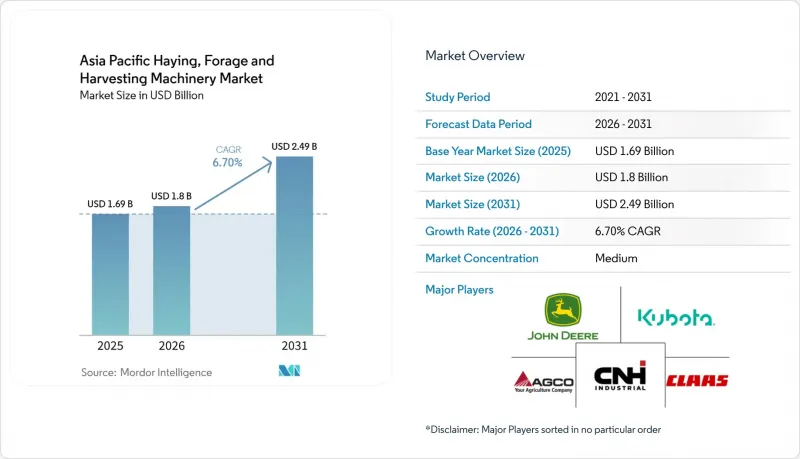
According to Mordor Intelligence, the Asia-Pacific haying, forage, and harvesting machinery market was valued at USD 1.69 billion in 2025 and is projected to grow from USD 1.80 billion in 2026 to USD 2.49 billion by 2031, registering a CAGR of 6.70% during the forecast period from 2026 to 2031.
This report is Segmented by Product Type (Mowers and Conditioners, Balers, Forage Harvesters, and More), by Operation Type (Tractor Mounted and More), by Power Source (Diesel and Hybrid), by Application (Hay Production and More), and by Geography (China, India, Japan, South Korea, Australia, and More). The Market Forecasts are Provided in Terms of Value (USD).
Asia-Pacific Haying, Forage and Harvesting Machinery Market Trends and Insights
Rising Labor Costs and Labor Scarcity in Farm Operations
Labor shortages and an aging agricultural workforce in the Asia-Pacific region are driving the adoption of mechanized forage harvesting solutions. According to the Food and Agriculture Organization of the United Nations (FAO) in its "The Status of Youth in Agrifood Systems" report (2025), rural youth account for only 5% of the population in industrial agrifood systems, indicating a declining future agricultural labor pool in areas such as East Asia. With younger workers increasingly shifting to urban employment, forage producers face significant challenges in securing labor during critical harvesting periods. As a result, farms are investing in balers, forage harvesters, and self-propelled haying equipment to enhance operational efficiency, reduce reliance on labor, and maintain forage quality. This trend is contributing to the growth of the Asia-Pacific haying, forage, and harvesting machinery market.
Government Mechanization Subsidies and Farm Equipment Financing
Government support programs are accelerating the adoption of haying, forage, and harvesting machinery across the Asia-Pacific region by reducing equipment acquisition costs. According to the National Development and Reform Commission (NDRC) of China (2025), the country expanded its agricultural machinery scrappage and renewal subsidy program and increased subsidy standards for selected equipment categories, with support reaching up to 50% of the sales price for certain eligible machinery under pilot implementation arrangements. These incentives encourage farmers and contractors to invest in modern balers, forage harvesters, mowers, and related forage equipment, improving mechanization efficiency and supporting market growth.
Fragmented Landholdings Limiting Machine Utilization
Fragmented landholdings continue to hinder the efficient use of advanced haying and forage machinery in the Asia-Pacific region. According to the National Institution for Transforming India (NITI) Aayog (2025), over 86% of Indian farmers are smallholders, managing relatively small and fragmented land parcels. These land structures reduce field efficiency, increase maneuvering time, and lower the annual utilization rates of high-capacity balers, forage harvesters, and self-propelled equipment. Consequently, farmers experience weaker returns on machinery investments and longer payback periods, which limit the adoption of larger harvesting systems and constrain the growth of the haying, forage, and harvesting machinery market in the Asia-Pacific.
Other drivers and restraints analyzed in the detailed report include:
- Precision Baling, Telematics, and Machine Automation Adoption
- Contractor Fleet Expansion and Custom Harvesting Demand
- Emissions Compliance and Certification Complexity
For complete list of drivers and restraints, kindly check the Table Of Contents.
Segment Analysis
The Asia-Pacific haying, forage, and harvesting machinery market share for balers accounted for the largest 31.0% in 2025. Balers maintain their leading position due to their critical role in forage preservation, enhancing storage efficiency, and streamlining feed logistics in livestock production systems. Their adoption is driven by the increasing demand for compact and transportable forage products, which simplify handling and minimize storage losses. Large-scale dairy and beef operations continue to depend on baling equipment to optimize feed management efficiency. Additionally, the segment benefits from replacement demand and compatibility with various forage crops, establishing balers as a key machinery category in regional farming systems.
Forage harvesters are forecast to grow at the fastest 6.8% CAGR from 2026 to 2031. This growth is supported by the increasing adoption of silage-based feeding systems and the rising need for higher forage quality in commercial livestock operations. Modern forage production emphasizes rapid harvesting, precise crop processing, and improved feed consistency, all of which drive the deployment of forage harvesters. Expanding dairy intensification and the growing demand for year-round feed availability are further boosting equipment utilization rates. The segment also benefits from broader integration with mechanized forage management practices, fostering stronger demand for advanced harvesting solutions across the region.
Self-propelled equipment held the largest 42.0% share in 2025. The segment's leadership reflects its suitability for commercial-scale operations requiring high field capacity, operational flexibility, and reduced dependence on multiple machines. Self-propelled platforms offer improved productivity through integrated harvesting systems and greater maneuverability in large forage production areas. Their ability to support advanced automation, operator-assistance functions, and precision agriculture technologies further enhances their appeal among professional operators. Growing labor constraints and increasing emphasis on operational efficiency continue to reinforce demand for self-propelled equipment throughout the regional forage harvesting sector.
Self-propelled equipment is also forecast to grow at the fastest 7.4% CAGR from 2026 to 2031. Expansion is being driven by increasing mechanization among commercial forage producers and agricultural contractors seeking greater harvesting efficiency. Larger operations are prioritizing equipment capable of delivering higher throughput while minimizing labor requirements and downtime. The growing adoption of digital monitoring systems, automated machine controls, and precision harvesting technologies is further supporting demand. Although tractor-mounted and trailed machinery remain important across smaller farming systems, investment trends increasingly favor self-propelled platforms where scale, productivity, and operational consistency are primary purchasing considerations.
Complete Report Scope:
- By Product Type
- Mowers and Conditioners
- Balers
- Forage Harvesters
- Tedders and Rakes
- Self-Propelled Windrowers
- Other Haying and Forage Machinery
- By Operation Type
- Tractor Mounted
- Self-Propelled
- Trailed and Pull-Type
- By Power Source
- Diesel
- Electric
- Hybrid
- By Application
- Hay Production
- Silage Making
- Forage Harvesting
- Pasture Management
- By Geography
- China
- India
- Japan
- South Korea
- Australia
- Indonesia
- Vietnam
- Thailand
- Rest of Asia-Pacific
List of Companies Covered in this Report:
- Deere and Company
- Kubota Corporation
- CNH Industrial N.V.
- AGCO Corporation
- CLAAS KGaA mbH
- Mahindra and Mahindra Ltd
- Iseki and Co., Ltd.
- KUHN SAS (Bucher Industries AG)
- Vermeer Corporation
- Yanmar Holdings Co., Ltd.
- Maschinenfabrik Bernard Krone GmbH & Co. KG (Bernard Krone Holding SE & Co. KG)
- Pottinger Landtechnik GmbH
- Yantai Lansu Measurement and Control Instrument Co., Ltd.
- Weichai Lovol Intelligent Agricultural Technology Co., Ltd. (Shandong Heavy Industry Group Co., Ltd.)
- China National Machinery Industry Corporation
Additional Benefits:
- The market estimate (ME) sheet in Excel format
- 3 months of analyst support
TABLE OF CONTENTS
1 Introduction
- 1.1 Study Assumptions and Market Definition
- 1.2 Scope of the Study
2 Research Methodology
3 Executive Summary
4 Market Landscape
- 4.1 Market Overview
- 4.2 Market Drivers
- 4.2.1 Rising labor costs and labor scarcity in farm operations
- 4.2.2 Government mechanization subsidies and farm equipment financing
- 4.2.3 Expansion of dairy and forage intensive livestock systems
- 4.2.4 Precision baling, telematics, and machine automation adoption
- 4.2.5 Contractor fleet expansion and custom harvesting demand
- 4.2.6 Smallholder demand for compact electrified hay tools
- 4.3 Market Restraints
- 4.3.1 High upfront capital cost and long payback cycles
- 4.3.2 Fragmented landholdings limiting machine utilization
- 4.3.3 Technician and spare parts service gaps in rural markets
- 4.3.4 Emissions compliance and certification complexity
- 4.4 Regulatory Landscape
- 4.5 Technology Outlook
- 4.6 Porter's Five Forces Analysis
- 4.6.1 Bargaining Power of Suppliers
- 4.6.2 Bargaining Power of Buyers
- 4.6.3 Threat of New Entrants
- 4.6.4 Threat of Substitutes
- 4.6.5 Intensity of Competitive Rivalry
5 Market Size and Growth Forecasts (Value)
- 5.1 By Product Type
- 5.1.1 Mowers and Conditioners
- 5.1.2 Balers
- 5.1.3 Forage Harvesters
- 5.1.4 Tedders and Rakes
- 5.1.5 Self-Propelled Windrowers
- 5.1.6 Other Haying and Forage Machinery
- 5.2 By Operation Type
- 5.2.1 Tractor Mounted
- 5.2.2 Self-Propelled
- 5.2.3 Trailed and Pull-Type
- 5.3 By Power Source
- 5.3.1 Diesel
- 5.3.2 Electric
- 5.3.3 Hybrid
- 5.4 By Application
- 5.4.1 Hay Production
- 5.4.2 Silage Making
- 5.4.3 Forage Harvesting
- 5.4.4 Pasture Management
- 5.5 By Geography
- 5.5.1 China
- 5.5.2 India
- 5.5.3 Japan
- 5.5.4 South Korea
- 5.5.5 Australia
- 5.5.6 Indonesia
- 5.5.7 Vietnam
- 5.5.8 Thailand
- 5.5.9 Rest of Asia-Pacific
6 Competitive Landscape
- 6.1 Market Concentration
- 6.2 Strategic Moves
- 6.3 Market Share Analysis
- 6.4 Company Profiles (Includes Global Level Overview, Market Level Overview, Core Segments, Financials as Available, Strategic Information, Market Rank/Share for Key Companies, Products and Services, and Recent Developments)
- 6.4.1 Deere and Company
- 6.4.2 Kubota Corporation
- 6.4.3 CNH Industrial N.V.
- 6.4.4 AGCO Corporation
- 6.4.5 CLAAS KGaA mbH
- 6.4.6 Mahindra and Mahindra Ltd
- 6.4.7 Iseki and Co., Ltd.
- 6.4.8 KUHN SAS (Bucher Industries AG)
- 6.4.9 Vermeer Corporation
- 6.4.10 Yanmar Holdings Co., Ltd.
- 6.4.11 Maschinenfabrik Bernard Krone GmbH & Co. KG (Bernard Krone Holding SE & Co. KG)
- 6.4.12 Pottinger Landtechnik GmbH
- 6.4.13 Yantai Lansu Measurement and Control Instrument Co., Ltd.
- 6.4.14 Weichai Lovol Intelligent Agricultural Technology Co., Ltd. (Shandong Heavy Industry Group Co., Ltd.)
- 6.4.15 China National Machinery Industry Corporation
7 Market Opportunities and Future Outlook

