PUBLISHER: Mordor Intelligence | PRODUCT CODE: 2100004

PUBLISHER: Mordor Intelligence | PRODUCT CODE: 2100004
Gate Driver Integrated Circuit - Market Share Analysis, Industry Trends & Statistics, Growth Forecasts (2026 - 2031)
According to Mordor Intelligence, the gate driver integrated circuit market size was valued at USD 1.79 billion in 2025 and estimated to grow from USD 1.87 billion in 2026 to reach USD 2.36 billion by 2031, at a CAGR of 4.72% during the forecast period (2026-2031).
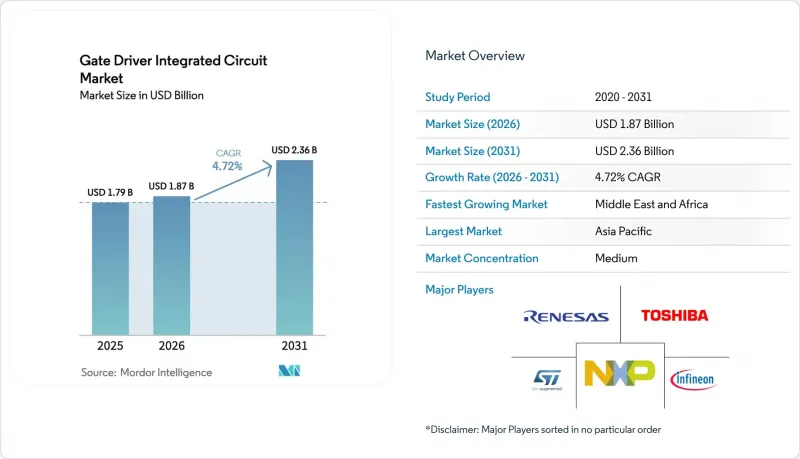
This report is Segmented by Transistor Type (MOSFET, and IGBT), Isolation Type (Isolated Gate Driver IC, and More), Semiconductor Material (Silicon (Si), and More), Input Configuration (Single-Channel, and More), Application (Commercial, Industrial, and More), End-User Industry (Automotive, Consumer Electronics, and More), and Geography. The Market Forecasts are Provided in Terms of Value (USD).
Global Gate Driver Integrated Circuit Market Trends and Insights
Surge in SiC and GaN Power Device Adoption Requiring Advanced Gate Drivers
Wide-bandgap devices switch at tens of megahertz, forcing designers to specify driver ICs with sub-35 ns delay and >300 kV/µs common-mode immunity. SiC MOSFETs also need bipolar gate voltages of +15 V/-4 V and robust short-circuit detection, which traditional silicon-focused drivers cannot supply. Infineon's trench-based SiC super-junction devices released in 2025 lower on-resistance by 40%, yet they place tighter constraints on gate-voltage accuracy and thermal handling. Co-development programs between driver and device teams reduce ringing, minimize EMI, and shorten validation cycles. As carmakers and data-center operators migrate to 800 V rails, the gate driver integrated circuit market expands by capturing higher content per module.
Rapid EV On-Board Charger and Traction Inverter Deployment
Automotive platforms moving from 400 V to 800 V battery packs double insulation stress yet promise faster charging. Driver ICs must satisfy ISO 26262 ASIL C or D and AEC-Q100 Grade 0, extending design cycles to five years but creating entry barriers that protect incumbent suppliers. Volkswagen's supply agreement with onsemi bundles SiC MOSFETs and drivers, illustrating customer demand for turnkey, qualified power stages. Content per vehicle rises as domain controllers, DCDC converters, and traction inverters each require dedicated isolated drivers with integrated de-saturation and soft-off. Automotive qualification premiums offset commodity price pressure and bolster overall gate driver integrated circuit market revenues
Thermal-Reliability Challenges under Above 1200 V, High dv/dt Operation
Gate drivers in 1200 V traction inverters face temperature swings from -40 °C to 150 °C during harsh duty cycles. Power-cycling studies show accelerated gate-oxide degradation once swings exceed 120 °C, forcing designers to adopt thicker isolation layers and derate switching speed. These mitigations add cost and PCB area. In cost-sensitive markets, engineers delay wide-bandgap adoption or cap bus voltage at 800 V. The restraint dampens near-term revenue growth for high-end products in the gate driver integrated circuit market, even though long-term demand remains intact.
Other drivers and restraints analyzed in the detailed report include:
- Expansion of Photovoltaic and Battery-Based Energy-Storage Inverters
- High-Frequency Switching Demand from Hyperscale Data-Centers
- Wide-Bandgap Substrate Supply Constraints
For complete list of drivers and restraints, kindly check the Table Of Contents.
Segment Analysis
MOSFET-based drivers accounted for 61.12% of revenue in 2025 as consumer and low-to-medium-power industrial products favor cost and efficiency at switching frequencies below 200 kHz. However, IGBT-centric designs will register a 7.35% CAGR through 2031 as electric-vehicle traction inverters and heavy-industrial drives demand higher current handling and rugged short-circuit tolerance. The gate driver integrated circuit market benefits because IGBT modules need peak-current drive up to 20 A and configurable soft-shut-off, features that command premium pricing. SiC MOSFET adoption blurs the boundary between MOSFET and IGBT categories, yet each device family preserves distinct gate-drive nuance, ensuring parallel demand streams.
Next-generation traction inverters pair 1200 V SiC MOSFET half-bridges with 20 A isolated drivers offering <35 ns delay skew, while industrial UPS makers still select 1700 V IGBTs driven at 15 A peak. Designers thus maintain dual qualification paths and evaluate total cost rather than strictly device technology. This coexistence keeps both MOSFET and IGBT driver innovation healthy within the gate driver integrated circuit market.
Isolated solutions retained 69.05% share in 2025 because high-voltage automotive and solar applications mandate reinforced safety barriers. Digital transformer isolation now achieves 8 kV peak ratings and <45 ns propagation delay, narrowing performance gaps to capacitive links. Nonetheless, non-isolated drivers will climb at 9.18% CAGR as system-on-chip and low-voltage motor-control boards integrate isolation elsewhere and prize lower BOM cost.
Cost-optimized brushless-DC appliance controllers exemplify this shift: motor module designers embed system isolation at the power stage and attach non-isolated gate drivers directly to microcontrollers. Such architecture trims PCB layers and shrinks form factor, a decisive edge in high-volume appliances. Consequently, the gate driver integrated circuit market flexes to serve divergent safety philosophies without cannibalizing existing offerings.
Complete Report Scope:
- By Transistor Type
- MOSFET
- IGBT
- By Isolation Type
- Isolated Gate Driver ICs
- Non-Isolated Gate Driver ICs
- By Semiconductor Material
- Silicon (Si)
- Silicon Carbide (SiC)
- Gallium Nitride (GaN)
- By Input Configuration
- Single-Channel
- Dual-Channel
- Multi-Channel
- By Application
- Commercial
- Industrial
- Residential
- By End-User Industry
- Automotive
- Consumer Electronics
- Energy and Power
- Healthcare
- Others
- By Geography
- North America
- United States
- Canada
- Mexico
- Europe
- Germany
- United Kingdom
- France
- Nordics
- Rest of Europe
- South America
- Brazil
- Rest of South America
- Asia-Pacific
- China
- Japan
- India
- South-East Asia
- Rest of Asia-Pacific
- Middle East and Africa
- Middle East
- Gulf Cooperation Council Countries
- Turkey
- Rest of Middle East
- Africa
- South Africa
- Rest of Africa
- Middle East
- North America
Geography Analysis
Asia-Pacific remains the core manufacturing and consumption hub for gate-drive solutions. China's dominance in smart-appliance output and Japan's high-reliability electronics heritage drive a complex mix of cost-sensitive and premium specifications. Government incentives for energy-efficient products, along with aggressive EV uptake targets, keep design cycles brisk. South Korea and Taiwan provide crucial semiconductor process capacity, allowing regional firms to iterate quickly without global logistics delays. Toshiba's TPD4165K intelligent power device, which cuts BLDC inverter footprints by 21% while raising voltage capability to 600 V, demonstrates how compact driver-device integration matches regional board-space constraints.
North America and Europe jointly account for a substantial share of high-value, safety-critical applications. Data-center expansions in the United States have pushed rack-level loads beyond 100 kW, requiring isolated drivers with remote telemetry for proactive thermal management. European regulators have updated electric motor efficiency standards effective June 2027, leading OEMs to retrofit motor drives that meet higher benchmark efficiency classes. onsemi's USD 2 billion SiC investment in the Czech Republic underscores how supply-chain security resonates with European automotive brands looking to localize wide-bandgap sourcing. These factors foster a premium segment of the gate driver integrated circuit market where safety certification and traceability outweigh pure cost.
The Middle East and Africa, though still accounting for a single-digit revenue share, show the most rapid growth. Gulf Cooperation Council countries finance multi-gigawatt solar parks and battery hubs to diversify beyond hydrocarbons. These projects demand megawatt-scale inverters using SiC modules and multi-channel gate drivers that guarantee >25-year operational life. Local technical talent pools remain thin, so suppliers that bundle reference designs and remote diagnostics win early design-ins. Over the forecast horizon through 2031, these initiatives create a durable growth corridor that strengthens the global presence of the gate driver integrated circuit market
- Infineon Technologies AG
- Texas Instruments Inc.
- onsemi Corp.
- STMicroelectronics N.V.
- Renesas Electronics Corp.
- NXP Semiconductors N.V.
- ROHM Co., Ltd.
- Toshiba Corp.
- Mitsubishi Electric Corp.
- Semtech Corp.
- Analog Devices Inc.
- Microchip Technology Inc.
- Diodes Inc.
- Power Integrations Inc.
- Allegro MicroSystems LLC
- Littelfuse Inc.
- Vishay Intertechnology Inc.
- Navitas Semiconductor Corp.
- Transphorm Inc.
- Maxim Integrated Products Inc. (ADI)
Additional Benefits:
- The market estimate (ME) sheet in Excel format
- 3 months of analyst support
TABLE OF CONTENTS
1 INTRODUCTION
- 1.1 Study Assumptions and Market Definition
- 1.2 Scope of the Study
2 RESEARCH METHODOLOGY
3 EXECUTIVE SUMMARY
4 MARKET LANDSCAPE
- 4.1 Market Overview
- 4.2 Market Drivers
- 4.2.1 Surge in SiC and GaN Power Device Adoption Requiring Advanced Gate Drivers
- 4.2.2 Rapid EV On-Board Charger and Traction Inverter Deployment
- 4.2.3 Expansion of Photovoltaic and Battery-Based Energy-Storage Inverters
- 4.2.4 High-Frequency Switching Demand from Hyperscale Data-Centers
- 4.2.5 Proliferation of Smart-Appliance BLDC Motors in Asia
- 4.2.6 Government-Mandated Efficiency Standards Elevating Gate-Driver Content
- 4.3 Market Restraints
- 4.3.1 Thermal-Reliability Challenges under Above 1200 V, High dv/dt Operation
- 4.3.2 Wide-Bandgap Substrate Supply Constraints
- 4.3.3 Stringent ISO 26262 and AEC-Q100 Compliance Raising Cost Barriers
- 4.3.4 Design Complexity for Multi-Channel, High-Side Isolated Drivers
- 4.4 Industry Ecosystem Analysis
- 4.5 Technology Snapshot
- 4.6 Porter's Five Forces Analysis
- 4.6.1 Bargaining Power of Suppliers
- 4.6.2 Bargaining Power of Buyers
- 4.6.3 Threat of New Entrants
- 4.6.4 Threat of Substitutes
- 4.6.5 Intensity of Competitive Rivalry
5 MARKET SIZE AND GROWTH FORECASTS (VALUES)
- 5.1 By Transistor Type
- 5.1.1 MOSFET
- 5.1.2 IGBT
- 5.2 By Isolation Type
- 5.2.1 Isolated Gate Driver ICs
- 5.2.2 Non-Isolated Gate Driver ICs
- 5.3 By Semiconductor Material
- 5.3.1 Silicon (Si)
- 5.3.2 Silicon Carbide (SiC)
- 5.3.3 Gallium Nitride (GaN)
- 5.4 By Input Configuration
- 5.4.1 Single-Channel
- 5.4.2 Dual-Channel
- 5.4.3 Multi-Channel
- 5.5 By Application
- 5.5.1 Commercial
- 5.5.2 Industrial
- 5.5.3 Residential
- 5.6 By End-User Industry
- 5.6.1 Automotive
- 5.6.2 Consumer Electronics
- 5.6.3 Energy and Power
- 5.6.4 Healthcare
- 5.6.5 Others
- 5.7 By Geography
- 5.7.1 North America
- 5.7.1.1 United States
- 5.7.1.2 Canada
- 5.7.1.3 Mexico
- 5.7.2 Europe
- 5.7.2.1 Germany
- 5.7.2.2 United Kingdom
- 5.7.2.3 France
- 5.7.2.4 Nordics
- 5.7.2.5 Rest of Europe
- 5.7.3 South America
- 5.7.3.1 Brazil
- 5.7.3.2 Rest of South America
- 5.7.4 Asia-Pacific
- 5.7.4.1 China
- 5.7.4.2 Japan
- 5.7.4.3 India
- 5.7.4.4 South-East Asia
- 5.7.4.5 Rest of Asia-Pacific
- 5.7.5 Middle East and Africa
- 5.7.5.1 Middle East
- 5.7.5.1.1 Gulf Cooperation Council Countries
- 5.7.5.1.2 Turkey
- 5.7.5.1.3 Rest of Middle East
- 5.7.5.2 Africa
- 5.7.5.2.1 South Africa
- 5.7.5.2.2 Rest of Africa
- 5.7.5.1 Middle East
- 5.7.1 North America
6 COMPETITIVE LANDSCAPE
- 6.1 Market Concentration
- 6.2 Strategic Moves
- 6.3 Market Share Analysis
- 6.4 Company Profiles (includes Global level Overview, Market level overview, Core Segments, Financials as available, Strategic Information, Market Rank/Share for key companies, Products and Services, and Recent Developments)
- 6.4.1 Infineon Technologies AG
- 6.4.2 Texas Instruments Inc.
- 6.4.3 onsemi Corp.
- 6.4.4 STMicroelectronics N.V.
- 6.4.5 Renesas Electronics Corp.
- 6.4.6 NXP Semiconductors N.V.
- 6.4.7 ROHM Co., Ltd.
- 6.4.8 Toshiba Corp.
- 6.4.9 Mitsubishi Electric Corp.
- 6.4.10 Semtech Corp.
- 6.4.11 Analog Devices Inc.
- 6.4.12 Microchip Technology Inc.
- 6.4.13 Diodes Inc.
- 6.4.14 Power Integrations Inc.
- 6.4.15 Allegro MicroSystems LLC
- 6.4.16 Littelfuse Inc.
- 6.4.17 Vishay Intertechnology Inc.
- 6.4.18 Navitas Semiconductor Corp.
- 6.4.19 Transphorm Inc.
- 6.4.20 Maxim Integrated Products Inc. (ADI)

