PUBLISHER: Mordor Intelligence | PRODUCT CODE: 2100010

PUBLISHER: Mordor Intelligence | PRODUCT CODE: 2100010
Europe E-commerce Apparel - Market Share Analysis, Industry Trends & Statistics, Growth Forecasts (2026 - 2031)
According to Mordor Intelligence, the Europe e-commerce apparel market size in 2026 is estimated at USD 130.96 billion, growing from 2025 value of USD 125.68 billion with 2031 projections showing USD 160.89 billion, growing at 4.2% CAGR over 2026-2031.
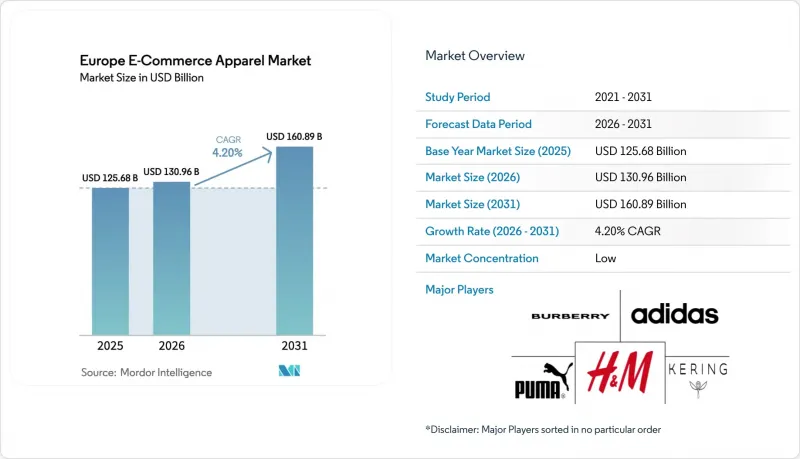
This report is Segmented by Product Type (Formal Wear, Casual Wear, Sportswear, Nightwear, and More), End User (Men and More), Fabric Material (Cotton and More), Category (Mass and Premium), Platform Type (Third Party Retailer and Company's Own Website), and Geography (Germany, United Kingdom, France, Italy, Spain, Russia, and More). The Market Forecasts are Provided in Terms of Value (USD).
Europe E-commerce Apparel Market Trends and Insights
Promotion and Discounts Enticing Consumer to Make Purchase
Promotions and discounts drive consumer purchasing decisions in the E-Commerce apparel market. These strategies influence buying behavior through multiple factors: creating urgency, providing value, and reducing purchase costs in a competitive market. Common promotional tactics include time-limited discounts, flash sales, and exclusive offers, which encourage immediate purchases. Additionally, loyalty programs and personalized promotions help build customer retention. The integration of omnichannel marketing and social commerce has enhanced promotional effectiveness, enabling brands to deliver targeted offers across platforms using customer data analytics. Social media platforms like TikTok and Instagram have become key promotional channels, with brands such as Zara and H&M implementing shoppable video content that connects users to exclusive online discounts.
Personalized Shopping Experience Enabled by Technology
The Europe e-commerce apparel industry's shift toward personalized shopping experiences is driven by technological advancements and evolving consumer preferences. Consumers seek convenience, relevance, and brand connection, prompting retailers to implement artificial intelligence, machine learning, and data analytics solutions. These technologies analyze customer data, including browsing patterns, purchase records, preferences, and social media interactions, to create personalized product recommendations and targeted promotions. Virtual fitting rooms and augmented reality solutions help customers visualize clothing fit and appearance before purchase, which helps reduce return rates. AI-powered chatbots provide immediate, personalized customer support throughout the shopping process. According to Eurostat, in 2024, 13.5% of enterprises in the European Union implemented artificial intelligence technologies in their operations, with retail emerging as a primary adopter .
Availability of Counterfeit Products
The proliferation of counterfeit products poses a significant challenge to the European e-commerce apparel market, eroding consumer trust and brand equity while creating unfair competitive dynamics. According to the European Union Intellectual Property Office (EUIPO), counterfeit goods cost the clothing, cosmetics, and toy industries EUR 16 billion in sales and nearly 200,000 jobs annually . The digital nature of e-commerce has inadvertently facilitated this problem, with counterfeiters using third-party marketplaces and social media platforms to reach consumers directly, often utilizing authentic product images and descriptions to create misleading listings. The industry's response has evolved from basic authentication tags to blockchain-based verification systems that provide proof of authenticity throughout the supply chain. Companies are implementing comprehensive anti-counterfeiting strategies that combine technological solutions with consumer education initiatives. This issue particularly affects premium and luxury segments, where brand equity directly influences value proposition and pricing power.
Other drivers and restraints analyzed in the detailed report include:
- Direct-to-Consumer (DTC) Brand Growth
- Influence of Social Media Platforms and Celebrity Endorsements
- Competition from Brick-and-Mortar Stores and Alternative Retail Channels
For complete list of drivers and restraints, kindly check the Table Of Contents.
Segment Analysis
The casual wear segment holds a 37.02% share of the European e-commerce apparel market in 2025, driven by consumers' increasing preference for comfortable and versatile clothing. This trend is supported by the growth in remote work, with 8.9% of employed people in the European Union working from home in 2023, according to Eurostat. The segment shows particular strength in Northern European countries, including Germany and the Netherlands, where practical clothing aligns with local preferences. The sportswear segment is expected to grow at a CAGR of 4.57% from 2026 to 2031, supported by athleisure trends and increased health awareness. The Formal Wear segment has adapted by incorporating more comfortable designs that work in both professional and casual settings.
The nightwear category shows growth due to increased consumer interest in sleep quality and wellness, with premium sleep brands gaining market share. Across all segments, manufacturers are incorporating technical fabrics with moisture-wicking, temperature-regulating, and odor-resistant properties to differentiate their products. Product strategies focus on versatility and year-round appeal, moving away from strict seasonal collections toward more sustainable inventory management. This trend is reflected in the popularity of modular clothing systems that adapt to various situations and weather conditions, appealing to consumers seeking maximum value from their clothing purchases.
The women's segment holds a dominant 44.18% market share in 2025, attributed to higher purchase frequency and broader product category selection compared to other segments. This dominance is strongest in Southern European markets, particularly Italy and Spain, where fashion plays a significant role in cultural identity. Major retailers have successfully implemented AI-powered size recommendation tools in the women's segment to resolve the persistent issue of size inconsistency across brands. The children's wear segment is expected to achieve the highest growth rate at 4.89% CAGR from 2026 to 2031, as parents prioritize quality and sustainable clothing options despite Europe's declining birth rates.
The men's segment is undergoing significant changes, focusing on style education and curation services to overcome traditional barriers in fashion engagement. Retailers are implementing data-driven personalization to streamline the shopping experience for male consumers through guided navigation that reduces choice complexity while maintaining style options. Across all segments, demand for inclusive sizing continues to increase, prompting brands to expand their size ranges. This inclusivity trend extends to age-appropriate styling, particularly targeting Europe's growing 50+ demographic, which represents a significant portion of discretionary spending power.
Complete Report Scope:
- By Product Type
- Formal Wear
- Casual Wear
- Sportswear
- Nightwear
- Intimate and Loungewear
- Other Product Tyoes
- By End User
- Men
- Women
- Children
- By Fabric Material
- Cotton
- Polyester
- Nylon
- Denim
- Other Fabric Types
- By Category
- Mass
- Premium
- By Platform Type
- Third-Party Marketplace
- Company-owned Platform
- By Country
- Germany
- United Kingdom
- Italy
- France
- Spain
- Netherlands
- Poland
- Belgium
- Sweden
- Rest of Europe
List of Companies Covered in this Report:
- Burberry Group plc
- Hennes & Mauritz AB
- Adidas AG
- Puma SE
- PVH Corp.
- Kering S.A.
- LVMH Moet Hennessy Louis Vuitton SE
- Chanel Limited
- Nike, Inc.
- Industria de Diseno Textil SA
- Hermes International S.A.
- Ralph Lauren Corporation
- Marks & Spencer Group plc
- Punta Na Holding SA
- VF Corporation
- Next plc
- Levi Strauss & Co.
- Authentic Brands Group, LLC
- Moncler S.p.A
- Decathlon SA
Additional Benefits:
- The market estimate (ME) sheet in Excel format
- 3 months of analyst support
TABLE OF CONTENTS
1 INTRODUCTION
- 1.1 Study Assumptions and Market Definition
- 1.2 Scope of the Study
2 RESEARCH METHODOLOGY
3 EXECUTIVE SUMMARY
4 MARKET LANDSCAPE
- 4.1 Market Overview
- 4.2 Market Drivers
- 4.2.1 Promotion and Discounts Enticing Consumer to Make Purchase
- 4.2.2 Personalized Shopping Experience Enabled by Technology
- 4.2.3 Direct-to-Consumer (DTC) Brand Growth
- 4.2.4 Influence of Social Media Platforms and Celebrity Endorsements
- 4.2.5 Flexible and Diverse Payment Options
- 4.2.6 Rising Demand for Sustainable and Ethical Fashion
- 4.3 Market Restraints
- 4.3.1 Availablity of Counterfeit Products
- 4.3.2 Competition from Brick-and-Mortar Stores and Alternative Retail Channels
- 4.3.3 Size, Fit, and Product Assessment Challenges
- 4.3.4 Logistical Challenges in Fulfillment and Delivery
- 4.4 Consumer Behaviour Analysis
- 4.5 Regulatory Outlook
- 4.6 Porter's Five Forces
- 4.6.1 Bargaining Power of Suppliers
- 4.6.2 Bargaining Power of Buyers
- 4.6.3 Threat of New Entrants
- 4.6.4 Threat of Substitutes
- 4.6.5 Degree of Competition
5 MARKET SIZE AND GROWTH FORECAST (VALUE)
- 5.1 By Product Type
- 5.1.1 Formal Wear
- 5.1.2 Casual Wear
- 5.1.3 Sportswear
- 5.1.4 Nightwear
- 5.1.5 Intimate and Loungewear
- 5.1.6 Other Product Tyoes
- 5.2 By End User
- 5.2.1 Men
- 5.2.2 Women
- 5.2.3 Children
- 5.3 By Fabric Material
- 5.3.1 Cotton
- 5.3.2 Polyester
- 5.3.3 Nylon
- 5.3.4 Denim
- 5.3.5 Other Fabric Types
- 5.4 By Category
- 5.4.1 Mass
- 5.4.2 Premium
- 5.5 By Platform Type
- 5.5.1 Third-Party Marketplace
- 5.5.2 Company-owned Platform
- 5.6 By Country
- 5.6.1 Germany
- 5.6.2 United Kingdom
- 5.6.3 Italy
- 5.6.4 France
- 5.6.5 Spain
- 5.6.6 Netherlands
- 5.6.7 Poland
- 5.6.8 Belgium
- 5.6.9 Sweden
- 5.6.10 Rest of Europe
6 COMPETITIVE LANDSCAPE
- 6.1 Market Concentration
- 6.2 Strategic Moves
- 6.3 Market Share Analysis
- 6.4 Company Profiles (includes Global level Overview, Market level overview, Core Segments, Financials as available, Strategic Information, Market Rank/Share for key companies, Products and Services, and Recent Developments)
- 6.4.1 Burberry Group plc
- 6.4.2 Hennes & Mauritz AB
- 6.4.3 Adidas AG
- 6.4.4 Puma SE
- 6.4.5 PVH Corp.
- 6.4.6 Kering S.A.
- 6.4.7 LVMH Moet Hennessy Louis Vuitton SE
- 6.4.8 Chanel Limited
- 6.4.9 Nike, Inc.
- 6.4.10 Industria de Diseno Textil SA
- 6.4.11 Hermes International S.A.
- 6.4.12 Ralph Lauren Corporation
- 6.4.13 Marks & Spencer Group plc
- 6.4.14 Punta Na Holding SA
- 6.4.15 VF Corporation
- 6.4.16 Next plc
- 6.4.17 Levi Strauss & Co.
- 6.4.18 Authentic Brands Group, LLC
- 6.4.19 Moncler S.p.A
- 6.4.20 Decathlon SA
7 MARKET OPPORTUNITES AND FUTURE OUTLOOK

