PUBLISHER: Mordor Intelligence | PRODUCT CODE: 2100018

PUBLISHER: Mordor Intelligence | PRODUCT CODE: 2100018
Semiconductor Device in Aerospace and Defense Industry - Market Share Analysis, Industry Trends & Statistics, Growth Forecasts (2026 - 2031)
According to Mordor Intelligence, the semiconductor device market in the Aerospace and Defense Industry market size is expected to increase from USD 14.74 billion in 2025 to USD 15.66 billion in 2026 and reach USD 21.07 billion by 2031, growing at a CAGR of 6.12% over 2026-2031.
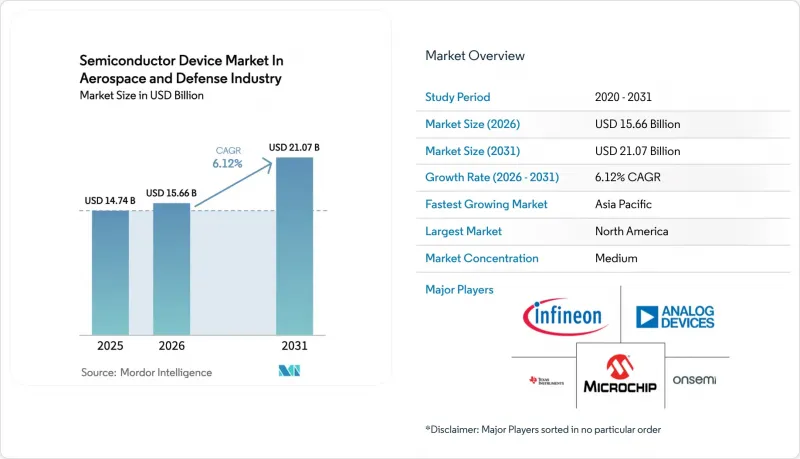
This report is Segmented by Device Type (Discrete Semiconductors, Optoelectronics, and More), Material (Silicon, Silicon Carbide, Gallium Nitride, and More), Application (Communication and Data Handling, Radar and ISR, and More), End-Use Platform (Commercial Aviation, Military Aviation, and More), and Geography. The Market Forecasts are Provided in Terms of Value (USD).
Insights and Trends of Semiconductor Device Market in Aerospace and Defense Industry
Surge in Wide-Bandgap (SiC and GaN) Adoption for Next-Gen Military and Space Power Systems
SiC and GaN devices tolerate higher voltages, switch faster, and dissipate heat more efficiently than silicon, enabling lighter power supplies in missiles and satellites. Wolfspeed qualified 1,700 V SiC MOSFETs for the U.S. Air Force's next-generation fighter, cutting converter mass by 30%. The European Space Agency selected GaN-on-silicon power ICs that reduced a 1 kW solar regulator's mass by 40%. Northrop Grumman executed long-term wafer purchases to secure SiC supply for AESA radars, underscoring its strategic forward purchasing. Qorvo reported GaN amplifiers rising from 11% to 18% of defense revenue between 2023 and 2025, driven by hypersonic weapons. SiC's three times higher thermal conductivity than silicon also reduces the size of heat sinks on weight-critical airborne payloads.
LEO Satellite Mega-Constellations Driving Radiation-Tolerant RFIC Demand
Mega-constellations demand radiation resilience at commercial price points. Starlink Gen2 satellites launched in 2025 carry more than 1 200 GaN RFICs each, multiplying total-ionizing-dose-hardened demand. Amazon's Project Kuiper awarded Microchip Technology a contract for RTG4-based FPGAs that survive 300 krad while halving power use. OneWeb's restart stretched wafer starts at Teledyne e2v by 35%, exposing sub-90 nm scarcity. The U.S. Space Force's Tranche 2 satellites embed AI routing on Versal AI Core FPGAs, reinforcing acceptance of "good-enough" rad tolerance. Traditional vendors now license commercial foundries to stay price-competitive.
Limited Rad-Hard Foundry Capacity Below 90 nm
Only BAE Systems' New Hampshire fab and Tower Semiconductor's Newport Beach site run volume rad-hard processes under 90 nm, both above 95% utilization. Lead times for RTG4 FPGAs stretched to 52 weeks in 2025. Qualifying a new rad-hard line costs up to USD 80 million and three years, discouraging entrants. Teledyne e2v even declined EUR 40 million orders as 65 nm slots were consumed by ESA missions. Designers therefore revert to 180 nm processes, accepting density and power trade-offs.
Other drivers and restraints analyzed in the detailed report include:
- Embedded AI Mission Computers in Multi-Domain Operations
- Hypersonic and Directed-Energy Programs Requiring Ultra-High-Frequency GaN RF Power Amplifiers
- Export-Control Tightening on Advanced Nodes
For complete list of drivers and restraints, kindly check the Table Of Contents.
Segment Analysis
Integrated circuits captured 44.61% of Semiconductor Device Market In Aerospace And Defense Industry market size in 2025, supplying processors, FPGAs, and mixed-signal front-ends for avionics and payloads. Optoelectronics, though smaller, will outpace others at 8.13% CAGR as LiDAR munitions and optical inter-satellite links spread. Raytheon's StormBreaker employs indium-gallium-arsenide photodetectors for laser targeting. Discrete power devices and sensors cover the remainder, accelerated by hyperspectral imagers on next-gen drones.
Optoelectronics' rise is structural. Optical links transmit gigabits per second and evade RF congestion. L3Harris achieved a 10 Gbps optical downlink in 2025 using lasers that survived 18 months on orbit. Discrete SiC MOSFETs stay vital for 1700 V switching in truck-mounted lasers. Hybrid packaging now micro-prints III-V lasers onto silicon CMOS, shrinking form factors at a 20-30% cost premium.
Silicon held 62.13% of Semiconductor Device Market In Aerospace And Defense Industry market share in 2025 thanks to supply depth and qualification heritage. GaN is projected to climb 7.36% annually as hypersonic, jammer, and phased-array programs exceed GaAs limits. The Air Force's next-gen jammer emits 1 kW across 6-18 GHz exclusively via GaN modules. SiC serves power conversion where 98% efficiency at 150 °C justifies its 3-5X cost premium.
Indium phosphide dominates millimeter-wave above 60 GHz; diamond substrates, though costly, enable 200 W/mm GaN densities. Qorvo showed 150 W at 44 GHz on GaN-on-diamond, 50% higher than GaN-on-SiC, though wafers exceed USD 10 000 each. Converting a GaN fab to SiC substrates needs about USD 250 million in tools, limiting participation to the largest players.
Complete Report Scope:
- By Device Type
- Discrete Semiconductors
- Optoelectronics
- Sensors
- Integrated Circuits
- By Material
- Silicon
- Silicon Carbide (SiC)
- Gallium Nitride (GaN)
- Others (GaAs, SiGe, InP, Diamond)
- By Application
- Communication and Data Handling
- Radar and ISR Payloads
- Navigation and Guidance
- Power Management and Propulsion Control
- Flight Control and Avionics
- Electronic Warfare and Counter-Measures
- Sensors and Scientific Payloads
- By End-Use Platform
- Commercial Aviation
- Military Aviation
- Spacecraft and Satellites
- Unmanned Aerial Vehicles (UAVs)
- Ground and Naval Defense Systems
- Missiles and Precision Munitions
- By Geography
- North America
- United States
- Canada
- Mexico
- South America
- Brazil
- Argentina
- Rest of South America
- Europe
- Germany
- United Kingdom
- France
- Italy
- Spain
- Rest of Europe
- Asia-Pacific
- China
- India
- Japan
- South Korea
- Australia and New Zealand
- Rest of Asia-Pacific
- Middle East
- Saudi Arabia
- United Arab Emirates
- Turkey
- Rest of Middle East
- Africa
- South Africa
- Nigeria
- Egypt
- Rest of Africa
- North America
Geography Analysis
North America retained 36.91% share in 2025, anchored by the USD 842 billion U.S. defense budget and DARPA's USD 1.5 billion Electronics Resurgence Initiative for 3D packaging. The CHIPS Act directs USD 39 billion in subsidies; BAE Systems expanded its New Hampshire fab by 25% wafer capacity, the nation's lone sub-90 nm rad-hard source. Canada's NORAD upgrade earmarks USD 3.6 billion for Arctic surveillance satellites using MDA Space processors.
Asia-Pacific will post the highest CAGR at 8.47% through 2031. India's USD 10 billion semiconductor mission drew Tower Semiconductor to propose a 65 nm trusted fab. Japan placed an USD 800 million order with Mitsubishi Electric for indigenous radiation-tolerant F-3 processors. South Korea partners Samsung Foundry to qualify 28 nm FD-SOI for the KF-21 mission computer. China's CETC produced 28 nm rad-hard FPGAs domestically in 2025, signaling reduced import reliance. Australia's AUD 3.5 billion missile-and-drone plan under AUKUS fuels demand for domestic assembly.
Europe relies on the EUR 43 billion EU Chips Act aiming to double regional share by 2030. ESA's ARIEL and PLATO missions sustain SiC and rad-tolerant demand. Germany's EUR 2.3 billion Typhoon radar upgrade uses GaN modules from United Monolithic Semiconductors. The Tempest fighter mandates FACE-compliant COTS processors from Texas Instruments and NXP, trading proprietary hardware for faster refresh.
- Analog Devices Inc.
- Microchip Technology Inc.
- Infineon Technologies AG
- onsemi (ON Semiconductor)
- Texas Instruments Inc.
- NXP Semiconductors N.V.
- STMicroelectronics N.V.
- Renesas Electronics Corp.
- Qorvo Inc.
- Wolfspeed Inc.
- Lattice Semiconductor Corp.
- Teledyne e2v (Teledyne Technologies)
- GSI Technology Inc.
- Cobham Advanced Electronic Solutions (CAES)
- BAE Systems plc (Microelectronics)
- Honeywell Aerospace Microelectronics
- Mercury Systems Inc.
- Broadcom Inc. (Rugged and Rad-Tolerant ASICs)
- Vorago Technologies
- L3Harris Technologies (Space Microelectronics)
- Airbus Defence and Space (HiRel ASIC Center)
Additional Benefits:
- The market estimate (ME) sheet in Excel format
- 3 months of analyst support
TABLE OF CONTENTS
1 INTRODUCTION
- 1.1 Study Assumptions and Market Definition
- 1.2 Scope of the Study
2 RESEARCH METHODOLOGY
3 EXECUTIVE SUMMARY
4 MARKET LANDSCAPE
- 4.1 Market Overview
- 4.2 Market Drivers
- 4.2.1 Surge in Wide-Bandgap (SiC and GaN) Adoption for Next-Gen Military and Space Power Systems
- 4.2.2 LEO Satellite Mega-Constellations Driving Radiation-Tolerant RFIC Demand
- 4.2.3 Embedded AI Mission Computers in Multi-Domain Operations (US and NATO)
- 4.2.4 Hypersonic and Directed-Energy Programs Requiring Ultra-High-Frequency GaN RF Power Amplifiers
- 4.2.5 Open-Architecture Avionics Refresh Cycles (FACE, MOSA) Expanding COTS IC Spend
- 4.2.6 Indigenous Fighter and UAV Platforms in Indo-Pacific Boosting Local Sourcing
- 4.3 Market Restraints
- 4.3.1 Limited Rad-Hard Foundry Capacity Below 90 nm
- 4.3.2 Export-Control Tightening on Advanced Nodes (US-China)
- 4.3.3 High QML-V and JANS Qualification Cost Burden
- 4.3.4 Thermal Management Limits in 3D-Packaged Space-Grade Chips
- 4.4 Industry Value-Chain Analysis
- 4.5 Regulatory Landscape
- 4.6 Technological Outlook
- 4.7 Porter's Five Forces Analysis
- 4.7.1 Bargaining Power of Buyers
- 4.7.2 Bargaining Power of Suppliers
- 4.7.3 Threat of New Entrants
- 4.7.4 Threat of Substitutes
- 4.7.5 Competitive Rivalry
5 MARKET SIZE AND GROWTH FORECASTS (VALUE)
- 5.1 By Device Type
- 5.1.1 Discrete Semiconductors
- 5.1.2 Optoelectronics
- 5.1.3 Sensors
- 5.1.4 Integrated Circuits
- 5.2 By Material
- 5.2.1 Silicon
- 5.2.2 Silicon Carbide (SiC)
- 5.2.3 Gallium Nitride (GaN)
- 5.2.4 Others (GaAs, SiGe, InP, Diamond)
- 5.3 By Application
- 5.3.1 Communication and Data Handling
- 5.3.2 Radar and ISR Payloads
- 5.3.3 Navigation and Guidance
- 5.3.4 Power Management and Propulsion Control
- 5.3.5 Flight Control and Avionics
- 5.3.6 Electronic Warfare and Counter-Measures
- 5.3.7 Sensors and Scientific Payloads
- 5.4 By End-Use Platform
- 5.4.1 Commercial Aviation
- 5.4.2 Military Aviation
- 5.4.3 Spacecraft and Satellites
- 5.4.4 Unmanned Aerial Vehicles (UAVs)
- 5.4.5 Ground and Naval Defense Systems
- 5.4.6 Missiles and Precision Munitions
- 5.5 By Geography
- 5.5.1 North America
- 5.5.1.1 United States
- 5.5.1.2 Canada
- 5.5.1.3 Mexico
- 5.5.2 South America
- 5.5.2.1 Brazil
- 5.5.2.2 Argentina
- 5.5.2.3 Rest of South America
- 5.5.3 Europe
- 5.5.3.1 Germany
- 5.5.3.2 United Kingdom
- 5.5.3.3 France
- 5.5.3.4 Italy
- 5.5.3.5 Spain
- 5.5.3.6 Rest of Europe
- 5.5.4 Asia-Pacific
- 5.5.4.1 China
- 5.5.4.2 India
- 5.5.4.3 Japan
- 5.5.4.4 South Korea
- 5.5.4.5 Australia and New Zealand
- 5.5.4.6 Rest of Asia-Pacific
- 5.5.5 Middle East
- 5.5.5.1 Saudi Arabia
- 5.5.5.2 United Arab Emirates
- 5.5.5.3 Turkey
- 5.5.5.4 Rest of Middle East
- 5.5.6 Africa
- 5.5.6.1 South Africa
- 5.5.6.2 Nigeria
- 5.5.6.3 Egypt
- 5.5.6.4 Rest of Africa
- 5.5.1 North America
6 COMPETITIVE LANDSCAPE
- 6.1 Market Concentration
- 6.2 Strategic Moves
- 6.3 Market Share Analysis
- 6.4 Company Profiles (includes Global Level Overview, Market Level Overview, Core Segments, Financials as available, Strategic Information, Market Rank/Share, Products and Services, Recent Developments)
- 6.4.1 Analog Devices Inc.
- 6.4.2 Microchip Technology Inc.
- 6.4.3 Infineon Technologies AG
- 6.4.4 onsemi (ON Semiconductor)
- 6.4.5 Texas Instruments Inc.
- 6.4.6 NXP Semiconductors N.V.
- 6.4.7 STMicroelectronics N.V.
- 6.4.8 Renesas Electronics Corp.
- 6.4.9 Qorvo Inc.
- 6.4.10 Wolfspeed Inc.
- 6.4.11 Lattice Semiconductor Corp.
- 6.4.12 Teledyne e2v (Teledyne Technologies)
- 6.4.13 GSI Technology Inc.
- 6.4.14 Cobham Advanced Electronic Solutions (CAES)
- 6.4.15 BAE Systems plc (Microelectronics)
- 6.4.16 Honeywell Aerospace Microelectronics
- 6.4.17 Mercury Systems Inc.
- 6.4.18 Broadcom Inc. (Rugged and Rad-Tolerant ASICs)
- 6.4.19 Vorago Technologies
- 6.4.20 L3Harris Technologies (Space Microelectronics)
- 6.4.21 Airbus Defence and Space (HiRel ASIC Center)
7 MARKET OPPORTUNITIES AND FUTURE OUTLOOK
- 7.1 White-Space and Unmet-Need Assessment

