PUBLISHER: Mordor Intelligence | PRODUCT CODE: 2100026

PUBLISHER: Mordor Intelligence | PRODUCT CODE: 2100026
AI-powered Mental Health Solutions - Market Share Analysis, Industry Trends & Statistics, Growth Forecasts (2026 - 2031)
According to Mordor Intelligence, the AI-powered mental health solutions market size is expected to grow from USD 1.82 billion in 2025 to USD 2.42 billion in 2026 and is forecast to reach USD 9.96 billion by 2031 at 32.74% CAGR over 2026-2031.
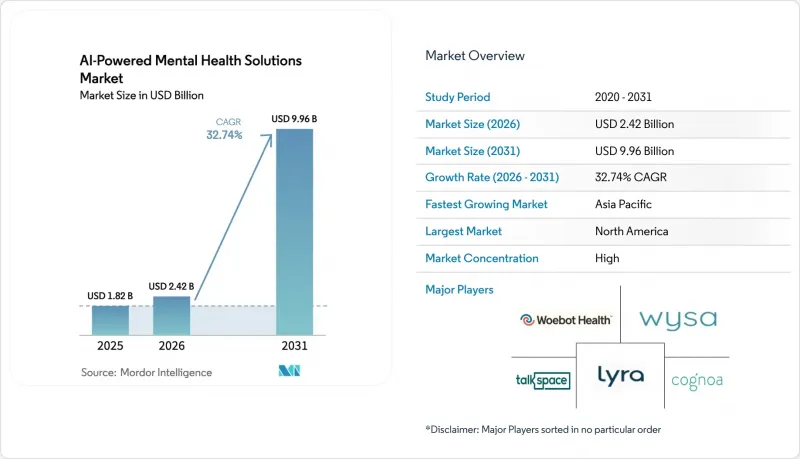
This report is Segmented by Technology (Machine Learning, Natural-Language Processing, and More), Solution Type (Diagnostics Assistance, and More), Deployment Mode (Cloud-Based, On-Premise), End User (Individuals, and More), Mental-Health Condition (Depression, and More), and Geography (North America, and More). The Market Forecasts are Provided in Terms of Value (USD).
Global AI-powered Mental Health Solutions Market Trends and Insights
Rapid Proliferation of AI-Driven Mental-Health Mobile Apps
More than 10 000 mental-health apps now incorporate AI, compared with fewer than 1 000 five years ago. Randomized trials show Therabot and similar tools achieve symptom reductions comparable to human therapy across major depressive, generalized-anxiety, and feeding disorders. Twenty-four percent of U.S. adults already use LLMs for emotional support, marking a shift among help-averse demographics. Employers document 12% productivity gains and 67% retention improvements after deploying mindfulness apps that include AI-generated coping exercises. FDA breakthrough-device designations for mobile therapeutics such as Wysa's chronic-pain module legitimize app-based care inside clinical workflows.
Reimbursement Expansion for Digital Therapeutics
Medicare's 2025 fee schedule introduces three new billing codes for providers integrating digital mental-health tools. The U.S. Food and Drug Administration and the Centers for Medicare & Medicaid Services now pilot outcomes-based payment models: reimbursement is tied to functional-improvement endpoints, signaling durable revenue streams. Germany, France, the U.K., and Belgium use DiGA-style frameworks that fund artificial-intelligence-enabled therapeutics once clinical-evidence thresholds are met. Vendors respond by launching large phase-III trials; Rejoyn secured U.S. clearance on the strength of cognitive-control training data. Payer support expands service reach to underserved Medicaid and rural populations.
Clinical Validation Gap for Algorithmic Recommendations
Diagnostic accuracy for AI mental-health tools ranges 21-100%, unsettling regulators. The FDA now demands pharmaceutical-grade evidence; small firms partner with universities to manage trial costs. Bias studies show model reliability drops in diverse cohorts, compelling developers to expand datasets. Clinicians remain wary until reproducible outcomes appear in peer-reviewed journals, slowing hospital procurement cycles despite patient enthusiasm.
Other drivers and restraints analyzed in the detailed report include:
- Enterprise Demand for Workforce-Wellness AI Platforms
- Integration of Multimodal Emotional-AI Sensors in Wearables
- Fragmented Data-Privacy Regulations
For complete list of drivers and restraints, kindly check the Table Of Contents.
Segment Analysis
The AI powered mental health solutions market saw Natural Language Processing hold 44.02% revenue in 2025, yet Machine Learning is growing at 34.36% CAGR. A multimodal EEG-and-speech classifier achieved 97.53% depression-diagnosis accuracy. Vendor road maps increasingly converge affective computing, predictive analytics, and LLM chat to create full-stack platforms. Hospitals note shorter triage times when AI chatbots collect structured patient histories before clinician review. Cloud hyperscalers integrate mental-health APIs into existing health-data ecosystems, boosting the AI powered mental health solutions market size attached to Machine Learning modules.
Emergent transformer models run inside virtual private clouds to meet data-sovereignty demands. Predictive-analytics dashboards benchmark workforce mood, enabling proactive resource allocation. More than 30 funding rounds now target bespoke therapy LLMs, underscoring data-asset primacy over algorithm novelty. Competitive advantage will accrue to vendors that certify under ISO/IEC safety standards and negotiate payer reimbursement at scale.
Treatment Personalization held 39.02% revenue in 2025; Diagnostics Assistance is projected to register the highest 34.78% CAGR. A voice-biomarker tool flags moderate-to-severe depression within 25 seconds at 71.3% sensitivity and 73.5% specificity. Early identification lowers downstream costs, attracting payer interest. Monitoring and Management suites pair wearable data with chat-based coaching for continuous feedback loops. Virtual-reality exposure therapy products deliver compelling PTSD outcomes, expanding "Other Applications" within the AI powered mental health solutions market.
Providers prefer integrated solutions that span screening, personalization, and relapse prevention. Vendors focus pipelines on high-burden conditions such as migraine (CT-132) and schizophrenia negative symptoms (CT-155), banking on clear regulatory pathways to secure premium pricing.
Complete Report Scope:
- By Technology
- Machine Learning
- Natural-Language Processing (NLP)
- Emotion AI/ Affective Computing
- Predictive Analytics
- Others Software Solutions
- By Solution Type
- Diagnostics Assistance
- Treatment Personalization
- Monitoring and Management
- Other Applications
- Other Solutions
- By Deployment Mode
- Cloud-Based
- On-Premise
- By End User
- Individuals
- Employers & Corporate Wellness Programs
- Healthcare Providers
- Payers
- Government & Non-Profit Organizations
- By Mental-Health Condition
- Depression
- Anxiety Disorders
- Stress Management
- Post-Traumatic Stress Disorder (PTSD)
- Substance-Use Disorders
- Other Conditions
- By Geography
- North America
- United States
- Canada
- Mexico
- Europe
- Germany
- United Kingdom
- France
- Italy
- Spain
- Rest of Europe
- Asia-Pacific
- China
- India
- Japan
- South Korea
- Australia
- Rest of Asia-Pacific
- South America
- Brazil
- Argentina
- Rest of South America
- Middle East and Africa
- GCC
- South Africa
- Rest of Middle East and Africa
- North America
Geography Analysis
North America generated 41.42% revenue in 2025, fueled by FDA clearances (Rejoyn, SleepioRx) and Medicare's reimbursement roadmap. Venture capital remains abundant: Slingshot AI raised USD 30 million to develop therapy-specific LLMs.
Europe sets global standards through the EU AI Act and GDPR. Germany's DiGA catalog reimburses more than 40 digital therapeutics. Italy's EUR 5 million Replika fine highlights enforcement strength. Limbic secured USD 14.7 million to integrate AI clinical decision support into electronic health records.
Asia-Pacific leads growth at 34.41% CAGR. Mental disorders contribute 5% of disability-adjusted life years region-wide. China matches the U.S. in digital-therapeutics approvals; South Korean GPT-4-powered chatbots receive high empathy ratings. Localization strategies-language adaptation and culturally sensitive prompt engineering-differentiate offerings.
South America faces projected GDP losses of USD 7.3 trillion from 2020-2050 due to mental-health and non-communicable diseases. Ministries in Brazil and Colombia pilot AI chatlines on low-cost mobile platforms. In the Middle East and Africa, SMS-based AI screening tools reach areas with limited broadband; sub-Saharan prevalence rates of 26.9% depression indicate sizable unmet need.
- Headspace Health
- Woebot Health
- Wysa
- Quartet Health
- Spring Health
- Teladoc Health
- Talkspace
- Koa Health
- Babylon Health
- Mindstrong
- AbleTo
- BetterUp
- Ada Health
- Amaha
- Happify Health
- Calm Health
- BenevolentAI (mental-health pipeline)
- Unmind
- SilverCloud Health
Additional Benefits:
- The market estimate (ME) sheet in Excel format
- 3 months of analyst support
TABLE OF CONTENTS
1 Introduction
- 1.1 Study Assumptions & Market Definition
- 1.2 Scope of the Study
2 Research Methodology
3 Executive Summary
4 Market Landscape
- 4.1 Market Overview
- 4.2 Market Drivers
- 4.2.1 Rapid proliferation of AI-driven mental-health mobile apps
- 4.2.2 Reimbursement expansion for digital therapeutics
- 4.2.3 Enterprise demand for workforce-wellness AI platforms
- 4.2.4 Integration of multimodal emotional-AI sensors in wearables
- 4.2.5 Foundation-model fine-tuning for psychotherapy chatbots
- 4.3 Market Restraints
- 4.3.1 Clinical-validation gap for algorithmic recommendations
- 4.3.2 Fragmented data-privacy regulations
- 4.3.3 Bias risks in emotion-AI training datasets
- 4.4 Value / Supply-Chain Analysis
- 4.5 Regulatory Landscape
- 4.6 Technological Outlook
- 4.7 Porter's Five Forces
- 4.7.1 Threat of New Entrants
- 4.7.2 Bargaining Power of Suppliers
- 4.7.3 Bargaining Power of Buyers
- 4.7.4 Threat of Substitutes
- 4.7.5 Competitive Rivalry
5 Market Size & Growth Forecasts (Value)
- 5.1 By Technology
- 5.1.1 Machine Learning
- 5.1.2 Natural-Language Processing (NLP)
- 5.1.3 Emotion AI/ Affective Computing
- 5.1.4 Predictive Analytics
- 5.1.5 Others Software Solutions
- 5.2 By Solution Type
- 5.2.1 Diagnostics Assistance
- 5.2.2 Treatment Personalization
- 5.2.3 Monitoring and Management
- 5.2.4 Other Applications
- 5.2.5 Other Solutions
- 5.3 By Deployment Mode
- 5.3.1 Cloud-Based
- 5.3.2 On-Premise
- 5.4 By End User
- 5.4.1 Individuals
- 5.4.2 Employers & Corporate Wellness Programs
- 5.4.3 Healthcare Providers
- 5.4.4 Payers
- 5.4.5 Government & Non-Profit Organizations
- 5.5 By Mental-Health Condition
- 5.5.1 Depression
- 5.5.2 Anxiety Disorders
- 5.5.3 Stress Management
- 5.5.4 Post-Traumatic Stress Disorder (PTSD)
- 5.5.5 Substance-Use Disorders
- 5.5.6 Other Conditions
- 5.6 By Geography
- 5.6.1 North America
- 5.6.1.1 United States
- 5.6.1.2 Canada
- 5.6.1.3 Mexico
- 5.6.2 Europe
- 5.6.2.1 Germany
- 5.6.2.2 United Kingdom
- 5.6.2.3 France
- 5.6.2.4 Italy
- 5.6.2.5 Spain
- 5.6.2.6 Rest of Europe
- 5.6.3 Asia-Pacific
- 5.6.3.1 China
- 5.6.3.2 India
- 5.6.3.3 Japan
- 5.6.3.4 South Korea
- 5.6.3.5 Australia
- 5.6.3.6 Rest of Asia-Pacific
- 5.6.4 South America
- 5.6.4.1 Brazil
- 5.6.4.2 Argentina
- 5.6.4.3 Rest of South America
- 5.6.5 Middle East and Africa
- 5.6.5.1 GCC
- 5.6.5.2 South Africa
- 5.6.5.3 Rest of Middle East and Africa
- 5.6.1 North America
6 Competitive Landscape
- 6.1 Market Concentration
- 6.2 Market Share Analysis
- 6.3 Company Profiles (includes Global level Overview, Market level overview, Core Segments, Financials as available, Strategic Information, Market Rank/Share for key companies, Products & Services, and Recent Developments)
- 6.3.1 Headspace Health
- 6.3.2 Woebot Health
- 6.3.3 Wysa
- 6.3.4 Quartet Health
- 6.3.5 Spring Health
- 6.3.6 Teladoc Health
- 6.3.7 Talkspace
- 6.3.8 Koa Health
- 6.3.9 Babylon Health
- 6.3.10 Mindstrong
- 6.3.11 AbleTo
- 6.3.12 BetterUp
- 6.3.13 Ada Health
- 6.3.14 Amaha
- 6.3.15 Happify Health
- 6.3.16 Calm Health
- 6.3.17 BenevolentAI (mental-health pipeline)
- 6.3.18 Unmind
- 6.3.19 SilverCloud Health
7 Market Opportunities & Future Outlook
- 7.1 White-Space & Unmet-Need Assessment

