PUBLISHER: Mordor Intelligence | PRODUCT CODE: 2100027

PUBLISHER: Mordor Intelligence | PRODUCT CODE: 2100027
Domiciliary Care - Market Share Analysis, Industry Trends & Statistics, Growth Forecasts (2026 - 2031)
According to Mordor Intelligence, the domiciliary care market size in 2026 is estimated at USD 220.88 billion, growing from 2025 value of USD 208.77 billion with 2031 projections showing USD 292.81 billion, growing at 5.80% CAGR over 2026-2031.
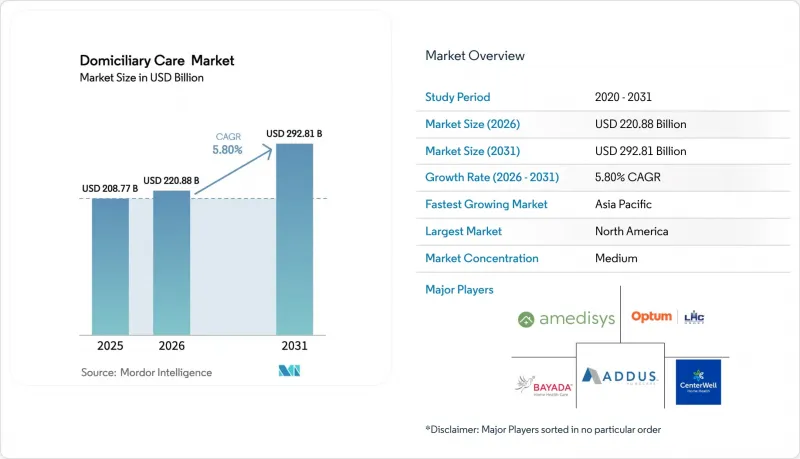
This report is Segmented by Service Type (Physical Support, Learning Disability Support, Mental Health Support, and More), Care Intensity (Low-Acuity Personal Care, Intermediate Skilled Nursing, and More), Funding Source (Public Health, Private Health Insurance, Out-Of-Pocket, and More), and Geography (North America, Europe, Asia Pacific, and More). The Market Forecasts are Provided in Terms of Value (USD).
Global Domiciliary Care Market Trends and Insights
Rising Geriatric Population
The United States expects its 65-plus cohort to climb from 58 million in 2023 to 82 million by 2050, intensifying demand for longitudinal, home-based services that support aging in place. Nine out of ten older adults prefer remaining at home, prompting Medicare Advantage plans to purchase home health agencies and scale domiciliary networks. Asia-Pacific faces an equally acute demographic curve, giving rise to professional caregivers who complement traditional family support. Smart-home sensors and AI-enabled fall detection are proliferating as baseline infrastructure, widening clinical insight while respecting the elderly's independence.
Surge in Chronic, Long-Term Illnesses & Disabilities
Chronic conditions afflict 129 million Americans and absorb 90% of national healthcare outlays, pushing payers toward settings that reduce emergency visits and inpatient volume. In-home multi-disciplinary teams have cut inpatient stays by 5.22% and emergency visits by 4.39% within a year, proving domiciliary efficacy in complex disease management. The shift drives an uptick in skilled nursing and rehab visits outside facility walls, encouraging investment in portable diagnostics and infusion therapies.
Workforce Shortages & High Turnover of Skilled Caregivers
Turnover among US home-care aides has reached 80%, jeopardizing service continuity and forcing agencies to decline up to 25% of referrals. Low wages, limited career ladders, and emotionally taxing shifts deter retention. States like Michigan project a 170,000-worker gap this decade, triggering sign-on bonuses and preceptor programs aimed at the first 90 days on the job. Technology that automates documentation and routes clinicians efficiently is emerging as a non-cash retention lever.
Other drivers and restraints analyzed in the detailed report include:
- Cost Advantage of Home-Based vs. Institutional Care
- Expansion of Hospital-at-Home Acute-Care Models
- Fragmented Reimbursement & Licensing Rules in Emerging Markets
For complete list of drivers and restraints, kindly check the Table Of Contents.
Segment Analysis
Hospital-at-home services, though currently smaller in volume, are forecast to grow at 6.75% CAGR to 2031, outpacing every other line. CMS certification of 378 programs substantiates payer confidence while evidence shows lower mortality and fewer readmissions relative to inpatient wards. Personal care & companion services remain the volume anchor with a 31.60% share in 2025, yet face pricing pressure as commoditization sets in. Hospice and palliative demand rises in tandem with end-of-life preferences, and infusion therapy at home benefits from biologic drug innovation. AdventHealth's January 2025 launch in Central Florida typifies hospital systems' pivot to acute domiciliary capacity.
Broader service-mix evolution demonstrates a bifurcated landscape: low-skill, high-volume personal assistance versus high-skill, premium-priced medical episodes. Providers therefore pursue dual strategies-scale in foundational services for margin stability while capturing hospital-at-home upside through tech partnerships. The domiciliary care market continues to reward portfolio breadth that balances predictable companion hours with episodic, high-acuity interventions.
Complete Report Scope:
- By Service Type
- Physical Support (ADL Assistance)
- Learning Disability Support
- Mental Health Support
- Memory & Cognition Support
- Personal Care & Companion Services
- Skilled Nursing Care
- Rehabilitation & Physiotherapy
- Hospice & Palliative Care
- Infusion Therapy At Home
- Other Services
- By Care Intensity
- Low-Acuity Personal Care
- Intermediate Skilled Nursing
- High-Acuity Hospital-at-Home
- End-of-Life / Palliative
- By Funding Source
- Public Health Insurance
- Private Health Insurance
- Out-of-Pocket / Self-Pay
- Charity & Non-Profit Sponsored
- By Geography
- North America
- United States
- Canada
- Mexico
- Europe
- Germany
- United Kingdom
- France
- Italy
- Spain
- Rest of Europe
- Asia Pacific
- China
- Japan
- India
- South Korea
- Australia
- Rest of Asia Pacific
- Middle East & Africa
- GCC
- South Africa
- Rest of Middle East & Africa
- South America
- Brazil
- Argentina
- Rest of South America
- North America
Geography Analysis
North America retains leadership at 42.10% domiciliary care market share, sustained by CMS waivers and Medicare Advantage investments that normalize hospital-grade home episodes. The United States hosts all 378 CMS-approved hospital-at-home facilities, while Canada pilots community aging-in-place models and Mexico scales telehomecare through private insurers. Persistent 80% staff turnover, however, constrains capacity and inflates operating costs, emphasizing the need for workforce innovation. US adoption of RPM-involving 50 million device users-illustrates a technological bulwark reinforcing regional dominance.
Asia-Pacific represents the fastest-growing bloc, anticipated to log 8.55% CAGR through 2031. China's domestic innovation mandates and Japan's super-aged society spur local med-tech manufacturing, while India's Make-in-India scheme cultivates portable diagnostic supply chains. Regulatory heterogeneity persists, though governments are steadily harmonizing home-health coding and telemedicine law to encourage private capital participation.
Europe continues gradual expansion via digital transformation agendas. Germany's electronic patient record (ePA) rollout and hospital payment reform incentivize outpatient substitution . The EU-wide Health Technology Assessment framework primes cross-border reimbursement for digital therapeutics, while the United Kingdom advances Integrated Care Systems that budget for hospital avoidance. Workforce deficits-1 million vacant healthcare roles in 2024-require remote supervision tools and cross-training to sustain domiciliary scale.
Middle East & Africa and South America offer greenfield potential where hospital bed shortages and burgeoning elderly populations intersect. Yet patchy broadband, limited home-health licensure, and reimbursement uncertainty keep penetration low. Multinationals often adopt hub-and-spoke entry models, clustering services around metropolitan centers with private insurer footholds.
- Amedisys Inc.
- LHC Group (Optum)
- BAYADA Home Health Care
- Kindred at Home / CenterWell
- Addus HomeCare Corporation
- Brookdale Senior Living
- Buurtzorg
- Home Instead (Honor Technology)
- Comfort Keepers (Sodexo)
- Interim HealthCare Inc.
- Visiting Nurse Service of New York
- Orpea Group
- Right at Home Japan Inc.
- Seoul National University Hospital
- Nichiigakkan
- Medical Care Service
- Riei Co.
- Egao Ichiban
- VITAS Healthcare
- Brook Health (Hospital-at-Home Platform)
Additional Benefits:
- The market estimate (ME) sheet in Excel format
- 3 months of analyst support
TABLE OF CONTENTS
1 Introduction
- 1.1 Study Assumptions & Market Definition
- 1.2 Scope of the Study
2 Research Methodology
3 Executive Summary
4 Market Landscape
- 4.1 Market Overview
- 4.2 Market Drivers
- 4.2.1 Rising Geriatric Population
- 4.2.2 Surge in Chronic, Long-Term Illnesses & Disabilities
- 4.2.3 Cost Advantage of Home-Based vs. Institutional Care
- 4.2.4 Government Reimbursement & Policy Tailwinds
- 4.2.5 Expansion of Hospital-at-Home Acute-Care Models
- 4.2.6 AI-Driven Remote Patient Monitoring Enables Higher-Acuity Home Care
- 4.3 Market Restraints
- 4.3.1 Workforce Shortages & High Turnover of Skilled Caregivers
- 4.3.2 Fragmented Reimbursement & Licensing Rules in Emerging Markets
- 4.3.3 Rising Liability Insurance & Litigation Risk for Agencies
- 4.3.4 Cyber-Security Risks Tied to Connected Home-Care Devices
- 4.4 Supply Chain Analysis
- 4.5 Regulatory Landscape
- 4.6 Technological Outlook
- 4.7 Porter's Five Forces Analysis
- 4.7.1 Threat of New Entrants
- 4.7.2 Bargaining Power of Buyers / Consumers
- 4.7.3 Bargaining Power of Suppliers
- 4.7.4 Threat of Substitute Products
- 4.7.5 Intensity of Competitive Rivalry
5 Market Size & Growth Forecasts (Value)
- 5.1 By Service Type
- 5.1.1 Physical Support (ADL Assistance)
- 5.1.2 Learning Disability Support
- 5.1.3 Mental Health Support
- 5.1.4 Memory & Cognition Support
- 5.1.5 Personal Care & Companion Services
- 5.1.6 Skilled Nursing Care
- 5.1.7 Rehabilitation & Physiotherapy
- 5.1.8 Hospice & Palliative Care
- 5.1.9 Infusion Therapy At Home
- 5.1.10 Other Services
- 5.2 By Care Intensity
- 5.2.1 Low-Acuity Personal Care
- 5.2.2 Intermediate Skilled Nursing
- 5.2.3 High-Acuity Hospital-at-Home
- 5.2.4 End-of-Life / Palliative
- 5.3 By Funding Source
- 5.3.1 Public Health Insurance
- 5.3.2 Private Health Insurance
- 5.3.3 Out-of-Pocket / Self-Pay
- 5.3.4 Charity & Non-Profit Sponsored
- 5.4 By Geography
- 5.4.1 North America
- 5.4.1.1 United States
- 5.4.1.2 Canada
- 5.4.1.3 Mexico
- 5.4.2 Europe
- 5.4.2.1 Germany
- 5.4.2.2 United Kingdom
- 5.4.2.3 France
- 5.4.2.4 Italy
- 5.4.2.5 Spain
- 5.4.2.6 Rest of Europe
- 5.4.3 Asia Pacific
- 5.4.3.1 China
- 5.4.3.2 Japan
- 5.4.3.3 India
- 5.4.3.4 South Korea
- 5.4.3.5 Australia
- 5.4.3.6 Rest of Asia Pacific
- 5.4.4 Middle East & Africa
- 5.4.4.1 GCC
- 5.4.4.2 South Africa
- 5.4.4.3 Rest of Middle East & Africa
- 5.4.5 South America
- 5.4.5.1 Brazil
- 5.4.5.2 Argentina
- 5.4.5.3 Rest of South America
- 5.4.1 North America
6 Competitive Landscape
- 6.1 Market Concentration
- 6.2 Market Share Analysis
- 6.3 Company Profiles {(includes Global level Overview, Market level overview, Core Segments, Financials as available, Strategic Information, Market Rank/Share for key companies, Products & Services, and Recent Developments)}
- 6.3.1 Amedisys Inc.
- 6.3.2 LHC Group (Optum)
- 6.3.3 BAYADA Home Health Care
- 6.3.4 Kindred at Home / CenterWell
- 6.3.5 Addus HomeCare Corporation
- 6.3.6 Brookdale Senior Living
- 6.3.7 Buurtzorg
- 6.3.8 Home Instead (Honor Technology)
- 6.3.9 Comfort Keepers (Sodexo)
- 6.3.10 Interim HealthCare Inc.
- 6.3.11 Visiting Nurse Service of New York
- 6.3.12 Orpea Group
- 6.3.13 Right at Home Japan Inc.
- 6.3.14 Seoul National University Hospital
- 6.3.15 Nichiigakkan
- 6.3.16 Medical Care Service
- 6.3.17 Riei Co.
- 6.3.18 Egao Ichiban
- 6.3.19 VITAS Healthcare
- 6.3.20 Brook Health (Hospital-at-Home Platform)
7 Market Opportunities & Future Outlook
- 7.1 White-Space & Unmet-Need Assessment

