PUBLISHER: Mordor Intelligence | PRODUCT CODE: 2100042

PUBLISHER: Mordor Intelligence | PRODUCT CODE: 2100042
Predictive Maintenance - Market Share Analysis, Industry Trends & Statistics, Growth Forecasts (2026 - 2031)
According to Mordor Intelligence, the predictive maintenance market size was valued at USD 14.09 billion in 2025 and estimated to grow from USD 18.9 billion in 2026 to reach USD 82.17 billion by 2031, at a CAGR of 34.14% during the forecast period (2026-2031).
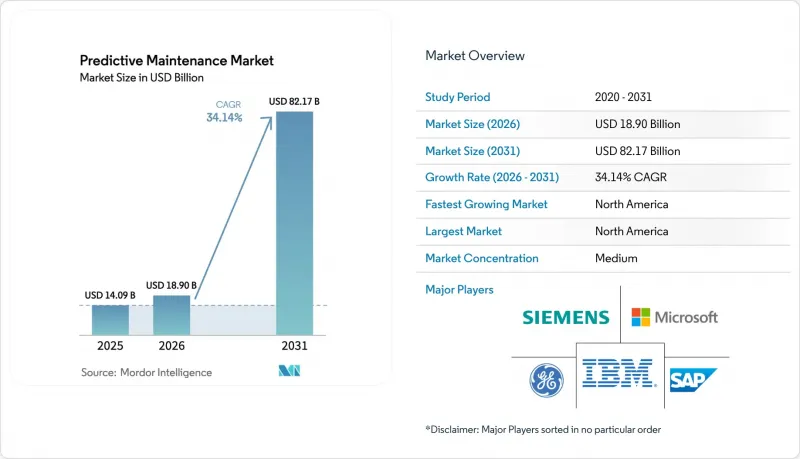
This report is Segmented by Component (Hardware, Software, Services), Enterprise Size (Small and Medium Enterprises, Large Enterprises), Deployment Mode (On-Premise, Cloud), End-User Industry (Industrial Manufacturing, Automotive & Transportation, Energy and Utilities, and More), and Geography. The Market Forecasts are Provided in Terms of Value (USD)
Global Predictive Maintenance Market Trends and Insights
IoT-Enabled Asset Connectivity Boom
Mass adoption of industrial IoT sensors now extends beyond vibration and temperature probes to include acoustic, thermal, and power-signature monitoring on a single board. Edge gateways process thousands of data points per second locally, ensuring immediacy of alerts while limiting traffic back to the cloud.Wireless mesh networks cut installation costs up to 60% relative to wired layouts, bringing remote mines, offshore rigs, and mobile equipment into predictive regimes. Standardized protocols such as MQTT and OPC-UA raise interoperability, reducing integration complexity for multi-vendor plants. Hardware inflation since 2024 has slowed procurement cycles, yet the resulting focus on edge efficiency means many plants are replacing complex servers with compact inference units.
AI/ML Accuracy Breakthroughs
Ensemble machine-learning pipelines and domain-adapted deep-learning models now achieve 85-95% precision in predicting bearing, pump, and motor failures 30-60 days in advance. Synthetic data and transfer-learning techniques let teams train models in weeks rather than years, even when historical failure events are scarce. Edge inference chips deliver real-time insights without persistent connectivity, maintaining operations in bandwidth-limited areas. Generative AI copilots embedded in maintenance suites provide technicians with contextual repair steps, parts lists, and safety checks using natural-language queries. Higher accuracy directly improves user trust, driving wider rollout across smaller production sites.
Data-Security and Privacy Gaps
Expanded sensor networks enlarge attack surfaces, exposing operational technology to cyberthreats. Legacy protocols lack native encryption, forcing retrofit of secure tunneling and authentication layers to meet regulations such as GDPR and NERC CIP. Balancing real-time data flows with strict security policies remains a challenge, especially in healthcare and critical-energy sites where both patient safety and grid stability are paramount. Enterprises therefore prioritize platforms featuring device-level encryption, zero-trust architectures, and audit-ready data-handling practices.
Other drivers and restraints analyzed in the detailed report include:
- Downtime-Reduction Cost Pressures
- Cloud-Native Deployment Scalability
- Skilled-Talent Shortage
For complete list of drivers and restraints, kindly check the Table Of Contents.
Segment Analysis
Hardware captured a 45.18% share of the predictive maintenance market in 2025. High-performance sensors and edge gateways create the data backbone that software analytics depend on. The segment remains pivotal because new installations expand the addressable base each year. Software revenues are climbing quickest, advancing at a 35.82% CAGR to 2031 as AI libraries mature and cloud subscriptions proliferate. Services, though smaller, deliver critical deployment, calibration, and model-tuning expertise across complex industrial estates.
Continued miniaturization and cost reductions in wireless sensors allow multi-parameter monitoring from a single device, reducing total installed cost. Edge units now execute machine-learning inference locally, trimming bandwidth usage and ensuring deterministic latency for safety-critical assets. Software providers focus on modular designs, allowing plants to license analytics packs specific to pumps, drives, or HVAC systems. Generative-AI front ends further lower training overhead by letting technicians converse with maintenance systems in plain language. Services firms combat talent shortages by offering turnkey packages that include remote monitoring, periodic model refreshes, and cybersecurity safeguards.
Large corporations controlled 63.65% of predictive maintenance market revenue in 2025 owing to expansive asset portfolios and deep IT budgets. However, SMEs represent the most dynamic constituency, advancing at a 36.2% CAGR to 2031 as barriers to adoption fall. Pay-as-you-go pricing lets smaller plants launch pilots for USD 50-100 per asset per month, achieving positive ROI within 12-18 months.
Enterprise incumbents leverage private clouds and internal data-science teams to tailor algorithms for proprietary equipment. They also integrate predictive dashboards into existing MES and ERP environments, streamlining workflow orchestration. SMEs, conversely, rely on vendor-managed cloud tools where updates, security patches, and model retraining occur automatically. Managed-service partners further ease uptake by bundling sensors, gateways, and analytics in a single subscription. Edge AI mitigates bandwidth constraints in rural factories, reducing dependence on high-capacity connections.
Complete Report Scope:
- By Component
- Hardware
- Software
- Services
- By Enterprise Size
- Small and Medium Enterprises
- Large Enterprises
- By Deploymet Mode
- On-Premise
- Cloud
- By End-user Industry
- Industrial Manufacturing
- Automotive and Transportation
- Energy and Utilities
- Healthcare
- Telecommunications
- Aerospace and Defense
- Others (Oil and Gas, Mining, etc.)
- By Geography
- North America
- United States
- Canada
- Mexico
- South America
- Brazil
- Argentina
- Rest of South America
- Europe
- Germany
- United Kingdom
- France
- Netherlands
- Rest of Europe
- Asia-Pacific
- China
- Japan
- India
- South Korea
- Australia and New Zealand
- Rest of Asia-Pacific
- Middle East and Africa
- Middle East
- United Arab Emirates
- Saudi Arabia
- Turkey
- Rest of Middle East
- Africa
- South Africa
- Nigeria
- Rest of Africa
- Middle East
- North America
Geography Analysis
North America held 28.85% revenue share in 2025 thanks to early digital-factory investment, abundant venture funding, and a supportive regulatory climate. Widespread adoption of industrial IoT platforms, coupled with high labor costs, drives continued spending on predictive solutions. Strategic collaborations between automation giants and hyperscale-cloud providers accelerate product innovation and market penetration. Nonetheless, acute shortages of cross-disciplinary talent and heightened cyber-risk awareness challenge smaller enterprises.
Asia-Pacific is the fastest-expanding region, advancing at a 35.25% CAGR through 2031. National Industry 4.0 programs, sizeable manufacturing output, and growing technical expertise underpin demand. Local governments subsidize sensor retrofits and digital-skills training to offset aging workforces and sustain export competitiveness. Regional firms benefit from lower hardware costs and in-region electronics supply chains, although legacy-system connectivity and data-governance concerns require targeted solutions.
Europe combines mature industrial automation with stringent data-protection laws, yielding steady adoption growth. German automotive and machinery sectors pilot advanced digital-twin projects that embed predictive routines, while the United Kingdom modernizes aging energy grids with condition-monitoring frameworks. Vendor ecosystems anchored by Siemens, ABB, and Schneider Electric provide integrated offerings certified for CE-marked environments. Middle East and Africa markets remain nascent but show promise in oil, gas, and renewables where asset reliability is paramount and remote-site logistics are costly.
- IBM Corporation
- Microsoft Corporation
- SAP SE
- Siemens AG
- General Electric Company
- Robert Bosch GmbH
- ABB Ltd.
- Schneider Electric SE
- Honeywell International Inc.
- Rockwell Automation, Inc.
- Emerson Electric Co.
- PTC Inc.
- Hitachi Ltd.
- Oracle Corporation
- C3.ai, Inc.
- Uptake Technologies, Inc.
- SAS Institute Inc.
- SKF AB
- Dell Technologies
- Senseye (Siemens)
- Aspen Technology, Inc.
- Fiix Software (Rockwell)
- OSIsoft (AVEVA)
Additional Benefits:
- The market estimate (ME) sheet in Excel format
- 3 months of analyst support
TABLE OF CONTENTS
1 INTRODUCTION
- 1.1 Study Assumptions and Market Definition
- 1.2 Scope of the Study
2 RESEARCH METHODOLOGY
3 EXECUTIVE SUMMARY
4 MARKET LANDSCAPE
- 4.1 Market Overview
- 4.2 Market Drivers
- 4.2.1 IoT-enabled asset connectivity boom
- 4.2.2 AI/ML accuracy breakthroughs
- 4.2.3 Downtime-reduction cost pressures
- 4.2.4 Cloud-native deployment scalability
- 4.2.5 Digital-twin-driven prescriptive workflows
- 4.2.6 ESG-linked maintenance KPIs
- 4.3 Market Restraints
- 4.3.1 Data-security and privacy gaps
- 4.3.2 Skilled-talent shortage
- 4.3.3 Legacy-protocol interoperability issues
- 4.3.4 AI model drift and liability risk
- 4.4 Supply-Chain Analysis
- 4.5 Regulatory Landscape
- 4.6 Technological Outlook
- 4.7 Porter's Five Forces
- 4.7.1 Threat of New Entrants
- 4.7.2 Bargaining Power of Buyers
- 4.7.3 Bargaining Power of Suppliers
- 4.7.4 Threat of Substitutes
- 4.7.5 Intensity of Rivalry
- 4.8 Assesment of Macroeconomic Factors on the Market
5 MARKET SIZE AND GROWTH FORECASTS (VALUE, 2024-2030)
- 5.1 By Component
- 5.1.1 Hardware
- 5.1.2 Software
- 5.1.3 Services
- 5.2 By Enterprise Size
- 5.2.1 Small and Medium Enterprises
- 5.2.2 Large Enterprises
- 5.3 By Deploymet Mode
- 5.3.1 On-Premise
- 5.3.2 Cloud
- 5.4 By End-user Industry
- 5.4.1 Industrial Manufacturing
- 5.4.2 Automotive and Transportation
- 5.4.3 Energy and Utilities
- 5.4.4 Healthcare
- 5.4.5 Telecommunications
- 5.4.6 Aerospace and Defense
- 5.4.7 Others (Oil and Gas, Mining, etc.)
- 5.5 By Geography
- 5.5.1 North America
- 5.5.1.1 United States
- 5.5.1.2 Canada
- 5.5.1.3 Mexico
- 5.5.2 South America
- 5.5.2.1 Brazil
- 5.5.2.2 Argentina
- 5.5.2.3 Rest of South America
- 5.5.3 Europe
- 5.5.3.1 Germany
- 5.5.3.2 United Kingdom
- 5.5.3.3 France
- 5.5.3.4 Netherlands
- 5.5.3.5 Rest of Europe
- 5.5.4 Asia-Pacific
- 5.5.4.1 China
- 5.5.4.2 Japan
- 5.5.4.3 India
- 5.5.4.4 South Korea
- 5.5.4.5 Australia and New Zealand
- 5.5.4.6 Rest of Asia-Pacific
- 5.5.5 Middle East and Africa
- 5.5.5.1 Middle East
- 5.5.5.1.1 United Arab Emirates
- 5.5.5.1.2 Saudi Arabia
- 5.5.5.1.3 Turkey
- 5.5.5.1.4 Rest of Middle East
- 5.5.5.2 Africa
- 5.5.5.2.1 South Africa
- 5.5.5.2.2 Nigeria
- 5.5.5.2.3 Rest of Africa
- 5.5.5.1 Middle East
- 5.5.1 North America
6 COMPETITIVE LANDSCAPE
- 6.1 Market Concentration
- 6.2 Strategic Moves
- 6.3 Market Share Analysis
- 6.4 Company Profiles (includes Global level Overview, Market level overview, Core Segments, Financials as available, Strategic Information, Market Rank/Share, Products and Services, Recent Developments)
- 6.4.1 IBM Corporation
- 6.4.2 Microsoft Corporation
- 6.4.3 SAP SE
- 6.4.4 Siemens AG
- 6.4.5 General Electric Company
- 6.4.6 Robert Bosch GmbH
- 6.4.7 ABB Ltd.
- 6.4.8 Schneider Electric SE
- 6.4.9 Honeywell International Inc.
- 6.4.10 Rockwell Automation, Inc.
- 6.4.11 Emerson Electric Co.
- 6.4.12 PTC Inc.
- 6.4.13 Hitachi Ltd.
- 6.4.14 Oracle Corporation
- 6.4.15 C3.ai, Inc.
- 6.4.16 Uptake Technologies, Inc.
- 6.4.17 SAS Institute Inc.
- 6.4.18 SKF AB
- 6.4.19 Dell Technologies
- 6.4.20 Senseye (Siemens)
- 6.4.21 Aspen Technology, Inc.
- 6.4.22 Fiix Software (Rockwell)
- 6.4.23 OSIsoft (AVEVA)
7 MARKET OPPORTUNITIES AND FUTURE OUTLOOK
- 7.1 White-space and Unmet-Need Assessment

