PUBLISHER: Mordor Intelligence | PRODUCT CODE: 2100246

PUBLISHER: Mordor Intelligence | PRODUCT CODE: 2100246
Web Development - Market Share Analysis, Industry Trends & Statistics, Growth Forecasts (2026 - 2031)
According to Mordor Intelligence, the web development services market size was valued at USD 80.6 billion in 2025 and estimated to grow from USD 87.75 billion in 2026 to reach USD 134.17 billion by 2031, at a CAGR of 8.87% during the forecast period (2026-2031).
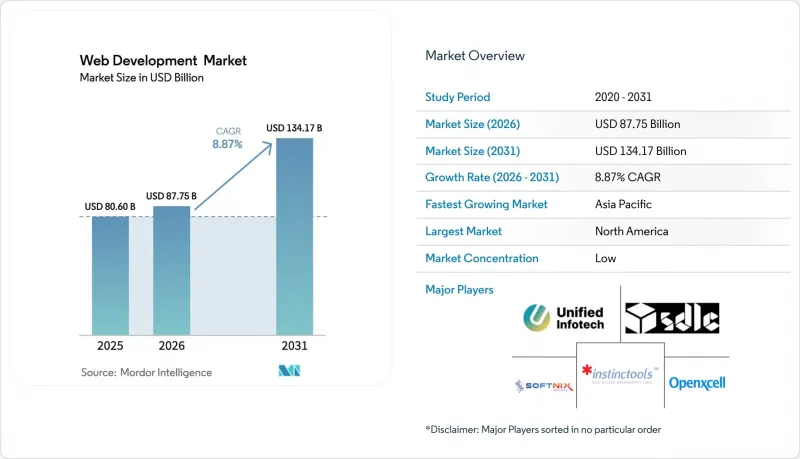
This report is Segmented by Type (Website, Web App and More), Enterprises (SMEs, Large Enterprises), End-User Vertical (Retail and E-Commerce, IT and Telecom and More), Technology Stack(Headless CMS / Composable, API-First and Serverless and More), Deployment Model (Cloud-Based, On-Premise and Hybrid) and Geography. The Market Forecasts are Provided in Terms of Value (USD).
Global Web Development Market Trends and Insights
E-commerce & Omnichannel Boom
Retailers now regard site reliability as a growth lever rather than a maintenance concern after peak-season outages erased millions in one-day revenue losses in 2024. Leading merchants are adopting composable commerce to swap individual services-search, cart, payments-without disrupting the core checkout flow, trimming release cycles from weeks to days. Retail case studies show that well-designed Progressive Web Apps can lift mobile conversion rates fourfold, reinforcing why decision makers view web development as a direct revenue driver. With ordering, loyalty, and fulfillment data flowing through a single stack, platform extensibility becomes a boardroom metric, further raising demand for the web development services market.
Enterprise Digital-Transformation Budgets
C-suite urgency around customer-experience parity with digital-native competitors keeps web budgets intact even when discretionary IT spending tightens. Global systems integrators are winning multi-year managed-services deals that embed AI, data fabric, and design capabilities in one contract, locking in predictable fee streams. The typical Fortune 500 client now allocates double-digit share of its tech budget to web-facing initiatives, seeking expertise in cloud refactoring and privacy-centric architecture. Those priorities sustain premium pricing power inside the web development services market.
Cross-Browser / Device Fragmentation
Inconsistent CSS and JavaScript behavior across browsers extends QA cycles and forces polyfills that bloat payload sizes, driving up hosting bills. Safari and Internet Explorer display layout quirks that require conditional stylesheets, burdensome for teams lacking automated test rigs. Fragmentation escalates on mobile where hundreds of screen sizes and chipset variants complicate performance tuning. SMEs feel the pinch because they cannot absorb added hours, tempering uptake for web development services.
Other drivers and restraints analyzed in the detailed report include:
- Mobile-First & PWA Adoption
- AI-Powered Chatbots & Personalization
- Global Talent Shortage & Rising Developer Costs
For complete list of drivers and restraints, kindly check the Table Of Contents.
Segment Analysis
The segment that groups classic web applications retained 57.35% revenue in 2025 thanks to entrenched enterprise workflows that rely on robust server-rendered stacks. That dominance translated into USD 46.2 billion of the web development services market size in the base year. Progressive Web Apps, however, expanded at 13.45% CAGR and are projected to narrow the gap rapidly. PWAs lower total cost of ownership by eliminating separate native builds while delivering push notifications and offline caching that heighten engagement. Early adopters within retail and travel note that bounce rates fall when customers can resume sessions without reinstalling apps. In parallel, low-code site builders keep attracting micro-enterprises seeking brochure-style pages, yet they rarely satisfy security, compliance, or multi-region traffic needs at the enterprise tier.
PWA success stories resonate across boardrooms: brands report double-digit revenue lifts after converting sites to service-worker-enabled architectures. Technology vendors are now bundling turnkey PWA accelerators with headless CMS licenses, compressing deployment from months to weeks. As a result, professional-services partners are packaging "PWA in a box" offerings that promise predictable budgets and outcomes, adding fuel to the web development services market.
Large corporations commanded 62.40% of 2025 billings, equal to USD 50.3 billion of web development services market share, because they outsource global rollouts that span hundreds of microsites and localized portals. They also require multilayer security assessments, content governance, and multi-cloud resilience-needs best met by tier-one integrators. Yet small and medium enterprises are the faster mover, expanding at 10.85% CAGR on the back of SaaS toolkits and pay-as-you-go cloud that cut initial outlays by a third. SMEs prize serverless back-ends for eliminating server patching and benefiting from usage-linked pricing, freeing scarce capital for marketing spend.
The ability to experiment cheaply levels the playing field: a 20-employee retailer can launch AI-assisted chat ordering capability in weeks by licensing pretrained models through an API. Vendors serving this cohort assemble standardized template libraries and managed-hosting bundles that deliver enterprise-grade uptime without enterprise overhead. These dynamics ensure balanced growth across client sizes within the web development services market.
Complete Report Scope:
- By Type
- Website
- Web Application
- Progressive Web App (PWA)
- Low-/No-Code Site Builder
- By Enterprise Size
- Small and Medium-sized Enterprises (SMEs)
- Large Enterprises
- By End-user Vertical
- Retail and E-commerce
- BFSI
- Healthcare and Life Sciences
- IT and Telecom
- Media and Entertainment
- Government and Public Sector
- Education
- Travel and Hospitality
- By Technology Stack
- Front-end Framework (React, Angular, Vue)
- Back-end Framework (Node, Django, .NET)
- Headless CMS / Composable
- API-first and Serverless
- By Deployment Model
- Cloud-based
- On-premise
- Hybrid
- By Geography
- North America
- United States
- Canada
- Mexico
- South America
- Brazil
- Argentina
- Rest of South America
- Europe
- Germany
- United Kingdom
- France
- Spain
- Italy
- Rest of Europe
- Asia-Pacific
- China
- India
- Japan
- South Korea
- Australia
- Rest of Asia-Pacific
- Middle East
- Israel
- Saudi Arabia
- United Arab Emirates
- Turkey
- Rest of Middle East
- Africa
- South Africa
- Egypt
- Nigeria
- Rest of Africa
- North America
Geography Analysis
North America safeguarded 39.40% of global billings in 2025 as entrenched enterprises pursued aggressive modernization programs underpinned by generous cloud credits from hyperscalers. Clients value local regulatory clarity and broad talent pools, allowing rapid experimentation with AI-as-a-Service offerings. The United States alone saw multiple nine-figure deals where customers outsourced legacy portal re-platforming to a single services partner who manages cloud costs, security, and DevSecOps at scale. Canada's immigration-friendly policies complement that dynamic by channeling high-skill developers into local delivery centers, reinforcing supply for the web development services market.
Asia-Pacific represents the fastest regional climb with a 17.05% CAGR. India anchors growth following multibillion-dollar data-center commitments that double rack capacity and reduce latency for domestic traffic. The rise of India-built Digital Public Infrastructure APIs makes onboarding payments, identity, and document storage straightforward, lowering entry barriers for startups who then contract external agencies to build compliant front-ends. In China, official blueprints to lift the digital-economy share of GDP unlock public incentives for AI-centric commerce platforms, channeling spend toward vendors versed in low-code, headless, and edge-rendered architectures. Japan's national Society 5.0 policy, backed by subsidy programs for AI testbeds, injects fresh demand for accessibility-compliant corporate portals, diversifying addressable revenue. Europe delivers steady mid-single-digit growth on the back of GDPR refinements and new accessibility directives that mandate inclusive user journeys. Enterprises put a premium on host-in-region data stores and audit trails, spawning opportunities for vendors that bundle sovereign-cloud hosting with turnkey WCAG-3.0 remediation. Elsewhere, Latin America benefits from Brazilian e-commerce momentum, while select Gulf Cooperation Council states fund "smart city" rollouts that integrate citizen services via web dashboards. Together these pockets sustain a globally diversified web development services market.
- Accenture
- Cognizant
- Tata Consultancy Services (TCS)
- IBM
- Infosys
- Capgemini
- Wipro
- EPAM Systems
- ThoughtWorks
- Globant
- Endava
- HCLTech
- SoftServe
- LTI-Mindtree
- Valtech
- Unified Infotech
- SDLC Corporation
- OpenXcell
- Plavno
- KitRUM
- PageTraffic
- 9thCO
- Instinctools GmbH
- Softnix Infotech
Additional Benefits:
- The market estimate (ME) sheet in Excel format
- 3 months of analyst support
TABLE OF CONTENTS
1 INTRODUCTION
- 1.1 Study Assumptions and Market Definition
- 1.2 Scope of the Study
2 RESEARCH METHODOLOGY
3 EXECUTIVE SUMMARY
4 MARKET LANDSCAPE
- 4.1 Market Overview
- 4.2 Market Drivers
- 4.2.1 E-commerce and omnichannel boom
- 4.2.2 Enterprise digital-transformation budgets
- 4.2.3 Mobile-first and PWA adoption
- 4.2.4 AI-powered chatbots and personalization
- 4.2.5 Headless CMS and composable architecture surge
- 4.2.6 Accessibility regulation (WCAG 3.0) deadlines
- 4.3 Market Restraints
- 4.3.1 Cross-browser/device fragmentation
- 4.3.2 Global talent shortage and rising developer costs
- 4.3.3 Data-privacy compliance overhead (GDPR, CPRA)
- 4.3.4 Sustainability pressure and web-carbon audits
- 4.4 Regulatory Landscape
- 4.5 Technological Outlook
- 4.6 Porter's Five Forces Analysis
- 4.6.1 Bargaining Power of Suppliers
- 4.6.2 Bargaining Power of Consumers
- 4.6.3 Threat of New Entrants
- 4.6.4 Threat of Substitutes
- 4.6.5 Intensity of Rivalry
- 4.7 Macroeconomic Impact Assessment
- 4.8 Investment Analysis
5 MARKET SIZE AND GROWTH FORECASTS (VALUE)
- 5.1 By Type
- 5.1.1 Website
- 5.1.2 Web Application
- 5.1.3 Progressive Web App (PWA)
- 5.1.4 Low-/No-Code Site Builder
- 5.2 By Enterprise Size
- 5.2.1 Small and Medium-sized Enterprises (SMEs)
- 5.2.2 Large Enterprises
- 5.3 By End-user Vertical
- 5.3.1 Retail and E-commerce
- 5.3.2 BFSI
- 5.3.3 Healthcare and Life Sciences
- 5.3.4 IT and Telecom
- 5.3.5 Media and Entertainment
- 5.3.6 Government and Public Sector
- 5.3.7 Education
- 5.3.8 Travel and Hospitality
- 5.4 By Technology Stack
- 5.4.1 Front-end Framework (React, Angular, Vue)
- 5.4.2 Back-end Framework (Node, Django, .NET)
- 5.4.3 Headless CMS / Composable
- 5.4.4 API-first and Serverless
- 5.5 By Deployment Model
- 5.5.1 Cloud-based
- 5.5.2 On-premise
- 5.5.3 Hybrid
- 5.6 By Geography
- 5.6.1 North America
- 5.6.1.1 United States
- 5.6.1.2 Canada
- 5.6.1.3 Mexico
- 5.6.2 South America
- 5.6.2.1 Brazil
- 5.6.2.2 Argentina
- 5.6.2.3 Rest of South America
- 5.6.3 Europe
- 5.6.3.1 Germany
- 5.6.3.2 United Kingdom
- 5.6.3.3 France
- 5.6.3.4 Spain
- 5.6.3.5 Italy
- 5.6.3.6 Rest of Europe
- 5.6.4 Asia-Pacific
- 5.6.4.1 China
- 5.6.4.2 India
- 5.6.4.3 Japan
- 5.6.4.4 South Korea
- 5.6.4.5 Australia
- 5.6.4.6 Rest of Asia-Pacific
- 5.6.5 Middle East
- 5.6.5.1 Israel
- 5.6.5.2 Saudi Arabia
- 5.6.5.3 United Arab Emirates
- 5.6.5.4 Turkey
- 5.6.5.5 Rest of Middle East
- 5.6.6 Africa
- 5.6.6.1 South Africa
- 5.6.6.2 Egypt
- 5.6.6.3 Nigeria
- 5.6.6.4 Rest of Africa
- 5.6.1 North America
6 COMPETITIVE LANDSCAPE
- 6.1 Market Concentration
- 6.2 Strategic Moves
- 6.3 Market Share Analysis
- 6.4 Company Profiles (includes Global level Overview, Market level overview, Core Segments, Financials as available, Strategic Information, Market Rank/Share for key companies, Products and Services, and Recent Developments)
- 6.4.1 Accenture
- 6.4.2 Cognizant
- 6.4.3 Tata Consultancy Services (TCS)
- 6.4.4 IBM
- 6.4.5 Infosys
- 6.4.6 Capgemini
- 6.4.7 Wipro
- 6.4.8 EPAM Systems
- 6.4.9 ThoughtWorks
- 6.4.10 Globant
- 6.4.11 Endava
- 6.4.12 HCLTech
- 6.4.13 SoftServe
- 6.4.14 LTI-Mindtree
- 6.4.15 Valtech
- 6.4.16 Unified Infotech
- 6.4.17 SDLC Corporation
- 6.4.18 OpenXcell
- 6.4.19 Plavno
- 6.4.20 KitRUM
- 6.4.21 PageTraffic
- 6.4.22 9thCO
- 6.4.23 Instinctools GmbH
- 6.4.24 Softnix Infotech
7 MARKET OPPORTUNITIES AND FUTURE OUTLOOK
- 7.1 White-space and Unmet-Need Assessment

