PUBLISHER: Mordor Intelligence | PRODUCT CODE: 2100247

PUBLISHER: Mordor Intelligence | PRODUCT CODE: 2100247
Fertility Treatment - Market Share Analysis, Industry Trends & Statistics, Growth Forecasts (2026 - 2031)
According to Mordor Intelligence, fertility treatment market size in 2026 is estimated at USD 37.1 billion, growing from 2025 value of USD 34.63 billion with 2031 projections showing USD 52.33 billion, growing at 7.12% CAGR over 2026-2031.
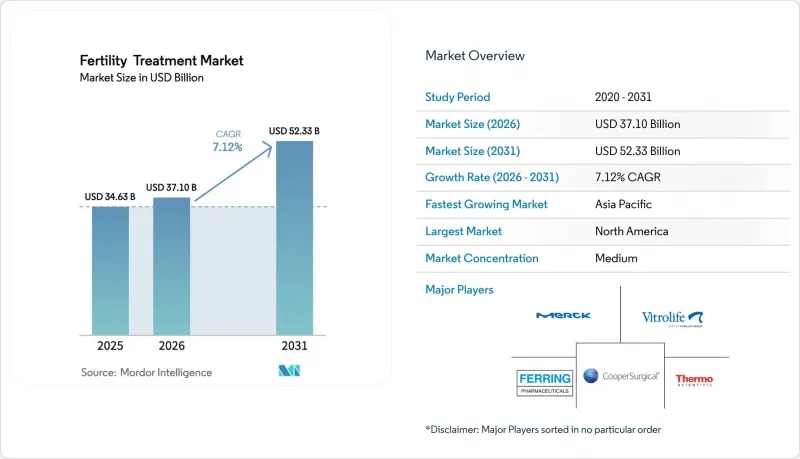
This report is Segmented by Gender (Female Infertility and Male Infertility), Treatment Type (In-Vitro Fertilization (IVF), and More), Procedure/Cycle Type (Fresh Non-Donor, and More), Service Provider (Fertility Clinics & ART Centres, and More), Geography (North America, Europe, Asia-Pacific, The Middle East and Africa, and South America). The Market Forecasts are Provided in Terms of Value (USD).
Global Fertility Treatment Market Trends and Insights
Rising Global Infertility Incidence
Roughly 186 million people now experience infertility, translating to 17.5% of the adult populatio. Asia-Pacific shows the sharpest rise, with secondary female infertility climbing faster than primary cases between 1990 and 2021. Polycystic ovary syndrome and lifestyle factors intensify demand, and in the Philippines one in four couples seek medical help. Developed economies face sub-replacement fertility, so government incentives and insurance mandates are widening access. These epidemiological stresses create lasting tailwinds for the fertility treatment market.
Delayed Childbearing Trends
Average maternal age at first birth continues to rise, and egg-freezing cycles for non-medical reasons increased 30% year-over-year at leading clinics. Employers now add fertility benefits to retain talent, with 31% covering preservation services and 30% reimbursing IVF. Women recognize the biologic clock yet lack awareness of age-related decline, spurring uptake of oocyte-cryopreservation packages. This postponement expands the fertility treatment market while encouraging bundled benefit models that lower out-of-pocket costs.
High Treatment Costs and Limited Reimbursement
In the United States, a single IVF cycle runs USD 12,000-30,000, and patients usually need 2.5 cycles to succeed. Only one-quarter of employers cover IVF, leaving many households to finance treatments via high-interest specialty loans. Disruptors such as Pozitivf Fertility trimmed cycle prices to USD 7,900 by streamlining lab protocols. While U.S. state mandates and California's 2025 insurance law may ease access, reimbursement gaps still slow the fertility treatment market's expansion.
Other drivers and restraints analyzed in the detailed report include:
- Technological Advancements in Assisted Reproductive Technologies
- Expansion of Cross-Border Fertility Tourism
- Ethical and Religious Constraints
For complete list of drivers and restraints, kindly check the Table Of Contents.
Segment Analysis
In 2025, female infertility accounted for 61.62% of the fertility treatment market. The male infertility segment, however, is forecast to register a 9.16% CAGR from 2026 to 2031 as clinicians acknowledge that men contribute to up to half of infertility cases. Artificial-intelligence-driven semen-analysis devices and smartphone-based diagnostics are improving accuracy and accessibility. Ferring Pharmaceuticals and Posterity Health launched a digital Male Fertility program that provides confidential assessments and personalized guidance, reducing diagnostic delays.
Growing social acceptance and targeted investment are enabling simultaneous testing of both partners, cutting unnecessary costs. Lifestyle modification apps, hormonal therapies, and micro-surgical interventions enlarge the therapeutic toolkit. As insurers gradually expand coverage for male diagnostic workups, the fertility treatment market gains a new revenue stream that complements the dominant female-focused services.
In-vitro fertilization retained 46.58% revenue share in 2025, yet intracytoplasmic sperm injection (ICSI) is projected to grow at a 9.63% CAGR, making it the fastest-rising modality. ICSI's precision suits severe male-factor or previously failed IVF cases, and its adoption reflects wider awareness of male contributions to infertility. As genetic screening becomes cheaper, the share of IVF cycles using preimplantation genetic testing is expected to rise to about 25% in coming years.
Adjunct innovations, including platelet-rich plasma therapy and mitochondrial transfer, aim to boost oocyte quality, though regulators now tighten oversight of stem-cell-based clinics. These layered treatment options diversify revenue and fuel the fertility treatment market. Medication protocols and surgical adjuncts still underpin all cycles, but automation and AI are reducing manual variability.
Complete Report Scope:
- By Gender
- Female Infertility
- Male Infertility
- By Treatment Type
- In-Vitro Fertilization (IVF)
- Intracytoplasmic Sperm Injection (ICSI)
- Intrauterine Insemination (IUI)
- Fertility Medications
- Surgery & Other ART
- Cryopreservation Services
- Genetic Testing & PGD/PGT-A
- Adjunct Therapies (PRP, Stem Cell, Mito Transfer)
- By Procedure / Cycle Type
- Fresh Non-Donor
- Frozen / Thawed Non-Donor
- Donor Egg / Embryo
- Surrogacy Cycles
- By Service Provider
- Fertility Clinics & ART Centres
- Hospitals & Surgical Centres
- Cryobanks & Genetic Labs
- Tele-Fertility Platforms
- Geography
- North America
- United States
- Canada
- Mexico
- Europe
- Germany
- United Kingdom
- France
- Italy
- Spain
- Rest of Europe
- Asia-Pacific
- China
- Japan
- India
- Australia
- South Korea
- Rest of Asia-Pacific
- Middle East & Africa
- GCC
- South Africa
- Rest of Middle East & Africa
- South America
- Brazil
- Argentina
- Rest of South America
- North America
Geography Analysis
North America commanded 38.11% of global revenue in 2025, anchored by advanced clinical infrastructure, higher disposable income, and state-level insurance mandates that now cover up to three IVF cycles for millions of residents. The United States also draws Canadian and Caribbean patients, benefiting from well-established donor registries and genetic laboratories. Private equity funding into clinic chains accelerates market consolidation and technology adoption, keeping the region at the forefront of the fertility treatment market.
Asia-Pacific is the fastest-growing geography with an 8.12% CAGR forecast through 2031. India opens 60-70 IVF centers each year, and organized networks now perform 35-40% of national cycles compared with negligible levels a decade ago. China's large unmet need and evolving reimbursement guidelines hold substantial promise, even though commercial surrogacy remains banned. Thailand and Malaysia leverage medical-tourism incentives to attract Chinese, Australian, and Middle-Eastern clients, thereby strengthening the regional fertility treatment market.
Europe maintains a robust position under supportive legislation in Spain, Denmark, and the Czech Republic, where public funding and liberal donor rules stimulate procedure volumes. Following Poland's recent policy shift, all 27 EU members now fund IVF in some form, yet only five grant full financing for up to six cycles. Latin America performs roughly 107,000 IVF cycles annually, led by Brazil, Argentina, and Mexico. The Middle East and Africa remain nascent but show rising demand in Gulf Cooperation Council states where expatriate populations commonly delay childbearing.
- The Cooper Companies
- Vitrolife
- Merck
- Ferring Holdings SA
- Thermo Fisher Scientific
- Cook Group
- Irvine Scientific
- Eppendorf
- Genea Biomedx
- Pfizer
- Teva Pharmaceutical Industries
- Sanofi
- Sun Pharma Ltd.
- Virtus Health
- Boston IVF
- CARE Fertility
- Kindbody
- Progyny Inc.
- Nova IVF Fertility
- Bloom IVF Group
- IHR Clinic
- Monash IVF Group
- Apollo Fertility
- San Diego Fertility Center
Additional Benefits:
- The market estimate (ME) sheet in Excel format
- 3 months of analyst support
TABLE OF CONTENTS
1 Introduction
- 1.1 Study Assumptions & Market Definition
- 1.2 Scope of the Study
2 Research Methodology
3 Executive Summary
4 Market Landscape
- 4.1 Market Overview
- 4.2 Market Drivers
- 4.2.1 Rising Global Infertility Incidence
- 4.2.2 Delayed Childbearing Trends
- 4.2.3 Technological Advancements in Assisted Reproductive Technologies
- 4.2.4 Expansion of Cross-Border Fertility Tourism
- 4.2.5 Employer-Sponsored Fertility Benefit Programs
- 4.2.6 Integration of Artificial Intelligence in Embryo Selection
- 4.3 Market Restraints
- 4.3.1 High Treatment Costs and Limited Reimbursement
- 4.3.2 Ethical and Religious Constraints
- 4.3.3 Declining Availability of Donor Gametes
- 4.3.4 Environmental Sustainability Pressures on IVF Laboratories
- 4.4 Regulatory Landscape
- 4.5 Porter's Five Forces Analysis
- 4.5.1 Threat Of New Entrants
- 4.5.2 Bargaining Power Of Buyers
- 4.5.3 Bargaining Power Of Suppliers
- 4.5.4 Threat Of Substitutes
- 4.5.5 Intensity Of Competitive Rivalry
5 Market Size & Growth Forecasts (Value, USD)
- 5.1 By Gender
- 5.1.1 Female Infertility
- 5.1.2 Male Infertility
- 5.2 By Treatment Type
- 5.2.1 In-Vitro Fertilization (IVF)
- 5.2.2 Intracytoplasmic Sperm Injection (ICSI)
- 5.2.3 Intrauterine Insemination (IUI)
- 5.2.4 Fertility Medications
- 5.2.5 Surgery & Other ART
- 5.2.6 Cryopreservation Services
- 5.2.7 Genetic Testing & PGD/PGT-A
- 5.2.8 Adjunct Therapies (PRP, Stem Cell, Mito Transfer)
- 5.3 By Procedure / Cycle Type
- 5.3.1 Fresh Non-Donor
- 5.3.2 Frozen / Thawed Non-Donor
- 5.3.3 Donor Egg / Embryo
- 5.3.4 Surrogacy Cycles
- 5.4 By Service Provider
- 5.4.1 Fertility Clinics & ART Centres
- 5.4.2 Hospitals & Surgical Centres
- 5.4.3 Cryobanks & Genetic Labs
- 5.4.4 Tele-Fertility Platforms
- 5.5 Geography
- 5.5.1 North America
- 5.5.1.1 United States
- 5.5.1.2 Canada
- 5.5.1.3 Mexico
- 5.5.2 Europe
- 5.5.2.1 Germany
- 5.5.2.2 United Kingdom
- 5.5.2.3 France
- 5.5.2.4 Italy
- 5.5.2.5 Spain
- 5.5.2.6 Rest of Europe
- 5.5.3 Asia-Pacific
- 5.5.3.1 China
- 5.5.3.2 Japan
- 5.5.3.3 India
- 5.5.3.4 Australia
- 5.5.3.5 South Korea
- 5.5.3.6 Rest of Asia-Pacific
- 5.5.4 Middle East & Africa
- 5.5.4.1 GCC
- 5.5.4.2 South Africa
- 5.5.4.3 Rest of Middle East & Africa
- 5.5.5 South America
- 5.5.5.1 Brazil
- 5.5.5.2 Argentina
- 5.5.5.3 Rest of South America
- 5.5.1 North America
6 Competitive Landscape
- 6.1 Market Concentration
- 6.2 Market Share Analysis
- 6.3 Company Profiles (includes Global level Overview, Market level overview, Core Business Segments, Financials, Headcount, Key Information, Market Rank, Market Share, Products and Services, and analysis of Recent Developments)
- 6.3.1 CooperSurgical Inc.
- 6.3.2 Vitrolife AB
- 6.3.3 Merck KGaA (EMD Serono)
- 6.3.4 Ferring Holdings SA
- 6.3.5 Thermo Fisher Scientific Inc.
- 6.3.6 Cook Medical LLC
- 6.3.7 Irvine Scientific
- 6.3.8 Eppendorf AG
- 6.3.9 Genea Biomedx
- 6.3.10 Pfizer Inc.
- 6.3.11 Teva Pharmaceutical Industries Ltd.
- 6.3.12 Sanofi SA
- 6.3.13 Sun Pharma Ltd.
- 6.3.14 Virtus Health
- 6.3.15 Boston IVF
- 6.3.16 CARE Fertility
- 6.3.17 Kindbody
- 6.3.18 Progyny Inc.
- 6.3.19 Nova IVF Fertility
- 6.3.20 Bloom IVF Group
- 6.3.21 IHR Clinic
- 6.3.22 Monash IVF Group
- 6.3.23 Apollo Fertility
- 6.3.24 San Diego Fertility Center
7 Market Opportunities & Future Outlook
- 7.1 White-Space & Unmet-Need Assessment

