PUBLISHER: Mordor Intelligence | PRODUCT CODE: 2100255

PUBLISHER: Mordor Intelligence | PRODUCT CODE: 2100255
ATM - Market Share Analysis, Industry Trends & Statistics, Growth Forecasts (2026 - 2031)
According to Mordor Intelligence, ATM market size in 2026 is estimated at USD 25.67 billion, growing from 2025 value of USD 24.91 billion with 2031 projections showing USD 29.76 billion, growing at 3.06% CAGR over 2026-2031.
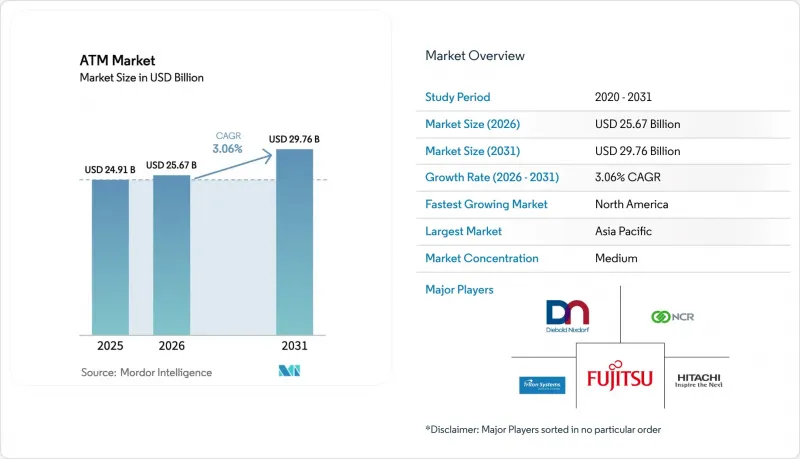
This report is Segmented by Deployment (Onsite ATMs, Offsite ATMs, Worksite ATMs, & Mobile ATMs), Type (Conventional Bank ATM, Brown Bank ATM, White Label ATM, Intelligent ATMs, & Cash Dispenser ATMs), End-User (BFSI, Retail and Convenience Stores, Transportation Hubs, Hospitality and Leisure, & Other Commercial Sites), Service Model (Deployment Solutions & Managed ATM Services), and Geography.
Global ATM Market Trends and Insights
Advent of Smart ATMs
Smart terminals now bundle biometric login, video banking, and AI-driven cash forecasting into a single enclosure, turning what was once a cash box into a micro-branch. Hyosung Americas' roll-out of NFC-enabled retail units shows how contactless layers improve both security and throughput. Fujitsu's AI framework cuts software-update effort by 50%, demonstrating tangible opex savings that justify hardware refresh cycles. The result is a clear pivot by global banks toward intelligent devices that sustain branch rationalization while protecting customer journey quality.
Growing Urbanization in Cash-Reliant Economies
Mega-city growth across India, Indonesia, Nigeria, and Mexico concentrates millions of cash-centric consumers in dense hubs that still lack broad point-of-sale coverage. Independent deployers plug these ATM gaps, as seen in South Africa where non-bank operators keep cash flowing in townships with limited branch footprints. Municipal transit corridors and industrial zones similarly rely on off-site ATMs for salary withdrawals and bill payments, cementing steady volume growth that feeds the ATM market well past 2030.
Escalating Security and Cyber-Crime Threats
Physical attacks grew 600% in 2024, with hydraulic "hook-and-chain" incidents costing USD 120,000 per hit on average. Cyber vectors are equally troubling: 85% of global estates still run unsupported OS images, leaving doorways for jackpotting malware. The US Federal Trade Commission tracked USD 120 million in crypto-ATM fraud losses, spotlighting vulnerabilities in unregulated segments. Counter-measures such as biometric second-factor, end-to-end encryption, and AI anomaly detection raise capex and opex, muting near-term profitability.
Other drivers and restraints analyzed in the detailed report include:
- Rising Adoption of Contactless and Cardless Transactions
- Expansion of Cash-Recycling and Deposit Functionality
- Branch Rationalization Driving ATM Shutdowns in Mature Markets
For complete list of drivers and restraints, kindly check the Table Of Contents.
Segment Analysis
Off-site terminals dominated value share in 2025, underscoring the market shift toward non-branch touchpoints. These units serve malls, transit hubs, and big-box stores where foot traffic sustains high transaction velocity. Work-site machines flourish in factories and campuses that prize on-premise salary access.
The mobile subset, though smaller in volume, is scaling at an 8.61% CAGR as banks dispatch truck-based kiosks to disaster zones, concerts, and rural fairs. Their short installation lead-time and low sunk cost make them ideal for testing demand before committing to brick-and-mortar spend. Industry players report that mobile fleets record utilisation spikes of up to 40% during festival seasons, validating a flexible deployment thesis that buoys the ATM market.
The cash-dispenser category retained 40.72% share in 2025, anchoring everyday withdrawals across global high-street corridors. Yet its growth curve is flattening as banks pivot budgets toward multifunction machines that pack cheque imaging, bill pay, and foreign exchange.
Smart/intelligent devices log an 8.80% CAGR, the fastest-rising slice of the ATM market. Biometric palm-vein login, high-definition video-assisted sessions, and multicurrency cash modules create a mini-branch experience that keeps complex transactions inside the bank's walled garden. Brown and white-label operators leverage OEM APIs to overlay branding, while blockchain-ready kiosks prepare for digital-currency convergence. This functional expansion positions smart ATMs as the hardware baseline for the coming decade.
Complete Report Scope:
- By Deployment
- On-site ATMs
- Off-site ATMs
- Work-site ATMs
- Mobile ATMs
- By Type
- Conventional / Bank ATMs
- Brown Label ATMs
- White Label ATMs
- Smart / Intelligent ATMs
- Cash-Dispenser ATMs
- By End-user
- Banking and Financial Institutions
- Retail and Convenience Stores
- Transportation Hubs
- Hospitality and Leisure
- Other Commercial Sites
- By Service Model
- Deployment Solutions
- Managed ATM Services
- By Geography
- North America
- United States
- Canada
- Mexico
- South America
- Brazil
- Argentina
- Rest of South America
- Europe
- United Kingdom
- Germany
- France
- Italy
- Spain
- Nordics
- Rest of Europe
- Middle East and Africa
- Middle East
- Saudi Arabia
- United Arab Emirates
- Turkey
- Rest of Middle East
- Africa
- South Africa
- Egypt
- Nigeria
- Rest of Africa
- Middle East
- Asia-Pacific
- China
- India
- Japan
- South Korea
- ASEAN
- Australia
- New Zealand
- Rest of Asia-Pacific
- North America
Geography Analysis
Asia-Pacific leads with 37.65% share in 2025, driven by India's semi-urban expansion, Indonesia's archipelago logistics needs, and China's continued demand for hybrid cash-digital acceptance points. Policy moves to lift interchange fees to INR 23 (USD 0.28) improve operator ROI, encouraging fresh deployments that enlarge the ATM market size in the region. Cross-border players like Euronet deepen footprints via asset acquisitions in Malaysia, signalling confidence in long-run consumer cash usage.
North America is the fastest climber at 6.05% CAGR through 2031, fuelled by more than 31,000 cryptocurrency-enabled kiosks that let users exchange fiat for Bitcoin and vice versa. Retail alliances, illustrated by 4,000 new NCR Atleos Allpoint devices inside 7-Eleven stores, keep surcharge-free cash top of wallet for underbanked demographics. This innovation cadence sustains premium hardware spend and lifts regional growth above the global mean.
Europe shows maturity yet pioneers energy-efficient fleet management. Komercni banka's shared-ATM initiative covering 2,000 Czech terminals slashes duplicate capacity and power draw, aligning with EU Green Deal goals. Swedbank's sale of 1,141 Baltic units to Euronet underscores a pivot toward ATM-as-a-Service economics for legacy institutions. Meanwhile, the digital-euro roadmap could trim cash circulation post-2028, but current guidance leaves a multi-year runway for optimisation projects that reinforce the ATM market.
- Diebold Nixdorf Incorporated
- NCR Atleos Corporation
- Hyosung TNS Inc.
- Fujitsu Limited
- GRG Banking Equipment Co., Ltd.
- Hitachi Channel Solutions Corporation
- HESS Cash Systems GmbH and Co. KG
- Euronet Worldwide, Inc.
- Triton Systems of Delaware LLC
- Cardtronics plc
- Link Scheme Ltd.
- NoteMachine Ltd.
- Nautilus Hyosung America Inc.
- Glory Ltd.
- ACI Worldwide, Inc.
- KAL ATM Software GmbH
- Fiserv, Inc.
- OKI Electric Industry Co., Ltd.
- Banco24Horas (SA Rede Banorte S.A.)
- CMS Info Systems Limited
Additional Benefits:
- The market estimate (ME) sheet in Excel format
- 3 months of analyst support
TABLE OF CONTENTS
1 INTRODUCTION
- 1.1 Study Assumptions and Market Definition
- 1.2 Scope of the Study
2 RESEARCH METHODOLOGY
3 EXECUTIVE SUMMARY
4 MARKET LANDSCAPE
- 4.1 Market Overview
- 4.2 Market Drivers
- 4.2.1 Advent of Smart ATMs
- 4.2.2 Growing urbanization in cash-reliant economies
- 4.2.3 Rising adoption of contactless and card-less ATM transactions
- 4.2.4 Expansion of cash-recycling and deposit functionality
- 4.2.5 Shift toward "ATM-as-a-Service" subscription models
- 4.2.6 Emergence of cryptocurrency ATMs broadening use-cases
- 4.3 Market Restraints
- 4.3.1 Escalating security and cyber-crime threats
- 4.3.2 Branch rationalization driving ATM shutdowns in mature markets
- 4.3.3 Regulatory caps on interchange fees hurting IAD economics
- 4.3.4 Sustainability push to reduce cash circulation and carbon footprint
- 4.4 Evaluation of Critical Regulatory Framework
- 4.5 Value Chain Analysis
- 4.6 Technological Outlook
- 4.7 Porter's Five Forces
- 4.7.1 Bargaining Power of Suppliers
- 4.7.2 Bargaining Power of Buyers
- 4.7.3 Threat of New Entrants
- 4.7.4 Threat of Substitutes
- 4.7.5 Competitive Rivalry
- 4.8 Impact Assessment of Key Stakeholders
- 4.9 Key Use Cases and Case Studies
- 4.10 Impact on Macroeconomic Factors of the Market
- 4.11 Investment Analysis
5 MARKET SEGMENTATION
- 5.1 By Deployment
- 5.1.1 On-site ATMs
- 5.1.2 Off-site ATMs
- 5.1.3 Work-site ATMs
- 5.1.4 Mobile ATMs
- 5.2 By Type
- 5.2.1 Conventional / Bank ATMs
- 5.2.2 Brown Label ATMs
- 5.2.3 White Label ATMs
- 5.2.4 Smart / Intelligent ATMs
- 5.2.5 Cash-Dispenser ATMs
- 5.3 By End-user
- 5.3.1 Banking and Financial Institutions
- 5.3.2 Retail and Convenience Stores
- 5.3.3 Transportation Hubs
- 5.3.4 Hospitality and Leisure
- 5.3.5 Other Commercial Sites
- 5.4 By Service Model
- 5.4.1 Deployment Solutions
- 5.4.2 Managed ATM Services
- 5.5 By Geography
- 5.5.1 North America
- 5.5.1.1 United States
- 5.5.1.2 Canada
- 5.5.1.3 Mexico
- 5.5.2 South America
- 5.5.2.1 Brazil
- 5.5.2.2 Argentina
- 5.5.2.3 Rest of South America
- 5.5.3 Europe
- 5.5.3.1 United Kingdom
- 5.5.3.2 Germany
- 5.5.3.3 France
- 5.5.3.4 Italy
- 5.5.3.5 Spain
- 5.5.3.6 Nordics
- 5.5.3.7 Rest of Europe
- 5.5.4 Middle East and Africa
- 5.5.4.1 Middle East
- 5.5.4.1.1 Saudi Arabia
- 5.5.4.1.2 United Arab Emirates
- 5.5.4.1.3 Turkey
- 5.5.4.1.4 Rest of Middle East
- 5.5.4.2 Africa
- 5.5.4.2.1 South Africa
- 5.5.4.2.2 Egypt
- 5.5.4.2.3 Nigeria
- 5.5.4.2.4 Rest of Africa
- 5.5.4.1 Middle East
- 5.5.5 Asia-Pacific
- 5.5.5.1 China
- 5.5.5.2 India
- 5.5.5.3 Japan
- 5.5.5.4 South Korea
- 5.5.5.5 ASEAN
- 5.5.5.6 Australia
- 5.5.5.7 New Zealand
- 5.5.5.8 Rest of Asia-Pacific
- 5.5.1 North America
6 COMPETITIVE LANDSCAPE
- 6.1 Market Concentration
- 6.2 Strategic Moves
- 6.3 Market Share Analysis
- 6.4 Company Profiles (includes Global level Overview, Market level overview, Core Segments, Financials as available, Strategic Information, Market Rank/Share for key companies, Products and Services, and Recent Developments)
- 6.4.1 Diebold Nixdorf Incorporated
- 6.4.2 NCR Atleos Corporation
- 6.4.3 Hyosung TNS Inc.
- 6.4.4 Fujitsu Limited
- 6.4.5 GRG Banking Equipment Co., Ltd.
- 6.4.6 Hitachi Channel Solutions Corporation
- 6.4.7 HESS Cash Systems GmbH and Co. KG
- 6.4.8 Euronet Worldwide, Inc.
- 6.4.9 Triton Systems of Delaware LLC
- 6.4.10 Cardtronics plc
- 6.4.11 Link Scheme Ltd.
- 6.4.12 NoteMachine Ltd.
- 6.4.13 Nautilus Hyosung America Inc.
- 6.4.14 Glory Ltd.
- 6.4.15 ACI Worldwide, Inc.
- 6.4.16 KAL ATM Software GmbH
- 6.4.17 Fiserv, Inc.
- 6.4.18 OKI Electric Industry Co., Ltd.
- 6.4.19 Banco24Horas (SA Rede Banorte S.A.)
- 6.4.20 CMS Info Systems Limited
7 MARKET OPPORTUNITIES AND FUTURE OUTLOOK
- 7.1 White-space and Unmet-need Assessment

