PUBLISHER: Mordor Intelligence | PRODUCT CODE: 2100258

PUBLISHER: Mordor Intelligence | PRODUCT CODE: 2100258
Network Security - Market Share Analysis, Industry Trends & Statistics, Growth Forecasts (2026 - 2031)
According to Mordor Intelligence, the network security market size is expected to grow from USD 24.95 billion in 2025 to USD 27.76 billion in 2026 and is forecast to reach USD 47.37 billion by 2031 at 11.28% CAGR over 2026-2031.
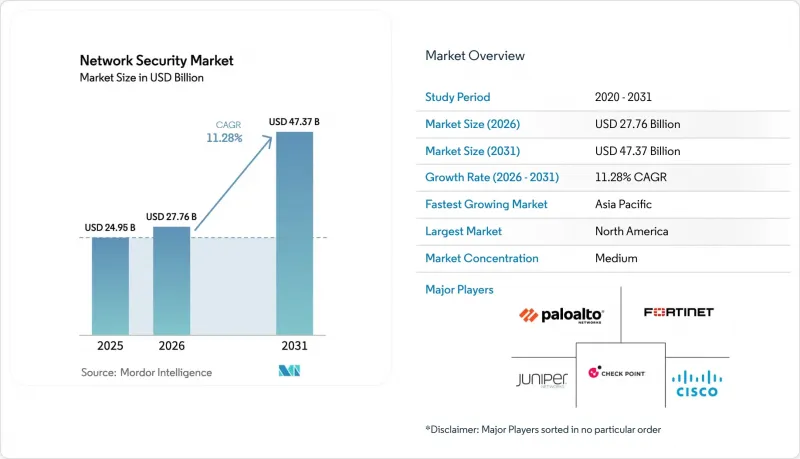
This report is Segmented by Security Offering ( Solutions, and Services), Deployment (Cloud, On-Premises, and Hybrid), Enterprise Size (Large Enterprises, and Small and Medium Enterprises), End-User Industry (IT and Telecom, BFSI, Government and Defense, Healthcare, Manufacturing, and More), and Geography. The Market Forecasts are Provided in Terms of Value (USD).
Global Network Security Market Trends and Insights
Escalating sophistication of ransomware-as-a-service
Service-based ransomware kits now bundle reconnaissance and lateral-movement tools, forcing companies to build zero-trust network architectures that inspect east-west traffic and apply real-time micro-segmentation. CrowdStrike reported that modern RaaS groups target network vulnerabilities more than endpoints, prompting purchases of analytics that spotlight suspicious internal flows. Arctic Wolf found that 72% of successful ransomware intrusions in 2024 originated from unsegmented networks, reinforcing the demand for behavior-based detection that minimizes blast radius. The economic fallout extends beyond ransom; boards now budget for resilience investments that maintain uptime even during attack recovery.
Rapid cloud migration expanding threat surface
With 95% of enterprises using at least one public cloud, policy sprawl poses a challenge to traditional perimeter tools. Palo Alto Networks observed that 70% of firms cannot enforce uniform rules across hybrid estates, motivating the adoption of cloud-native firewalls and SASE overlays. Menlo Security attributes 65% of data-exposure incidents to cloud misconfigurations, an issue addressed by platforms that auto-detect risky settings and provide integrated remediation across workloads. These capabilities differentiate vendors able to deliver elastic protection without infrastructure bottlenecks.
Shortage of skilled cyber-security professionals
ISC2 cites a 4.8 million-person global talent gap, with 90% of employers anticipating staff shortfalls that directly affect protection quality. NIST lists over 663,000 unfilled US cyber roles, inflating salaries for network specialists and pushing companies toward automated platforms and managed detection services. AI-driven monitoring tools that reduce manual tuning gain traction, yet the skill deficit continues to limit rollout speed of complex zero-trust projects
Other drivers and restraints analyzed in the detailed report include:
- Proliferation of IoT/OT devices requiring network segmentation
- Adoption of SASE driving thin-branch refreshes
- High capex for next-gen ASIC-based appliances
For complete list of drivers and restraints, kindly check the Table Of Contents.
Segment Analysis
Solutions retained 55.15% share of the network security market in 2025, but Services are poised for a brisk 14.55% CAGR to 2031. Demand for external expertise arises because threat actors now weaponize AI, forcing enterprises to outsource 24/7 monitoring and incident response. Professional services consultancies win projects designing zero-trust blueprints, while managed security service providers (MSSPs) secure recurring contracts to operate those environments. Cisco doubled security revenue to USD 2.02 billion in Q1 2025 after folding Splunk analytics into its portfolio and layering managed offerings atop the combined stack.
Vendor pricing models are shifting from perpetual licenses to outcome-based subscriptions tied to risk-reduction KPIs, locking in predictable annuities. Baseline tools such as network access control and DDoS protection continue to sell steadily, yet the fastest-rising solution is Zero Trust Network Access, which operates natively in cloud and edge contexts. The network security market benefits as buyers bundle consulting, integration, and ongoing management into a single contract that simplifies budgeting and accountability.
Cloud deployments commanded 52.35% of the network security market share in 2025 and are expected to compound at 15.5% annual growth rate through 2031, as enterprises retire their appliance stacks. Uniform policy enforcement across on-prem, public cloud, and edge requires centralized orchestration rather than siloed firewall rules. The network security market size for cloud controls is projected to expand during the forecast period, reflecting the adoption of inspection points embedded in SaaS, PaaS, and container workloads.
Europe's NIS2 Directive obligates critical infrastructure operators to demonstrate consistent protection and reporting, a task simplified by centrally managed cloud security dashboards. Even air-gapped industrial sites now employ hybrid models, where analytics and patch intelligence are delivered from the cloud, while data planes remain on-site. Palo Alto Networks' 36% jump in cloud security revenue underscores market confidence that virtualized enforcement can equal or surpass the performance of bespoke hardware.
Complete Report Scope:
- By Security Offering
- Solutions
- Network Firewall
- Intrusion Detection and Prevention Systems (IDPS)
- Secure Web Gateway
- Unified Threat Management (UTM)
- Distributed Denial-of-Service (DDoS) Protection
- Zero Trust Network Access (ZTNA)
- Network Access Control (NAC)
- Other Solutions
- Services
- Professional Services
- Managed Security Services
- Solutions
- By Deployment Mode
- Cloud
- On-Premises
- Hybrid
- By Enterprise Size
- Small and Medium Enterprises (SMEs)
- Large Enterprises
- By End-user Industry
- IT and Telecom
- BFSI
- Government and Defense
- Healthcare
- Manufacturing
- Retail and E-commerce
- Energy and Utilities
- Other End-user Industries
- By Geography
- North America
- United States
- Canada
- Mexico
- South America
- Brazil
- Argentina
- Rest of South America
- Europe
- Germany
- United Kingdom
- France
- Italy
- Spain
- Rest of Europe
- Asia-Pacific
- China
- Japan
- India
- South Korea
- Australia and New Zealand
- Rest of Asia-Pacific
- Middle East and Africa
- Middle East
- Saudi Arabia
- UAE
- Turkey
- Rest of Middle East
- Africa
- South Africa
- Nigeria
- Egypt
- Rest of Africa
- Middle East
- North America
Geography Analysis
North America generated 35.10% of network security market revenue in 2025, underpinned by stringent mandates such as the SEC's cyber-incident disclosure rule and a mature ecosystem of vendors and MSSPs. Spending is concentrated among Fortune 1000 enterprises that are refreshing their architectures around zero-trust and observability convergence. The region also pilots emerging technologies, including AI-based anomaly scoring and post-quantum cryptography inspection.
The Asia-Pacific region is expected to register a 12.05% CAGR through 2031, the fastest growth rate worldwide. The public cloud's uptake, e-commerce expansion, and manufacturing digitalization create fertile ground for modern defenses. Singapore demonstrates the pattern; its cybersecurity outlays are projected to reach USD 2 billion to USD 2.5 billion by 2026, buoyed by a national strategy that funds workforce development and sector-specific guidelines. Local telcos bundle security with 5G private networks, enabling factories to adopt automation without compromising safety.
Europe delivers steady growth anchored by the NIS2 Directive, which broadens coverage to 18 critical sectors and imposes stiff fines for non-compliance. ENISA states security budgets now account for 9% of total IT expenditures, with median spending per organization doubling compared with 2023. Cross-border data residency and sovereignty concerns boost demand for solutions that support regional cloud zones while offering harmonized dashboards for multinationals.
- Cisco Systems, Inc.
- Palo Alto Networks, Inc.
- Fortinet, Inc.
- Check Point Software Technologies Ltd.
- Juniper Networks, Inc.
- Trend Micro Incorporated
- Cloudflare, Inc.
- Zscaler, Inc.
- Sophos Limited
- Barracuda Networks, Inc.
- WatchGuard Technologies, Inc.
- F5, Inc.
- Arista Networks, Inc. (Awake Security)
- Akamai Technologies, Inc.
- Forcepoint LLC
- Ivanti Software, Inc. (Pulse Secure)
- Dell Technologies Inc. (SonicWall)
- Hewlett Packard Enterprise Development LP (Aruba)
- Broadcom Inc. (Symantec Enterprise)
- Proofpoint, Inc.
- CrowdStrike Holdings, Inc.
- Elastic N.V. (Endgame)
- Darktrace plc
- Nozomi Networks, Inc.
- Radware Ltd.
Additional Benefits:
- The market estimate (ME) sheet in Excel format
- 3 months of analyst support
TABLE OF CONTENTS
1 INTRODUCTION
- 1.1 Market Definition and Study Assumptions
- 1.2 Scope of the Study
2 RESEARCH METHODOLOGY
3 EXECUTIVE SUMMARY
4 MARKET LANDSCAPE
- 4.1 Market Overview
- 4.2 Market Drivers
- 4.2.1 Escalating sophistication of ransomware-as-a-service (RaaS) eco-system
- 4.2.2 Rapid cloud migration expanding threat surface
- 4.2.3 Proliferation of IoT/OT devices requiring network segmentation
- 4.2.4 Adoption of SASE driving thin-branch security refreshes
- 4.2.5 Mandatory software bill-of-materials (SBOM) rules pushing network anomaly detection
- 4.2.6 Telcos launching security-as-a-service bundles for 5G private networks
- 4.3 Market Restraints
- 4.3.1 Shortage of skilled cyber-security professionals
- 4.3.2 High capex for next-gen ASIC-based appliances
- 4.3.3 Performance trade-offs of full TLS 1.3 inspection on legacy gear
- 4.3.4 Vendor API lock-in impeding best-of-breed strategy adoption
- 4.4 Industry Value Chain Analysis
- 4.5 Evaluation of Critical Regulatory Framework
- 4.6 Impact Assessment of Key Stakeholders
- 4.7 Technological Outlook
- 4.8 Porter's Five Forces Analysis
- 4.8.1 Bargaining Power of Suppliers
- 4.8.2 Bargaining Power of Consumers
- 4.8.3 Threat of New Entrants
- 4.8.4 Threat of Substitutes
- 4.8.5 Intensity of Competitive Rivalry
- 4.9 Impact of Macroeconomic Factors on the Market
5 MARKET SIZE AND GROWTH FORECASTS (VALUE)
- 5.1 By Security Offering
- 5.1.1 Solutions
- 5.1.1.1 Network Firewall
- 5.1.1.2 Intrusion Detection and Prevention Systems (IDPS)
- 5.1.1.3 Secure Web Gateway
- 5.1.1.4 Unified Threat Management (UTM)
- 5.1.1.5 Distributed Denial-of-Service (DDoS) Protection
- 5.1.1.6 Zero Trust Network Access (ZTNA)
- 5.1.1.7 Network Access Control (NAC)
- 5.1.1.8 Other Solutions
- 5.1.2 Services
- 5.1.2.1 Professional Services
- 5.1.2.2 Managed Security Services
- 5.1.1 Solutions
- 5.2 By Deployment Mode
- 5.2.1 Cloud
- 5.2.2 On-Premises
- 5.2.3 Hybrid
- 5.3 By Enterprise Size
- 5.3.1 Small and Medium Enterprises (SMEs)
- 5.3.2 Large Enterprises
- 5.4 By End-user Industry
- 5.4.1 IT and Telecom
- 5.4.2 BFSI
- 5.4.3 Government and Defense
- 5.4.4 Healthcare
- 5.4.5 Manufacturing
- 5.4.6 Retail and E-commerce
- 5.4.7 Energy and Utilities
- 5.4.8 Other End-user Industries
- 5.5 By Geography
- 5.5.1 North America
- 5.5.1.1 United States
- 5.5.1.2 Canada
- 5.5.1.3 Mexico
- 5.5.2 South America
- 5.5.2.1 Brazil
- 5.5.2.2 Argentina
- 5.5.2.3 Rest of South America
- 5.5.3 Europe
- 5.5.3.1 Germany
- 5.5.3.2 United Kingdom
- 5.5.3.3 France
- 5.5.3.4 Italy
- 5.5.3.5 Spain
- 5.5.3.6 Rest of Europe
- 5.5.4 Asia-Pacific
- 5.5.4.1 China
- 5.5.4.2 Japan
- 5.5.4.3 India
- 5.5.4.4 South Korea
- 5.5.4.5 Australia and New Zealand
- 5.5.4.6 Rest of Asia-Pacific
- 5.5.5 Middle East and Africa
- 5.5.5.1 Middle East
- 5.5.5.1.1 Saudi Arabia
- 5.5.5.1.2 UAE
- 5.5.5.1.3 Turkey
- 5.5.5.1.4 Rest of Middle East
- 5.5.5.2 Africa
- 5.5.5.2.1 South Africa
- 5.5.5.2.2 Nigeria
- 5.5.5.2.3 Egypt
- 5.5.5.2.4 Rest of Africa
- 5.5.5.1 Middle East
- 5.5.1 North America
6 COMPETITIVE LANDSCAPE
- 6.1 Market Concentration
- 6.2 Strategic Moves
- 6.3 Market Share Analysis
- 6.4 Company Profiles (includes Global level Overview, Market level overview, Core Segments, Financials as available, Strategic Information, Market Rank/Share for key companies, Products and Services, and Recent Developments)
- 6.4.1 Cisco Systems, Inc.
- 6.4.2 Palo Alto Networks, Inc.
- 6.4.3 Fortinet, Inc.
- 6.4.4 Check Point Software Technologies Ltd.
- 6.4.5 Juniper Networks, Inc.
- 6.4.6 Trend Micro Incorporated
- 6.4.7 Cloudflare, Inc.
- 6.4.8 Zscaler, Inc.
- 6.4.9 Sophos Limited
- 6.4.10 Barracuda Networks, Inc.
- 6.4.11 WatchGuard Technologies, Inc.
- 6.4.12 F5, Inc.
- 6.4.13 Arista Networks, Inc. (Awake Security)
- 6.4.14 Akamai Technologies, Inc.
- 6.4.15 Forcepoint LLC
- 6.4.16 Ivanti Software, Inc. (Pulse Secure)
- 6.4.17 Dell Technologies Inc. (SonicWall)
- 6.4.18 Hewlett Packard Enterprise Development LP (Aruba)
- 6.4.19 Broadcom Inc. (Symantec Enterprise)
- 6.4.20 Proofpoint, Inc.
- 6.4.21 CrowdStrike Holdings, Inc.
- 6.4.22 Elastic N.V. (Endgame)
- 6.4.23 Darktrace plc
- 6.4.24 Nozomi Networks, Inc.
- 6.4.25 Radware Ltd.
7 MARKET OPPORTUNITIES AND FUTURE TRENDS
- 7.1 White-space and Unmet-need Assessment

