PUBLISHER: Mordor Intelligence | PRODUCT CODE: 2100264

PUBLISHER: Mordor Intelligence | PRODUCT CODE: 2100264
Independent Software Vendors (ISV) - Market Share Analysis, Industry Trends & Statistics, Growth Forecasts (2026 - 2031)
According to Mordor Intelligence, independent software vendors market size in 2026 is estimated at USD 2.77 billion, growing from 2025 value of USD 2.35 billion with 2031 projections showing USD 6.33 billion, growing at 17.98% CAGR over 2026-2031.
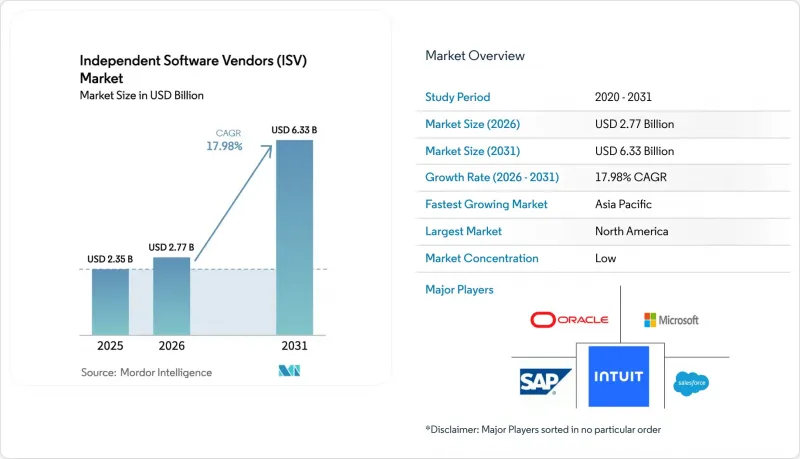
This report is Segmented by Deployment (On-Premise and Cloud), End-User Enterprise Size (Large Enterprises and Small and Medium Enterprises (SMEs)), End-User Industry (IT and Telecommunication, BFSI) and by Geography. The Market Forecasts are Provided in Terms of Value (USD).
Global Independent Software Vendors (ISV) Market Trends and Insights
Cloud/SaaS as Default Enterprise Architecture
Software-as-a-Service formats have become the standard architecture for new enterprise applications, materially changing contract structures and revenue timing for ISVs. Microsoft's cloud revenue grew to USD 137.4 billion in fiscal 2024, a 23% year-over-year increase, illustrating the scale advantages of cloud-first distribution. Subscription pricing improves customer predictability, and automated updates reduce administrative overhead. Public-sector procurement policies reinforce the shift, with the United Kingdom's G-Cloud programme recording average savings of 50% against traditional sourcing mechanisms. Together these factors are raising adoption velocity and underpinning growth in the Independent Software Vendors market.
Industry-specific "Vertical SaaS" Demand Surge
Enterprises are choosing applications engineered for their regulatory frameworks and workflow nuances. eClinicalWorks surpassed USD 1.1 billion revenue in 2024 on the strength of healthcare-focused EHR suites, while ServiceTitan reached USD 840 million annual recurring revenue in field-service management. Deep domain knowledge embeds natural switching costs, letting providers sustain higher average selling prices and stronger renewal metrics. Asia-Pacific is emerging as a pivotal theatre because regulatory and language complexity increases the value of tailored solutions, making vertical SaaS a durable growth vector for the Independent Software Vendors market.
Legacy-system Integration Debt
Enterprises shoulder average maintenance expenses of USD 40,000 per legacy instance and lose 17 hours weekly in IT productivity, according to ServiceNow's 2024 workflow modernisation study. Manufacturing alone sits on USD 2.65 trillion of depreciating technology that still houses mission-critical processes, complicating decommissioning. Integration failures often stem from incompatible data formats, extending project timelines and swelling total implementation cost for ISVs, thereby tempering growth in the Independent Software Vendors market.
Other drivers and restraints analyzed in the detailed report include:
- Hyperscaler Marketplace Co-sell and Credits Programs
- Rapid Gen-AI Toolkits Lowering Product-Launch Cost
- Escalating Cloud Egress and Marketplace Fees
For complete list of drivers and restraints, kindly check the Table Of Contents.
Segment Analysis
Cloud implementations accounted for 68.12% of Independent Software Vendors market share in 2025 and are projected to expand at 14.25% CAGR to 2031. For customers, subscription pricing converts capital outlays to predictable operating spend, while automatic updates harden security posture. Hybrid models persist where data-sovereignty mandates restrict full cloud adoption, but the direction of travel remains unidirectional toward SaaS. SAP reflects this transition: its cloud revenue climbed to EUR 17.14 billion in 2024, a 26% increase, with cloud-ERP growth at 33%.
Cost savings only partially explain uptake; feature velocity is more decisive. Continuous integration pipelines let ISVs release enhancements weekly, giving clients access to emerging AI, analytics and security features without disruptive version upgrades. This cadence improves retention because switching to another platform means forfeiting a rapid innovation stream. As more regulated industries certify SaaS environments, resistance to cloud wanes, reinforcing expansion of the Independent Software Vendors market.
Complete Report Scope:
- By Deployment
- Cloud
- On-premise
- By End-user Enterprise Size
- Large Enterprises
- Small and Medium Enterprises
- By End-Use Industry
- IT and Telecommunication
- BFSI
- Healthcare and Life Sciences
- Retail and E-Commerce
- Manufacturing
- Government and Public Sector
- Education
- By Geography
- North America
- United States
- Canada
- Mexico
- South America
- Brazil
- Rest of South America
- Europe
- Germany
- United Kingdom
- France
- Russia
- Rest of Europe
- Asia-Pacific
- China
- Japan
- India
- South Korea
- Australia and New Zealand
- Rest of Asia-Pacific
- Middle East and Africa
- Middle East
- United Arab Emirates
- Saudi Arabia
- Turkey
- Rest of Middle East
- Africa
- Middle East
- South Africa
- Nigeria
- Rest of Africa
- Middle East
- North America
Geography Analysis
North America retained 42.21% of global revenue in 2025, anchored by mature enterprise cloud budgets and proximity to major hyperscaler headquarters. Federal cloud outlays climbed by USD 6.2 billion in fiscal 2023 to reach USD 20 billion, a clear signal that public-sector demand remains on the upswing. Ongoing investments in AI-ready infrastructure and cybersecurity frameworks sustain a fertile environment for ISV uptake. Competitive dynamics also spur refresh cycles as companies reposition around generative AI differentiation, expanding the installed base for developer tooling and middleware.
Asia-Pacific is the fastest-growing theatre, registering a 15.62% CAGR to 2031. India's SaaS sector is expanding 30% annually and could command 8% of worldwide share by 2028, equivalent to USD 37 billion revenue. Success of digital-public infrastructure, notably UPI's 83 billion annual payment transactions, illustrates how government-backed API ecosystems accelerate private-sector software adoption. Markets such as Indonesia and Vietnam mirror this pattern by investing in national digital-ID and payments rails, lowering onboarding friction for vertical SaaS vendors.
Europe follows with steady replacement of on-premise ERP and CRM estates in favour of SaaS deployments. GDPR compliance costs have prompted companies to adopt solutions that embed privacy-by-design features, indirectly benefiting the Independent Software Vendors market. Latin America and the Middle East and Africa show nascent but accelerating uptake as broadband penetration expands and governments publish cloud-first procurement policies. Currency volatility and skills shortages remain hurdles, yet rising smartphone adoption and fintech innovation create ample whitespace for ISVs offering modular, mobile-first solutions.
- Microsoft
- Oracle
- Salesforce
- SAP
- Intuit
- BMC Software
- Dynatrace
- Systemware
- Beta Systems Software
- Informatica
- Veeva Systems
- Commvault
- VMware
- SAS Institute
- Atlassian
- Adobe
- ServiceNow
- Snowflake
- Databricks
- HubSpot
Additional Benefits:
- The market estimate (ME) sheet in Excel format
- 3 months of analyst support
TABLE OF CONTENTS
1 INTRODUCTION
- 1.1 Study Assumptions and Market Definition
- 1.2 Scope of the Study
2 RESEARCH METHODOLOGY
3 EXECUTIVE SUMMARY
4 MARKET LANDSCAPE
- 4.1 Market Overview
- 4.2 Market Drivers
- 4.2.1 Cloud/SaaS as Default Enterprise Architecture
- 4.2.2 Industry-specific "Vertical SaaS" demand surge
- 4.2.3 Hyperscaler marketplace co-sell and credits programs
- 4.2.4 Rapid Gen-AI toolkits lowering product-launch cost
- 4.2.5 Low-code / no-code platforms expanding ISV reach
- 4.2.6 Emerging-market digital-public-goods (DPG) APIs
- 4.3 Market Restraints
- 4.3.1 Legacy-system integration debt
- 4.3.2 Escalating cloud egress and marketplace fees
- 4.3.3 Heightened industry-specific compliance hurdles
- 4.3.4 IP differentiation squeeze in crowded SaaS niches
- 4.4 Value Chain Analysis
- 4.5 Pricing and Cost Analysis
- 4.6 Regulatory Landscape
- 4.7 Technological Outlook
- 4.8 Porter's Five Forces
- 4.8.1 Bargaining Power of Suppliers
- 4.8.2 Bargaining Power of Buyers
- 4.8.3 Threat of New Entrants
- 4.8.4 Threat of Substitutes
- 4.8.5 Intensity of Competitive Rivalry
5 MARKET SIZE and GROWTH FORECASTS (VALUE)
- 5.1 By Deployment
- 5.1.1 Cloud
- 5.1.2 On-premise
- 5.2 By End-user Enterprise Size
- 5.2.1 Large Enterprises
- 5.2.2 Small and Medium Enterprises
- 5.3 By End-Use Industry
- 5.3.1 IT and Telecommunication
- 5.3.2 BFSI
- 5.3.3 Healthcare and Life Sciences
- 5.3.4 Retail and E-Commerce
- 5.3.5 Manufacturing
- 5.3.6 Government and Public Sector
- 5.3.7 Education
- 5.4 By Geography
- 5.4.1 North America
- 5.4.1.1 United States
- 5.4.1.2 Canada
- 5.4.1.3 Mexico
- 5.4.2 South America
- 5.4.2.1 Brazil
- 5.4.2.2 Rest of South America
- 5.4.3 Europe
- 5.4.3.1 Germany
- 5.4.3.2 United Kingdom
- 5.4.3.3 France
- 5.4.3.4 Russia
- 5.4.3.5 Rest of Europe
- 5.4.4 Asia-Pacific
- 5.4.4.1 China
- 5.4.4.2 Japan
- 5.4.4.3 India
- 5.4.4.4 South Korea
- 5.4.4.5 Australia and New Zealand
- 5.4.4.6 Rest of Asia-Pacific
- 5.4.5 Middle East and Africa
- 5.4.5.1 Middle East
- 5.4.5.1.1 United Arab Emirates
- 5.4.5.1.2 Saudi Arabia
- 5.4.5.1.3 Turkey
- 5.4.5.1.4 Rest of Middle East
- 5.4.5.2 Africa
- 5.4.5.3 Middle East
- 5.4.5.3.1 South Africa
- 5.4.5.3.2 Nigeria
- 5.4.5.3.3 Rest of Africa
- 5.4.5.1 Middle East
- 5.4.1 North America
6 COMPETITIVE LANDSCAPE
- 6.1 Market Concentration
- 6.2 Strategic Moves
- 6.3 Market Share Analysis
- 6.4 Company Profiles (includes Global level Overview, Market level overview, Core Segments, Financials as available, Strategic Information, Market Rank/Share for key companies, Products and Services, and Recent Developments)
- 6.4.1 Microsoft
- 6.4.2 Oracle
- 6.4.3 Salesforce
- 6.4.4 SAP
- 6.4.5 Intuit
- 6.4.6 BMC Software
- 6.4.7 Dynatrace
- 6.4.8 Systemware
- 6.4.9 Beta Systems Software
- 6.4.10 Informatica
- 6.4.11 Veeva Systems
- 6.4.12 Commvault
- 6.4.13 VMware
- 6.4.14 SAS Institute
- 6.4.15 Atlassian
- 6.4.16 Adobe
- 6.4.17 ServiceNow
- 6.4.18 Snowflake
- 6.4.19 Databricks
- 6.4.20 HubSpot
7 MARKET OPPORTUNITIES and FUTURE OUTLOOK
- 7.1 White-space and Unmet-Need Assessment

