PUBLISHER: Mordor Intelligence | PRODUCT CODE: 2100267

PUBLISHER: Mordor Intelligence | PRODUCT CODE: 2100267
Healthcare Analytical Testing Services - Market Share Analysis, Industry Trends & Statistics, Growth Forecasts (2026 - 2031)
According to Mordor Intelligence, the healthcare analytical testing services market size was valued at USD 12.85 billion in 2025 and estimated to grow from USD 14.2 billion in 2026 to reach USD 23.41 billion by 2031, at a CAGR of 10.52% during the forecast period (2026-2031).
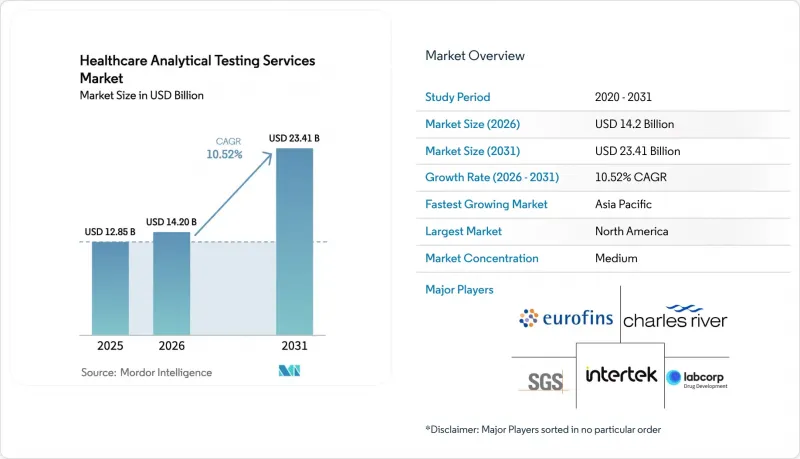
This report is Segmented by Service Type (Bioanalytical Testing, Stability Testing, and More), Molecule (Small-Molecul, and More), Development Phase (Pre-Clinical, Phase I-III, and More), End User (Pharmaceutical Companies, Biopharmaceutical Companies, and More), and Geography (North America, Europe, Asia Pacific, and More). The Market Sizes and Forecasts are Provided in Terms of Value (USD).
Global Healthcare Analytical Testing Services Market Trends and Insights
Outsourcing Surge for Complex Biologics & Biosimilars
Biologics and biosimilars now dominate late-stage pipelines, yet their multidimensional characterization needs, such as protein folding, aggregation, glycosylation, and potency, outstrip in-house capabilities for many sponsors. WuXi Biologics recorded RMB 18.675 billion revenue in 2024, supported by 151 new integrated projects that leaned on external analytics to handle 40-60 comparability batches per product, well beyond historical norms. Contract labs offering state-of-the-art LC-MS and orthogonal bioassays, therefore secure recurring fee streams across the product lifecycle.
Adoption of Quality-By-Design in Drug Development
ICH Q8-Q12 guidelines elevate analytical procedure development from routine compliance to a strategic lever. Sponsors increasingly insist on design-space establishment, critical quality attribute mapping, and statistical DoE during method validation. Laboratories that can provide software-driven QbD packages win earlier engagement and stickier contracts, reducing client attrition rates.
Complex Global Data-Integrity Regulations
The ALCOA+ principles championed by the FDA and echoed by the MHRA oblige laboratories to deploy audit-ready electronic systems, redundant backups, and full audit trails. Smaller firms struggle with capital outlays for 21 CFR Part 11-compliant LIMS and frequent re-validation exercises, narrowing their bid competitiveness.
Other drivers and restraints analyzed in the detailed report include:
- Personalized-medicine-led Biomarker Demand
- Regulatory Tightening on Extractables & Leachable
- Shortage of Mass-Spectrometry Talent
For complete list of drivers and restraints, kindly check the Table Of Contents.
Segment Analysis
Bioanalytical Testing held 31.75% of the healthcare analytical testing services market share in 2025, driven by indispensable pharmacokinetic and immunogenicity assessments across all trial phases. The healthcare analytical testing services market size attributed to Bioanalytical Testing is projected to rise at 8.42% CAGR to 2031 as monoclonal antibodies and antibody-drug conjugates proliferate. Routine ligand-binding assays, hybrid LC-MS workflows, and immunogenicity panels, therefore, remain core revenue pillars. Complementing this base, Cell & Gene-Therapy Viral Vector Testing will expand at 14.86% CAGR, outpacing every peer segment through specialized replication-competent virus assays and next-generation sequencing-based genome integrity checks. Method development & validation services gain uplift from QbD adoption, while extractables & leachables testing sees double-digit growth as single-use manufacturing expands.
Charles River Laboratories leverages four decades of bioanalytical experience and a global network of GLP facilities to service early- and late-phase programs. Meanwhile, bioMerieux's 3P ENTERPRISE platform automates environmental monitoring, reflecting wider digitalization inside microbiology labs. Rapid sterility methods from Nelson Labs cut incubation windows down to six days, freeing cold-chain inventory space and accelerating lot release.
Complete Report Scope:
- By Service Type
- Bioanalytical Testing
- Stability Testing
- Batch-Release Testing
- Raw Material & Physical Characterization
- Method Development & Validation
- Microbial & Environmental Monitoring
- Extractables & Leachables
- Biosafety & Sterility Testing
- Other Specialized Services
- By Molecule
- Small-Molecule Drugs
- Large-Molecule Biologics
- Cell & Gene Therapies
- Combination & Medical Device Products
- Nutraceuticals
- By Development Phase
- Pre-Clinical
- Phase I
- Phase II
- Phase III
- Commercial/Marketed
- By End User
- Pharmaceutical Companies
- Biopharmaceutical Companies
- Medical Device Companies
- CDMOs/CROs
- Hospitals & Clinics
- Academic/Research Institutes
- Others
- Geography
- North America
- United States
- Canada
- Mexico
- Europe
- Germany
- United Kingdom
- France
- Italy
- Spain
- Rest of Europe
- Asia Pacific
- China
- Japan
- India
- South Korea
- Australia
- Rest of Asia Pacific
- Middle East & Africa
- GCC
- South Africa
- Rest of Middle East & Africa
- South America
- Brazil
- Argentina
- Rest of South America
- North America
Geography Analysis
North America controlled 41.20% of the healthcare analytical testing services market share in 2025, sustained by the FDA's globally influential rulemaking, dense pharmaceutical headquarters, and a deep bench of GLP-compliant laboratories. The region also attracts heavy capital investment: Thermo Fisher inaugurated a 29,000 sq ft bioanalytical hub in Gothenburg while maintaining Boston as its command centre, signaling a trans-Atlantic footprint that prioritises proximity to sponsors.
Europe sustains robust growth due to strict GMP Annex 1 revisions that push sterility and environmental monitoring volumes. Eurofins Scientific runs 900 laboratories across 62 countries and posted EUR 6.515 billion revenue in 2023, reflecting continental breadth. SGS strengthened its biologics testing facility in Lincolnshire, supplying a one-stop microbiology and chemistry offer that resonates with European biosimilar developers.
Asia Pacific is the fastest climber, advancing at 11.12% CAGR as China, India, and South Korea absorb global manufacturing mandates. WuXi AppTec's divestiture of its Advanced Therapies unit to Altaris highlights fluid strategic positioning around high-value analytics. Government incentives, from Singapore's biomedical schemes to South Korea's gene-therapy grants, attract new GLP labs that align with PIC/S GMP, propelling cross-border data acceptance. Domestic regulatory agencies are aligning with ICH and ISO standards, streamlining dossier acceptance across regions, and lowering re-testing duplication.
- Eurofins
- LabCorp
- SGS
- Intertek Group
- Charles River
- Thermo Fisher Scientific
- Parexel International
- Pace Analytical Services
- Frontage Laboratories Inc.
- WuXi App Tec
- ICON
- MedPace
- Microbac Laboratories Inc.
- Smithers
- ALS Limited
- Element Materials Technology
- BioReliance (Merck KGaA)
- Synlab AG
- Inotiv (Envigo)
- Lab Testing Inc.
Additional Benefits:
- The market estimate (ME) sheet in Excel format
- 3 months of analyst support
TABLE OF CONTENTS
1 Introduction
- 1.1 Study Assumptions & Market Definition
- 1.2 Scope of the Study
2 Research Methodology
3 Executive Summary
4 Market Landscape
- 4.1 Market Overview
- 4.2 Market Drivers
- 4.2.1 Outsourcing Surge For Complex Biologics & Biosimilars
- 4.2.2 Adoption Of Quality-By-Design In Drug Development
- 4.2.3 Personalized/Precision-Medicine Led Biomarker Demand
- 4.2.4 Regulatory Tightening On Extractables & Leachables
- 4.2.5 Cell- & Gene-Therapy Viral-Vector Testing Boom
- 4.2.6 AI-Enabled High-Throughput Method Development
- 4.3 Market Restraints
- 4.3.1 Complex Global Data-Integrity Regulations
- 4.3.2 Shortage Of Mass-Spectrometry Talent
- 4.3.3 High Capex For Next-Gen Analytical Platforms
- 4.3.4 Intensifying IP-Ownership Disputes In Outsourced Studies
- 4.4 Regulatory Landscape
- 4.5 Technological Outlook
- 4.6 Porter's Five Forces Analysis
- 4.6.1 Threat of New Entrants
- 4.6.2 Bargaining Power of Buyers
- 4.6.3 Bargaining Power of Suppliers
- 4.6.4 Threat of Substitutes
- 4.6.5 Competitive Rivalry
5 Market Size & Growth Forecasts (Value, USD)
- 5.1 By Service Type
- 5.1.1 Bioanalytical Testing
- 5.1.2 Stability Testing
- 5.1.3 Batch-Release Testing
- 5.1.4 Raw Material & Physical Characterization
- 5.1.5 Method Development & Validation
- 5.1.6 Microbial & Environmental Monitoring
- 5.1.7 Extractables & Leachables
- 5.1.8 Biosafety & Sterility Testing
- 5.1.9 Other Specialized Services
- 5.2 By Molecule
- 5.2.1 Small-Molecule Drugs
- 5.2.2 Large-Molecule Biologics
- 5.2.3 Cell & Gene Therapies
- 5.2.4 Combination & Medical Device Products
- 5.2.5 Nutraceuticals
- 5.3 By Development Phase
- 5.3.1 Pre-Clinical
- 5.3.2 Phase I
- 5.3.3 Phase II
- 5.3.4 Phase III
- 5.3.5 Commercial/Marketed
- 5.4 By End User
- 5.4.1 Pharmaceutical Companies
- 5.4.2 Biopharmaceutical Companies
- 5.4.3 Medical Device Companies
- 5.4.4 CDMOs/CROs
- 5.4.5 Hospitals & Clinics
- 5.4.6 Academic/Research Institutes
- 5.4.7 Others
- 5.5 Geography
- 5.5.1 North America
- 5.5.1.1 United States
- 5.5.1.2 Canada
- 5.5.1.3 Mexico
- 5.5.2 Europe
- 5.5.2.1 Germany
- 5.5.2.2 United Kingdom
- 5.5.2.3 France
- 5.5.2.4 Italy
- 5.5.2.5 Spain
- 5.5.2.6 Rest of Europe
- 5.5.3 Asia Pacific
- 5.5.3.1 China
- 5.5.3.2 Japan
- 5.5.3.3 India
- 5.5.3.4 South Korea
- 5.5.3.5 Australia
- 5.5.3.6 Rest of Asia Pacific
- 5.5.4 Middle East & Africa
- 5.5.4.1 GCC
- 5.5.4.2 South Africa
- 5.5.4.3 Rest of Middle East & Africa
- 5.5.5 South America
- 5.5.5.1 Brazil
- 5.5.5.2 Argentina
- 5.5.5.3 Rest of South America
- 5.5.1 North America
6 Competitive Landscape
- 6.1 Market Concentration
- 6.2 Market Share Analysis
- 6.3 Company Profiles (includes Global Overview, Market Overview, Core Segments, Financials, Strategic Information, Market Rank/Share, Services, Recent Developments)
- 6.3.1 Eurofins Scientific
- 6.3.2 Labcorp Drug Development
- 6.3.3 SGS SA
- 6.3.4 Intertek Group plc
- 6.3.5 Charles River Laboratories
- 6.3.6 Thermo Fisher Scientific
- 6.3.7 Parexel International
- 6.3.8 Pace Analytical Services LLC
- 6.3.9 Frontage Laboratories Inc.
- 6.3.10 Wuxi AppTec
- 6.3.11 ICON plc
- 6.3.12 Medpace Holdings Inc.
- 6.3.13 Microbac Laboratories Inc.
- 6.3.14 Smithers
- 6.3.15 ALS Limited
- 6.3.16 Element Materials Technology
- 6.3.17 BioReliance (Merck KGaA)
- 6.3.18 Synlab AG
- 6.3.19 Inotiv (Envigo)
- 6.3.20 Lab Testing Inc.
7 Market Opportunities & Future Outlook
- 7.1 White-Space & Unmet Needs Assessment

