PUBLISHER: Mordor Intelligence | PRODUCT CODE: 2100272

PUBLISHER: Mordor Intelligence | PRODUCT CODE: 2100272
Europe Recreational Boating - Market Share Analysis, Industry Trends & Statistics, Growth Forecasts (2026 - 2031)
According to Mordor Intelligence, the Europe recreational boating market size was valued at USD 16.78 billion in 2025 and estimated to grow from USD 17.89 billion in 2026 to reach USD 24.67 billion by 2031, at a CAGR of 6.64% during the forecast period (2026-2031).
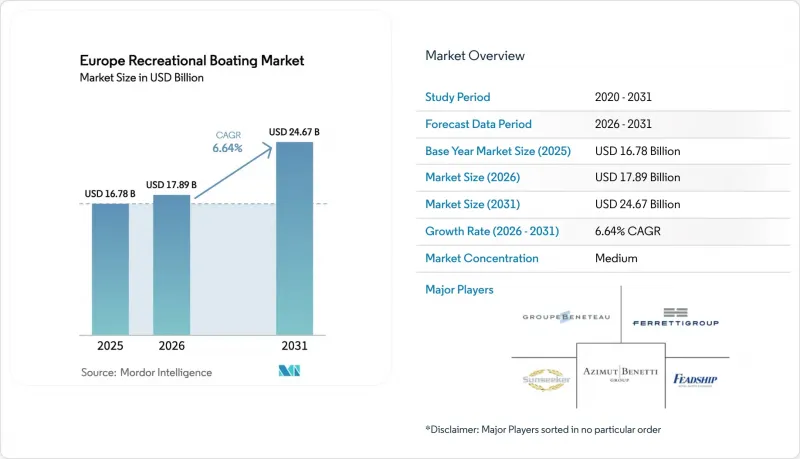
This report is Segmented by Boat Type (Inboard Boats, Outboard Boats, and More), Length (Less Than 30 Feet and More), Propulsion System (Internal Combustion Engine and More), Application (Watersports and Racing and More), Distribution Channel (Direct OEM Sales and More), and Country (Germany, United Kingdom, France, Italy, and More). The Market Forecasts are Provided in Terms of Value (USD).
Europe Recreational Boating Market Trends and Insights
Rising Participation in Adventure Tourism & Water Sports Across Central & Northern Europe
European water-sports tourism is set to grow at a robust CAGR, steering new demand toward group-friendly boats in the 30-60 feet class. Nordic GDP recovery, led by Sweden's expected rebound to growth in 2026, boosts discretionary spending, while EU-backed inland-waterway investments widen boating access beyond coastal hotspots. The Europe recreational boating market is therefore capturing a new cohort of consumers who favor active itineraries over traditional beach vacations. Operators catering to adventure tourism are increasing fleet renewals, further stimulating sales of mid-size cruisers and performance-oriented water-sports craft.
Surge in Charter-Based Fractional Ownership Models Driving First-Time Boaters
GetMyBoat processed USD 75 million in bookings across 150,000 listings, illustrating how peer-to-peer access reduces entry barriers for novice boaters. Groupe Beneteau's Wiziboat rollout and its Your Boat Club acquisition validate OEM appetite for recurring-revenue models. Marina fees between EUR 1,990 and EUR 9,879 per year for 10-12 meter boats reinforce the economic logic of sharing, while rental channel growth at 7.11% CAGR underscores a structural shift toward access over ownership. These dynamics augment utilization rates of idle private vessels, directly enlarging the addressable Europe recreational boating market.
Stringent Stage V Emission & Noise Regulations Inflating Compliance Costs
FuelEU Maritime Regulation mandates a 2% greenhouse-gas intensity cut in 2025, rising to 80% by 2050, forcing rapid drivetrain innovation at significant cost. Inclusion of shipping in the EU Emissions Trading System shifts allowance expenses onto charterers through BIMCO clauses, tightening margins for fleet operators. Smaller yards struggle to finance R&D, sparking accelerated consolidation inside the Europe recreational boating market.
Other drivers and restraints analyzed in the detailed report include:
- Expanding Network of Inland Waterways & EU-Funded Marina Upgrades
- OEM Push Toward Low-Noise Electric Outboards Aligning with Scandinavian Zero-Emission Lakes
- Escalating Insurance Premiums After Climate-Driven Loss Events
For complete list of drivers and restraints, kindly check the Table Of Contents.
Segment Analysis
Current demand skews toward versatile outboards that captured 45.74% revenue in 2025, yet inboard craft are rising fastest at a 6.75% CAGR as affluent buyers pursue performance, space, and integrated luxury features. This shift enlarges the Europe recreational boating market because premium price points lift overall industry value. In 2025, the inboard portion of the Europe recreational boating market size is forecasted to grow exponentially, with Italian builders such as Ferretti and Sanlorenzo introducing hybrid propulsion to entice eco-conscious yacht enthusiasts. Compact personal watercraft retain a niche in Nordic summer cottages, while RIBs supply entry-level charter fleets that funnel new users into ownership pathways.
OEMs are bundling digital navigation, advanced stabilization, and AI-enabled safety into inboard models, increasing appeal among tech-savvy migrants to Mediterranean innovation hubs. Strong charter yields also convince investors to allocate capital toward larger craft, further buoying the Europe recreational boating market. Manufacturers that scale hybrid powertrains across mid-size ranges are likely to win share as regulatory pressure intensifies.
The 30-60 feet class maintains 45.88% dominance because it balances comfort with marina versatility throughout Europe's varied coastline. However, sub-30 feet boats will outpace all other lengths at a 6.69% CAGR. High ownership costs motivate urban dwellers to rent smaller craft for weekend trips, boosting turnover at sharing platforms. EU-funded inland-waterway upgrades further stimulate purchases of trailerable models, bolstering the lower-end of the pricing spectrum.
Mid-size craft still capture discretionary upgrades as family cruisers, particularly in France and Spain where multi-day coastal itineraries prevail. Electric conversion economics favor sub-30 feet units because lighter displacement extends battery range, attracting funding from various sources. Conversely, super-yachts over 60 feet remain a luxury niche, adding value rather than volume to the Europe recreational boating market.
Complete Report Scope:
- By Boat Type
- Inboard Boats
- Outboard Boats
- Personal Watercraft
- Sailboats
- Inflatable & RIBs
- Other Boat Types
- By Length
- Less than 30 Feet
- 30-60 Feet
- More than 60 Feet
- By Propulsion System
- Internal Combustion Engine
- Hybrid
- Electric
- Hydrogen & Alt-Fuels
- By Application
- Watersports & Racing
- Fishing & Angling
- Cruising & Day-Sailing
- Charter & Rental
- By Distribution Channel
- Direct OEM Sales
- Dealers & Brokers
- Rental & Subscription Services
- By Country
- Germany
- United Kingdom
- France
- Italy
- Spain
- Denmark
- Netherlands
- Greece
- Norway
- Sweden
- Finland
- Poland
- Croatia
- Russia
- Rest of Europe
List of Companies Covered in this Report:
- Groupe Beneteau
- Azimut-Benetti Group
- Ferretti Group
- Sunseeker International Ltd.
- Brunswick Corp
- Bombardier Recreational Products (Sea-Doo)
- Bavaria Yachtbau
- Dufour Yachts
- Feadship
- Princess Yachts
- HanseYachts AG
- Nimbus Group AB
- Axopar Boats Oy
- Saxdor Yachts Oy
- Windy Scandinavia AB
- X-Yachts
- Sanlorenzo S.p.A.
- Rand Boats
- Candela Speed Boats AB
- Greenline Yachts
- Frauscher Bootswerft
- Capelli Boats
- ZAR Formenti
Additional Benefits:
- The market estimate (ME) sheet in Excel format
- 3 months of analyst support
TABLE OF CONTENTS
1 Introduction
- 1.1 Study Assumptions & Market Definition
- 1.2 Scope of the Study
2 Research Methodology
3 Executive Summary
4 Market Landscape
- 4.1 Market Overview
- 4.2 Market Drivers
- 4.2.1 Rising participation in adventure tourism & water sports across Central & Northern Europe
- 4.2.2 Surge in charter-based fractional ownership models driving first-time boaters
- 4.2.3 Expanding network of inland waterways & EU-funded marina upgrades
- 4.2.4 OEM push toward low-noise electric outboards aligning with Scandinavian zero-emission lakes
- 4.2.5 Digital boat-sharing platforms unlocking utilisation of idle private vessels
- 4.2.6 High-net-worth migration to Mediterranean tech hubs boosting demand for luxury day-cruisers
- 4.3 Market Restraints
- 4.3.1 Stringent Stage V emission & noise regulations inflating compliance costs
- 4.3.2 Escalating insurance premiums after climate-driven loss events
- 4.3.3 Skilled-labour shortages in Italian & Polish shipyards lengthening lead-times
- 4.3.4 Berth scarcity & soaring mooring fees in Mediterranean marinas
- 4.4 Value/Supply-Chain Analysis
- 4.5 Regulatory Landscape
- 4.6 Technological Outlook
- 4.7 Porter's Five Forces
- 4.7.1 Bargaining Power of Buyers/Consumers
- 4.7.2 Bargaining Power of Suppliers
- 4.7.3 Threat of New Entrants
- 4.7.4 Threat of Substitute Products
- 4.7.5 Intensity of Competitive Rivalry
5 Market Size & Growth Forecasts (Value (USD))
- 5.1 By Boat Type
- 5.1.1 Inboard Boats
- 5.1.2 Outboard Boats
- 5.1.3 Personal Watercraft
- 5.1.4 Sailboats
- 5.1.5 Inflatable & RIBs
- 5.1.6 Other Boat Types
- 5.2 By Length
- 5.2.1 Less than 30 Feet
- 5.2.2 30-60 Feet
- 5.2.3 More than 60 Feet
- 5.3 By Propulsion System
- 5.3.1 Internal Combustion Engine
- 5.3.2 Hybrid
- 5.3.3 Electric
- 5.3.4 Hydrogen & Alt-Fuels
- 5.4 By Application
- 5.4.1 Watersports & Racing
- 5.4.2 Fishing & Angling
- 5.4.3 Cruising & Day-Sailing
- 5.4.4 Charter & Rental
- 5.5 By Distribution Channel
- 5.5.1 Direct OEM Sales
- 5.5.2 Dealers & Brokers
- 5.5.3 Rental & Subscription Services
- 5.6 By Country
- 5.6.1 Germany
- 5.6.2 United Kingdom
- 5.6.3 France
- 5.6.4 Italy
- 5.6.5 Spain
- 5.6.6 Denmark
- 5.6.7 Netherlands
- 5.6.8 Greece
- 5.6.9 Norway
- 5.6.10 Sweden
- 5.6.11 Finland
- 5.6.12 Poland
- 5.6.13 Croatia
- 5.6.14 Russia
- 5.6.15 Rest of Europe
6 Competitive Landscape
- 6.1 Market Concentration
- 6.2 Strategic Moves
- 6.3 Market Share Analysis
- 6.4 Company Profiles (Includes Global Level Overview, Market Level Overview, Core Segments, Financials as Available, Strategic Information, Market Rank/Share for Key Companies, Products and Services, SWOT Analysis, and Recent Developments)
- 6.4.1 Groupe Beneteau
- 6.4.2 Azimut-Benetti Group
- 6.4.3 Ferretti Group
- 6.4.4 Sunseeker International Ltd.
- 6.4.5 Brunswick Corp
- 6.4.6 Bombardier Recreational Products (Sea-Doo)
- 6.4.7 Bavaria Yachtbau
- 6.4.8 Dufour Yachts
- 6.4.9 Feadship
- 6.4.10 Princess Yachts
- 6.4.11 HanseYachts AG
- 6.4.12 Nimbus Group AB
- 6.4.13 Axopar Boats Oy
- 6.4.14 Saxdor Yachts Oy
- 6.4.15 Windy Scandinavia AB
- 6.4.16 X-Yachts
- 6.4.17 Sanlorenzo S.p.A.
- 6.4.18 Rand Boats
- 6.4.19 Candela Speed Boats AB
- 6.4.20 Greenline Yachts
- 6.4.21 Frauscher Bootswerft
- 6.4.22 Capelli Boats
- 6.4.23 ZAR Formenti
7 Market Opportunities & Future Outlook
- 7.1 White-space & Unmet-need Assessment

