PUBLISHER: Mordor Intelligence | PRODUCT CODE: 2100496

PUBLISHER: Mordor Intelligence | PRODUCT CODE: 2100496
United States E-cigarettes - Market Share Analysis, Industry Trends & Statistics, Growth Forecasts (2026 - 2031)
According to Mordor Intelligence, the United States e-cigarette market was valued at USD 4.67 billion in 2025 and estimated to grow from USD 4.74 billion in 2026 to reach USD 5.13 billion by 2031, registering a CAGR of 1.59% during the forecast period (2026-2031).
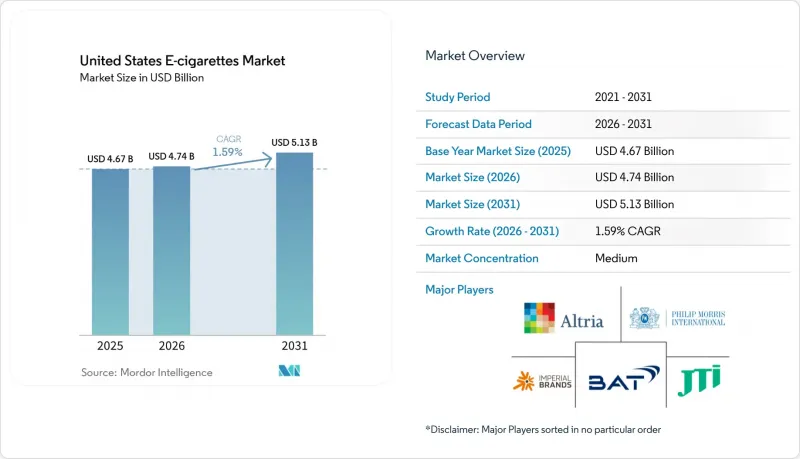
This report is Segmented by Product Type (E-Cigarette Device, E-Liquid), Category (Open Vaping System, Closed Vaping System), End User (Men, Women), and Distribution Channel (Offline Stores, Online Stores). The Market Forecasts are Provided in Terms of Value (USD).
United States E-cigarettes Market Trends and Insights
Rising health awareness and demand for smoking alternatives
Cigarette smoking among adults in the United States was 9.9% in 2024, as public health campaigns and clinical evidence highlighted e-cigarettes as a transitional tool. A 2022 Cochrane systematic review concluded with moderate certainty that nicotine e-cigarettes improve quit rates compared to nicotine replacement therapy, supporting harm-reduction claims. The FDA's authorization of JUUL's tobacco and menthol products in July 2025 validated the premarket tobacco application pathway, indicating that manufacturers with comprehensive toxicology data can achieve market access. Dual users, individuals who use both vaping products and combustible cigarettes, present a potential market opportunity.
Continuous innovation in vaping device technology
Disposable e-cigarettes now offer over 5,000 puffs per unit, an increase from 2,000 puffs in 2022. This development extends replacement cycles and improves cost-per-use efficiency. Mesh coil atomizers, which have replaced traditional wire coils in premium devices, increase the surface area by 40%, resulting in denser vapor production and minimizing dry hits. USB-C charging ports became standard in rechargeable models, aligning with trends in consumer electronics and enabling faster charging. Nicotine salt formulations, with a pH buffer of 5.0-5.5, allow nicotine concentrations of up to 50 milligrams per milliliter without causing throat irritation. This advancement has significantly narrowed the satisfaction gap between e-cigarettes and combustible cigarettes. Moreover, ongoing product innovation focused on safety, efficiency, and user convenience is a key driver of the United States e-cigarettes market. For instance, in March 2024, British American Tobacco filed a patent for a rechargeable e-cigarette featuring a unique recharging mechanism. The device includes a battery, an external connector for recharging, and a mechanism designed to prevent overcharging, aiming to enhance both safety and efficiency in e-cigarette usage.
Strict FDA regulations and complex PMTA approval process
The U.S. Food and Drug Administration (FDA) has rejected the majority of premarket tobacco applications in recent years, approving only a limited number of products. This high rejection rate has led to the exit of many smaller manufacturers from the market. The application process is notably expensive, requiring comprehensive toxicology testing, behavioral studies, and detailed manufacturing protocols. These requirements create significant entry barriers, favoring larger, well-funded companies. Among the few approvals granted was JUUL, which had to provide extensive scientific data and agree to ongoing post-market monitoring, including regular audits to assess youth usage. Additionally, the FDA has proposed a rule to significantly reduce nicotine levels in combustible cigarettes. While this measure aims to encourage smokers to transition to alternatives like e-cigarettes, it is expected to face substantial legal opposition from tobacco companies. Compliance with the FDA's manufacturing standards further increases production costs, as companies must implement batch testing and traceability systems, intensifying financial challenges for smaller industry participants.
Other drivers and restraints analyzed in the detailed report include:
- Wide range of flavor offerings boosting consumer appeal
- Growing social acceptance and changing cultural norms
- Presence of illegal and unregulated vaping products
For complete list of drivers and restraints, kindly check the Table Of Contents.
Segment Analysis
E-cigarette devices captured 86.93% of market value in 2025, reflecting the dominance of closed-system pods and disposables that bundle hardware and consumables into a single purchase. The e-liquid segment is expected to expand at 1.98% CAGR through 2031, as refillable systems gain traction among cost-conscious users and enthusiasts seeking flavor customization. Disposable e-cigarettes within the device category now feature over 5,000 puffs per unit, extending replacement cycles and improving economics for heavy users. Non-disposable devices, including rechargeable pods and mod systems, benefit from USB-C charging and mesh coil atomizers that increase vapor density significantly.
Nicotine salt formulations in e-liquids, which buffer pH to 5.0-5.5, enable concentrations up to 50 milligrams per milliliter without throat harshness, a breakthrough that closed the satisfaction gap with combustible cigarettes. The FDA's authorization of JUUL's tobacco and menthol products in July 2025 validated nicotine salt technology, providing a regulatory template for other manufacturers. E-liquid sales are being challenged by flavor restrictions in several major states, but manufacturers have adapted by introducing tobacco-oriented blends that meet regulatory requirements while still offering a nuanced sensory experience. Growth in this segment is also driven by experienced open-system users, who increasingly favor bulk e-liquid purchases over pre-filled pods, allowing them to lower their overall costs.
Closed vaping systems held 82.62% market share in 2025, benefiting from brand loyalty, regulatory clarity, and retail convenience, while open systems will grow at 1.89% CAGR through 2031 as enthusiasts prioritize customization over simplicity. Closed systems, exemplified by JUUL, Vuse, and NJOY, integrate proprietary pods with device firmware, locking users into brand ecosystems and generating recurring consumable revenue. British American Tobacco's Vuse Alto, which received PMTA authorization in 2024, leverages this model by pairing its devices with proprietary pods, generating strong profitability through recurring consumable sales. The FDA's premarket process favors closed systems because manufacturers can demonstrate tighter quality control and age-verification at point-of-sale, reducing youth access risk.
Open vaping systems, which allow users to refill tanks with third-party e-liquids and adjust wattage, appeal to a smaller but more engaged cohort. These devices will capture incremental share as vapers seek to reduce costs and experiment with flavor blends. Innovations in open systems include temperature control chips that prevent dry hits and extend coil life by 50%, according to patents filed by SMOORE in 2024. However, open systems face regulatory scrutiny because users can modify nicotine concentrations and introduce non-compliant liquids, complicating enforcement. State-level flavor bans disproportionately impact open systems, as bulk e-liquid suppliers operate in gray zones where product registration requirements remain unclear.
Complete Report Scope:
- By Product Type
- E-Cigarette Device
- Disposable E-Cigarette
- Non-Disposable E-Cigarette
- E-Liquid
- E-Cigarette Device
- By Category
- Open Vaping Systems
- Closed Vaping Systems
- By End User
- Men
- Women
- By Distribution Channel
- Offline Stores
- Online Stores
List of Companies Covered in this Report:
- Altria Group Inc.
- British American Tobacco plc
- Juul Labs Inc.
- Imperial Brands plc
- Philip Morris International
- Japan Tobacco Inc.
- RELX Technology
- Geek Bar (Shenzhen Geekvape)
- Puff Bar (Cool Clouds)
- Flumgio Technology Inc
- Breeze Smoke LLC
- Kaival Brands (BIDI Stick)
- SMOORE (Vaporesso)
- Aspire (Global CigTech)
- Innokin Technology
- Suorin (Shenzhen Bluemark)
- Smok Tech Co.
- Intelligent Cigarettes LLC
- BOTS Inc.
- Turning Point Brands, Inc.
Additional Benefits:
- The market estimate (ME) sheet in Excel format
- 3 months of analyst support
TABLE OF CONTENTS
1 INTRODUCTION
- 1.1 Study Assumptions and Market Definition
- 1.2 Scope of the Study
2 RESEARCH METHODOLOGY
3 EXECUTIVE SUMMARY
4 MARKET LANDSCAPE
- 4.1 Market Overview
- 4.2 Market Drivers
- 4.2.1 Rising health awareness and demand for smoking alternatives
- 4.2.2 Continuous innovation in vaping device technology
- 4.2.3 Wide range of flavor offerings boosting consumer appeal
- 4.2.4 Growing social acceptance and changing cultural norms
- 4.2.5 Strong influence of social media and influencer promotions
- 4.2.6 Increased customization across nicotine strengths and flavors
- 4.3 Market Restraints
- 4.3.1 Strict FDA regulations and complex PMTA approval process
- 4.3.2 Supply chain disruptions and sourcing risks
- 4.3.3 Presence of illegal and unregulated vaping products
- 4.3.4 Youth vaping concerns leading to tighter restrictions
- 4.4 Consumer Behaviour Analysis
- 4.5 Regulatory Outlook
- 4.6 Porter's Five Forces Analysis
- 4.6.1 Bargaining Power of Suppliers
- 4.6.2 Bargaining Power of Buyers
- 4.6.3 Threat of New Entrants
- 4.6.4 Threat of Substitutes
- 4.6.5 Degree of Competition
5 MARKET SIZE AND GROWTH FORECASTS (VALUE)
- 5.1 By Product Type
- 5.1.1 E-Cigarette Device
- 5.1.1.1 Disposable E-Cigarette
- 5.1.1.2 Non-Disposable E-Cigarette
- 5.1.2 E-Liquid
- 5.1.1 E-Cigarette Device
- 5.2 By Category
- 5.2.1 Open Vaping Systems
- 5.2.2 Closed Vaping Systems
- 5.3 By End User
- 5.3.1 Men
- 5.3.2 Women
- 5.4 By Distribution Channel
- 5.4.1 Offline Stores
- 5.4.2 Online Stores
6 COMPETITIVE LANDSCAPE
- 6.1 Market Concentration
- 6.2 Strategic Moves
- 6.3 Market Share Analysis
- 6.4 Company Profiles (Includes Global-level Overview, Market-level Overview, Core Segments, Financials, Strategic Info, Market Rank/Share, Products and Services, Recent Developments)
- 6.4.1 Altria Group Inc.
- 6.4.2 British American Tobacco plc
- 6.4.3 Juul Labs Inc.
- 6.4.4 Imperial Brands plc
- 6.4.5 Philip Morris International
- 6.4.6 Japan Tobacco Inc.
- 6.4.7 RELX Technology
- 6.4.8 Geek Bar (Shenzhen Geekvape)
- 6.4.9 Puff Bar (Cool Clouds)
- 6.4.10 Flumgio Technology Inc
- 6.4.11 Breeze Smoke LLC
- 6.4.12 Kaival Brands (BIDI Stick)
- 6.4.13 SMOORE (Vaporesso)
- 6.4.14 Aspire (Global CigTech)
- 6.4.15 Innokin Technology
- 6.4.16 Suorin (Shenzhen Bluemark)
- 6.4.17 Smok Tech Co.
- 6.4.18 Intelligent Cigarettes LLC
- 6.4.19 BOTS Inc.
- 6.4.20 Turning Point Brands, Inc.
7 MARKET OPPORTUNITIESAND FUTURE OUTLOOK

