PUBLISHER: Mordor Intelligence | PRODUCT CODE: 2100497

PUBLISHER: Mordor Intelligence | PRODUCT CODE: 2100497
Functional Beverage - Market Share Analysis, Industry Trends & Statistics, Growth Forecasts (2026 - 2031)
According to Mordor Intelligence, the functional beverage market size is expected to grow from USD 151.80 billion in 2025 to USD 163.84 billion in 2026 and is forecast to reach USD 239.95 billion by 2031 at a 7.93% CAGR over 2026-2031.
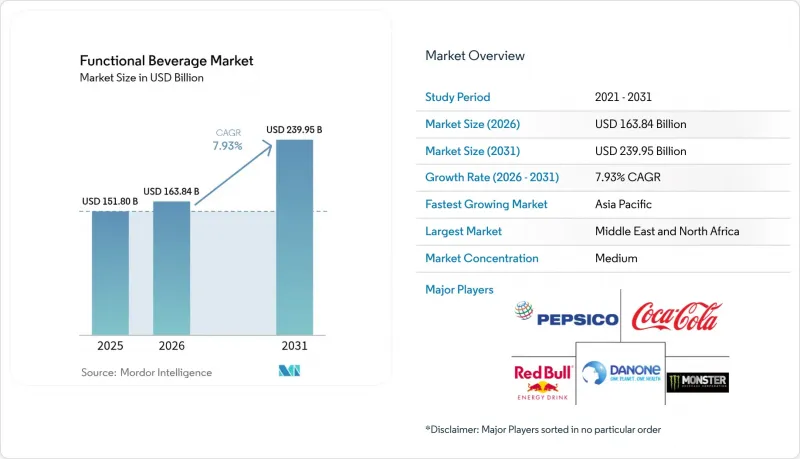
This report is Segmented by Product Type (Energy Drinks, Sports Drinks, Fortified Juice, Dairy and Dairy Alternative Beverages, Functional/Fortified Water, and More), by Packaging Type (PET/Glass Bottles, Cans, Tetra Pak, and More), by Distribution Channel (On-Trade and Off-Trade), and by Geography. The Market Forecasts are Provided in Terms of Value (USD).
Global Functional Beverage Market Trends and Insights
Increasing Consumer Focus on Health and Wellness
As consumers become more health-conscious, their focus has shifted from basic nutrition to specific wellness outcomes. This evolution underscores a growing belief among many that food and beverages can serve medicinal purposes. Today, gut health takes precedence for most, closely followed by an emphasis on mental well-being. This trend, which gained momentum in the wake of the pandemic, sees consumers gravitating towards products that bolster immune function, manage stress, and enhance cognitive performance. Highlighting this shift, Kirin Holdings noted a 40% surge in sales of its LC-Plasma product series from January to June 2024. Notably, their immune care beverages alone saw a staggering 183% year-on-year growth, underscoring the market's appetite for health-centric offerings. This burgeoning demand is birthing new market categories. For instance, while probiotics have long been a staple, postbiotic beverages are now emerging as the next big thing in the functional beverage market. A testament to this trend is Asahi Beverages America's recent launch of 'Refrezz', a beverage specifically targeting sleep and relaxation.
Demand for Clean Label and Natural Ingredients
As consumers increasingly demand transparency and recognizable ingredients in functional beverages, clean label requirements are reshaping formulation strategies. This trend not only focuses on ingredient lists but also delves into sourcing practices, processing methods, and packaging sustainability. Such demands pose intricate challenges for manufacturers navigating their supply chains. Reinforcing this trend, the FDA's updated definition of "Healthy," set to take effect in February 2025, introduces stricter criteria for health claims. These criteria mandate that products adhere to specific nutrient profiles, with limitations on added sugars, saturated fats, and sodium. In response, manufacturers are not only reformulating existing products but also crafting new ones to meet clean label standards. However, this alignment often comes at the cost of increased production expenses and heightened complexity in the functional beverage industry. The challenge amplifies with the inclusion of functional ingredients like adaptogens and nootropics. While consumers gravitate towards these natural alternatives over synthetic compounds, they grapple with taste and stability hurdles. Addressing these challenges necessitates advanced masking and preservation technologies. Furthermore, health-conscious consumption patterns have catalyzed unprecedented innovation in clean-label formulations, with consumers globally actively limiting sugar intake and seeking transparency in ingredient sourcing in the functional beverage market. According to the International Food Information Council, in 2023, approximately 29% of respondents in the United States mentioned that they buy food and beverages on a regular basis because they are labeled as "clean ingredients.
Stringent Regulatory and Labeling Requirements
As health authorities worldwide tighten their grip on functional beverage claims and ingredient safety, the complexity of regulations is escalating. Starting February 2028, the FDA's revamped definition of "Healthy" mandates manufacturers to keep meticulous compliance records and adhere to specific nutrient benchmarks, pressuring them to reformulate significantly. In Europe, regulations are tightening too. In August 2024, the EU denied health claims for isomaltulose, pointing to a lack of scientific backing and the risk of confusing consumers. Meanwhile, Korea's "Food with Functional Claims" system blurs the lines for consumers, distinguishing between health foods that undergo rigorous testing and those with loosely regulated claims. Such regional regulatory disparities not only inflate compliance costs but also erect barriers to market entry. This is especially challenging for smaller manufacturers who often lack the expertise and resources to adeptly navigate the maze of global regulations in the functional beverage market.
Other drivers and restraints analyzed in the detailed report include:
- Growing Awareness of Gut Health and Microbiome
- Innovation in Ingredients and Formulations
- High Production and Ingredient Costs
For complete list of drivers and restraints, kindly check the Table Of Contents.
Segment Analysis
In 2025, energy drinks command a 28.85% market share, but sports drinks are surging ahead with the fastest growth rate, boasting an 8.42% CAGR projected through 2031. This trend underscores a shift in consumer preferences, leaning towards hydration and recovery solutions that emphasize performance. While energy categories hint at market maturation, sports nutrition is broadening its appeal, reaching out to mainstream wellness enthusiasts, not just traditional athletes. Innovations in electrolyte formulations, natural caffeine sources, and recovery-centric ingredients, such as branched-chain amino acids and adaptogens are propelling the popularity of sports drinks. These advancements cater to fitness aficionados who prioritize functional hydration, as highlighted by the International Food Information Council.
As consumers gravitate towards familiar formats infused with functional benefits, fortified juices and dairy alternatives witness steady growth. Meanwhile, functional water emerges as a category, championed by its convenience and clean-label appeal. The "Others" segment, which includes kombucha, kefir, and other specialty functional beverages, is on a rapid ascent. This surge is fueled by manufacturers' willingness to experiment with unique ingredients and innovative delivery methods. The FDA's revamped "Healthy" definition is making waves in product formulations. It's particularly influencing energy drinks laden with sugars, simultaneously paving the way for naturally sweetened substitutes. The competitive arena is heating up, underscored by significant moves like Celsius's USD 1.8 billion acquisition of Alani Nutrition in April 2025, a deal that's reshaping the functional beverage market landscape and bolstering the share of health-centric energy alternatives.
Complete Report Scope:
- By Product Type
- Energy Drinks
- Sports Drinks
- Fortified Juice
- Dairy and Dairy Alternative Beverages
- Functional/Fortified Water
- Others
- By Packaging Type
- PET/Glass Bottles
- Cans
- Tetra Pak
- Other Types
- By Distribution Channel
- On-Trade
- Off-Trade
- Supermarkets/Hypermarkets
- Pharmacies and Health Stores
- Convenience Stores
- Online Retail Stores
- Other Retail Channels
- By Geography
- North America
- United States
- Canada
- Mexico
- Rest of North America
- South America
- Brazil
- Argentina
- Colombia
- Chile
- Rest of South America
- Europe
- United Kingdom
- Germany
- France
- Italy
- Spain
- Russia
- Sweden
- Belgium
- Poland
- Netherlands
- Rest of Europe
- Asia-Pacific
- China
- Japan
- India
- Thailand
- Singapore
- Indonesia
- South Korea
- Australia
- New Zealand
- Rest of Asia-Pacific
- Middle East and Africa
- United Arab Emirates
- South Africa
- Saudi Arabia
- Nigeria
- Egypt
- Morocco
- Turkey
- Rest of Middle East and Africa
- North America
Geography Analysis
In 2025, North America accounted for 39.05% of sales, driven by high disposable incomes, a sophisticated retail infrastructure, and an early embrace of wellness concepts. New product introductions keep shelves dynamic, while the 2025 FDA's "Healthy" rule brings clarity, fostering a science-driven competitive landscape. Major players are intensifying consolidation, acquiring digital-native startups to tap into emerging growth areas. Despite high category penetration, the regional functional beverage market enjoys mid-single-digit growth rates, buoyed by premiumization and functional layering in the functional beverage market.
Asia Pacific is set to lead with an impressive 8.29% CAGR through 2031, driven by urbanization, a burgeoning affluent middle class, and a blend of traditional herbal remedies with contemporary ready-to-drink formats. In China, Japan, and South Korea, the market for protein drinks and microbiome-focused tonics is thriving, spurred by the rise of fitness apps and the influence of youth culture. The use of locally sourced ingredients like red ginseng, pandan, and chrysanthemum not only enhances product localization but also boosts price competitiveness in the functional beverage market.
Europe grapples with strong demand while navigating stringent environmental and health-claim regulations. Brands that align with the EU's packaging reuse mandates and can substantiate their nutritional claims gain a competitive edge on the shelves. While South America and the Middle East and Africa lag in overall spending, there's a noticeable uptick in interest for energy and immunity-boosting drinks, thanks to rising disposable incomes and enhanced retail cool-chain networks. To capitalize on these trends, multinationals are increasingly rolling out pilot lines in these regions, eyeing first-mover advantages.
- PepsiCo Inc.
- The Coca-Cola Company
- Red Bull GmbH
- Monster Beverage Corp.
- Danone SA
- CENTR Brands Corporation (Centr)
- Nestle SA
- Otsuka Holdings Co. Ltd
- Blue Diamond Growers
- Oatly Group AB
- Keurig Dr Pepper Inc.
- Celsius Holdings Inc.
- Yakult Honsha Co. Ltd
- Vita Coco Company Inc.
- Hint Inc.
- Flow Beverage Corp. (Flow)
- Vitamin Well
- BioSteel Sports Nutrition Inc.
- VOSS Water Global
- Glanbia Plc
Additional Benefits:
- The market estimate (ME) sheet in Excel format
- 3 months of analyst support
TABLE OF CONTENTS
1 INTRODUCTION
- 1.1 Study Assumptions and Market Definition
- 1.2 Scope of the Study
2 RESEARCH METHODOLOGY
3 EXECUTIVE SUMMARY
4 MARKET LANDSCAPE
- 4.1 Market Overview
- 4.2 Market Drivers
- 4.2.1 Increasing Consumer Focus on Health and Wellness
- 4.2.2 Demand for Clean Label and Natural Ingredients
- 4.2.3 Growing Awareness of Gut Health and Microbiome
- 4.2.4 Innovation in Ingredients and Formulations
- 4.2.5 Sustainability and Ethical Sourcing Focus
- 4.2.6 Personalization and Targeted Functional Benefits
- 4.3 Market Restraints
- 4.3.1 Stringent Regulatory and Labeling Requirements
- 4.3.2 Packaging and Sustainability Challenges
- 4.3.3 Taste and Consumer Palatability Challenges
- 4.3.4 High Production and Ingredient Costs
- 4.4 Supply-Chain Analysis
- 4.5 Regulatory Landscape
- 4.6 Technological Outlook
- 4.7 Porter's Five Forces
- 4.7.1 Threat of New Entrants
- 4.7.2 Bargaining Power of Buyers
- 4.7.3 Bargaining Power of Suppliers
- 4.7.4 Threat of Substitutes
- 4.7.5 Competitive Rivalry
5 MARKET SIZE AND GROWTH FORECASTS
- 5.1 By Product Type
- 5.1.1 Energy Drinks
- 5.1.2 Sports Drinks
- 5.1.3 Fortified Juice
- 5.1.4 Dairy and Dairy Alternative Beverages
- 5.1.5 Functional/Fortified Water
- 5.1.6 Others
- 5.2 By Packaging Type
- 5.2.1 PET/Glass Bottles
- 5.2.2 Cans
- 5.2.3 Tetra Pak
- 5.2.4 Other Types
- 5.3 By Distribution Channel
- 5.3.1 On-Trade
- 5.3.2 Off-Trade
- 5.3.2.1 Supermarkets/Hypermarkets
- 5.3.2.2 Pharmacies and Health Stores
- 5.3.2.3 Convenience Stores
- 5.3.2.4 Online Retail Stores
- 5.3.2.5 Other Retail Channels
- 5.4 By Geography
- 5.4.1 North America
- 5.4.1.1 United States
- 5.4.1.2 Canada
- 5.4.1.3 Mexico
- 5.4.1.4 Rest of North America
- 5.4.2 South America
- 5.4.2.1 Brazil
- 5.4.2.2 Argentina
- 5.4.2.3 Colombia
- 5.4.2.4 Chile
- 5.4.2.5 Rest of South America
- 5.4.3 Europe
- 5.4.3.1 United Kingdom
- 5.4.3.2 Germany
- 5.4.3.3 France
- 5.4.3.4 Italy
- 5.4.3.5 Spain
- 5.4.3.6 Russia
- 5.4.3.7 Sweden
- 5.4.3.8 Belgium
- 5.4.3.9 Poland
- 5.4.3.10 Netherlands
- 5.4.3.11 Rest of Europe
- 5.4.4 Asia-Pacific
- 5.4.4.1 China
- 5.4.4.2 Japan
- 5.4.4.3 India
- 5.4.4.4 Thailand
- 5.4.4.5 Singapore
- 5.4.4.6 Indonesia
- 5.4.4.7 South Korea
- 5.4.4.8 Australia
- 5.4.4.9 New Zealand
- 5.4.4.10 Rest of Asia-Pacific
- 5.4.5 Middle East and Africa
- 5.4.5.1 United Arab Emirates
- 5.4.5.2 South Africa
- 5.4.5.3 Saudi Arabia
- 5.4.5.4 Nigeria
- 5.4.5.5 Egypt
- 5.4.5.6 Morocco
- 5.4.5.7 Turkey
- 5.4.5.8 Rest of Middle East and Africa
- 5.4.1 North America
6 COMPETITIVE LANDSCAPE
- 6.1 Market Concentration
- 6.2 Strategic Moves
- 6.3 Market Share Analysis
- 6.4 Company Profiles (includes Global level Overview, Market level overview, Core Segments, Financials as available, Strategic Information, Market Rank/Share for key companies, Products and Services, and Recent Developments)
- 6.4.1 PepsiCo Inc.
- 6.4.2 The Coca-Cola Company
- 6.4.3 Red Bull GmbH
- 6.4.4 Monster Beverage Corp.
- 6.4.5 Danone SA
- 6.4.6 CENTR Brands Corporation (Centr)
- 6.4.7 Nestle SA
- 6.4.8 Otsuka Holdings Co. Ltd
- 6.4.9 Blue Diamond Growers
- 6.4.10 Oatly Group AB
- 6.4.11 Keurig Dr Pepper Inc.
- 6.4.12 Celsius Holdings Inc.
- 6.4.13 Yakult Honsha Co. Ltd
- 6.4.14 Vita Coco Company Inc.
- 6.4.15 Hint Inc.
- 6.4.16 Flow Beverage Corp. (Flow)
- 6.4.17 Vitamin Well
- 6.4.18 BioSteel Sports Nutrition Inc.
- 6.4.19 VOSS Water Global
- 6.4.20 Glanbia Plc
7 MARKET OPPORTUNITIES AND FUTURE OUTLOOK

