PUBLISHER: Mordor Intelligence | PRODUCT CODE: 2100501

PUBLISHER: Mordor Intelligence | PRODUCT CODE: 2100501
Body Armor - Market Share Analysis, Industry Trends & Statistics, Growth Forecasts (2026 - 2031)
According to Mordor Intelligence, the body armor market size is expected to grow from USD 3.01 billion in 2025 to USD 3.15 billion in 2026 and is forecast to reach USD 3.92 billion by 2031 at a 4.47% CAGR over 2026-2031.
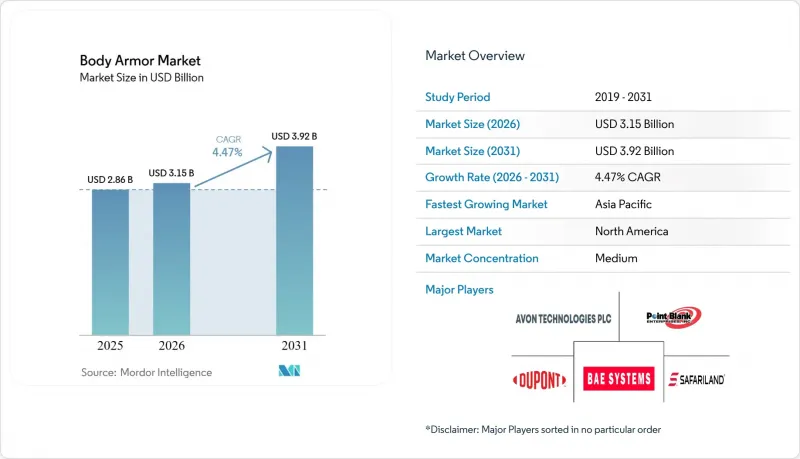
This report is Segmented by Armor Type (Soft Armor, Hard Armor, Helmets, Shields, and Others), Protection Level (Level IIA, Level II, Level IIIA, Level III, Level III+, and Level IV), End User (Defense, Law Enforcement, and Civilian and Private Security), and Geography (North America, Europe, Asia-Pacific, South America, and Middle East and Africa). The Market Forecasts are Provided in Terms of Value (USD).
Global Body Armor Market Trends and Insights
Rise in Defense Budgets and Soldier Modernization Programs
Global military expenditure reached USD 2.44 trillion in 2024, and the resulting procurement pipelines guarantee multi-year funding for ballistic protection. The US Army's Integrated Visual Augmentation System (IVAS), Next Generation Squad Weapon (NGSW), and Soldier Protection System (SPS) are expected to allocate more than USD 22 billion through 2030, bundling plate carriers with thermal sights and digital networking modules. India's Future Infantry Soldier as a System program mandates domestic production targets that spur factory expansions by MKU Limited and other local firms. South Korea's Warrior Platform includes exoskeleton-ready carriers, slated for fielding by 2027, demonstrating the influence of ergonomics on armor decisions. Long-term visibility is positive for the body armor market, although fixed price contracts expose suppliers to the risk of raw material inflation.
Escalating Geopolitical Conflicts and Terrorism Threats
Large-scale consumption in Ukraine, Israel, and Taiwan forces NATO states to accelerate replenishment orders, creating abrupt spikes that roll through supply chains. Police tactical units in Western Europe adopted overt plate carriers following the 2024 Paris and Brussels attacks, driving overt-wear sales to higher levels. Such surges are temporary yet sizable, underscoring why inventory buffers remain small relative to battlefield burn rates. Manufacturers capitalize on urgent requirements but must manage the risk of post-conflict demand drops. The body armor market thus experiences short-term revenue bursts atop a slower but durable modernization wave.
High Cost of Advanced Hard-Armor Plates
Level IV ceramic plates retail between USD 500 and USD 900, a price range that exhausts equipment budgets at smaller law enforcement agencies and deters many civilians from purchasing them. Production relies on 2,200°C sintering and rigorous crack inspection, driving high energy bills and scrap rates. Emerging 3D-printed tiles promise a 25% cost cut but require durability data before widespread adoption. The expense gap keeps soft armor popular even though rifle-threat protection is superior. As a result, price acts as a ceiling on the body armor market, especially in civilian channels.
Other drivers and restraints analyzed in the detailed report include:
- Increasing Demand for Ballistic Protection Among Law-Enforcement Agencies
- Advancements in Lightweight Composite Materials
- Stringent NIJ Certification and Testing Timelines
For complete list of drivers and restraints, kindly check the Table Of Contents.
Segment Analysis
Soft armor accounted for 46.21% of 2025 revenue, while hard armor, with a forecasted 5.54% CAGR, positioned itself as a principal growth engine for the body armor market. Military forces field ceramic-polyethylene inserts that stop 7.62X51 mm armor-piercing rounds, and plate-ready carriers are the baseline issue for US infantry. Helmets and shields form smaller niches, but they benefit from the same material advances.
Soft armor remains essential for routine policing because it is lightweight and can be concealed under uniforms. Quick-release vest designs and moisture-wicking liners from Point Blank improve daily wearability. The divergence highlights how the user's mission drives purchase decisions within the body armor market.
Complete Report Scope:
- By Armor Type
- Soft Armor
- Hard Armor
- Helmets
- Shields
- Others
- By Protection Level
- Level IIA
- Level II
- Level IIIA
- Level III
- Level III+
- Level IV
- By End User
- Defense
- Law Enforcement
- Civilian and Private Security
- By Geography
- North America
- United States
- Canada
- Mexico
- Europe
- United Kingdom
- France
- Germany
- Italy
- Russia
- Rest of Europe
- Asia-Pacific
- China
- India
- Japan
- South Korea
- Australia
- Rest of Asia-Pacific
- South America
- Brazil
- Argentina
- Rest of South America
- Middle East and Africa
- Middle East
- Saudi Arabia
- United Arab Emirates
- Israel
- Rest of Middle East
- Africa
- South Africa
- Rest of Africa
- Middle East
- North America
Geography Analysis
North America accounted for 44.31% of 2025 revenue, primarily driven by the USD 842 billion US defense budget, which allocates USD 12.3 billion to soldier systems. Federal vest grants and state subsidies shorten replacement cycles, while Canada's CAD 1.90 billion (USD 1.37 billion) Integrated Soldier System Project sustains regional orders.
Asia-Pacific offers the swiftest 5.84% CAGR, propelled by China's next-generation plate purchases for 2 million troops and India's insistence on indigenous content under the Atmanirbhar Bharat policy. South Korea's upcoming exoskeleton-compatible carriers further advance ergonomic innovation.
Europe accelerates spending as NATO states replenish stocks sent to Ukraine, with Germany ordering 25,000 carriers and Poland investing USD 230 million in upgrades. The Middle East remains an enduring customer amid ongoing conflicts, where Saudi Arabian Military Industries co-produces Level IV plates locally. South America and Africa trail behind due to constrained defense budgets, although Brazil's national police procured 8,000 Level IIIA vests in 2024, signaling gradual progress.
- BAE Systems plc
- Point Blank Enterprises, Inc.
- Safariland, LLC
- Avon Technologies plc
- DuPont de Nemours, Inc.
- Honeywell International Inc.
- ArmorSource, LLC
- MKU Limited
- Rheinmetall AG
- Saab AB
- Revision Inc.
- Hesco Bastion Group
- United Shield International LLC
- Australian Defence Apparel Pty. Ltd.
- NFM Group AS
- Hardwire, LLC
- Spartan Armor Systems
- BulletSafe (Sellmark Corporation)
Additional Benefits:
- The market estimate (ME) sheet in Excel format
- 3 months of analyst support
TABLE OF CONTENTS
1 INTRODUCTION
- 1.1 Study Assumptions and Market Definition
- 1.2 Scope of the Study
2 RESEARCH METHODOLOGY
3 EXECUTIVE SUMMARY
4 MARKET LANDSCAPE
- 4.1 Market Overview
- 4.2 Market Drivers
- 4.2.1 Rise in defense budgets and soldier modernization programs
- 4.2.2 Escalating geopolitical conflicts and terrorism threats
- 4.2.3 Increasing demand for ballistic protection among law-enforcement agencies
- 4.2.4 Advancements in lightweight composite materials
- 4.2.5 Integration of IoT-enabled health-monitoring sensors in smart armor
- 4.2.6 Surge in civilian concealed-carry license holders
- 4.3 Market Restraints
- 4.3.1 High cost of advanced hard-armor plates
- 4.3.2 Stringent NIJ certification and testing timelines
- 4.3.3 Supply-chain volatility for high-grade polyethylene fibers
- 4.3.4 Environmental regulations on PFAS-based fabric treatments
- 4.4 Value Chain Analysis
- 4.5 Regulatory Landscape
- 4.6 Technological Outlook
- 4.7 Porter's Five Forces Analysis
- 4.7.1 Bargaining Power of Buyers
- 4.7.2 Bargaining Power of Suppliers
- 4.7.3 Threat of New Entrants
- 4.7.4 Threat of Substitutes
- 4.7.5 Competitive Rivalry
5 MARKET SIZE AND GROWTH FORECASTS (VALUE)
- 5.1 By Armor Type
- 5.1.1 Soft Armor
- 5.1.2 Hard Armor
- 5.1.3 Helmets
- 5.1.4 Shields
- 5.1.5 Others
- 5.2 By Protection Level
- 5.2.1 Level IIA
- 5.2.2 Level II
- 5.2.3 Level IIIA
- 5.2.4 Level III
- 5.2.5 Level III+
- 5.2.6 Level IV
- 5.3 By End User
- 5.3.1 Defense
- 5.3.2 Law Enforcement
- 5.3.3 Civilian and Private Security
- 5.4 By Geography
- 5.4.1 North America
- 5.4.1.1 United States
- 5.4.1.2 Canada
- 5.4.1.3 Mexico
- 5.4.2 Europe
- 5.4.2.1 United Kingdom
- 5.4.2.2 France
- 5.4.2.3 Germany
- 5.4.2.4 Italy
- 5.4.2.5 Russia
- 5.4.2.6 Rest of Europe
- 5.4.3 Asia-Pacific
- 5.4.3.1 China
- 5.4.3.2 India
- 5.4.3.3 Japan
- 5.4.3.4 South Korea
- 5.4.3.5 Australia
- 5.4.3.6 Rest of Asia-Pacific
- 5.4.4 South America
- 5.4.4.1 Brazil
- 5.4.4.2 Argentina
- 5.4.4.3 Rest of South America
- 5.4.5 Middle East and Africa
- 5.4.5.1 Middle East
- 5.4.5.1.1 Saudi Arabia
- 5.4.5.1.2 United Arab Emirates
- 5.4.5.1.3 Israel
- 5.4.5.1.4 Rest of Middle East
- 5.4.5.2 Africa
- 5.4.5.2.1 South Africa
- 5.4.5.2.2 Rest of Africa
- 5.4.5.1 Middle East
- 5.4.1 North America
6 COMPETITIVE LANDSCAPE
- 6.1 Market Concentration
- 6.2 Strategic Moves
- 6.3 Market Share Analysis
- 6.4 Company Profiles (includes Global level Overview, Market level overview, Core Segments, Financials as available, Strategic Information, Market Rank/Share for key companies, Products and Services, and Recent Developments)
- 6.4.1 BAE Systems plc
- 6.4.2 Point Blank Enterprises, Inc.
- 6.4.3 Safariland, LLC
- 6.4.4 Avon Technologies plc
- 6.4.5 DuPont de Nemours, Inc.
- 6.4.6 Honeywell International Inc.
- 6.4.7 ArmorSource, LLC
- 6.4.8 MKU Limited
- 6.4.9 Rheinmetall AG
- 6.4.10 Saab AB
- 6.4.11 Revision Inc.
- 6.4.12 Hesco Bastion Group
- 6.4.13 United Shield International LLC
- 6.4.14 Australian Defence Apparel Pty. Ltd.
- 6.4.15 NFM Group AS
- 6.4.16 Hardwire, LLC
- 6.4.17 Spartan Armor Systems
- 6.4.18 BulletSafe (Sellmark Corporation)
7 MARKET OPPORTUNITIES AND FUTURE OUTLOOK
- 7.1 White-space and Unmet-Need Assessment

