PUBLISHER: Mordor Intelligence | PRODUCT CODE: 2100513

PUBLISHER: Mordor Intelligence | PRODUCT CODE: 2100513
Africa Sports Drinks - Market Share Analysis, Industry Trends & Statistics, Growth Forecasts (2026 - 2031)
According to Mordor Intelligence, the Africa sports drinks market size is expected to grow from USD 192.62 billion in 2025 to USD 209.72 billion in 2026 and is forecast to reach USD 324.51 billion by 2031, at a 9.12% CAGR over 2026-2031.
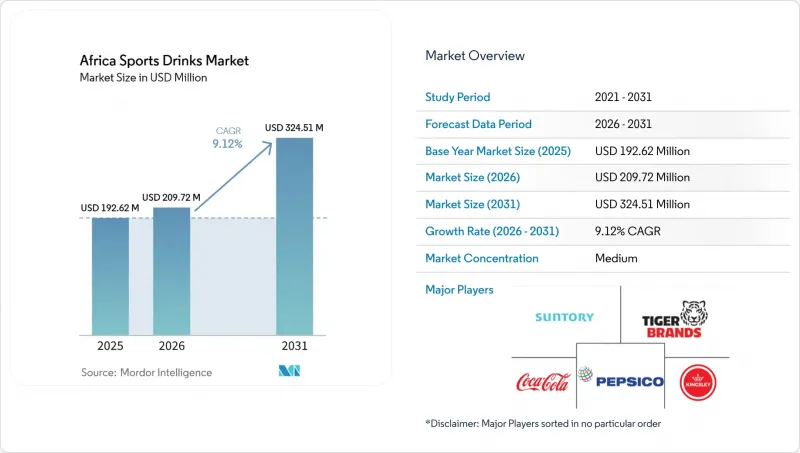
This report is Segmented by Drink Type (Isotonic, Hypertonic, Hypotonic, and More), Functionality (Pre-Workout, Intra-Workout, Post-Workout, Others), Packaging Type (PET Bottles, Glass Bottles, Metal Can, and More), Distribution Channel (On-Trade, Off-Trade), and Geography (South Africa, Egypt, Nigeria, Rest of Africa). The Market Forecasts are Provided in Terms of Value (USD) and Volume (Liters).
Africa Sports Drinks Market Trends and Insights
Rising participation in organized sports and fitness activities
The expansion of fitness chains is supporting growth in the Africa sports drinks market by increasing repeat purchase occasions within the continent's active-lifestyle economy. Smart Fit's planned entry into Morocco with five fitness centers in 2025 and iFitness' confirmed expansion into Ghana and Cote d'Ivoire in 2026 highlight how international and regional operators are investing in fitness infrastructure to address increasing demand for organized fitness services. These developments are increasing sports drink consumption occasions in branded, high-frequency fitness environments, where the products align closely with workout and recovery routines. Meanwhile, the growth of group formats, such as CrossFit, functional training, and parkrun, is creating new on-trade distribution sub-channels and extending the category's reach beyond traditional retail channels. Together, these trends indicate that fitness chain expansion is reshaping the demand landscape and positioning sports drinks as an important product category within Africa's evolving wellness and lifestyle ecosystem.
Increasing demand for hydration solutions in hot climatic conditions
The Africa sports drinks market is increasingly influenced by demand for hydration solutions suited to hot climatic conditions, where plain water often does not meet baseline electrolyte needs. This demand is most evident among the informal urban workforce, including laborers, vendors, and transport operators in cities such as Lagos, Cairo, Nairobi, and Accra. Their hydration requirements often resemble those of endurance athletes, but mainstream brands continue to underserve this consumer base. Electrolyte-enhanced water variants are well positioned to capture this opportunity if companies can expand their presence in informal trade channels at accessible price points. At the same time, Africa's wellness tourism sector and outdoor endurance sports are increasing demand for high-intensity hydration solutions in climate-vulnerable environments. In addition, National Library of Medicine data dated September 2025 indicate that only 20% of African adolescents meet recommended physical activity guidelines, with girls significantly less active than boys. This trend creates a latent demand pool as governments and nongovernmental organizations invest in youth sports programs. Together, these factors show how climate conditions, workforce dynamics, and youth engagement initiatives are converging to expand the structural demand base for sports drinks across Africa.
Strong competition from bottled water, energy drinks, and other functional alternatives
The Africa sports drinks market faces a structural restraint due to strong competition from bottled water, energy drinks, and other functional beverage alternatives, which continue to command consumer attention, retail shelf space, and marketing expenditure. Bottled water provides a cost-effective and widely available hydration option, while energy drinks, such as Red Bull and Monster, appeal to a broader consumer base by emphasizing alertness and mood enhancement, without being tied to exercise-led consumption occasions that support sports drink demand. This positioning challenge limits impulse purchase opportunities for sports drinks primarily to self-identified active consumers, making category expansion more challenging. In South Africa, global companies use extensive distribution networks and aggressive marketing investments to sustain brand visibility, while local beverage companies compete on pricing, flavor variety, and accessibility, increasing competitive intensity across the market landscape. Without the financial and operational resources to match the sponsorship programs and brand-building initiatives of multinational energy drink companies, sports drinks remain exposed to margin pressure and slower adoption compared to more versatile beverage alternatives.
Other drivers and restraints analyzed in the detailed report include:
- Rising adoption of low- and zero-sugar sports drinks among health-conscious consumers
- Increasing government and private investment in sports infrastructure and athletics
- Underdeveloped cold chain and distribution infrastructure
For complete list of drivers and restraints, kindly check the Table Of Contents.
Segment Analysis
In the Africa sports drinks market, isotonic drinks remain the largest category, accounting for a 56.26% share in 2025. Their leadership reflects their suitability for moderate- to high-intensity exercise and their long-standing positioning as the standard hydration format in African sports culture. Established brands continue to support strong distribution and market visibility, while isotonic drinks shape mainstream consumer perceptions of sports hydration. Hypertonic formulas address a more limited endurance-focused consumer base, and adjacent formats, such as electrolyte-enhanced water and protein-based drinks, are only beginning to develop distinct consumer segments among urban fitness enthusiasts. This established leadership positions isotonic drinks as the benchmark against which consumers and brands assess all other formats.
By contrast, hypotonic drinks are the fastest-growing segment and are forecast to expand at a CAGR of 11.01% through 2031. The segment's growth is supported by low-sugar reformulation priorities, the increasing participation of casual exercisers, and demand from broader wellness-oriented consumers seeking lighter hydration solutions. Commercial launches, such as naturally sweetened and zero-calorie ranges, have positioned hypotonic drinks as a key response to regulatory pressure and rising consumer health awareness. Notably, hypotonic drink growth extends beyond athletic use into everyday hydration occasions, including office, travel, and outdoor leisure, broadening the category's relevance beyond traditional sports environments. This shift signals a structural evolution in the market, as hypotonic drinks redefine the boundaries of sports hydration.
In the Africa sports drinks market, post-workout functionality remained the largest segment, accounting for a 46.27% share in 2025. This leadership reflects consumers' established preference for post-exercise replenishment, making recovery the most common consumption occasion across geographies and income levels. Sports culture has long reinforced recovery-led positioning, with post-workout drinks serving as the default hydration choice for both recreational exercisers and competitive athletes. Intra-workout hydration, although smaller, is gradually gaining traction among endurance athletes and high-volume gym users. However, recovery continues to support the category's mainstream relevance and retail visibility.
By contrast, pre-workout functionality is the fastest-growing segment and is forecast to expand at a CAGR of 10.90% through 2031. This growth reflects the increasing maturity of Africa's urban gym population, as consumer awareness of workout timing develops alongside fitness culture. A large share of first-generation gym participants is only beginning to adopt pre-workout supplementation protocols, creating opportunities for demand generation and awareness building. Brands that invest in in-gym communication, fitness influencer partnerships, and product education strategies are well positioned to capture this growth opportunity. As gym ecosystems expand across Lagos, Nairobi, and Cairo, the pre-workout segment is expected to gain further momentum, redefine consumption patterns, and emerge as a key driver of category growth.
Complete Report Scope:
- By Drink Type
- Isotonic
- Hypertonic
- Hypotonic
- Electrolyte-Enhanced Water
- Protein-based Sports Drinks
- By Functionality
- Pre-Workout
- Intra-Workout
- Post-Workout
- Others
- By Packaging Type
- PET Bottles
- Glass Bottles
- Metal Can
- Aseptic packages
- Disposable Cups
- By Distribution Channel
- On-Trade
- Off-Trade
- Supermarket/Hypermarket
- Convenience Stores
- Specialty Stores
- Online Retail
- Other Distribution Channels
- By Country
- South Africa
- Egypt
- Nigeria
- Kenya
- Morocco
- Ghana
- Rest of Africa
List of Companies Covered in this Report:
- The Coca-Cola Company
- PepsiCo, Inc.
- Suntory Holdings Ltd.
- Tiger Brands Ltd.
- Kingsley Beverages Ltd.
- AJE Group
- Congo Brands
- Ekhamanzi Springs (Pty) Ltd
- BOS Brands (Pty) Ltd
- Oshee Polska Sp. z o.o.
- THIRSTI Water (Pty) Ltd
- Monster Beverage Corp.
- PowerPlay
- aQuelle
- iPRO Hydrate
- BigTree Beverages
- USN (Ultimate Sports Nutrition)
- Prime Hydration LLC
Additional Benefits:
- The market estimate (ME) sheet in Excel format
- 3 months of analyst support
TABLE OF CONTENTS
1 INTRODUCTION
- 1.1 Study Assumptions and Market Definition
- 1.2 Scope of the Study
2 RESEARCH METHODOLOGY
3 EXECUTIVE SUMMARY
4 MARKET LANDSCAPE
- 4.1 Market Overview
- 4.2 Market Drivers
- 4.2.1 Rising participation in organized sports and fitness activities
- 4.2.2 Increasing demand for hydration solutions in hot climatic conditions
- 4.2.3 Expansion of gyms, fitness centers, and health clubs across urban areas
- 4.2.4 Rising adoption of low- and zero-sugar sports drinks among health-conscious consumers
- 4.2.5 Rising urbanization supporting on-the-go beverage consumption
- 4.2.6 Increasing government and private investment in sports infrastructure and athletics development
- 4.3 Market Restraints
- 4.3.1 Strong competition from bottled water, energy drinks, and other functional alternatives
- 4.3.2 Regulatory variations and labeling requirements across countries
- 4.3.3 Underdeveloped cold chain and distribution infrastructure
- 4.3.4 Limited consumer awareness in rural and semi-urban markets
- 4.4 Consumer Behavior Analysis
- 4.5 Regulatory Outlook
- 4.6 Porter's Five Forces Analysis
- 4.6.1 Threat of New Entrants
- 4.6.2 Bargaining Power of Buyers/Consumers
- 4.6.3 Bargaining Power of Suppliers
- 4.6.4 Threat of Substitute Products
- 4.6.5 Intensity of Competitive Rivalry
5 MARKET SIZE AND GROWTH FORECASTS (VALUE AND VOLUME)
- 5.1 By Drink Type
- 5.1.1 Isotonic
- 5.1.2 Hypertonic
- 5.1.3 Hypotonic
- 5.1.4 Electrolyte-Enhanced Water
- 5.1.5 Protein-based Sports Drinks
- 5.2 By Functionality
- 5.2.1 Pre-Workout
- 5.2.2 Intra-Workout
- 5.2.3 Post-Workout
- 5.2.4 Others
- 5.3 By Packaging Type
- 5.3.1 PET Bottles
- 5.3.2 Glass Bottles
- 5.3.3 Metal Can
- 5.3.4 Aseptic packages
- 5.3.5 Disposable Cups
- 5.4 By Distribution Channel
- 5.4.1 On-Trade
- 5.4.2 Off-Trade
- 5.4.3 Supermarket/Hypermarket
- 5.4.4 Convenience Stores
- 5.4.5 Specialty Stores
- 5.4.6 Online Retail
- 5.4.7 Other Distribution Channels
- 5.5 By Country
- 5.5.1 South Africa
- 5.5.2 Egypt
- 5.5.3 Nigeria
- 5.5.4 Kenya
- 5.5.5 Morocco
- 5.5.6 Ghana
- 5.5.7 Rest of Africa
6 COMPETITIVE LANDSCAPE
- 6.1 Market Concentration
- 6.2 Strategic Moves
- 6.3 Market Share Analysis
- 6.4 Company Profiles (includes Global-level Overview, Market-level Overview, Core Segments, Financials (if available), Strategic Information, Market Rank/Share, Products and Services, Recent Developments)
- 6.4.1 The Coca-Cola Company
- 6.4.2 PepsiCo, Inc.
- 6.4.3 Suntory Holdings Ltd.
- 6.4.4 Tiger Brands Ltd.
- 6.4.5 Kingsley Beverages Ltd.
- 6.4.6 AJE Group
- 6.4.7 Congo Brands
- 6.4.8 Ekhamanzi Springs (Pty) Ltd
- 6.4.9 BOS Brands (Pty) Ltd
- 6.4.10 Oshee Polska Sp. z o.o.
- 6.4.11 THIRSTI Water (Pty) Ltd
- 6.4.12 Monster Beverage Corp.
- 6.4.13 PowerPlay
- 6.4.14 aQuelle
- 6.4.15 iPRO Hydrate
- 6.4.16 BigTree Beverages
- 6.4.17 USN (Ultimate Sports Nutrition)
- 6.4.18 Prime Hydration LLC
7 MARKET OPPORTUNITIES AND FUTURE OUTLOOK

