PUBLISHER: Mordor Intelligence | PRODUCT CODE: 2100515

PUBLISHER: Mordor Intelligence | PRODUCT CODE: 2100515
Photonic Sensors - Market Share Analysis, Industry Trends & Statistics, Growth Forecasts (2026 - 2031)
According to Mordor Intelligence, the photonic sensors market size is expected to grow from USD 33.01 billion in 2025 to USD 36.68 billion in 2026 and is forecast to reach USD 62.13 billion by 2031 at 11.12% CAGR over 2026-2031.
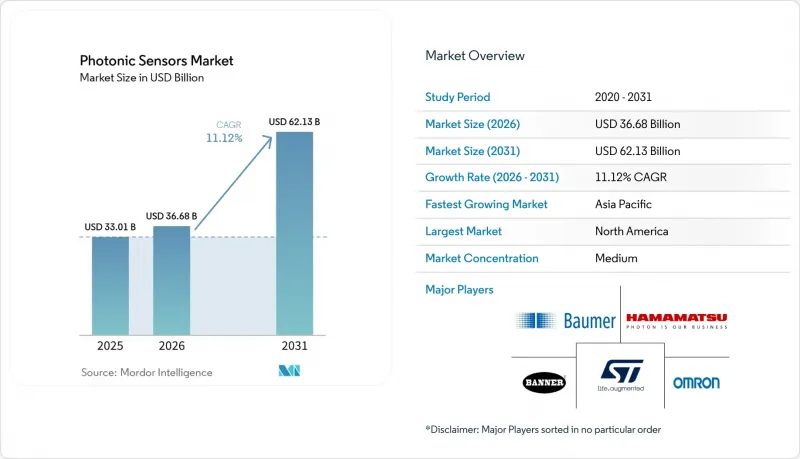
This report is Segmented by Product Type (Fiber-Optic Sensors, Image Sensors, and More), End-User Industry (Aerospace and Defense, Automotive, Industrial Automation, and More), Application (Structural Health Monitoring, Temperature and Pressure Sensing, and More), Technology (Fiber Bragg Grating, Fabry-perot Interferometry, and More), and Geography. The Market Forecasts are Provided in Terms of Value (USD).
Global Photonic Sensors Market Trends and Insights
Growing Automation Demand in Manufacturing Environments
Industrial facilities deploy photonic sensors where micron-level accuracy and immunity to electromagnetic noise are mission-critical. Paint-thickness checks, weld inspection, and vibration surveillance demonstrate how fiber-optic sensing raises production yields. Predictive-maintenance programs integrate distributed photonic arrays that identify bearing wear before catastrophic failure. Automotive body shops leverage laser displacement sensors for robotic guidance, reducing cycle times. Industry 4.0 adoption amplifies demand for real-time analytics, and photonic sensor longevity offsets initial capital outlays. As factories digitize, the photonic sensors market embeds deeper in control loops that require deterministic data.
Increasing Investment in Fiber-Optic Communication Infrastructure
Telecom carriers roll out distributed fiber-optic sensing to track temperature, strain, and intrusion along thousands of kilometers of network, safeguarding service uptime. Data-center operators integrate photonic temperature arrays inside racks to pinpoint hotspots that electronic probes miss. 5G densification multiplies base-station links and drives uptake of inline optical monitors that report latency and power drift. Smart-grid programs funded by stimulus bills in North America and Europe include fiber-optic fault-detection to curb outage frequency. As capacity upgrades proceed, embedded sensing becomes a default feature, extending the photonic sensors market into carrier-class hardware.
High Initial Implementation Cost
Comprehensive photonic sensor systems cost USD 50,000-200,000 versus USD 10,000-30,000 for electronic counterparts, stretching payback periods for factories and clinics. Small enterprises delay upgrades despite lower maintenance expenses over the product life cycle. Deployment requires specialist installers and training, inflating total cost of ownership. In healthcare, reimbursement schedules lag technology, limiting adoption of biophotonic diagnostics even when clinical benefits are clear. As volume grows and integrated designs mature, unit prices fall, but near-term budgets restrain the photonic sensors market trajectory.
Other drivers and restraints analyzed in the detailed report include:
- Rising Demand for Safety and Security Systems in Smart Cities
- Expansion of Healthcare Diagnostics Leveraging Biophotonic Sensing
- Supply-Chain Bottlenecks in Specialty Optical-Fiber Preforms
For complete list of drivers and restraints, kindly check the Table Of Contents.
Segment Analysis
Image sensors retained a 37.55% share of the photonic sensors market size in 2025 as automotive cameras, industrial line-scan systems, and machine-vision tools required scalable, low-cost optoelectronics. LiDAR platforms, however, record the fastest 12.03% CAGR due to autonomous mobility, warehouse robotics, and smart-infrastructure deployments that need real-time 3D mapping. Solid-state designs have collapsed unit pricing from USD 10,000 in 2020 to under USD 1,000 by 2024, removing a major adoption barrier. Fiber-optic sensors hold niche roles in structural health monitoring where immunity to lightning and electromagnetic interference outweighs cost. Biophotonic sensors gain ground in diagnostics, especially glucose and lactate monitoring for chronic-disease management.
LiDAR vendors integrate beam steering and signal processing on silicon photonic chips, a key innovation within the broader Photonics industry, to shrink enclosure size and curb power draw, which aligns with automotive qualification demands. Image-sensor suppliers exploit CMOS fabrication economies to release high dynamic-range devices for factory inspection lighting extremes. Terahertz imagers address security screening and non-destructive testing, although material absorption and regulatory hurdles cap near-term volume. Quantum-dot detectors promise infrared sensitivity at room temperature, attracting interest for night vision. As each technology matures, cross-pollination occurs: 3D cameras embed structured-light emitters, and LiDAR units incorporate cameras for sensor fusion. This convergence diversifies revenue streams within the photonic sensors market.
Industrial automation owned 29.21% of photonic sensors market share in 2025 because predictive maintenance and quality assurance require continuous, interference-free data. The automotive category advances at an 11.71% CAGR through 2031 as advanced driver-assistance systems add LiDAR, imaging, and infrared arrays for safety redundancy. Aerospace and defense demand remains steady for navigation and threat detection, with ruggedized photonic sensors specified for vibration, radiation, and temperature extremes.
Healthcare accelerates on wearable biosensors and robotic surgery, while energy utilities adopt distributed fiber-optic systems for real-time pipeline and cable-line monitoring. Consumer electronics remain price-sensitive, yet augmented-reality headsets and gesture-control devices open new design-win opportunities. Environmental monitoring agencies deploy photonic gas analyzers that detect pollutants at parts-per-billion levels. Collectively, these trends broaden the photonic sensors industry footprint beyond early industrial roots.
Complete Report Scope:
- By Product Type
- Fiber-Optic Sensors
- Image Sensors
- Biophotonic Sensors
- LiDAR Sensors
- Other Product Types
- By End-User Industry
- Aerospace and Defense
- Automotive
- Industrial Automation
- Healthcare and Life Sciences
- Energy and Power
- Consumer Electronics
- Environmental Monitoring
- Other End-User Industries
- By Application
- Structural Health Monitoring
- Temperature and Pressure Sensing
- Chemical and Biological Sensing
- Position and Displacement Sensing
- Safety and Security
- Imaging and Scanning
- Others
- By Technology
- Fiber Bragg Grating
- Fabry-Perot Interferometry
- Raman and Brillouin Scattering
- Photodiode and CMOS
- Quantum Dots and Nanophotonics
- Terahertz Photonics
- Others
- By Geography
- North America
- United States
- Canada
- Mexico
- South America
- Brazil
- Argentina
- Rest of South America
- Europe
- Germany
- United Kingdom
- France
- Italy
- Spain
- Rest of Europe
- Asia-Pacific
- China
- Japan
- South Korea
- India
- ASEAN
- Rest of Asia-Pacific
- Middle East and Africa
- Middle East
- Saudi Arabia
- United Arab Emirates
- Turkey
- Rest of Middle East
- Africa
- South Africa
- Nigeria
- Rest of Africa
- Middle East
- North America
Geography Analysis
North America accounted for 38.28% of 2025 revenue due to sustained defense procurement, semiconductor fabs, and early autonomous-vehicle pilots that rely on high-performance sensing. Research universities and venture capital ecosystems shorten concept-to-commercial cycles, while reshoring incentives boost demand in chip and battery plants. FDA regulation lengthens medical-device launch timelines but also elevates entry barriers, shielding incumbents in the photonic sensors market.
Asia-Pacific expands at a 12.09% CAGR through 2031 as China, Japan, and South Korea automate factories to offset labor costs and meet export-quality standards. China's Belt and Road projects embed fiber-optic monitoring in pipelines and railways. Japan's aging society adopts photonic diagnostics for home care, while South Korea's semiconductor industry installs airborne-particle detectors with picogram sensitivity. Local governments provide tax breaks for sensor fabs, strengthening regional supply chains.
Europe balances technology exports with strict safety and sustainability mandates. Germany's Industry 4.0 program disseminates intelligent sensing into Mittelstand factories, and EU Green Deal funds smart-grid rollouts that use distributed fiber-optic sensing. Automotive OEMs in Germany, France, and Sweden incorporate multi-sensor redundancy to achieve Euro NCAP ratings, bolstering photonic sensor demand. Latin America and Africa remain nascent but will unlock growth as telecom and energy infrastructure modernize. Overall, regional diversification protects the photonic sensors market from single-region shocks.
- Banner Engineering Corp.
- Baumer Holding AG
- STMicroelectronics N.V.
- Hamamatsu Photonics K.K.
- Omron Corporation
- Sick AG
- Keyence Corporation
- Pepperl+Fuchs SE
- Rockwell Automation, Inc.
- Autonics Corporation
- Teledyne FLIR LLC
- Luna Innovations Incorporated
- Altechna Co. Ltd.
- First Sensor AG
- Micron Technology, Inc.
- Texas Instruments Incorporated
- Excelitas Technologies Corp.
- Thorlabs, Inc.
- Coherent Corp.
- II-VI Incorporated
- Yokogawa Electric Corporation
- Bosch Sensortec GmbH
- TriLumina Corp.
- Leonardo S.p.A.
- Qorvo, Inc.
Additional Benefits:
- The market estimate (ME) sheet in Excel format
- 3 months of analyst support
TABLE OF CONTENTS
1 INTRODUCTION
- 1.1 Study Assumptions and Market Definition
- 1.2 Scope of the Study
2 RESEARCH METHODOLOGY
3 EXECUTIVE SUMMARY
4 MARKET LANDSCAPE
- 4.1 Market Overview
- 4.2 Market Drivers
- 4.2.1 Growing automation demand in manufacturing environments
- 4.2.2 Increasing investment in fiber-optic communication infrastructure
- 4.2.3 Rising demand for safety and security systems in smart cities
- 4.2.4 Expansion of healthcare diagnostics leveraging biophotonic sensing
- 4.2.5 Emergence of photonic integrated circuits enabling on-chip sensing
- 4.2.6 Demand for LiDAR-based perception in warehouse robotics
- 4.3 Market Restraints
- 4.3.1 High initial implementation cost
- 4.3.2 Lack of universal industry standards
- 4.3.3 Supply-chain bottlenecks in specialty optical-fiber preforms
- 4.3.4 Photonic-sensor performance drift under harsh radiation environments
- 4.4 Industry Value Chain Analysis
- 4.5 Regulatory Landscape
- 4.6 Technological Outlook
- 4.7 Porter's Five Forces Analysis
- 4.7.1 Bargaining Power of Suppliers
- 4.7.2 Bargaining Power of Buyers
- 4.7.3 Threat of New Entrants
- 4.7.4 Threat of Substitutes
- 4.7.5 Intensity of Competitive Rivalry
- 4.8 Impact of Macroeconomic Factors
5 MARKET SIZE AND GROWTH FORECASTS (VALUE)
- 5.1 By Product Type
- 5.1.1 Fiber-Optic Sensors
- 5.1.2 Image Sensors
- 5.1.3 Biophotonic Sensors
- 5.1.4 LiDAR Sensors
- 5.1.5 Other Product Types
- 5.2 By End-User Industry
- 5.2.1 Aerospace and Defense
- 5.2.2 Automotive
- 5.2.3 Industrial Automation
- 5.2.4 Healthcare and Life Sciences
- 5.2.5 Energy and Power
- 5.2.6 Consumer Electronics
- 5.2.7 Environmental Monitoring
- 5.2.8 Other End-User Industries
- 5.3 By Application
- 5.3.1 Structural Health Monitoring
- 5.3.2 Temperature and Pressure Sensing
- 5.3.3 Chemical and Biological Sensing
- 5.3.4 Position and Displacement Sensing
- 5.3.5 Safety and Security
- 5.3.6 Imaging and Scanning
- 5.3.7 Others
- 5.4 By Technology
- 5.4.1 Fiber Bragg Grating
- 5.4.2 Fabry-Perot Interferometry
- 5.4.3 Raman and Brillouin Scattering
- 5.4.4 Photodiode and CMOS
- 5.4.5 Quantum Dots and Nanophotonics
- 5.4.6 Terahertz Photonics
- 5.4.7 Others
- 5.5 By Geography
- 5.5.1 North America
- 5.5.1.1 United States
- 5.5.1.2 Canada
- 5.5.1.3 Mexico
- 5.5.2 South America
- 5.5.2.1 Brazil
- 5.5.2.2 Argentina
- 5.5.2.3 Rest of South America
- 5.5.3 Europe
- 5.5.3.1 Germany
- 5.5.3.2 United Kingdom
- 5.5.3.3 France
- 5.5.3.4 Italy
- 5.5.3.5 Spain
- 5.5.3.6 Rest of Europe
- 5.5.4 Asia-Pacific
- 5.5.4.1 China
- 5.5.4.2 Japan
- 5.5.4.3 South Korea
- 5.5.4.4 India
- 5.5.4.5 ASEAN
- 5.5.4.6 Rest of Asia-Pacific
- 5.5.5 Middle East and Africa
- 5.5.5.1 Middle East
- 5.5.5.1.1 Saudi Arabia
- 5.5.5.1.2 United Arab Emirates
- 5.5.5.1.3 Turkey
- 5.5.5.1.4 Rest of Middle East
- 5.5.5.2 Africa
- 5.5.5.2.1 South Africa
- 5.5.5.2.2 Nigeria
- 5.5.5.2.3 Rest of Africa
- 5.5.5.1 Middle East
- 5.5.1 North America
6 COMPETITIVE LANDSCAPE
- 6.1 Market Concentration
- 6.2 Strategic Moves
- 6.3 Market Share Analysis
- 6.4 Company Profiles (includes Global level Overview, Market level overview, Core Segments, Financials as available, Strategic Information, Market Rank/Share for key companies, Products and Services, and Recent Developments)
- 6.4.1 Banner Engineering Corp.
- 6.4.2 Baumer Holding AG
- 6.4.3 STMicroelectronics N.V.
- 6.4.4 Hamamatsu Photonics K.K.
- 6.4.5 Omron Corporation
- 6.4.6 Sick AG
- 6.4.7 Keyence Corporation
- 6.4.8 Pepperl+Fuchs SE
- 6.4.9 Rockwell Automation, Inc.
- 6.4.10 Autonics Corporation
- 6.4.11 Teledyne FLIR LLC
- 6.4.12 Luna Innovations Incorporated
- 6.4.13 Altechna Co. Ltd.
- 6.4.14 First Sensor AG
- 6.4.15 Micron Technology, Inc.
- 6.4.16 Texas Instruments Incorporated
- 6.4.17 Excelitas Technologies Corp.
- 6.4.18 Thorlabs, Inc.
- 6.4.19 Coherent Corp.
- 6.4.20 II-VI Incorporated
- 6.4.21 Yokogawa Electric Corporation
- 6.4.22 Bosch Sensortec GmbH
- 6.4.23 TriLumina Corp.
- 6.4.24 Leonardo S.p.A.
- 6.4.25 Qorvo, Inc.
7 MARKET OPPORTUNITIES AND FUTURE OUTLOOK
- 7.1 White-space and Unmet-Need Assessment

