PUBLISHER: Mordor Intelligence | PRODUCT CODE: 2100528

PUBLISHER: Mordor Intelligence | PRODUCT CODE: 2100528
Methanol - Market Share Analysis, Industry Trends & Statistics, Growth Forecasts (2026 - 2031)
According to Mordor Intelligence, the methanol market size is expected to increase from 115.92 million tons in 2025 to 120.16 million tons in 2026 and reach 143.74 million tons by 2031, growing at a CAGR of 3.65% over 2026-2031.
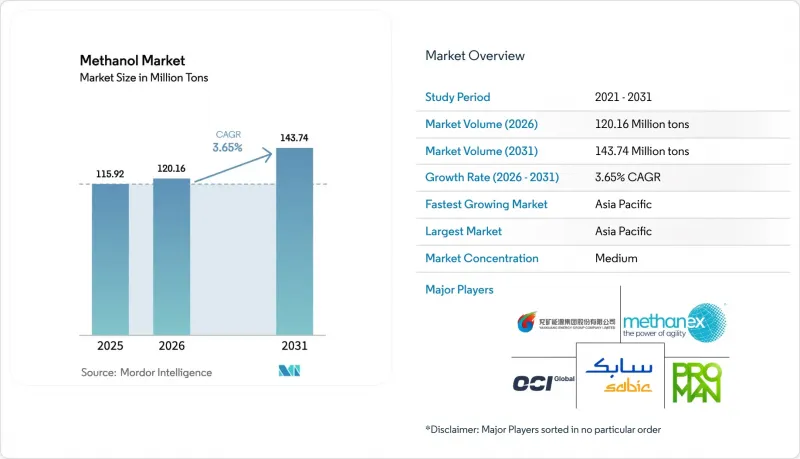
This report is Segmented by Feedstock (Natural Gas, Coal, and More), Derivative/Application (Traditional Chemical and Energy-Related), End-Use Industry (Automotive and Transportation, Chemicals, and More), Grade (Chemical Grade, Fuel Grade, and Others), and Geography (Asia-Pacific, North America, Europe, South America, and Middle East and Africa). Market Forecasts are Provided in Terms of Volume (tons).
Global Methanol Market Trends and Insights
Expanding Petrochemical Capacity in China, US, and Emerging Asia
China added more than 10 million tons per year of coal-to-methanol capacity between 2024 and 2025, primarily in Inner Mongolia and Shaanxi, where coal remains cost-competitive under current environmental levies. US Gulf Coast producers leveraged Henry Hub gas near USD 4.00 per million Btu in 2026 to supply Latin American importers at a delivered-cost advantage. Import demand in Vietnam, Thailand, and Indonesia rose as formaldehyde and acetic-acid capacity outpaced indigenous supply, compressing methanol market Asia-to-Europe spot differentials and forcing traders to optimize fleet allocation. Capacity additions raise an over-supply risk should real-estate activity soften faster than methanol-to-olefins absorption, underscoring the importance of flexible offtake structures and downstream integration.
Marine Sector Shift to Low-Carbon Fuels - Green Methanol Adoption
The International Maritime Organization mandates a 20% emissions-intensity cut by 2030 and net-zero by 2050, with carbon penalties beginning at USD 100 per ton CO2-equivalent in 2028 and escalating thereafter. Maersk contracted 500,000 tons per year of green methanol and is deploying 25 dual-fuel vessels by 2027, front-running infrastructure constraints at global bunkering hubs. Similar commitments from CMA CGM and MSC suggest shipping could absorb 13 million tons annually by 2030, equal to roughly 9% of the 2026 global methanol market supply. Green-methanol premiums of USD 200-400 per ton in 2025 mirror renewable-energy input costs and carbon-credit value capture. Limited refueling capacity at only 15 ports worldwide creates a bottleneck, yet high carbon-levy visibility is accelerating terminal-upgrade announcements in Rotterdam and Singapore.
Feedstock Price Volatility
North American gas ranged between USD 2.00 and USD 6.00 per million Btu during 2024-2025, with each USD 1.00 swing adding roughly USD 30 per ton to to methanol market production cost. Chinese coal spot prices moved between CNY 800 and CNY 1,200 per ton in 2025; environmental levies on high-sulfur coal further eroded cost advantages. Producers with integrated coal mines or long-term gas supply managed higher utilizations, whereas merchant plants cut operating rates below 70% during price spikes. Dual-feedstock designs and tolling agreements are emerging as hedge mechanisms, but dilute upside when spreads widen.
Other drivers and restraints analyzed in the detailed report include:
- Increasing Use of Methanol-to-Olefins Routes
- Waste-to-Methanol Projects Scaling via MSW Gasification
- Health and Safety Hazards of Methanol Handling
For complete list of drivers and restraints, kindly check the Table Of Contents.
Segment Analysis
Natural-gas feedstock controlled 65.12% of the Methanol market share in 2025, anchored by low-cost supply in the US Gulf Coast and the Middle East. Renewable feedstock is expanding at a 5.07% CAGR, outpacing the overall market. Enerkem's Varennes plant monetizes both gate fees and carbon credits, illustrating superior economics under robust policy incentives. Repsol's Tarragona project, due in 2029, signals European momentum toward circular feedstock despite higher capital intensity. Coal remains relevant in China, yet tightening air-quality rules and environmental levies are squeezing margins. Emerging CO2-plus-green-hydrogen routes are subscale but enjoy strong policy tailwinds, hinting at future supply diversification.
The global methanol market size attributable to renewable feedstock remains small today, yet long-term visibility on carbon pricing suggests a sustained shift in capital allocation toward these pathways. Producers capable of arbitraging between gas, coal, and waste-derived feedstocks will gain flexibility in balancing compliance premiums against feedstock cost volatility. Early movers that secure waste-sorting partnerships and renewable-power contracts are likely to lock in margin advantages as regulatory thresholds ratchet upward.
Energy-related derivatives held 54.34% of 2025 methanol market volume and are projected to grow at a 4.18% CAGR through 2031, faster than traditional chemical uses. Twenty MTO units in China and a rising fleet of methanol-fueled vessels underpin this trajectory. Dimethyl ether pilots in Indonesia and Vietnam show promise as diesel substitutes, further broadening the energy footprint. Conversely, MTBE demand is retreating in North America and Europe due to environmental restrictions, although gasoline blending in Chinese tier-2 cities is offsetting some of the decline.
Traditional chemical derivatives still anchor one-third of global demand, with formaldehyde tied to construction activity and acetic acid linked to packaging and textiles. The divergence in growth rates suggests incremental supply will tilt toward energy applications, tightening availability for chemical buyers during crude-oil up-cycles and potentially widening quality-based price differentials.
Complete Report Scope:
- By Feedstock
- Natural Gas
- Coal
- Renewable (Biomass, Municipal Solid Waste)
- Others (Carbon Dioxide, Green Hydrogen, Petroleum Residues)
- By Derivative / Application
- Traditional Chemical
- Formaldehyde
- Acetic Acid
- Solvents
- Methylamines
- Other Traditional Chemicals
- Energy-related
- Methanol-to-Olefins (MTO)
- Methyl Tert-Butyl Ether (MTBE)
- Gasoline Blending
- Dimethyl Ether (DME)
- Biodiesel
- Traditional Chemical
- By End-use Industry
- Automotive & Transportation
- Chemicals
- Marine Fuel
- Others (Electronics, Power)
- By Grade
- Chemical Grade
- Fuel Grade
- Others (Ultra-Clean/Battery Grade and Renewable (Bio-/E-Methanol))
- By Geography
- Asia-Pacific
- China
- India
- Japan
- South Korea
- Vietnam
- Thailand
- Indonesia
- Malaysia
- Australia
- New Zealand
- Rest of Asia-Pacific
- North America
- United States
- Canada
- Mexico
- Europe
- Germany
- United Kingdom
- Italy
- France
- Turkey
- Russia
- Nordics
- Spain
- Rest of Europe
- South America
- Brazil
- Argentina
- Colombia
- Rest of South America
- Middle East and Africa
- Saudi Arabia
- Qatar
- United Arab Emirates
- South Africa
- Nigeria
- Egypt
- Rest of Middle East & Africa
- Asia-Pacific
Geography Analysis
Asia-Pacific dominated the methanol market with a 78.10% share in 2025 and is forecast to grow at a 3.91% CAGR through 2031. China's 50 million tons per year coal-to-methanol capacity and aggressive MTO expansion underpin regional leadership. India's push for self-sufficiency through coal gasification and policy-backed fuel blending adds incremental demand. Southeast Asian imports continue rising to serve construction-driven formaldehyde needs. Japan and South Korea remain net importers, focusing on high-purity methanol for electronics and automotive uses.
North America maintained a mid-single-digit share, with Methanex's Geismar complex and new renewable capacity from Enerkem anchoring supply. Low-cost shale gas and proximity to Latin American markets offer a structural advantage, though LNG export growth is tightening domestic gas balances during winter peaks. Canada's focus on waste-to-methanol highlights policy-driven diversification, while Mexico's demand tracks automotive and construction cycles.
Europe's share is small but strategically important due to its pivot toward e-methanol. Innovation-Fund grants, OCI's blue-methanol retrofit, and Repsol's Tarragona investment demonstrate capital commitment to low-carbon supply. The Port of Rotterdam targets 2 million tons per year of bunkering capacity by 2030, positioning the region as a trading hub for green methanol. The Carbon Border Adjustment Mechanism strengthens the competitive position of low-carbon domestic producers versus high-carbon imports.
South America and the Middle East & Africa each hold mid-single-digit shares of the methanol market. Brazil's methanol demand is tied to biodiesel and construction, while Argentina explores gas-to-methanol projects linked to Vaca Muerta shale. The Middle East remains a cost leader, leveraging cheap associated gas to export to Asia. African demand is import-dependent and constrained by currency volatility and logistics costs, though mining and construction provide stable baseline consumption.
- Atlantic Methanol
- BASF SE
- Carbon Recycling International (CRI)
- Celanese Corporation
- China National Chemical Corporation (ChemChina)
- Coogee
- Enerkem
- Eni S.p.A.
- Gujarat State Fertilizers & Chemicals Limited (GSFC)
- INEOS
- Kaveh Methanol Company
- Kingboard Holdings Limited
- LyondellBasell Industries Holdings B.V.
- Methanex Corporation
- MITSUBISHI GAS CHEMICAL COMPANY, INC
- Natgasoline
- OCI
- Petroliam Nasional Berhad (PETRONAS)
- Proman
- SABIC
- Ningxia Baofeng Energy Group
- Yankuang Energy Group Company Limited
- ZPC Integrated Refining & Petrochemical (Zhejiang)
Additional Benefits:
- The market estimate (ME) sheet in Excel format
- 3 months of analyst support
TABLE OF CONTENTS
1 Introduction
- 1.1 Study Assumptions & Market Definition
- 1.2 Scope of the Study
2 Research Methodology
3 Executive Summary
4 Market Landscape
- 4.1 Market Overview
- 4.2 Market Drivers
- 4.2.1 Expanding petrochemical capacity in China, US, and emerging Asia
- 4.2.2 Marine sector shift to low-carbon fuels - green methanol adoption
- 4.2.3 Increasing use of methanol-to-olefins routes
- 4.2.4 Waste-to-methanol projects scaling via MSW gasification
- 4.2.5 CO2-utilisation hubs driving e-methanol demand in Europe
- 4.3 Market Restraints
- 4.3.1 Feedstock price volatility
- 4.3.2 Health and safety hazards of methanol handling
- 4.3.3 Competition from bio-MPG and RNG in marine decarbonisation
- 4.4 Value Chain Analysis
- 4.5 Technological Outlook
- 4.6 Porter's Five Forces
- 4.6.1 Bargaining Power of Suppliers
- 4.6.2 Bargaining Power of Buyers
- 4.6.3 Threat of New Entrants
- 4.6.4 Threat of Substitutes
- 4.6.5 Degree of Competition
- 4.7 Production Capacity Analysis by Key Feedstock
- 4.8 Trade Flow Analysis
- 4.9 Pricing Trends and Forecasts
5 Market Size & Growth Forecasts (Value & Volume)
- 5.1 By Feedstock
- 5.1.1 Natural Gas
- 5.1.2 Coal
- 5.1.3 Renewable (Biomass, Municipal Solid Waste)
- 5.1.4 Others (Carbon Dioxide, Green Hydrogen, Petroleum Residues)
- 5.2 By Derivative / Application
- 5.2.1 Traditional Chemical
- 5.2.1.1 Formaldehyde
- 5.2.1.2 Acetic Acid
- 5.2.1.3 Solvents
- 5.2.1.4 Methylamines
- 5.2.1.5 Other Traditional Chemicals
- 5.2.2 Energy-related
- 5.2.2.1 Methanol-to-Olefins (MTO)
- 5.2.2.2 Methyl Tert-Butyl Ether (MTBE)
- 5.2.2.3 Gasoline Blending
- 5.2.2.4 Dimethyl Ether (DME)
- 5.2.2.5 Biodiesel
- 5.2.1 Traditional Chemical
- 5.3 By End-use Industry
- 5.3.1 Automotive & Transportation
- 5.3.2 Chemicals
- 5.3.3 Marine Fuel
- 5.3.4 Others (Electronics, Power)
- 5.4 By Grade
- 5.4.1 Chemical Grade
- 5.4.2 Fuel Grade
- 5.4.3 Others (Ultra-Clean/Battery Grade and Renewable (Bio-/E-Methanol))
- 5.5 By Geography
- 5.5.1 Asia-Pacific
- 5.5.1.1 China
- 5.5.1.2 India
- 5.5.1.3 Japan
- 5.5.1.4 South Korea
- 5.5.1.5 Vietnam
- 5.5.1.6 Thailand
- 5.5.1.7 Indonesia
- 5.5.1.8 Malaysia
- 5.5.1.9 Australia
- 5.5.1.10 New Zealand
- 5.5.1.11 Rest of Asia-Pacific
- 5.5.2 North America
- 5.5.2.1 United States
- 5.5.2.2 Canada
- 5.5.2.3 Mexico
- 5.5.3 Europe
- 5.5.3.1 Germany
- 5.5.3.2 United Kingdom
- 5.5.3.3 Italy
- 5.5.3.4 France
- 5.5.3.5 Turkey
- 5.5.3.6 Russia
- 5.5.3.7 Nordics
- 5.5.3.8 Spain
- 5.5.3.9 Rest of Europe
- 5.5.4 South America
- 5.5.4.1 Brazil
- 5.5.4.2 Argentina
- 5.5.4.3 Colombia
- 5.5.4.4 Rest of South America
- 5.5.5 Middle East and Africa
- 5.5.5.1 Saudi Arabia
- 5.5.5.2 Qatar
- 5.5.5.3 United Arab Emirates
- 5.5.5.4 South Africa
- 5.5.5.5 Nigeria
- 5.5.5.6 Egypt
- 5.5.5.7 Rest of Middle East & Africa
- 5.5.1 Asia-Pacific
6 Competitive Landscape
- 6.1 Market Concentration
- 6.2 Strategic Moves
- 6.3 Market Share/Ranking Analysis
- 6.4 Company Profiles (includes Global level Overview, Market level overview, Core Segments, Financials as available, Strategic Information, Market Rank/Share for key companies, Products & Services, and Recent Developments)
- 6.4.1 Atlantic Methanol
- 6.4.2 BASF SE
- 6.4.3 Carbon Recycling International (CRI)
- 6.4.4 Celanese Corporation
- 6.4.5 China National Chemical Corporation (ChemChina)
- 6.4.6 Coogee
- 6.4.7 Enerkem
- 6.4.8 Eni S.p.A.
- 6.4.9 Gujarat State Fertilizers & Chemicals Limited (GSFC)
- 6.4.10 INEOS
- 6.4.11 Kaveh Methanol Company
- 6.4.12 Kingboard Holdings Limited
- 6.4.13 LyondellBasell Industries Holdings B.V.
- 6.4.14 Methanex Corporation
- 6.4.15 MITSUBISHI GAS CHEMICAL COMPANY, INC
- 6.4.16 Natgasoline
- 6.4.17 OCI
- 6.4.18 Petroliam Nasional Berhad (PETRONAS)
- 6.4.19 Proman
- 6.4.20 SABIC
- 6.4.21 Ningxia Baofeng Energy Group
- 6.4.22 Yankuang Energy Group Company Limited
- 6.4.23 ZPC Integrated Refining & Petrochemical (Zhejiang)
7 Market Opportunities & Future Outlook
- 7.1 White-space & Unmet-Need Assessment

