PUBLISHER: Mordor Intelligence | PRODUCT CODE: 2100551

PUBLISHER: Mordor Intelligence | PRODUCT CODE: 2100551
Nuclear Medicine Radioisotopes - Market Share Analysis, Industry Trends & Statistics, Growth Forecasts (2026 - 2031)
According to Mordor Intelligence, the nuclear medicine radioisotopes market size is projected to be USD 7.43 billion in 2025, USD 8.09 billion in 2026, and reach USD 13.12 billion by 2031, growing at a CAGR of 10.17% from 2026 to 2031.
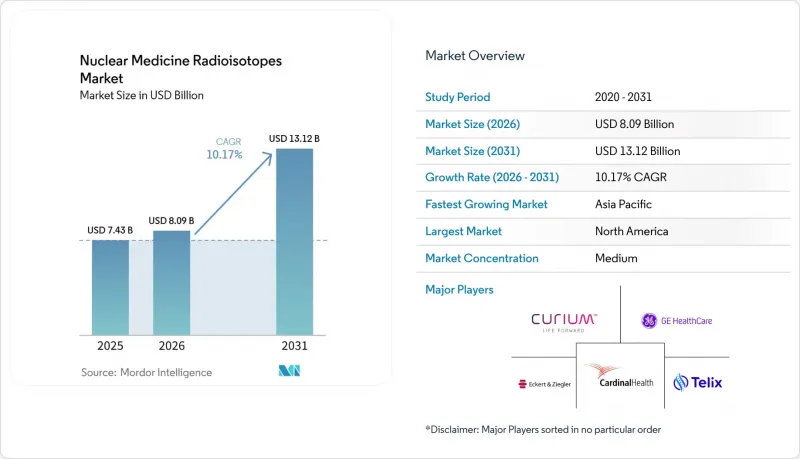
This report is Segmented by Type of Radioisotopes (Diagnostic Radioisotopes [Technetium-99m, Fluorine-18, and More] and Therapeutic Radioisotopes [Iodine-131, Lutetium-177, and More]), Application (Oncology and More), Source (Reactor-Produced Isotopes, and More), End-User (Public Sector and More), and Geography (North America, and More). The Market Forecasts are Provided in Terms of Value (USD).
Global Nuclear Medicine Radioisotopes Market Trends and Insights
Rising Burden of Cancer and Cardiac Disorders
The nuclear medicine radioisotopes market has a durable demand base because cancer and cardiovascular disease continue to generate large and recurring diagnostic and treatment needs across health systems. The global burden of cardiovascular disease now accounts for more than 437 million disability-adjusted life years each year, while cancer incidence is nearing 20 million new cases annually, which keeps molecular imaging and targeted isotope therapy clinically relevant at scale. This matters for the nuclear medicine radioisotopes market because both disease groups often require repeated scans, staging work, treatment monitoring, and follow-up procedures rather than a single encounter. Older patients are also more likely to present with both cardiac disease and cancer, which raises repeat utilization per patient and supports steady procedure demand in hospitals and specialty centers. The World Heart Federation reported in 2025 that the cardiovascular burden will continue to rise through 2050, which supports a long planning horizon for isotope procurement and cardiac imaging capacity. As a result, the nuclear medicine radioisotopes market is supported not only by headline incidence growth, but also by a patient mix that requires more intensive imaging and therapy pathways over time.
Widening Applications of Nuclear Medicine
The nuclear medicine radioisotopes market is widening its clinical reach as theranostics links imaging and therapy around the same molecular targets, which expands use beyond conventional diagnostic workflows. This change is no longer limited to oncology because cardiology and neurology are drawing greater attention as hospitals build familiarity with targeted imaging pathways and dose handling requirements. The World Health Assembly adopted Resolution WHA78.13 in May 2025, which placed medical imaging capacity, including nuclear medicine, into national planning priorities and established progress reporting milestones for 2027, 2029, and 2031. That policy shift matters for the nuclear medicine radioisotopes market because access remains very uneven, with 1 SPECT scanner serving nearly 33 million people in low-income countries compared with 57,000 people in high-income countries. A formal push to close that access gap creates room for procedure growth using existing isotope classes rather than depending entirely on new isotope discovery. It also improves the long-run outlook for the nuclear medicine radioisotopes market in countries where reimbursement and equipment coverage had previously delayed adoption.
Short Half-Life, Just-In-Time Logistics & Waste Challenges
The nuclear medicine radioisotopes market remains constrained by the fact that many isotopes decay too quickly to support conventional pharmaceutical inventory practices. Mo-99 has a 66-hour half-life, which makes the supply chain highly sensitive to timing between irradiation, processing, shipment, and patient administration. Shorter-lived isotopes such as Ga-68 and F-18 create an even tighter logistics window, so regional production access becomes a structural requirement rather than a commercial preference. Waste handling adds another layer because licensed transport, controlled storage, and documentation obligations increase cost and reduce operational flexibility across borders. In the nuclear medicine radioisotopes market, these limits are especially relevant for emerging supply chains that are still building cyclotron coverage, radiopharmacy networks, and trained handling capacity. The same issue becomes more demanding as alpha-emitting therapies scale because contamination control and dose management requirements are stricter than what many beta-emitter workflows were designed to handle.
Other drivers and restraints analyzed in the detailed report include:
- Increasing SPECT and PET Applications
- Co-Production of Isotopes in Power Reactors Cutting Marginal Costs
- Aging Research-Reactor Fleet Limiting Isotope Output
For complete list of drivers and restraints, kindly check the Table Of Contents.
Segment Analysis
Diagnostic radioisotopes retained a 70.33% share of the nuclear medicine radioisotopes market in 2025, which reflected the large and established procedure base for routine nuclear imaging. This lead rested on the daily role of Tc-99m in hospital and imaging center workflows, where access, familiarity, and reimbursement are more mature than in newer therapeutic pathways. Japan's Atomic Energy Commission noted in December 2024 that Tc-99m supports nearly 60% of SPECT procedures, which shows how deeply diagnostic use remains embedded in clinical practice. The diagnostic side of the nuclear medicine radioisotopes industry also benefits from broad application diversity because the same supply base serves cardiology, oncology, neurology, and thyroid imaging. That breadth keeps diagnostic demand more stable across health systems than treatment categories that are still building center-level expertise and treatment slots.
Therapeutic radioisotopes are forecast to grow at a 12.99% CAGR through 2031 in the nuclear medicine radioisotopes market, which makes them the faster-moving side of the product mix. Lu-177 remains the commercial anchor because it has already moved from pipeline promise into scaled revenue generation and wider treatment use. Novartis reported that Pluvicto generated USD 642 million in Q1 2026 revenue, up 70% year on year at constant currency, and combined 2025 revenue from Pluvicto and Lutathera reached USD 2.8 billion. That revenue profile matters because it supports further investment in isotope production, treatment center readiness, and radiolabeling capacity across the nuclear medicine radioisotopes market. Research published in Annals of Nuclear Medicine also pointed to Terbium-161 as a promising future option, which suggests that therapeutic breadth may expand beyond the current commercial leaders during the forecast period.
Oncology accounted for 45.75% of the nuclear medicine radioisotopes market size in 2025, which made it the largest application area by a clear margin. That position came from the combined use of diagnostic agents such as PSMA-PET and FDG-PET and therapeutic options such as radioligand therapy and somatostatin receptor-targeted treatment. The oncology profile of the nuclear medicine radioisotopes market is reinforced by strong clinical validation in prostate cancer and neuroendocrine tumors, where molecular targeting has already shaped care pathways. It also benefits from the fact that cancer treatment pathways often include serial imaging and response monitoring, which supports recurring isotope demand rather than one-time use. This kept oncology at the center of the nuclear medicine radioisotopes market in 2025 and will likely preserve its leadership through the forecast period.
Cardiology remained a major volume contributor in the nuclear medicine radioisotopes market because myocardial perfusion SPECT and Rb-82 PET continue to serve routine clinical decision-making in large patient populations. Neurology is gaining more strategic importance because amyloid and tau imaging are moving deeper into memory disorder assessment pathways and are becoming more aligned with clinical practice guidance. That broadening use case matters because it allows the nuclear medicine radioisotopes market to grow from new clinical pathways without relying only on further oncology penetration. Thyroid disorders remain a stable and mature use area, with demand shaped by established referral patterns and long-standing treatment protocols. Other applications, including infection imaging and pulmonology, remain smaller but give the nuclear medicine radioisotopes market room to diversify its future demand base. The practical result is that oncology remains dominant today, while adjacent applications are gradually widening the procedural and commercial base of the market.
Complete Report Scope:
- By Type of Radioisotopes
- Diagnostic Radioisotopes
- Technetium-99m (Tc-99m)
- Fluorine-18 (F-18)
- Gallium-68 (Ga-68)
- Iodine-123 (I-123)
- Copper-64 (Cu-64)
- Other Diagnostic Radioisotopes (Carbon-11 and Zirconium-89, among others)
- Therapeutic Radioisotopes
- Lutetium-177 (Lu-177)
- Yttrium-90 (Y-90)
- Iodine-131 (I-131)
- Actinium-225 (Ac-225)
- Radium-223 (Ra-223)
- Copper-67 (Cu-67)
- Other Therapeutic Radioisotopes (Samarium-153 and Holmium-166, among others)
- Diagnostic Radioisotopes
- By Application
- Oncology
- Cardiology
- Neurology
- Thyroid Disorders
- Other Applications (Infection Imaging and Pulmonology, among others)
- By Source
- Reactor-produced Isotopes
- Cyclotron-produced Isotopes
- Linear Accelerator / LINAC Isotopes
- Power-reactor Co-production
- Generator-produced Isotopes
- By End-user
- Public Sector
- Government Hospitals
- Public Cancer Institutes
- Government-funded Diagnostic Centers
- Private Sector
- Private Hospitals
- Private Diagnostic Imaging Centers
- Specialty Oncology Clinics
- Public Sector
- By Geography
- North America
- United States
- Canada
- Mexico
- Europe
- Germany
- United Kingdom
- France
- Italy
- Spain
- Rest of Europe
- Asia-Pacific
- China
- India
- Japan
- South Korea
- Australia
- Rest of Asia-Pacific
- Middle East and Africa
- GCC
- South Africa
- Rest of Middle East and Africa
- South America
- Brazil
- Argentina
- Rest of South America
- North America
Geography Analysis
North America held 37.33% of the nuclear medicine radioisotopes market share in 2025, which kept it as the leading regional market. The region benefits from dense PET and SPECT infrastructure, broad reimbursement support, and stronger clinical readiness for both imaging and radioligand therapy. Canada adds an important supply layer because Darlington begins commercial Y-90 production in 2026 and is expected to add Lu-177 from 2027, with planned distribution to more than 30 countries. The North American position in the nuclear medicine radioisotopes market is also shaped by ongoing domestic manufacturing investment and by efforts to reduce reliance on imported inputs. At the same time, medical societies have urged the U.S. administration to delay radiopharmaceutical tariffs until domestic supply is better established, which shows that trade policy still poses a near-term planning risk for the region.
Europe remained the second-largest regional market in the nuclear medicine radioisotopes market, supported by mature imaging infrastructure and several established isotope suppliers. The region combines strong clinical usage with an industrial base that still plays a major role in global supply continuity. Belgium's BR2 reactor reached a record level in 2025 by helping 13 million patients worldwide, which showed the scale that individual European facilities can deliver. Curium and NRG PALLAS extended their collaboration in May 2025 to maintain essential isotope supply, which reflected the continued need for planned continuity during the infrastructure transition period. France is also treating nuclear medicine as a strategic area, with France Biotech calling for stronger domestic isotope capabilities and coordinated support for radioligand therapy expansion.
Asia-Pacific is forecast to grow at a 10.87% CAGR through 2031, making it the fastest-growing region in the nuclear medicine radioisotopes market. The region is advancing through infrastructure buildout, a rising disease burden, and gradually improving reimbursement support across major healthcare systems. Japan has already moved Lu-177-PSMA therapy into national coverage and is also pushing for domestic Ac-225 capability under its economic security framework, which supports both treatment demand and supply planning. In China, SHINE and C-Ray Therapeutics formed an exclusive mainland distribution partnership for no-carrier-added Lu-177 in March 2026, which highlighted the importance of supply access in regional growth. Eckert and Ziegler also opened its Jintan production site in June 2026, reinforcing the view that Asia-Pacific is becoming a priority location for new isotope capacity before demand peaks. Middle East and Africa, along with South America, remain earlier-stage areas where access is still limited by equipment gaps and funding limits, but the WHA78.13 reporting framework creates a formal path for gradual capacity development through 2031.
- BWX Technologies, Inc. (BWXT Medical Ltd)
- Cardinal Health
- Curium Pharma
- Cyclotek
- Eckert & Ziegler SE
- GE Healthcare
- IONETIX Corporation
- IRE ELiT
- Isotopia
- ITM Isotopes Technologies Munich SE
- Jubilant Radiopharma Limited
- Lantheus Holdings, Inc.
- NECSA SOC Ltd (NTP Radioisotopes SOC Ltd)
- NorthStar Medical Radioisotopes
- Nusano
- SHINE Technologies, LLC
- Siemens Healthineers
- Sotera Health Company (Nordion Inc.)
- Telix Pharmaceuticals Limited
- TerraPower, LLC
Additional Benefits:
- The market estimate (ME) sheet in Excel format
- 3 months of analyst support
TABLE OF CONTENTS
1 Introduction
- 1.1 Study Assumptions & Market Definition
- 1.2 Scope of the Study
2 Research Methodology
3 Executive Summary
4 Market Landscape
- 4.1 Market Overview
- 4.2 Market Drivers
- 4.2.1 Rising Burden of Cancer and Cardiac Disorders
- 4.2.2 Widening Applications of Nuclear Medicine
- 4.2.3 Increasing Single Photon Emission Computed Tomography (SPECT) and Positron Emission Tomography (PET) Applications
- 4.2.4 Increasing Patient Awareness of Radiation and Radiation Therapy
- 4.2.5 Co-Production of Isotopes in Power Reactors Cutting Marginal Costs
- 4.2.6 AI-Driven Radio Pharmacy Automation Lifting Dose Yields
- 4.3 Market Restraints
- 4.3.1 Short Half-Life, Just-In-Time Logistics & Waste Challenges
- 4.3.2 Aging Research-Reactor Fleet Limiting Isotope Output
- 4.3.3 Export Controls on Enriched Yb-176 Constraining NCA Lu-177 Supply
- 4.3.4 Evolving Trade Policies and Import Duties on Radiopharmaceuticals
- 4.4 Supply Chain Analysis
- 4.5 Regulatory Landscape
- 4.6 Technological Outlook
- 4.7 Porter's Five Forces Analysis
- 4.7.1 Bargaining Power of Suppliers
- 4.7.2 Bargaining Power of Buyers
- 4.7.3 Threat of New Entrants
- 4.7.4 Threat of Substitutes
- 4.7.5 Competitive Rivalry
5 Market Size & Growth Forecasts (Value, USD)
- 5.1 By Type of Radioisotopes
- 5.1.1 Diagnostic Radioisotopes
- 5.1.1.1 Technetium-99m (Tc-99m)
- 5.1.1.2 Fluorine-18 (F-18)
- 5.1.1.3 Gallium-68 (Ga-68)
- 5.1.1.4 Iodine-123 (I-123)
- 5.1.1.5 Copper-64 (Cu-64)
- 5.1.1.6 Other Diagnostic Radioisotopes (Carbon-11 and Zirconium-89, among others)
- 5.1.2 Therapeutic Radioisotopes
- 5.1.2.1 Lutetium-177 (Lu-177)
- 5.1.2.2 Yttrium-90 (Y-90)
- 5.1.2.3 Iodine-131 (I-131)
- 5.1.2.4 Actinium-225 (Ac-225)
- 5.1.2.5 Radium-223 (Ra-223)
- 5.1.2.6 Copper-67 (Cu-67)
- 5.1.2.7 Other Therapeutic Radioisotopes (Samarium-153 and Holmium-166, among others)
- 5.1.1 Diagnostic Radioisotopes
- 5.2 By Application
- 5.2.1 Oncology
- 5.2.2 Cardiology
- 5.2.3 Neurology
- 5.2.4 Thyroid Disorders
- 5.2.5 Other Applications (Infection Imaging and Pulmonology, among others)
- 5.3 By Source
- 5.3.1 Reactor-produced Isotopes
- 5.3.2 Cyclotron-produced Isotopes
- 5.3.3 Linear Accelerator / LINAC Isotopes
- 5.3.4 Power-reactor Co-production
- 5.3.5 Generator-produced Isotopes
- 5.4 By End-user
- 5.4.1 Public Sector
- 5.4.1.1 Government Hospitals
- 5.4.1.2 Public Cancer Institutes
- 5.4.1.3 Government-funded Diagnostic Centers
- 5.4.2 Private Sector
- 5.4.2.1 Private Hospitals
- 5.4.2.2 Private Diagnostic Imaging Centers
- 5.4.2.3 Specialty Oncology Clinics
- 5.4.1 Public Sector
- 5.5 By Geography
- 5.5.1 North America
- 5.5.1.1 United States
- 5.5.1.2 Canada
- 5.5.1.3 Mexico
- 5.5.2 Europe
- 5.5.2.1 Germany
- 5.5.2.2 United Kingdom
- 5.5.2.3 France
- 5.5.2.4 Italy
- 5.5.2.5 Spain
- 5.5.2.6 Rest of Europe
- 5.5.3 Asia-Pacific
- 5.5.3.1 China
- 5.5.3.2 India
- 5.5.3.3 Japan
- 5.5.3.4 South Korea
- 5.5.3.5 Australia
- 5.5.3.6 Rest of Asia-Pacific
- 5.5.4 Middle East and Africa
- 5.5.4.1 GCC
- 5.5.4.2 South Africa
- 5.5.4.3 Rest of Middle East and Africa
- 5.5.5 South America
- 5.5.5.1 Brazil
- 5.5.5.2 Argentina
- 5.5.5.3 Rest of South America
- 5.5.1 North America
6 Competitive Landscape
- 6.1 Market Concentration
- 6.2 Market Share Analysis
- 6.3 Company Profiles (includes Global level Overview, Market level overview, Core Segments, Financials as available, Strategic Information, Market Rank/Share for key companies, Products & Services, Recent Developments)
- 6.3.1 BWX Technologies, Inc. (BWXT Medical Ltd)
- 6.3.2 Cardinal Health, Inc.
- 6.3.3 Curium
- 6.3.4 Cyclotek
- 6.3.5 Eckert & Ziegler SE
- 6.3.6 GE HealthCare
- 6.3.7 IONETIX Corporation
- 6.3.8 IRE ELiT
- 6.3.9 Isotopia
- 6.3.10 ITM Isotopes Technologies Munich SE
- 6.3.11 Jubilant Radiopharma Limited
- 6.3.12 Lantheus Holdings, Inc.
- 6.3.13 NECSA SOC Ltd (NTP Radioisotopes SOC Ltd)
- 6.3.14 NorthStar Medical Radioisotopes
- 6.3.15 Nusano
- 6.3.16 SHINE Technologies, LLC
- 6.3.17 Siemens Healthineers AG
- 6.3.18 Sotera Health Company (Nordion Inc.)
- 6.3.19 Telix Pharmaceuticals Limited
- 6.3.20 TerraPower, LLC
7 Market Opportunities & Future Outlook
- 7.1 White-space & Unmet-Need Assessment

